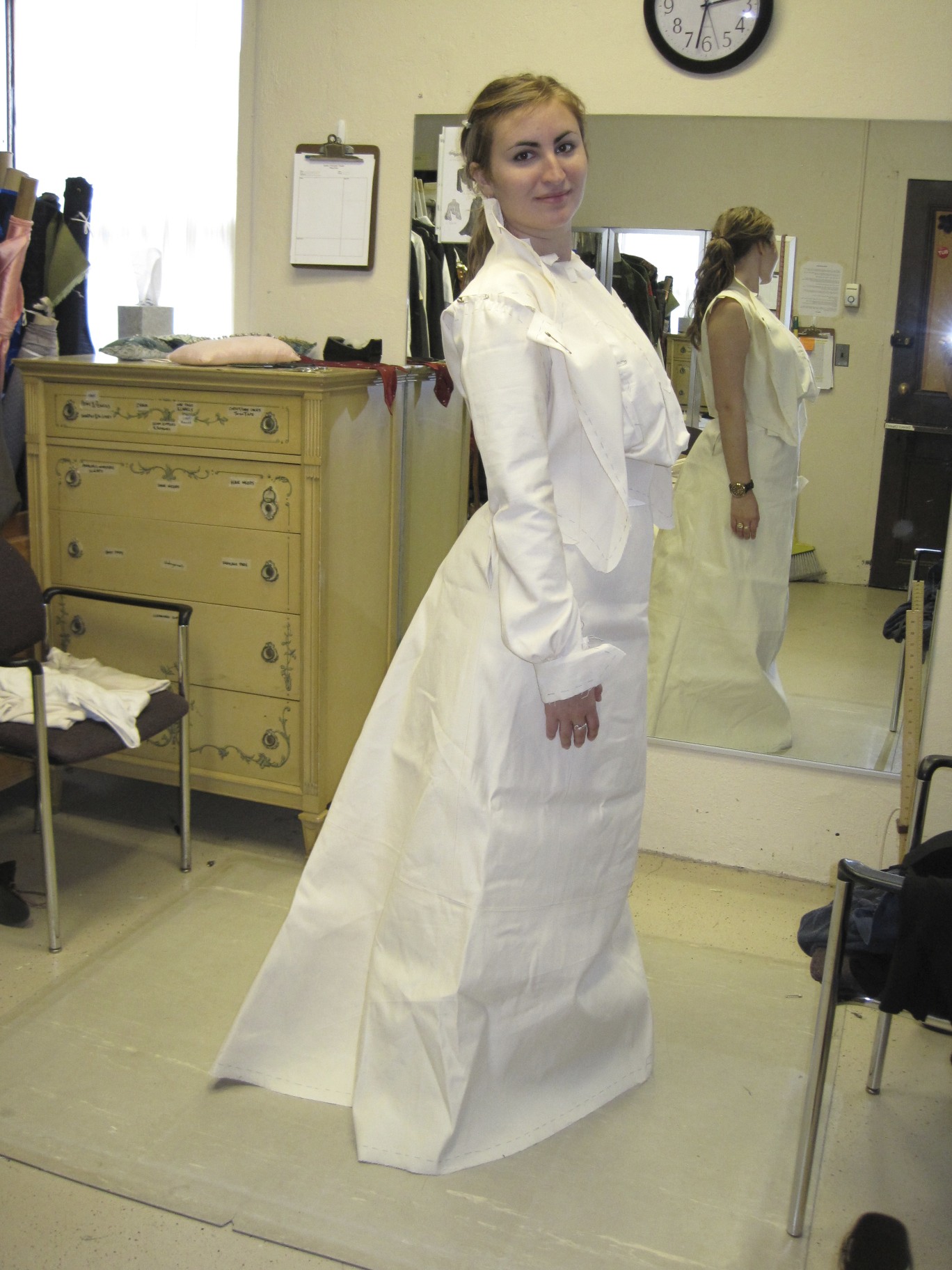
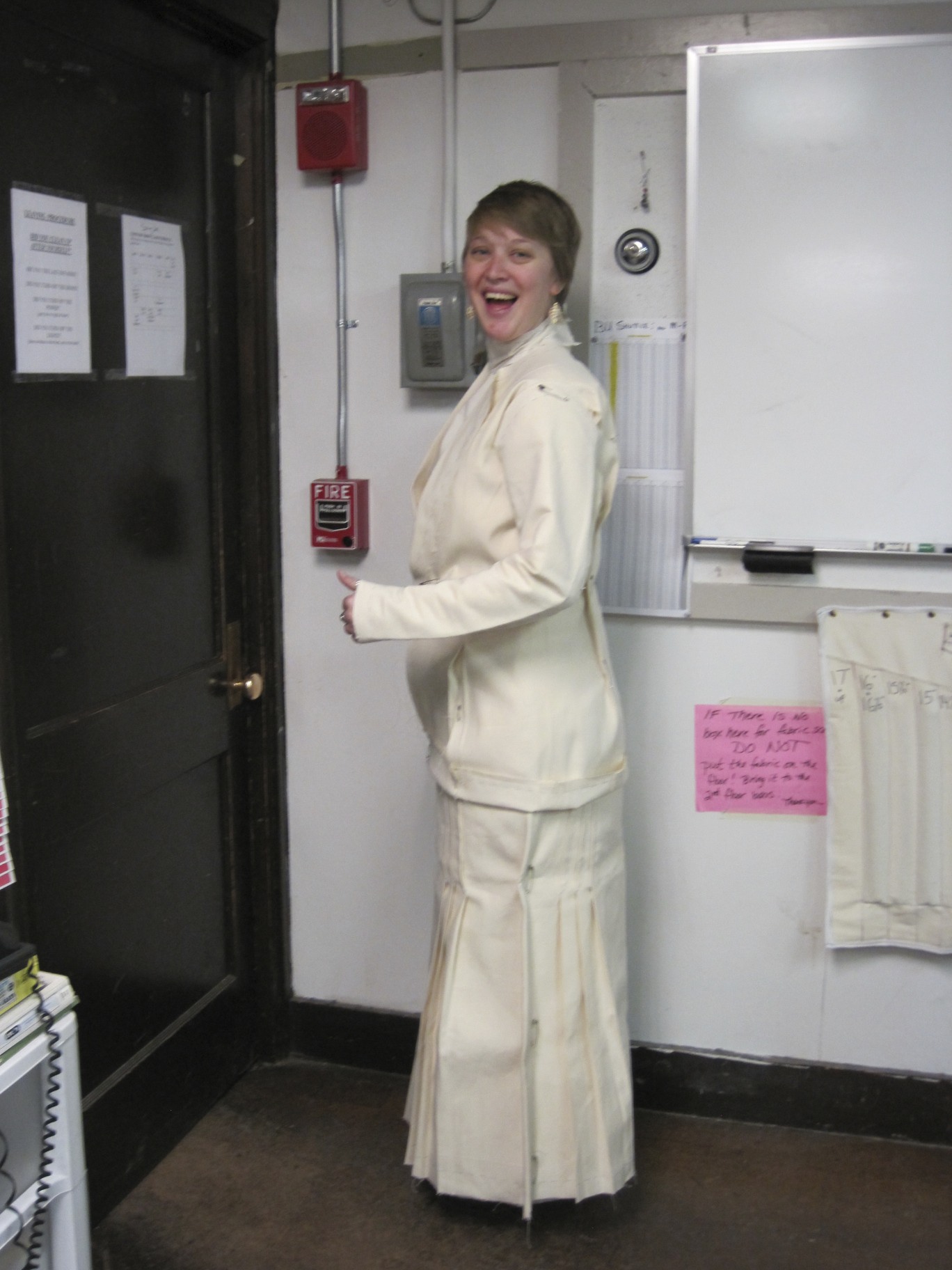
I reached a point where all my patterns were complete! The next step was to make a mock-up, or toile, of each garment. My mock-ups are made out of muslin: their goal is to determine what changes I need to make to my patterns so that the garments will fit well before I cut and sew the garments out of my fashion fabrics.
By eliminating major fit issues in my mock-ups I am able to achieve a better fit in my final garments with fewer alterations. In these photos you can see the pins that mark the areas of the garments that I need to go back and change on my patterns so that the fashion fabric garments will fit better.
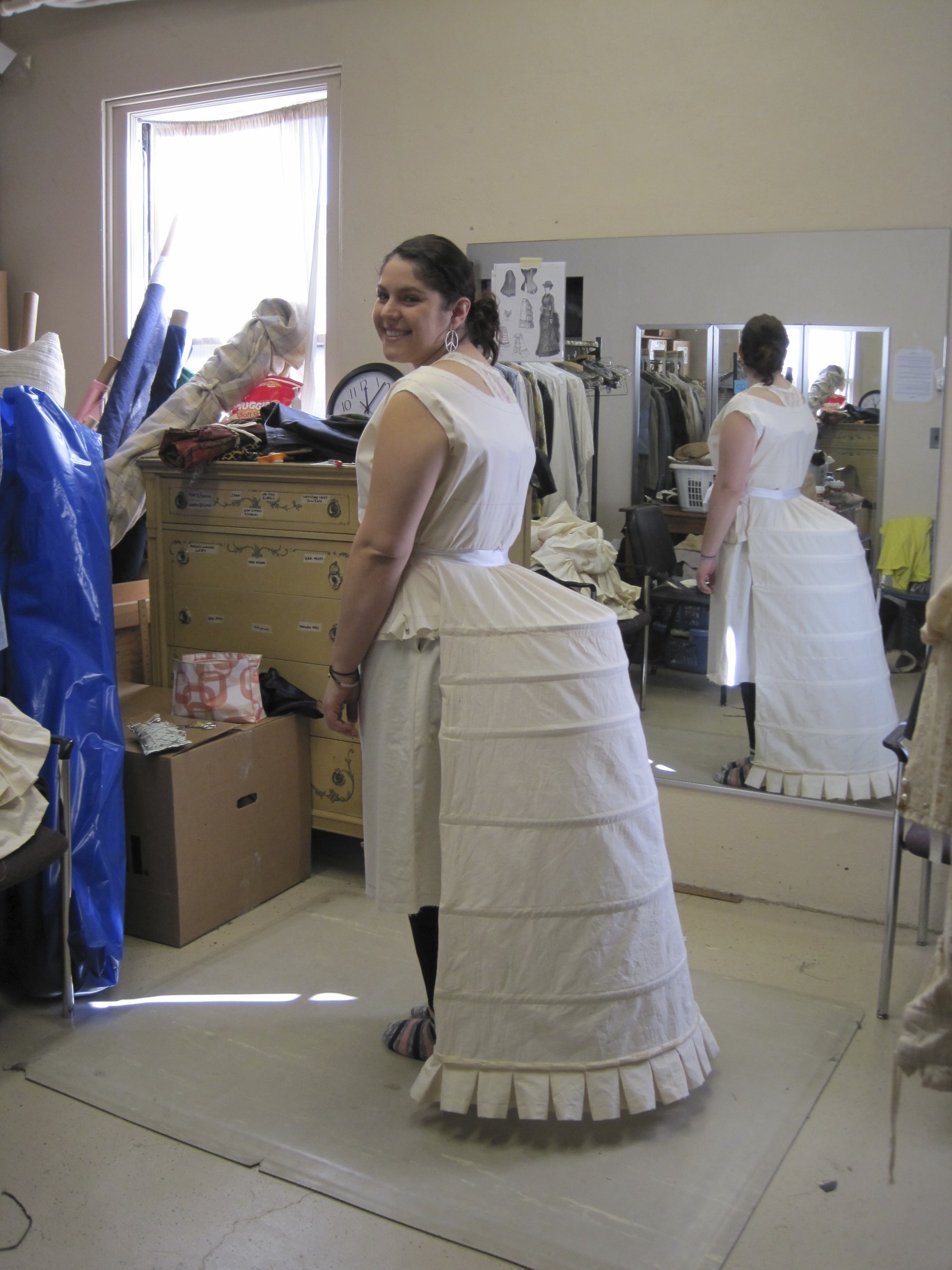
Look 1: 1883. In my brain this is the “bustle dress.”
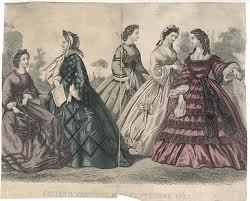
1883 mockups--including the bustle!1883 mockups.My inspiration "cheat sheet" for this look.
The first step of this women’s tailoring project was to research what exactly I wanted to recreate. That being finished, I embarked on the next task: to create patterns for each of the garments I would be building. Each look is made up of about 8 separate garments: a chemise/combination, corset, corset cover, petticoat, blouse, skirt, jacket, and hat (the 1883 look also includes a bustle). To create the patterns for these garments I used a combination of the methods mentioned below.
Basic Sloper: a starting point for patterning
The simple undergarment patterns such as the chemises and corset covers were drafted using my models’ measurements. Pattern Drafting for Fashion Design, by Helen Joseph Armstrong, was a great starting point for creating these shapes.
The corset patterns were adapted to fit my models from the book Corsets and Crinolines by Norah Waugh.
The petticoat patterns were created using a combination of methods. For all of them I found an image I wanted to recreate, then I either used the drafting method I used for chemises and corset covers, or I used a historic pattern that was lifted from a historic garment like the patterns for the skirts and jackets (mentioned below). The images came from a wide variety of books, including The History of Underclothes by C. Willett Cunnington, Everyday Fashions, 1909-1920, as Pictured in Sears Catalogs edited by JoAnne Olian, and Victorian Fashions and Costumes from Harper’s Bazaar, 1867-1898 edited by Stella Blum.
My first large sewing project for myself was, fittingly, an 1860s gown nick-named “Belle.” (This is the full story of Belle.) Owning a gown like this was a childhood fantasy for me, ever since my first days of loving Gone With The Wind. I finished construction of this gown about four years ago and since then I’ve lovingly stored it and its accompanying undergarments and hoops in my closet, alongside all my modern clothes.
I’ve been hoping for an opportunity to wear Belle for the last four years, not only to give a purpose to the dress I so lovingly created, but also to see how it feels to wear it for a hours at a time. I just recently attended an event called Fezziwig’s Ball, which was presented by the Commonwealth Vintage Dancers in Salem, Massachusetts. I was able to sing Christmas carols, dance, and have a real experience wearing Belle–and I was in the company of others who not only appreciated my hard work, but who had also worked hard to create and wear their own 1860s dresses!
I learned a vast amount of small details about the practicalities (or hindrances) of wearing 1860s clothing. For example, I understand now why vintage dances from this period turn constantly in the same direction: because your hoops gain so much momentum that they can only sustain fast, continuous movement in one direction, not changing directions. That particular sensation was just not as clear when I was practicing dancing in modern pants or knee length skirts. Also, I have much clearer idea of why women would faint so often. Imagine dancing fast for four minutes in modern clothes, but then imagine doing the same amount of movement while laced into a corset! I felt faint after four minutes of fast dancing, and my corset wasn’t laced nearly as tightly as ladies would have been laced in the 1860s.
I had so much fun learning first hand and am quite sure I have more lessons in store for me in the future! I’m eagerly awaiting the next 1860s themed ball to be presented in March 2011 by the Commonwealth Vintage Dancers, the Returning Heroes Ball, a specifically 1860s Grand Ball.
Hoop skirts and crinolines make me so excited I get the wiggles. I was in ninth grade the first time I read Gone With The Wind. Scarlett O’Hara, while being a debatably lovable character in my mind, has inspired my absolute love of the 1860s, crinolines, hoops, and costume history ever since that first time I read the book. It only took once.
Years later, I am fascinated by costume, material, and social history. I get excited about the entire 19th century–but the only period that really gives me the wiggles remains the 1860s. There’s just something about women resembling giant moving cupcakes that is fascinating and inspiring.
There is something very dreamy about imagining the world these huge constructions moved through. The world had to adapt to these gowns: chairs for ladies had no arms and doors were wider to accommodate their skirts. Can you imagine wearing clothing five feet across? That’s two feet too wide to fit through a modern door! How does a person cope with that all day every day? Sometimes I can envision it and sometimes it just seems impossible. But these questions just remind me that THIS is why the 1860s are particularly fascinating to me.
Gone With The Wind is definitely a controversial story. I found this report to be an interesting and factual discussion of its merits and faults. It clearly states why it is such a classic story and how it glosses over reality. This blog also has an interesting post about Gone With The Wind, discussing if it is a “great American novel.”
As a side note, I love both the book and movie versions of Gone With The Wind. While both are moving, sweeping epics, the book has much more depth and character exploration than the movie. Thus, I encourage you to read Gone With The Wind for yourself and to be inspired by history and by skirts with a circumference of 124″!
Here is my first question to both of us (you, the reader, and myself!): what is this blog all about?
Clothes. Specifically, historic clothes–clothes that were worn in the past. I am most passionate about clothes in Europe and America from about 1800-1940, but really I just love clothes. Underclothes, outer clothes, outerwear, accessories, shoes… Clothes. The articles we put on our bodies to cover up and adorn ourselves.
I know there are those of you who share my love of clothes–studying clothes, conserving clothes, designing clothes, making clothes, collecting clothes, or maybe just wearing clothes! I want to find you and share my thoughts with you. I want to hear your thoughts. I want us to encourage each other in our passions (and probably bursting closets!).
I want to explore what we wore and how those articles were made, how and why we wore the clothes we did, and maybe even what we might wear in the future.








 The Quintessential Clothes Pen