Two Sacques At ‘The Salon at Palais-Royal’

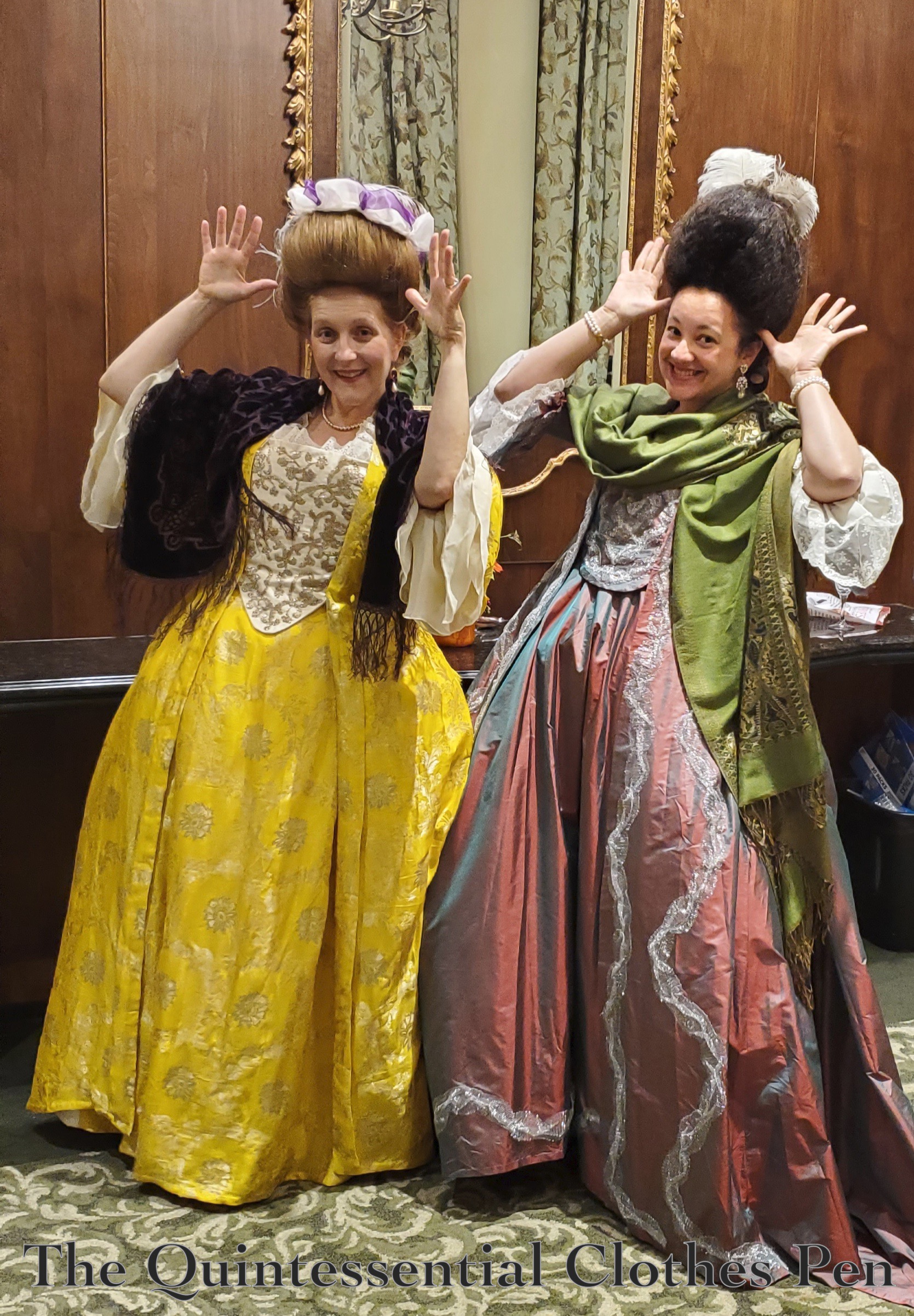
I am finally ready to share a full set of photos of the new Yellow Sacque and its friend, my older Versailles sacque (all of the construction details for these dresses can be found by clicking the links)! The two dresses had a joyful outing together at an event last year. This post is going to share about the event itself as well as photos and recollections.

Below, a photo of the Versailles Sacque and new Yellow Sacque next to each other!
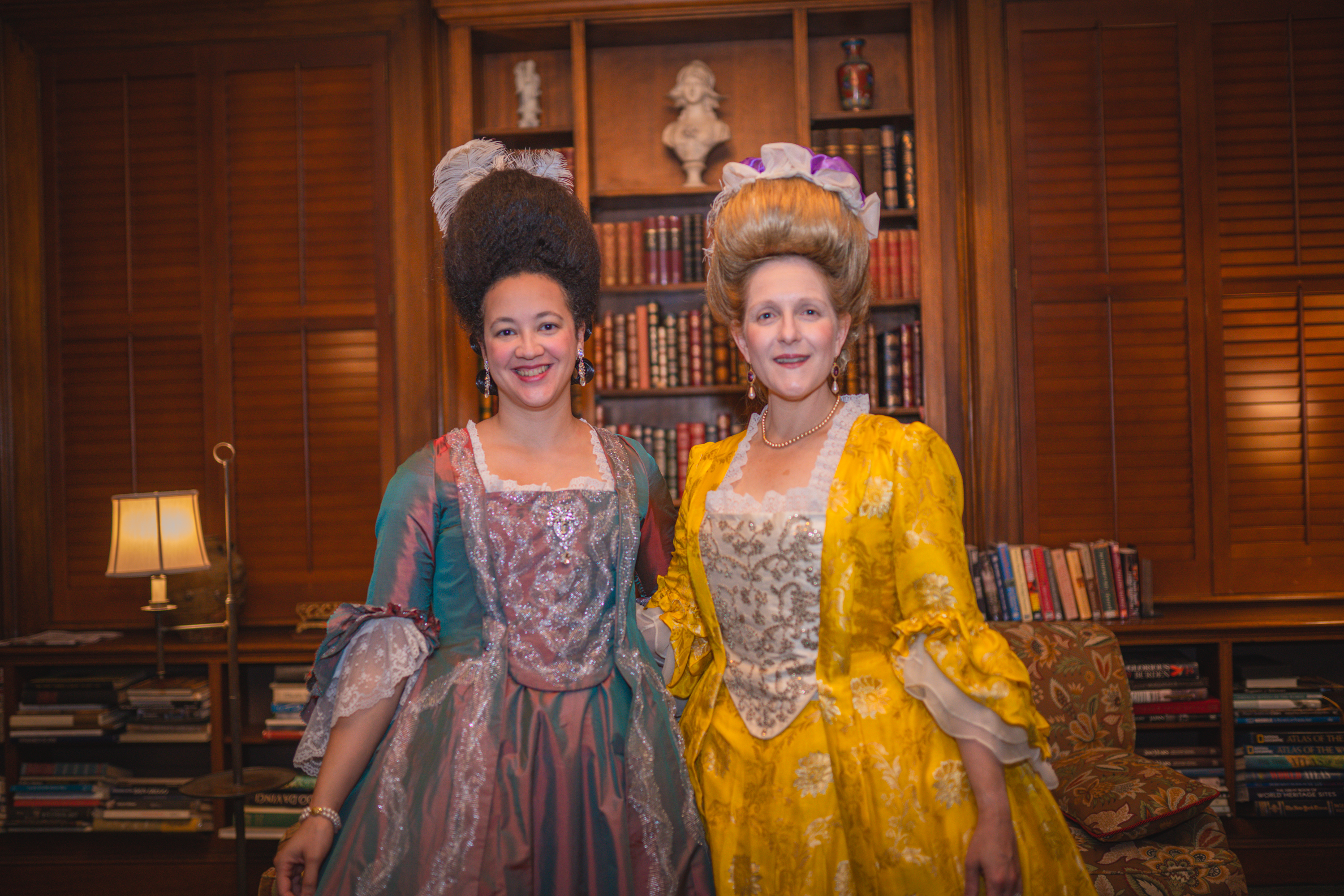
Photo courtesy of Aleks Vu

About The Event

In October 2024, I had the great joy of attending the ‘Salon at Palais-Royal: An 18th-Century Chevalier Experience’ weekend hosted by Costumers of Color. The program included educational lectures, a violin concert, historical activity discussions and demonstrations, dancing, and more, with the goal of providing an inclusive environment for people of color both in terms of attendance and in terms of the educational theme of the event.

It was a success! Costumers of Color shared on the page for the event that “over 40 of the 140 attendees were POC (people of color).” That’s pretty amazing, and special! (If you go to the linked page, you can see group photos, one of which is of all the people at the event who identify as people of color.) I enjoyed that aspect of the event, as well as the educational theme that centered Joseph Bologne, Chevalier de Saint Georges, an 18th century Black “scholar, a fencer, a virtuoso violinist and a famous and sought-after composer.” (This quote is from the Costumers of Color blog post about Joseph Bologne. Please go give it a read if you would like to learn more! Bologne’s achievements are impressive!) In addition to these elements, I also enjoyed the combination of learning and participating that was incorporated into the weekend.

What Was Worn

For the formal evening part of the event, I chose to wear my Versailles Sacque (made and last worn in 2016, which I posted about here)! For this wearing, I updated the ensemble with a lace tucker around the neckline of the dress. This small new accessory helps complete the full look. It took a little bit of referencing my old blog posts to reconstruct my hair form and remind myself what accessories to wear, but I was successful. I was very grateful to myself for documenting things so well!

I also had the pleasure of seeing the new Yellow Sacque and all of the new accessories I’ve been making being elegantly worn by a friend!

Below, showing off both the front and back of the sacque (or Robe à la Française) style of dress.

Photo courtesy of Aleks Vu

More Photos

I was so pleased that my American Duchess Kensingtons were still in good shape after the immense amount of rain they endured in 2016. It was really exciting to break them out again with this dress! I’m still chuffed with the metallic lace I added. For Versailles, more bling was the thing! And in this photo, you can see how the light turquoise paint color picks up on the hints of turquoise in the dress fabric!
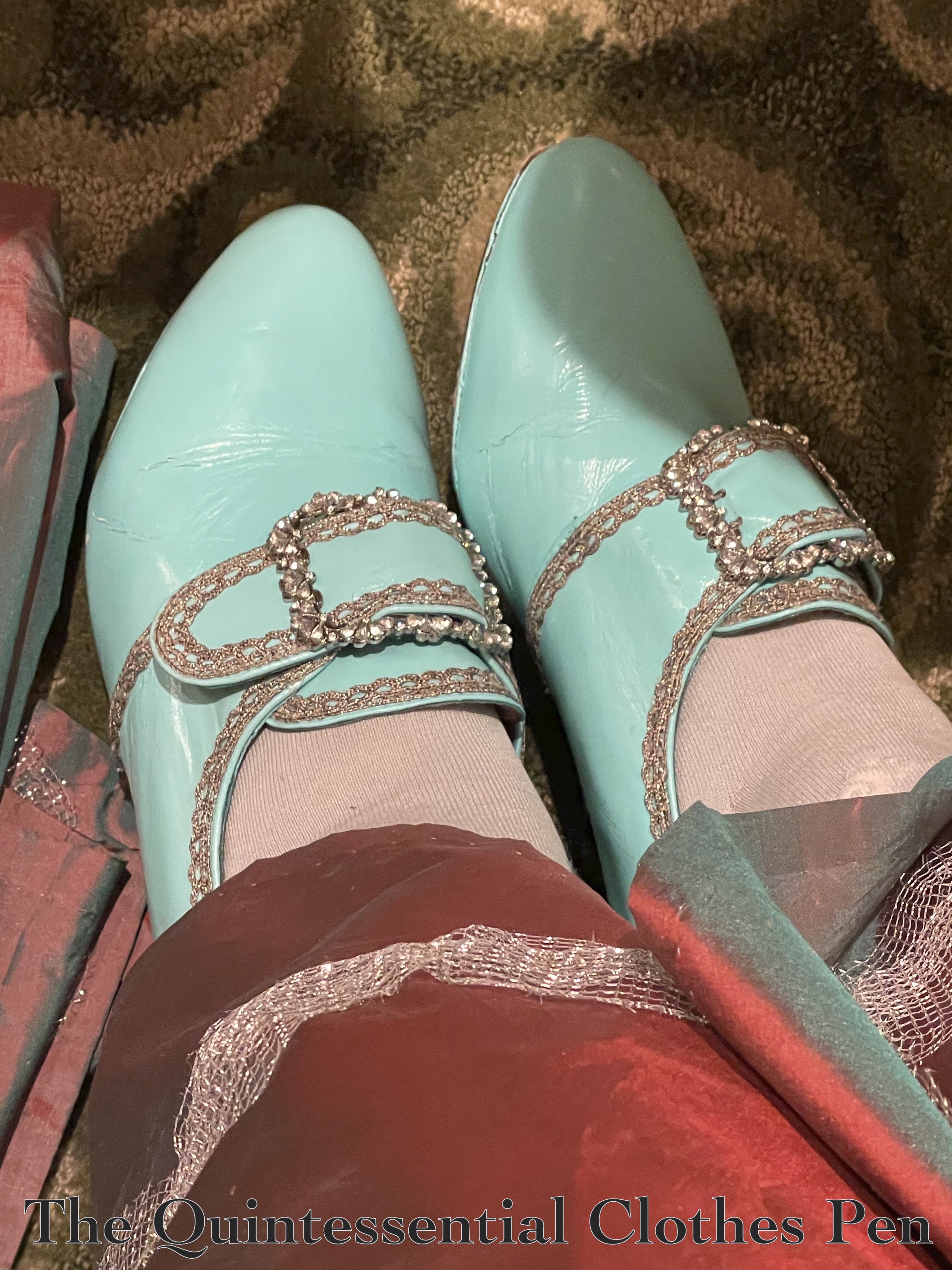
One of the things that I’d struggled to capture in photos for the Versailles dress’s first wearing was the changeable nature of the silk fabric. It is a ‘shot’ fabric, meaning that it uses two different colors woven in opposite directions: a vibrant turquoise and a deep red. This means that fabric appears to be both colors, or a mixture that looks a bit purple, depending on how the light hits it.

Most of my photos from the first wearing of the dress show the purple color, but the lighting at this event captured the many colors of the fabric much more clearly! Below is one example. Most of the dress appears in the red tone, but the shadows of the dress in the back look like the green color.

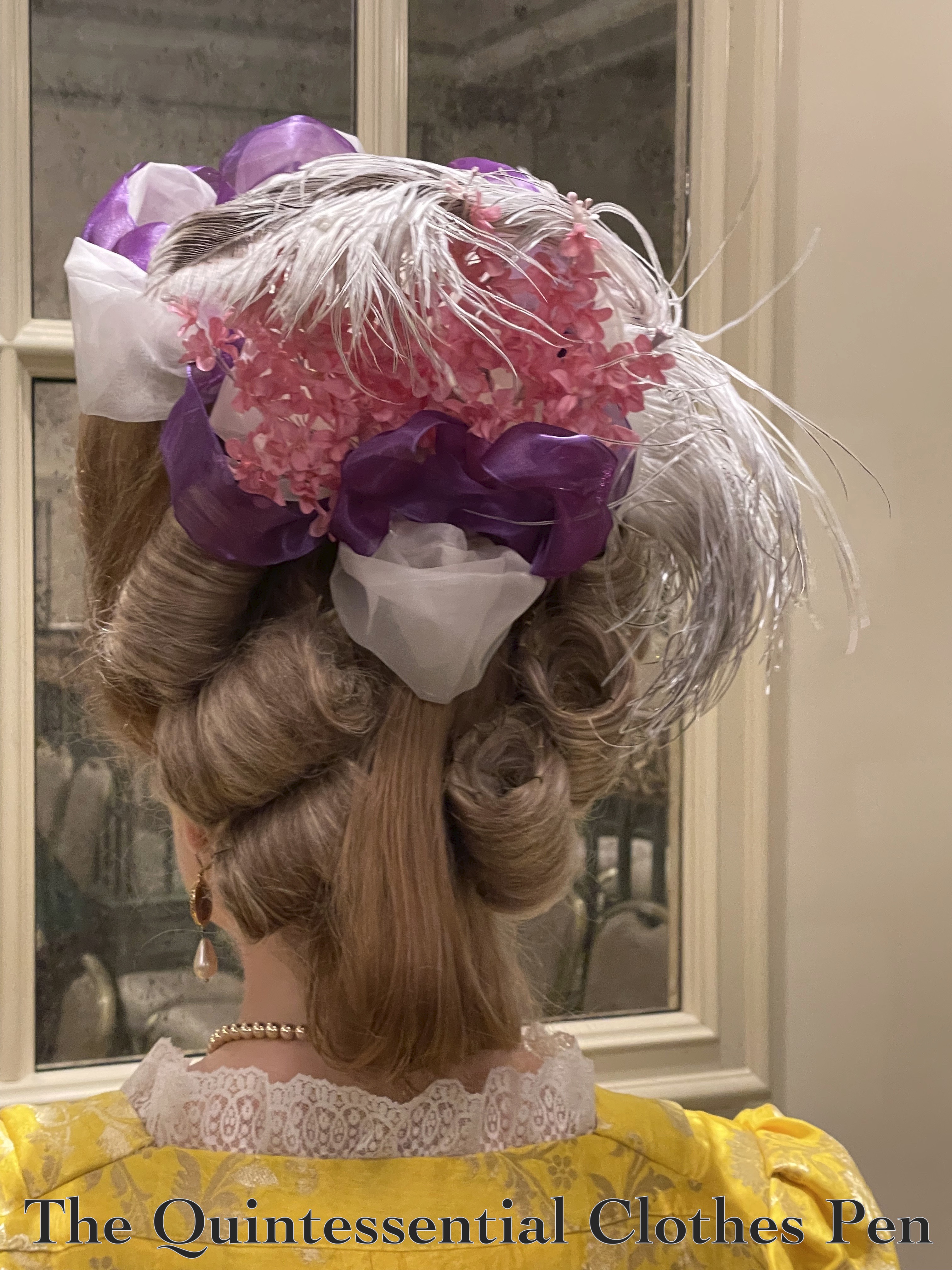
As I mentioned earlier, I had to reconstruct my hair style for this wearing. In 2016, I cobbled together a large form from many hair supports on hand (you can read about that in this past post). After that event, I deconstructed the large form in order to be able to use the individual parts again. So for this, re-forming the large form was necessary.

Below, you can see the final result of the style. This is the same style I created in 2016. (You can read more about it in this past post.)

My friend wearing the Yellow Sacque also had a fabulously large hairstyle! Her style uses elements from the book The American Duchess Guide To 18th Century Beauty, including the ‘Ski Slope Hair Cushion’ and ‘1770s Pouf’ on pages 119 and 127. She also created her own buckles (those pre-made rolls of hair on the sides). And I had fun helping her place them the day of. It was fun to make two styles that are similar, but different in shape and details!
Recollections

I had a fantastic time traveling with friends to this event. We all enjoyed the content of the weekend as well as the opportunity to make or refresh our clothing and accessories.
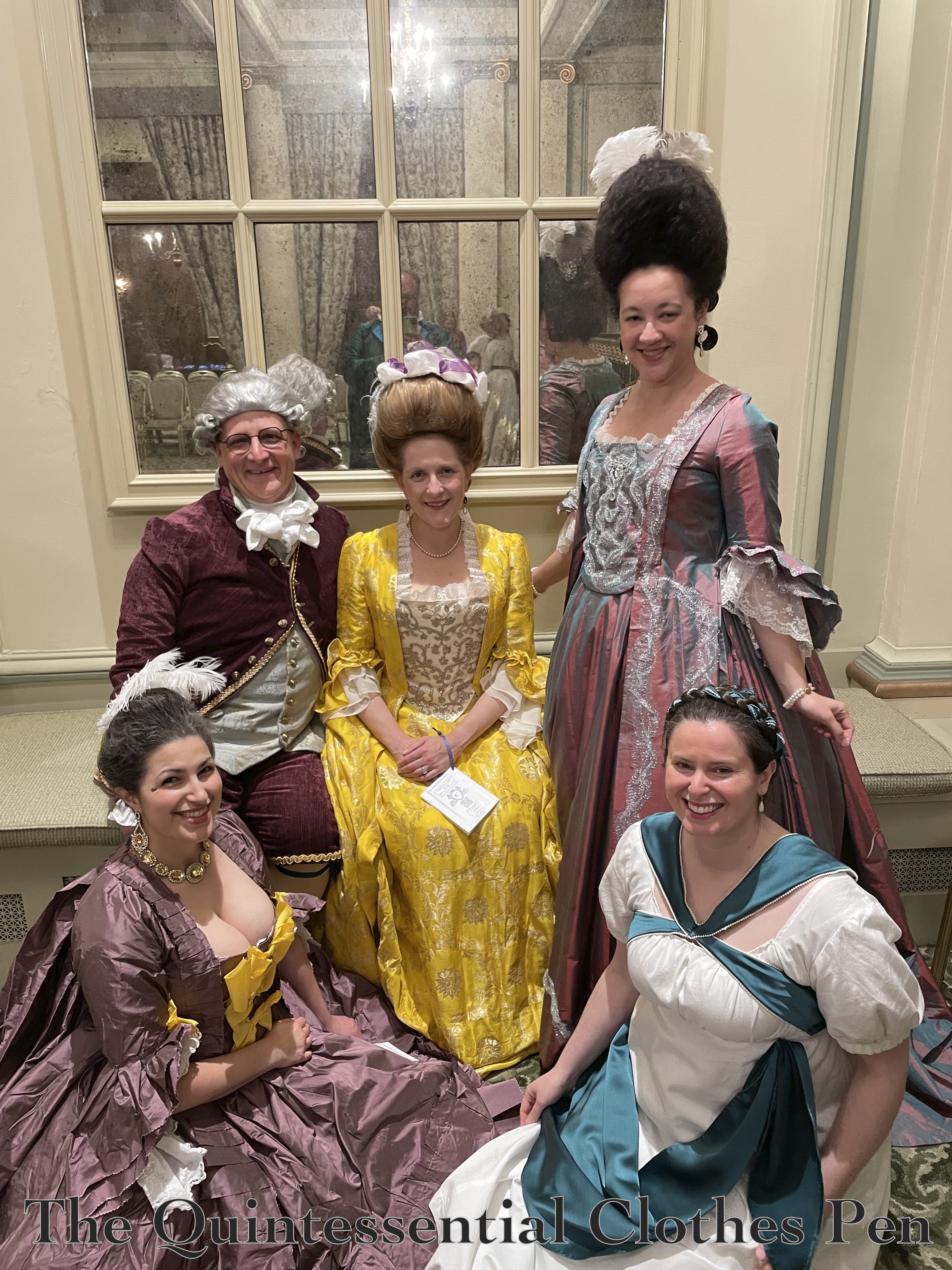
In fact, we had such a lovely time we felt the need to take a break in the ladies dressing room! How could we not, with such an elegant day bed and foot stool to lounge on?

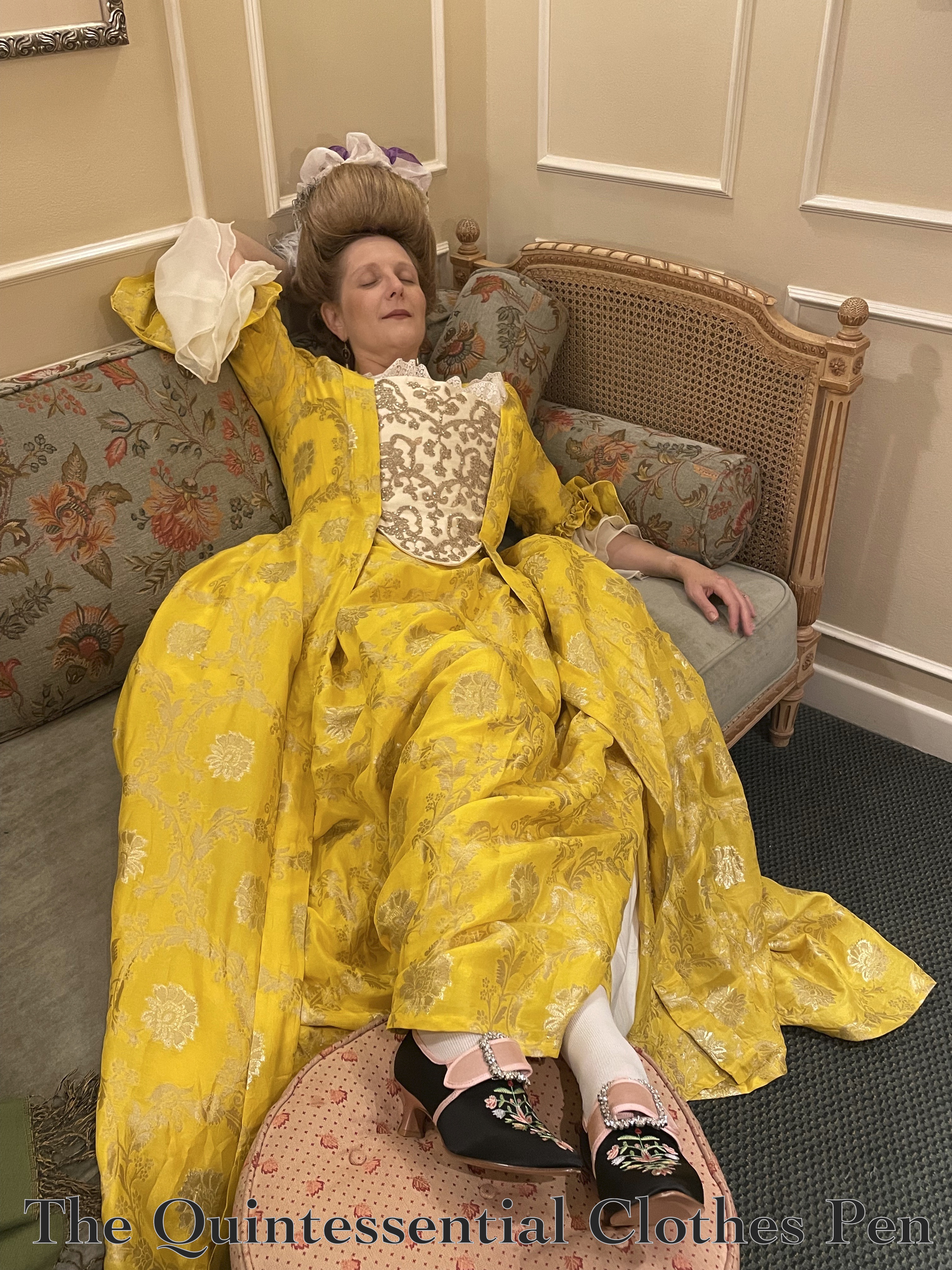
It was also a special experience to have the opportunity to meet other bloggers and costumers I don’t often (or ever) get to see in person! We might exchange comments and be inspired by each other’s creations, but to meet people and have a conversation is extra wonderful. I’m so grateful that Cindy, of Cation Designs (who is in the photo with me, below), took the time to chat with me and express her appreciation for how this blog has made costuming feel approachable for her!

After a lovely evening, it was time to head out. It wasn’t particularly warm outside, so an extra layer was much appreciated!

But a pause was necessary… I love my silly moose poses! Thanks for enjoying this outing with me!
Project Journal: 1863 Apricot Evening Gown Part IX: Braided Crown Hairstyle Details

I am very pleased with how my hairstyle turned out for the first wearing of Genevieve, the 1863 dress I’ve been blogging about for the last few months. I took the idea directly from my inspiration drawing, though I changed the hair decoration that accompanied the style.

I’ve used false hair to have braided crown styles before (here’s an example of the same braid used for a Regency hairstyle), but that old braid is only about 1 ½” wide, which is a bit subtle for the look I wanted for this dress. It’s also long enough to wrap around my head about 1.5 times, which is longer than what I wanted for the new hairstyle.

So I decided to buy some new false hair and make a new, fatter braid. I used this hair in dark brown. It’s intended for African style braid extensions, so it has a texture that’s great for matching my curly hair–I don’t think it would work well for someone with straight hair. I also bought these black hair nets.

I used one bundle of the false hair for this braid. The hair comes braided already, but I took it out and re-braided it a little tighter than how it was originally. Then I cut the elastic on one of the hair nets so that it would stretch out to be as long as my braid.

I laid the braid on top of the hair net and wrapped the hair net around to the back side of the braid. Then I used large whip stitches to secure the net to the braid. You can see one of those stitches mostly centered in the next photo. Covering the braid with a hair net helps keep all the frizzies from making the braid look messy. (My old braid isn’t covered in a hair net, so it looks very organic, like my real hair… nice and frizzy!)

The final step was to go back and stitch the hair net down in the dips between each section of the braid. In the photo above you can see the hair net traveling between braid bumps, but in the finished photo below those are mostly sewn down and much less visible.

For the actual hairstyle, I secured the braid to my head behind the sections near my face that get swept back over my ears. (I also pinned the braid to the top of my head to keep it in place while dancing. Those pins were put into the back side of the braid (to keep them hidden) and secured into the roots of my hair.) After securing the braid I was able to arrange the front sweep sections on either side of my face. I made sure to cover the ends of the braid with these sections.

Then I arranged the back of my hair. I wanted to keep it simple to showcase the braid and the velvet bow, so I arranged the back of my hair into a low puff. It continues the ring of the braid around my head while being more unobtrusive than the braid itself.

The final step was the bit of lace and the velvet bow. I opted for those instead of the lace framing the braid in the inspiration image. I wasn’t sure how I would accomplish that without essentially creating a cap… and that’s not the look I wanted. So I made up something else!

The bow is one I was able to make after my bow disaster. I think it adds a nice touch of color on my dark hair. I wasn’t sure what I was going to do with it and the lace until the ball, so I bobby pinned each piece in place for that first wearing. Then one of my after-the-ball tasks before I could put this away was to sew these two pieces together and add a comb so that it is now an official accessory that will be easier to put in my hair the next time I wear this dress.

Here’s a side view of what all of that amounts to. I intentionally placed the bow and lace off-center on my head in order to pick up on the asymmetrical bow on the skirt of the dress.

When I did a quick trial with the braid in modern clothes it felt very large and I was worried it would be too big, but once dressed in Genevieve I think the scale of this new braid is great–an excellent hair crown size and length, and the hair net keeps it looking super tidy and frizz free!


1817 Gold Stripes And Face Framing Curls

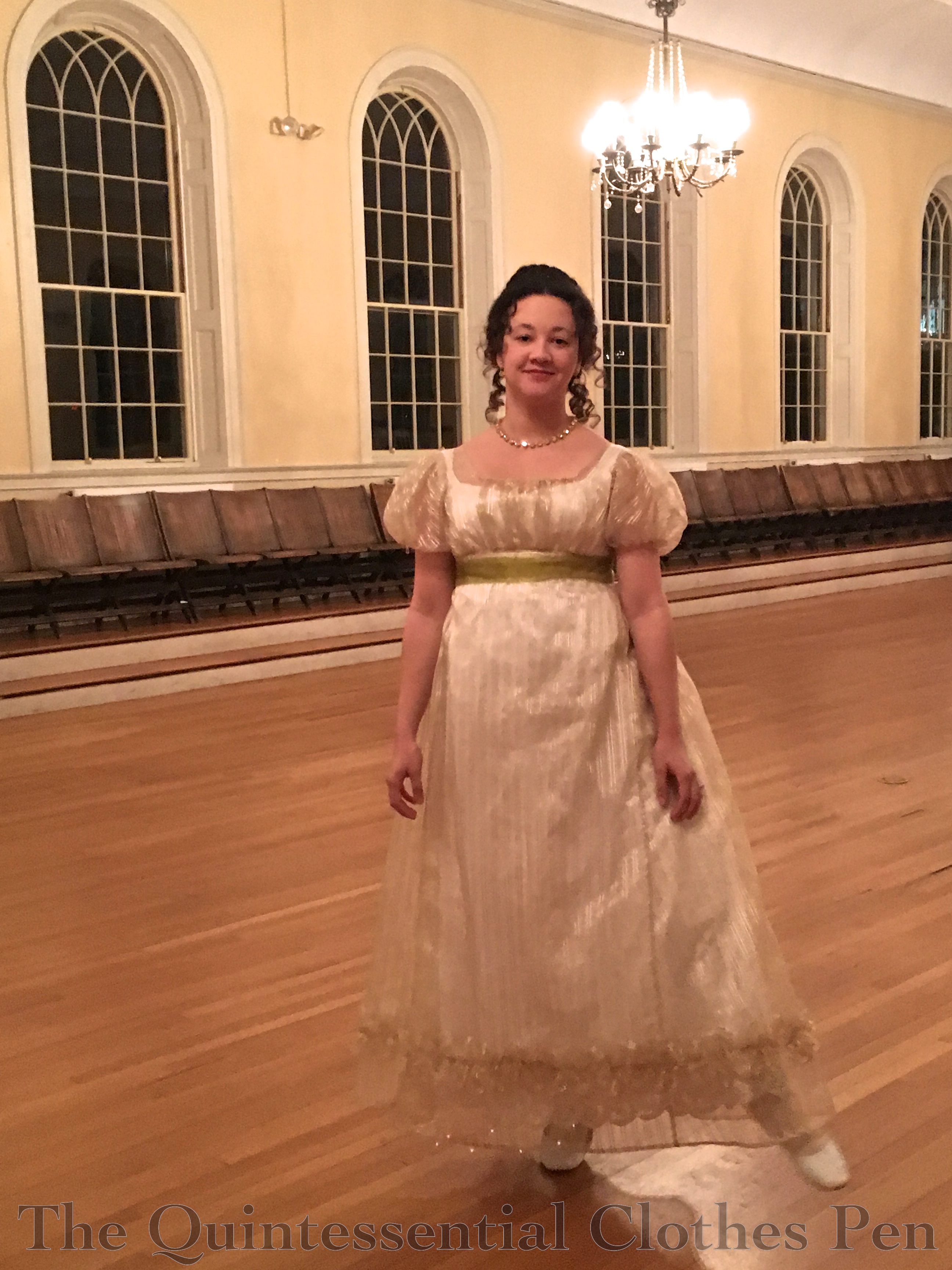
Back in February, I was able to re-wear my 1817 Gold Stripe Duchess Gown to The Commonwealth Vintage Dancers’ annual Regency Ball.

I love this dress! The sheer fabric is unusual to see in modern recreation settings and has lots of body, making for a lovely shape that is fun to dance in. It turns out that the gold stripe is rather neutral, so I’ve had fun accessorizing it in different ways this spring. We’ll start with this wearing, but there’s another one to blog about as well!

This time I decided to add a bit of color to the dress by adding a wide chartreuse organza sash with a simple bow in the back and rather long ends. (I’m all for variation in ribbon sashes for Regency dresses. In fact, I wrote a post detailing different sash styles a number of years ago!)

I also added lovely new jewelry from In The Long Run Designs. The color I chose, jonquil, is a light yellow color . It compliments my skin tone and adds quite a bit of neutral-toned sparkle to my ensembles (the goal was to match as many dresses as possible so I can get the most use out of the set).

The day of the ball I thought I had lots of time and so I decided on a whim to do a complicated hair style with face curls. It turns out I was off by an hour but I didn’t realize it until I was in the car! Thankfully I arrived in time and didn’t cause anyone else issues with my lateness. Oops! But I was very pleased with my hair (and the fact that it was done before I arrived to get dressed definitely helped offset the fact that I was late).

The hairstyle is directly inspired by the following image of Maria Leopoldine of Austria from 1815 (source). I have a note that it was painted by Friedrich Johann Gottlieb Lieder but I can’t find documentation for that detail outside of my note-to-self. Maria Leopoldine caught my eye because I love big braid buns (my hair does volume so well!) and I thought it was high time to try face curls again (see my 2014 attempt and a different narrower circumference of curl in 2016 to see other attempts I’ve posted about).

So off I went with a curling iron to try and reproduce this hairstyle. Given that I thought I had lots of time, I even took photos of the process so I could share it with you!

Let me start by saying that yes, even though my hair is curly I still use a curling iron (or other curling method) to get precise curls. To show the difference, here’s my hair at a partially done stage. You can see the curling iron curls to the left of my forehead and chin with my natural curls being held sideways in between them and on the right side of my face.

How did I get to that point? I’ve determined that great looking historical hairstyles are often styled in many parts. The complicated thing about face framing curls with my hair is that it’s all quite long: past my shoulders when it’s curly and almost to the middle of my back when it’s straight. I don’t have short lengths around my face to curl, so I have to fake it with long lengths that are pinned up to be shorter.

To begin, I split each half of my hair into sections–a front top section, a back top section, a section behind my ear, and the rest of the hair on the back of my head. In the photo above, I’ve already used the curling iron to curl the top back section of hair, pinned up some of the length, and used the front top section of hair to smooth out and cover up the pinned up length. I’ve also curled the back section behind my ear and pinned the curls up to shorten them as well. The rest of the hair is being held out to the side so you can see the different sections I’m referring to.

I realized after taking that photo that I should show a better example of what all of those words mean. So in the next photo I’ve let go of the back section and put a loose hair tie around it to keep it separate from my nicely curled sections. And I’ve curled the back top section of the other side of my hair, but I haven’t pinned those curls up to shorten or arrange them. I’m holding the front top section up in the air so you can see how untamed the curling iron curls look before being arranged.

The curls are the hard part. After arranging the top front sections and pinning them down around the back of my head it was a matter of wrapping and pinning up the back sections to look nice and make a big bun on the top of my head. I’m pretty sure I used a big bun form under there (the medium one from my Versailles hair in 2016–and for reference that post pretty clearly shows how long my hair is–it’s great for volume but can be a lot to wrangle), but it’s hard to remember as that was now almost three months ago and I didn’t take photos of those steps!

The final step was to wrap and pin my trusty (and yikes, 15 years old!) faux braid around the bun and give the whole thing a liberal dose of hairspray!

I love that I’ve found a new look for this dress and a new historical hairstyle. Looking at the photos, it doesn’t look like my braid bun is quite as large or wide as Maria Leopoldine’s (I’ll have to try again someday!). Despite that, I was very pleased with the face framing curls and the bouncing curls behind my ears. The style felt very regal!

1864 Evie Hair (Returning Heroes Ball 2018)

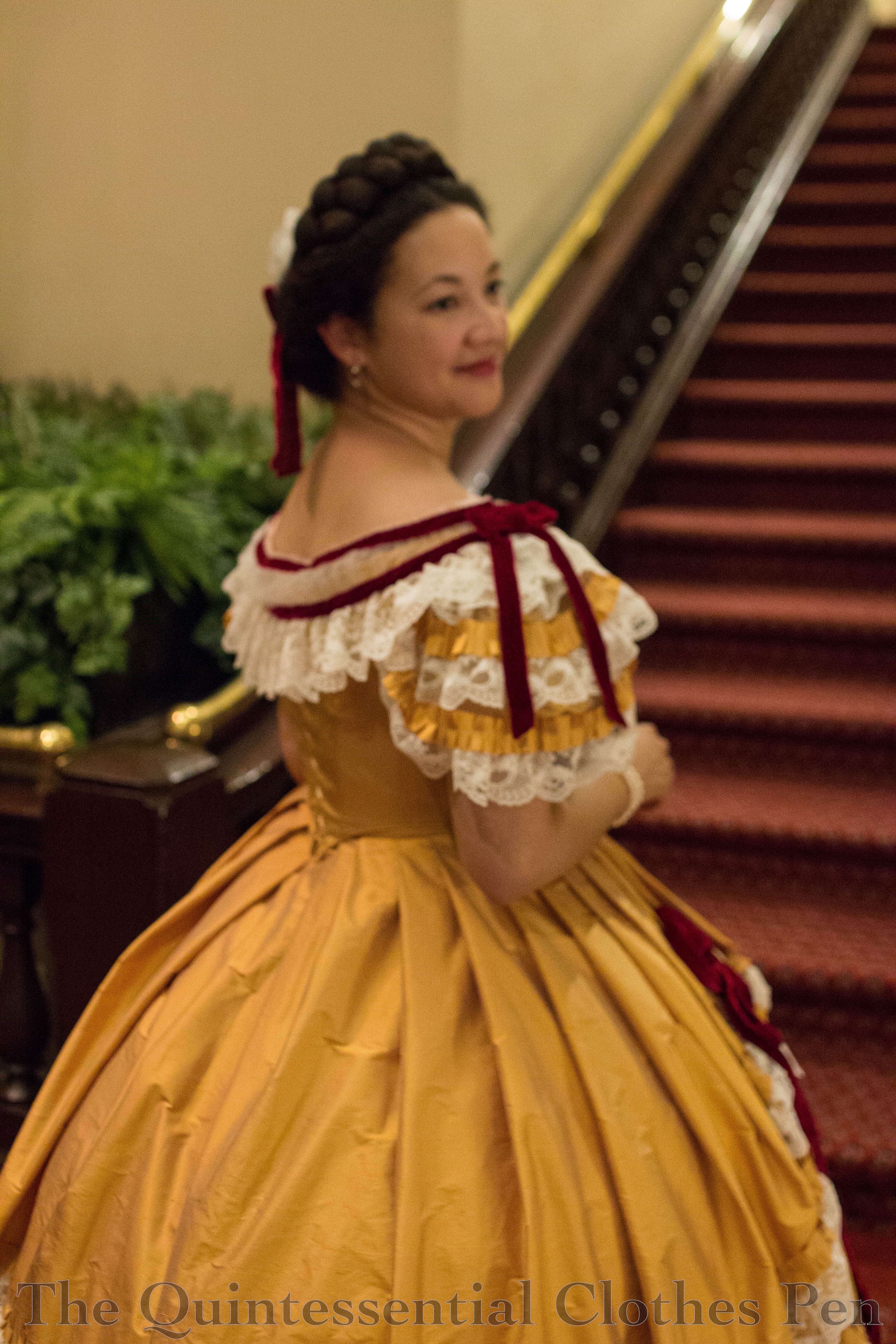
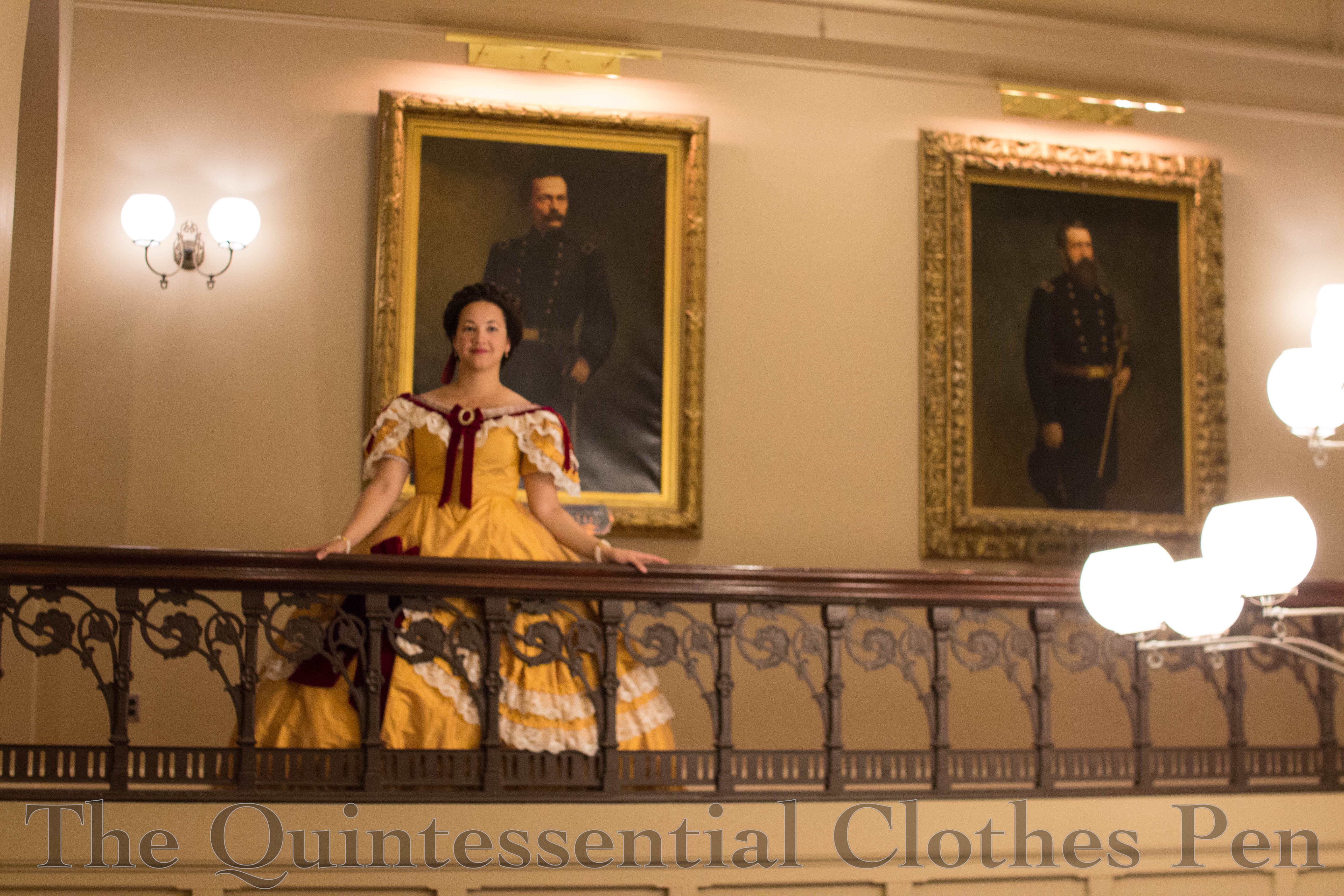
In March, I again had the pleasure of attending The Commonwealth Vintage Dancers‘ annual Returning Heroes Ball (you can read about other years I’ve attended here). I decided to wear Evie, my 1864 ballgown, simply because it had been a year or so since the last time I wore that particular gown.

In order to change things up I did two things differently with this wearing: I wore different earrings and did my hair differently. Small changes, but it makes wearing an old dress feel new and exciting!

I don’t think I’ve ever worn these earrings for mid-19th century events before (only for things later and earlier than this period), though now that I’ve tried it I think they work quite well. I made them from triple drop earrings that I bought from a modern store (I forget now, but I think it was New York and Company). I just took off the bottom drop and attached them to clip hardware. They catch the light and sparkle nicely.

1860s and earrings together reminds me of the scene in Gone With The Wind in which a straggling soldier try to steal ‘ear bobs’ from the house. Not that these look at all similar (and luckily my story ends on a happier note than that scene), but a GWTW reference generally makes me smile.

I was going to do a simple hairstyle (my usual go-to c.1860 style with a center part and the hair in a low mass at the back of my head), but as I was getting ready I chanced a look at Pinterest and got excited about trying a more complicated style than I usually do. In particular, I liked the puffed fronts on some of these styles from 1864 and the curls on the sides like some of these from 1861.

I sort of mashed these two looks together, using small rats to puff the front sections of hair and a curling iron to get smooth curls for the sides. My hair is getting to be so long that I had to pin the hanging curls up to shorten them! The rest of my hair was just twisted and pinned on my neck without too much attention paid to it. I was running out of time and knew I’d be adding my hair piece on top, which would cover most of the back of my hair anyway.

I really like the end result for this particular dress of mine. I feel it compliments the hair piece and the silk dress nicely. Isn’t it lovely when all these little details come together to create one cohesive end result? Yay!

SaveSave