c. 1860 Crinoline Size Comparison & Tutorial

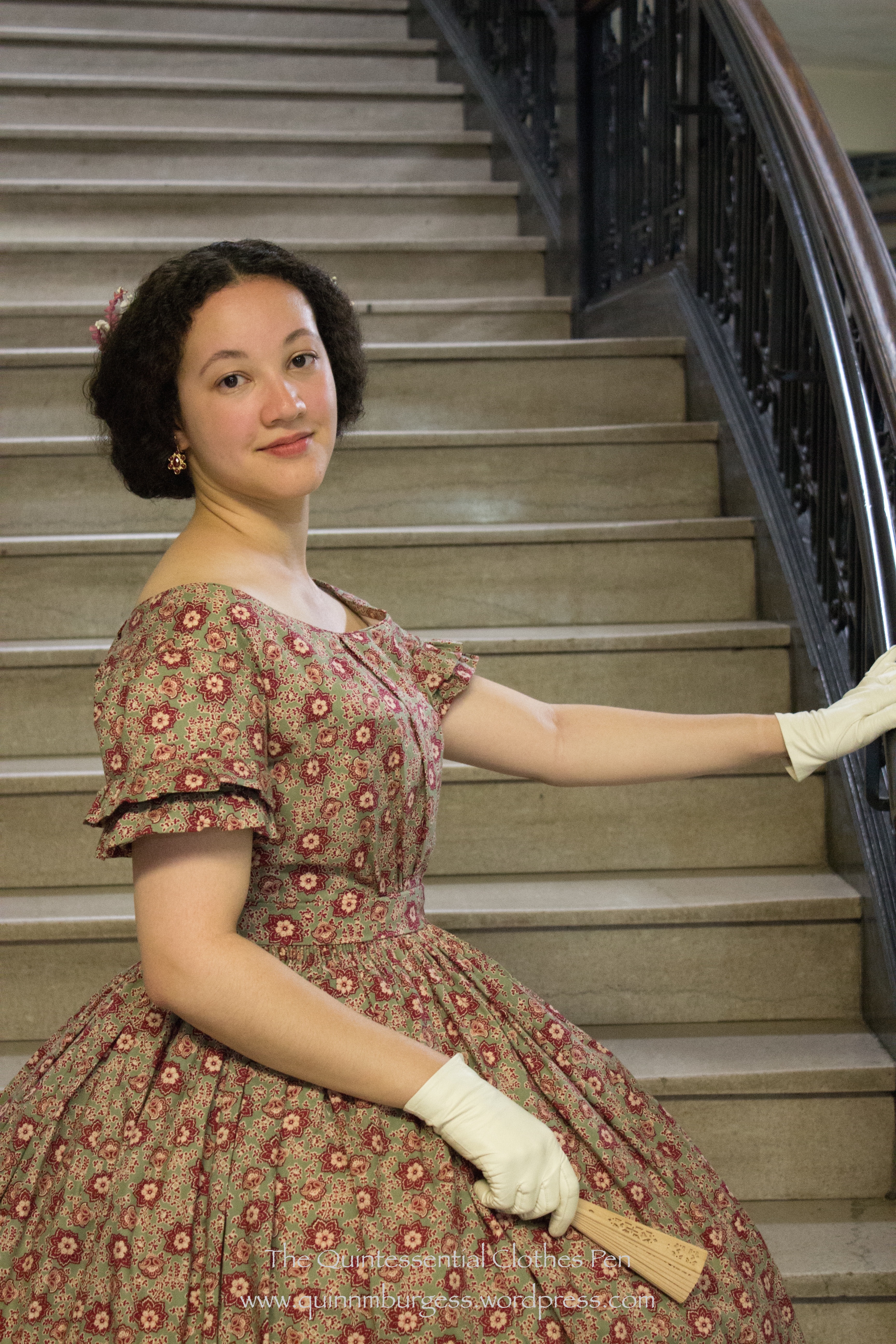
Back in October of 2016, I made a new, smaller crinoline (also called a hoop skirt) than the one I’d had for about the last 10 years. I thought it would be great, and it was… in terms of shape. Unfortunately, the new crinoline had a fatal flaw: the channels for the hoops were too wide for the slippery-ness of the hoops and therefore all the tapes would slide to one side while being worn, causing the hoops to drop down and create a trip hazard for the wearer. I had loaned these to a friend at a ball and was horrorstruck as I realized the problem and she attempted to dance without realizing the problem. It was such an awful feeling! We solved the problem for the night, but I resolved to fix the hoops before wearing them again and I learned a good lesson about trying out new garments myself before loaning them! I’ll get to my solution for the sliding hoops in a bit, but first I’ll start at the beginning.

The new crinoline was an experiment to see if I could use the hooping from a cheap Amazon hoop skirt like this to create a cage crinoline with smaller dimensions than my usual crinoline, the super-cupcake, which has a decidedly high fashion silhouette. The answer to that question is ‘yes’ it was easy to reuse the hoop steel from the Amazon crinoline to make a cage crinoline.

You see, the super-cupcake looks great with the right circumference of skirt and the right environment (high fashion daywear or a ballroom); however, under a cotton day dress I wanted a more subtle, practical, reasonable shape. I have to admit to liking a big skirt though, so a reasonable crinoline for me still has a larger circumference than what it might be for others. Also, at 5’6″ I am taller than the average woman, which allows me to carry off a larger circumference while staying within reasonable looking proportions. (For more thoughts on practical sized crinolines, Maggie May has shared useful research and an equation to help determine crinoline circumferences.)

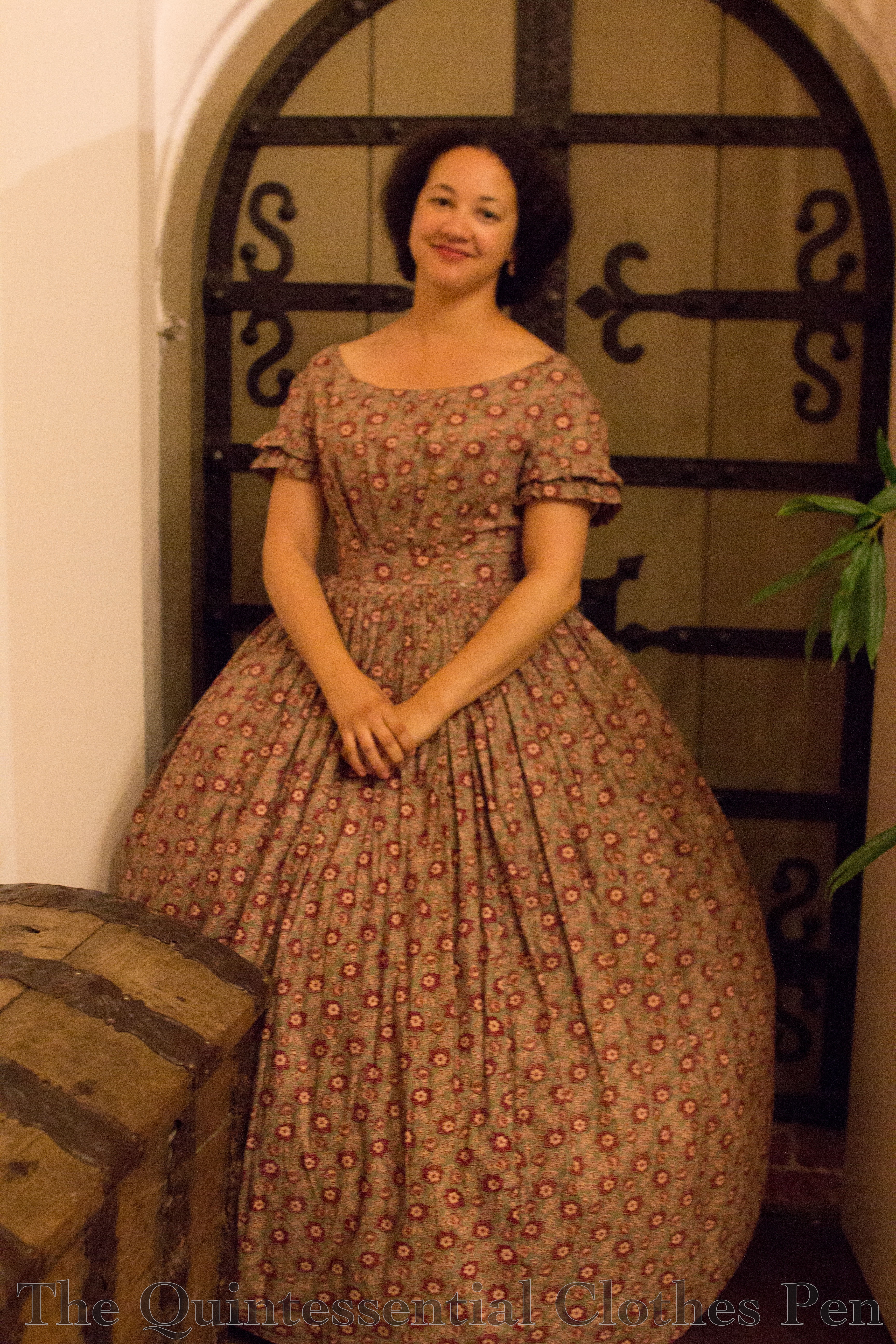
Here’s a comparison of my two crinolines worn with cotton dresses: the super-cupcake is on the left and the newer reasonable crinoline is on the right.

Interestingly, the dimensions of these two crinolines aren’t terribly different. The lowest hoop is only about 8″ smaller  on the new crinoline. The biggest difference (and what alters the silhouette most) is that the new crinoline has a more tapered shape in the upper hoops.

I’ve provided the following size chart in an effort to help those who might be making or adjusting their own crinolines. Even if you don’t want to deal with all the vertical tapes, you can use these dimensions to adjust the hoop sizes in a ready-made modern crinoline to achieve the same effect.

Interestingly, both of these crinolines have the same vertical tape length that is short enough to keep the bottom hoop decidedly above the floor. The lowest hoop on these is about at my mid-calf height. This keeps my feet from getting tangled–especially useful while dancing! In order to keep my dresses from folding under the bottom hoop as I move, I have a cotton petticoat with a substantial ruffle around the hem which provides stability for the dress worn on top. You can see the length of the super-cupcake on me as well as the ruffled petticoat that I wear over both crinolines in this post.

Here are my two crinolines next to each other while the new one was still in progress. They have an overall similar construction (although I did simplify the new ones, using fewer hoops and fewer vertical tapes).

My old crinoline used ivory twill tape for the vertical supports. There are actually two layers of it that are hand sewn together to make channels for the hoops, creating channels along the lines of those seen in this 1859 hoop skirt patent filed by James Draper of New York (while the hoop circumferences are not provided in the patent, the silhouette of Draper’s hoop skirt is similar to that of my super-cupcake). This method used a ridiculous amount of twill tape, so I came up with a way to make the new channels that would use only one layer of twill tape for each vertical support. More on that in a moment.

The old crinoline’s hoops are made from cotton covered steel that was in a ribbon form originally. I had cut each ribbon in half (and over time, the fabric covering started to fall off, which caused me to painstakingly wrap each hoop all the way around with thread to make it more durable–a caution to anyone else using this to make a crinoline, although I’m not sure where you’d source this type of material these days as I believe this type of ribbon wire is no longer being produced). The fabric covering combined with the narrow channels in the twill tape means that the vertical ribbons only slide when I want them to, but that they otherwise stay in place nicely.

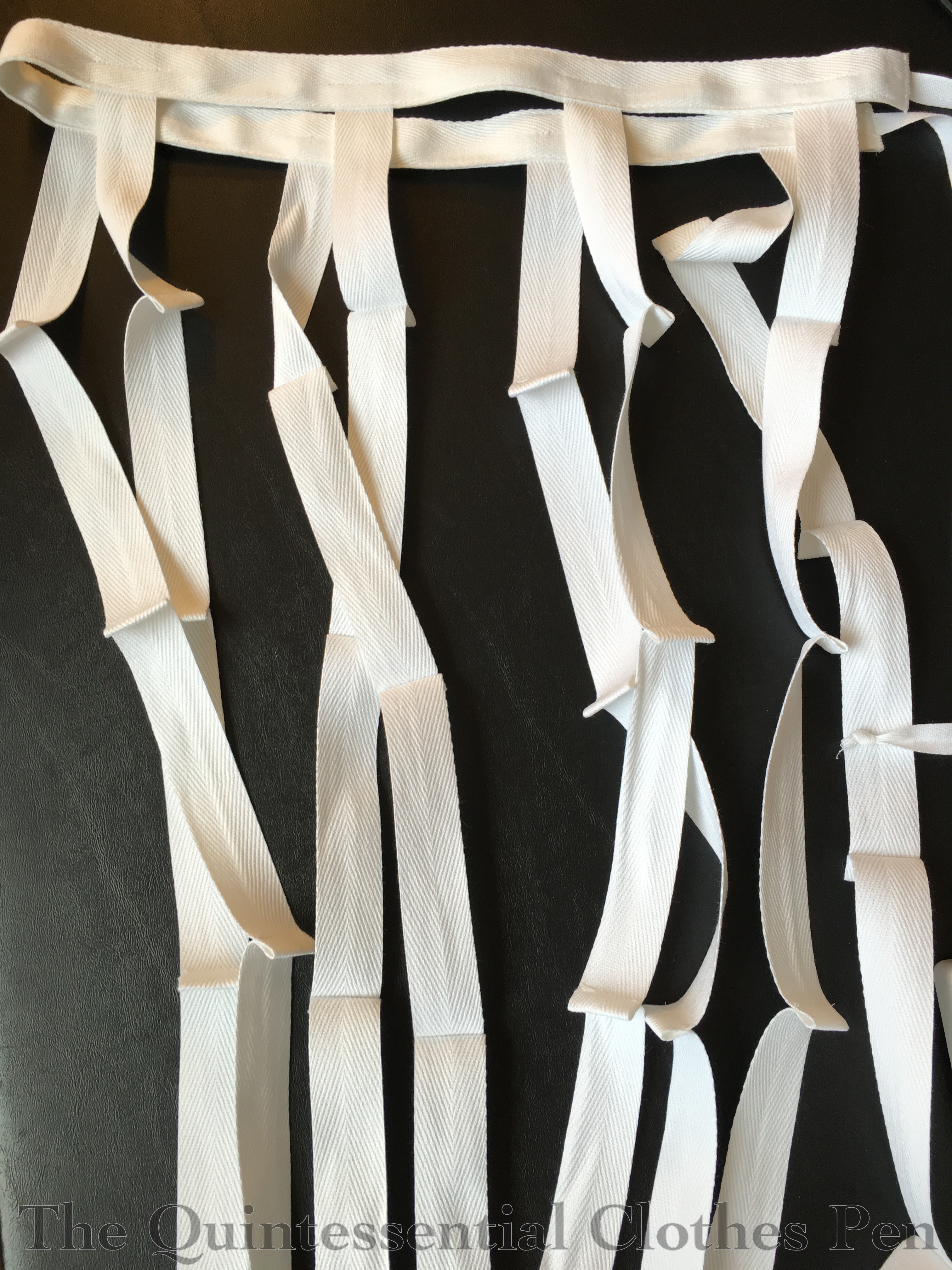
For the new crinoline, I machine sewed tucks into a single layer of twill tape to create channels for the hoops. You can see those tucks in the photo below.

I also machine sewed the vertical tapes to the twill tape waistband, because why not–I was machine sewing anyway. The waistband is two layers of twill tape sandwiched together.

That’s basically it for the construction before the awful incident of loaning them out. I cut the hoops to be the dimensions I wanted, slid them through the channels, and used the plastic joiners that had come with crinoline to secure the ends. Done! Or so I thought…

After realizing that these hoops were going to slide horribly, I went back to research to figure out how this problem was solved in the past. What I noticed are little metal dots on each join of hoop to vertical support. That makes so much sense! I wanted to add these to my hoops but I didn’t know what to call them while searching for materials.

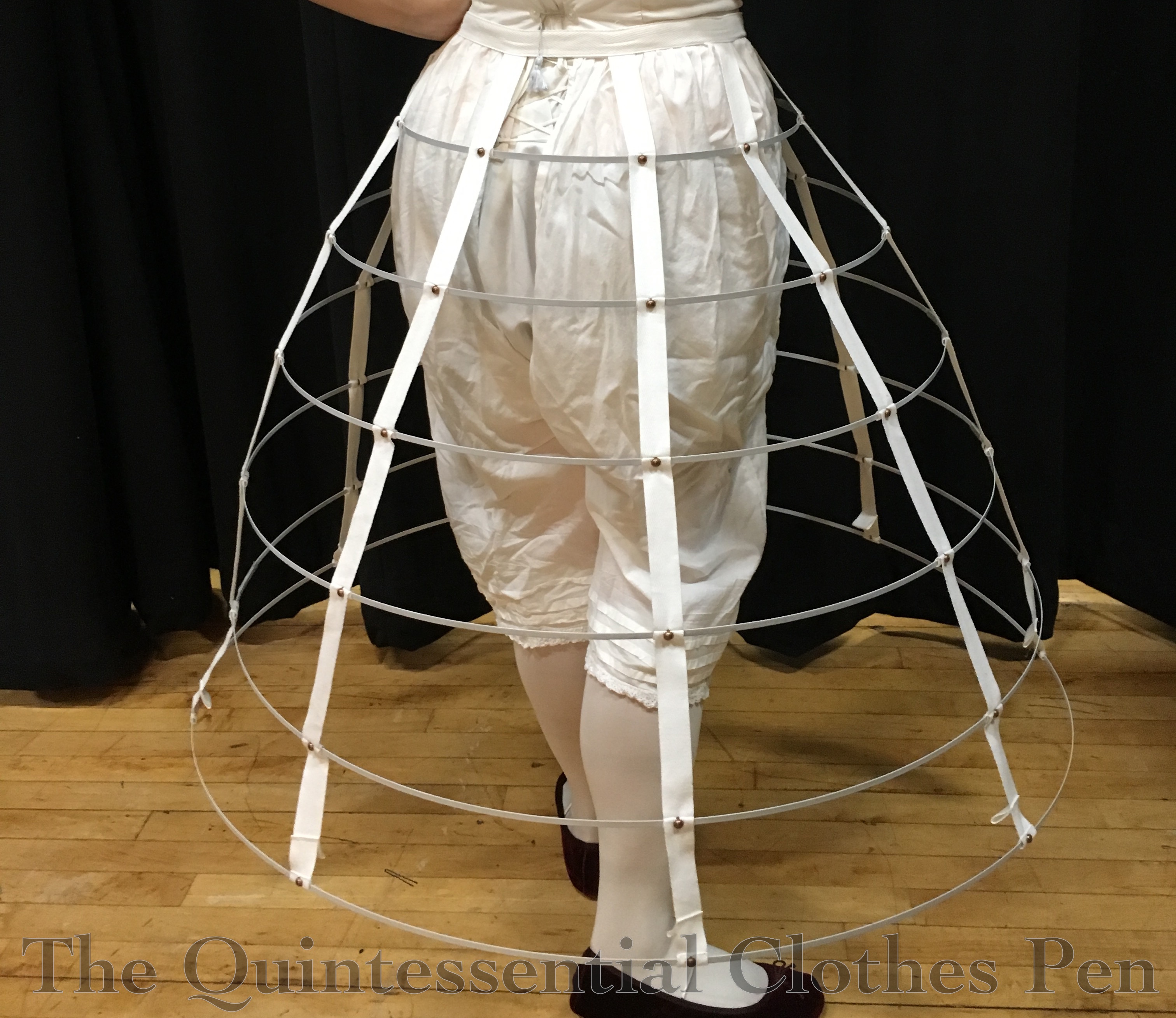
It took me a little research to figure it out, but I did and now I’ll share that with you. They are called spots! Once you realize that then a whole world of spots becomes available to you. Decorative ones, bronze, copper, nickel, black… so many options! I got plain domed copper from this seller on eBay and am very happy with them. They’re easy to apply with a pair of pliers and seem quite durable. Now my hoops and tapes stay in place–no more sliding around!

And here is the finished result of the spots on the reasonable crinoline. I like the look as well as the practicality. I’m planning to add gold ones to the super-cupcake as well, for looks more than anything else.

SaveSave

SaveSave

SaveSave

SaveSave

SaveSave

SaveSave

SaveSave

SaveSave

SaveSave

SaveSave

1864 Evie Hair (Returning Heroes Ball 2018)

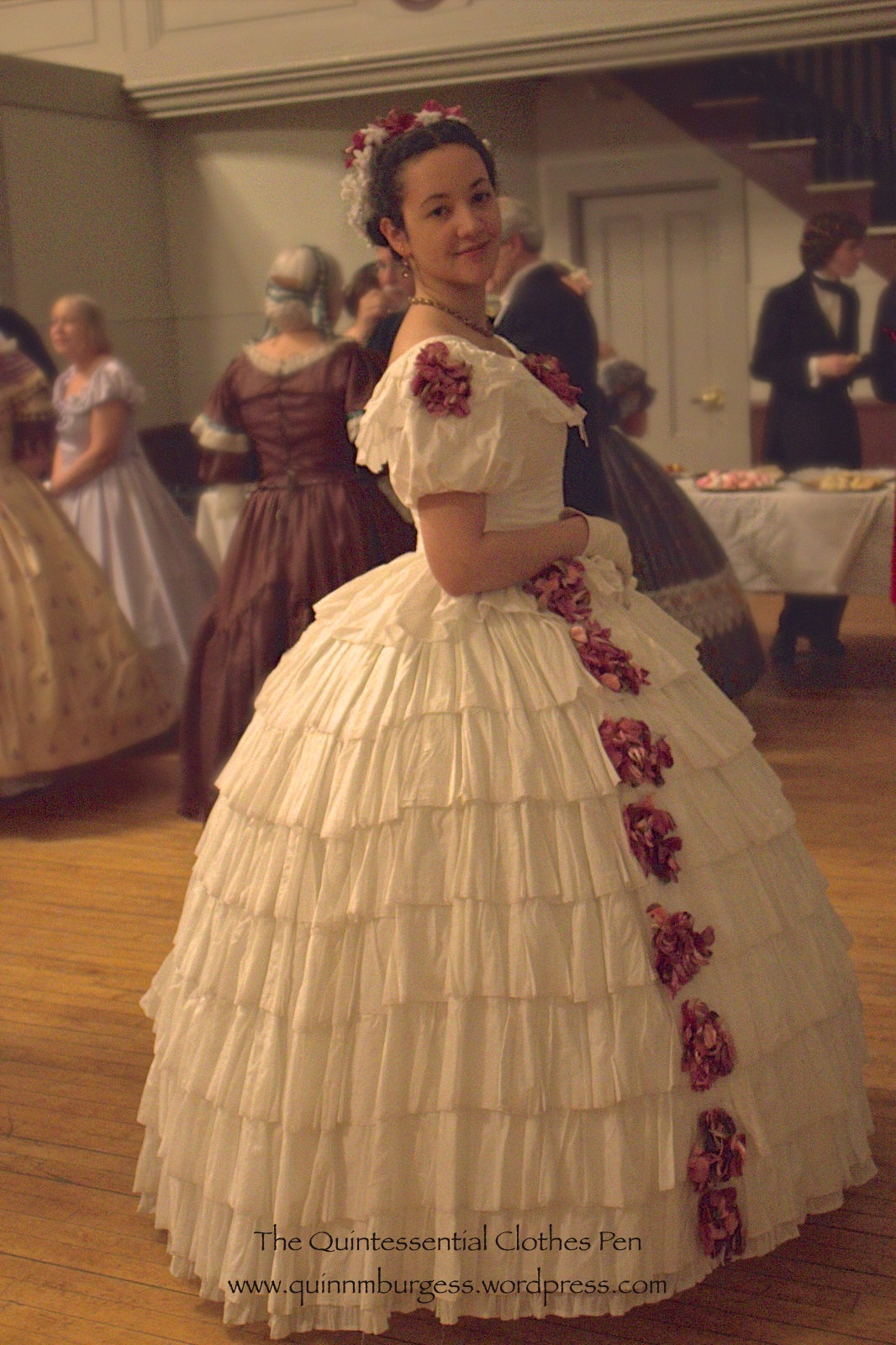
In March, I again had the pleasure of attending The Commonwealth Vintage Dancers‘ annual Returning Heroes Ball (you can read about other years I’ve attended here). I decided to wear Evie, my 1864 ballgown, simply because it had been a year or so since the last time I wore that particular gown.

In order to change things up I did two things differently with this wearing: I wore different earrings and did my hair differently. Small changes, but it makes wearing an old dress feel new and exciting!

I don’t think I’ve ever worn these earrings for mid-19th century events before (only for things later and earlier than this period), though now that I’ve tried it I think they work quite well. I made them from triple drop earrings that I bought from a modern store (I forget now, but I think it was New York and Company). I just took off the bottom drop and attached them to clip hardware. They catch the light and sparkle nicely.

1860s and earrings together reminds me of the scene in Gone With The Wind in which a straggling soldier try to steal ‘ear bobs’ from the house. Not that these look at all similar (and luckily my story ends on a happier note than that scene), but a GWTW reference generally makes me smile.

I was going to do a simple hairstyle (my usual go-to c.1860 style with a center part and the hair in a low mass at the back of my head), but as I was getting ready I chanced a look at Pinterest and got excited about trying a more complicated style than I usually do. In particular, I liked the puffed fronts on some of these styles from 1864 and the curls on the sides like some of these from 1861.

I sort of mashed these two looks together, using small rats to puff the front sections of hair and a curling iron to get smooth curls for the sides. My hair is getting to be so long that I had to pin the hanging curls up to shorten them! The rest of my hair was just twisted and pinned on my neck without too much attention paid to it. I was running out of time and knew I’d be adding my hair piece on top, which would cover most of the back of my hair anyway.

I really like the end result for this particular dress of mine. I feel it compliments the hair piece and the silk dress nicely. Isn’t it lovely when all these little details come together to create one cohesive end result? Yay!

SaveSave

An Introduction To Eleanor (HSM #10)

The Historical Sew Monthly challenge for October is Heroes – Make a garment inspired by your historical hero, or your historical costuming hero.

img_3400-1

You may or may not know that one of my favorite movies is Gone With The Wind. (I posted about this topic years ago when the blog was in its infancy–most of what I claimed then is still true and the 1860s will always have a special place in my heart, but I can now say that other periods give me excited wiggles too!) You can read the old blog post to get more specifics, but the essential point is that despite her personal shortcomings and the turbulent and controversial history of the period, Scarlett reminds me of the clothing that I love and therefore is an historical costuming hero to me.

And this gown has an added historical hero, Eleanor ‘Felcie’ Bull, who came to my rescue when I was contemplating what sleeve style to give my dress.

b9d863448d33e96ca7ce04a041dfd005
Eleanor “Felicie” Bull. 1863.

Prior to finding her image, I had been planning to name this dress Johanna, in honor of the friend who convinced me that I needed the fabric a few years ago. But I had sort of decided this was weird, since all my other dresses from this period have names that I like, but that are not from a specific living person. Once I found this image I was completely overtaken with excitement–I love the name Eleanor and there she was, helping me out! The choice was obvious.

img_3382

I made a new hair decoration to go with Eleanor. I had the perfect stem of purple velvet leaves, but no flowers to match the dress. So I dyed some white millinery flowers to a golden yellow. They have a fluffier texture than before being dyed, but the color is perfect. Using millinery flowers brings me so much joy, because it’s easy to shape any section since each stem is fully wired. And I couldn’t pass up the opportunity to wear my Dames a la Mode purple earrings and necklace.

img_3384

Regarding dress construction, we must start with a bit of a personal habit, or perhaps a theory, though I’m not sure it’s as thought out as that. When the opportunities arise for me to make multiple garments from the same period that could be carbon copies of each other in different fabrics (so much speedier on the patterning and planning front!), I hardly ever take that easy road. I am drawn to exploring the small variations.

So it is with Eleanor. I decided to: knife pleat her skirt instead of box pleating, cartridge pleating, or gathering; to make a plain darted bodice instead of using seams or gathers; to make the bodice straight across all around, which is more unusual for evening gowns made of silk than having points in front and back; to overlap and topstitch her side back seams; to omit the oft-seen bertha around the neckline; and to have single puff bias cut sleeves. These things all make this dress just slightly different than my others from this period, adding a bit of thought and time to the process. And if we’re talking about time, let’s just mention how mind-boggling cutting plaid pieces with curved seams and darts is when the pattern matching is important to you!

I collected images of plaid gowns with a focus on evening bodices and noticed these features, which is why I decided on them. The most useful images are in one place here, on my Pinterest board for the project. I was contemplating the sleeve type when I came across Eleanor ‘Felcie’ Bull. Interestingly, she shows all of those traits I’d decided on. I loved her simple sleeves and restrained bodice trimming, which then set me on an extensive Ebay and Etsy hunt to find just the right brooches to replicate her style. Yes, I did look through about 150 pages of bow brooches to find just the right one for less than $15. Plus many pages of gold oval brooches. I couldn’t have wished for better results! Remember the look I gave you a look a few posts ago? The only thing I did was to brush the oval brooch (which is new, not vintage) with a bit of brown acrylic paint to bring it down to the old gold color of the bow brooch.

img_3403-1

Other construction details include flatlining the bodice and facing the skirt in a remnant of dusty mauve cotton from my stash (used it up, yay!), creating boning channels in the darts to keep the front nicely shaped, and finishing the neck and bottom edge of the bodice as well as the armholes with very narrow cording.

Just the facts:

Fabric: About 6 yards of silk taffeta and 1 yard of cotton.

Pattern: Adapted from Past Patterns #702, 1850s-1863 Dart Fitted Bodices and Period Costumes for Stage and Screen as a reference for the sleeves.

Year: 1862, given the details that I decided on.

Notions: Thread, hooks and bars, canvas to interline the belt, narrow yarn for cording, and plastic wire ties for boning the bodice.

How historically accurate is it?: I’m going to go with 99% on this one. Materials and methods are well researched and executed. This would be entirely recognizable in its time.

Hours to complete: I really didn’t keep track. But I can safely say many!

First worn: October 22 for a ball.

Total cost: $98 total: $68 for the silk, $10 for bow brooch, and $18 for the oval brooch.

I’ll end this with my photographic homage to Eleanor ‘Felcie’ Bull.

img_3386-2-1

Returning Heroes 2015

Back in March, I was again able to attend The Commonwealth Vintage Dancers‘ annual strictly-Civil-War ball (this is the 5th year I’ve been there, wow!). It’s been a joy every year I’ve attended and this year was no exception. Unfortunately, I only had my phone to document the evening, which means my pictures came out rather blurry. Here’s just a few.

IMG_2052
Obviously, the most important thing to document was that I was able to wear my Refreshing Apron for the first time with a mid-century dress.
IMG_2087
Also, I danced. In this case, a schottische. (Other people danced, too, and looked quite elegant and lovely.)

Evie is always special to wear and was accompanied by the usual accessories and undergarments. The only thing I did when I came home was to mark front on the skirt, because every time I wear this gown I struggle to remember where front is! (It makes a difference when your skirt hooks to your bodice–without everything lined up properly it just doesn’t work!)


1860s Flower Basket Fancy Dress

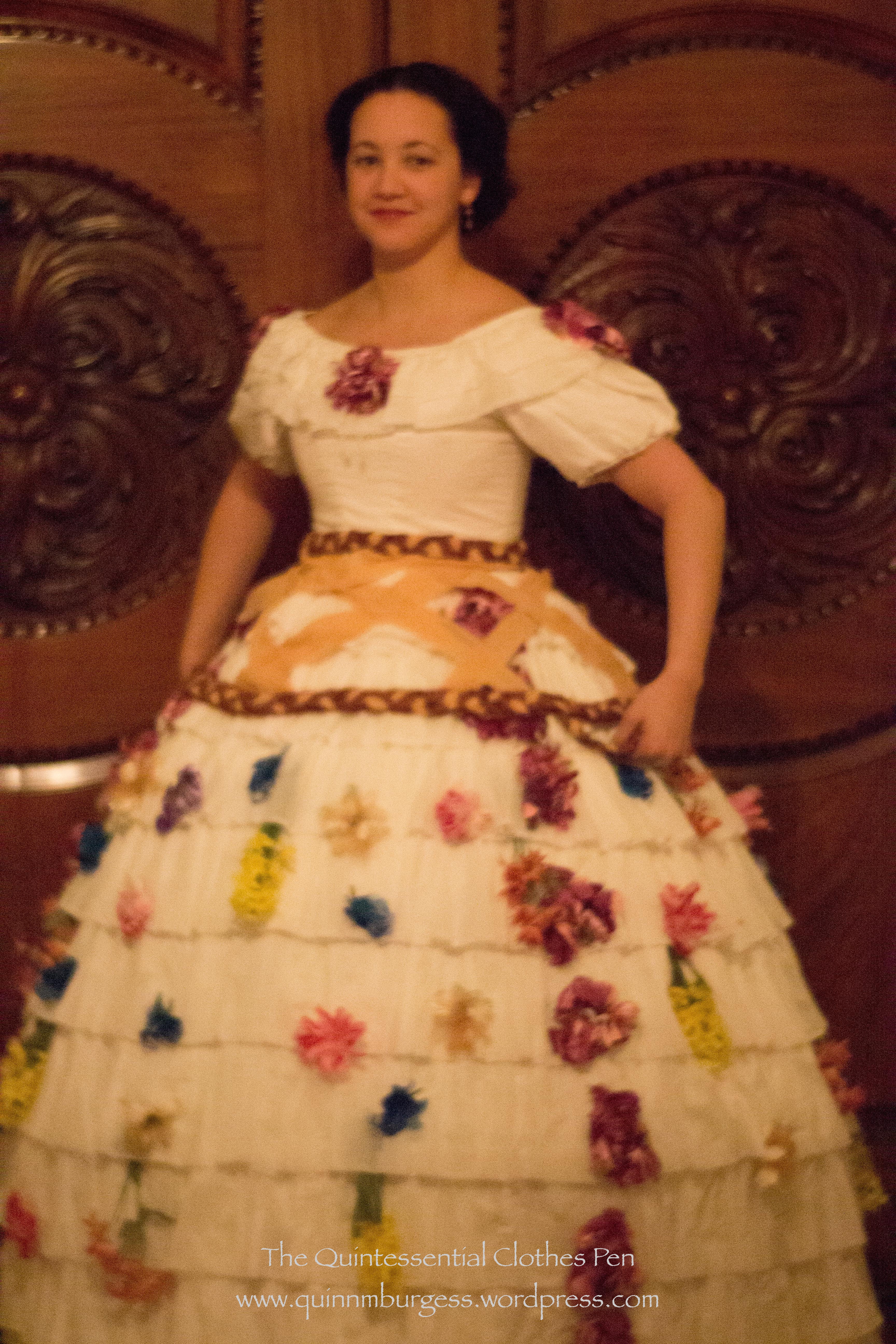
A few weekends ago now, I went to an event at The Down Town Association in New York. It was an event out of my usual ordinary line of events and so I took the opportunity to create something out of the ordinary to wear. The title of the post rather gives it away… but I only had a week to put my outfit together!

20493f96d0c4b86b724418e53a1d9f25
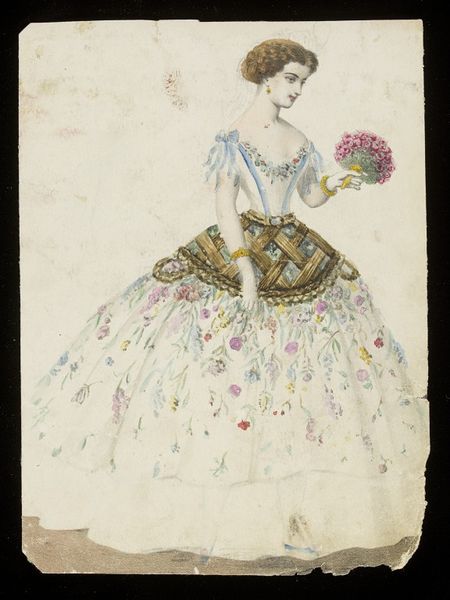
Flower Basket, 1860s. This design was created by Jules Helleu or Léon Sault, possibly for Charles Frederick Worth.

Using this image as my inspiration, I determined that I needed to make a flower basket, but that I could use Annabelle as the base for the floral dress. I also wanted to use only items from my stash, thus limiting my options a little bit. So I spent my weeknights creating a fabric basket that fit over my hoops and then furiously pinned flowers to my skirt the day we were leaving for New York in the hopes that they would look good and at least a little like my inspiration image…

IMG_2154
(What does a flower basket do with her hands without a bouquet?)

In the end, I enjoyed my flower basket very much, but didn’t like the fact that my furious pinning job didn’t really achieve the cascading flower look I was going for and that Annabelle’s pre-existing flowers were rather heavier looking than I had hoped, also contributing to the lack of cascading flower look. Maybe someday I’ll try again with the same basket and a different, or differently modified dress, but it was fun to do something different even if the results were not as great as I hoped for.

IMG_0622
I like the basket when you don’t see the skirt flowers.
IMG_0618
(Maybe a flower basket holds her handles?)

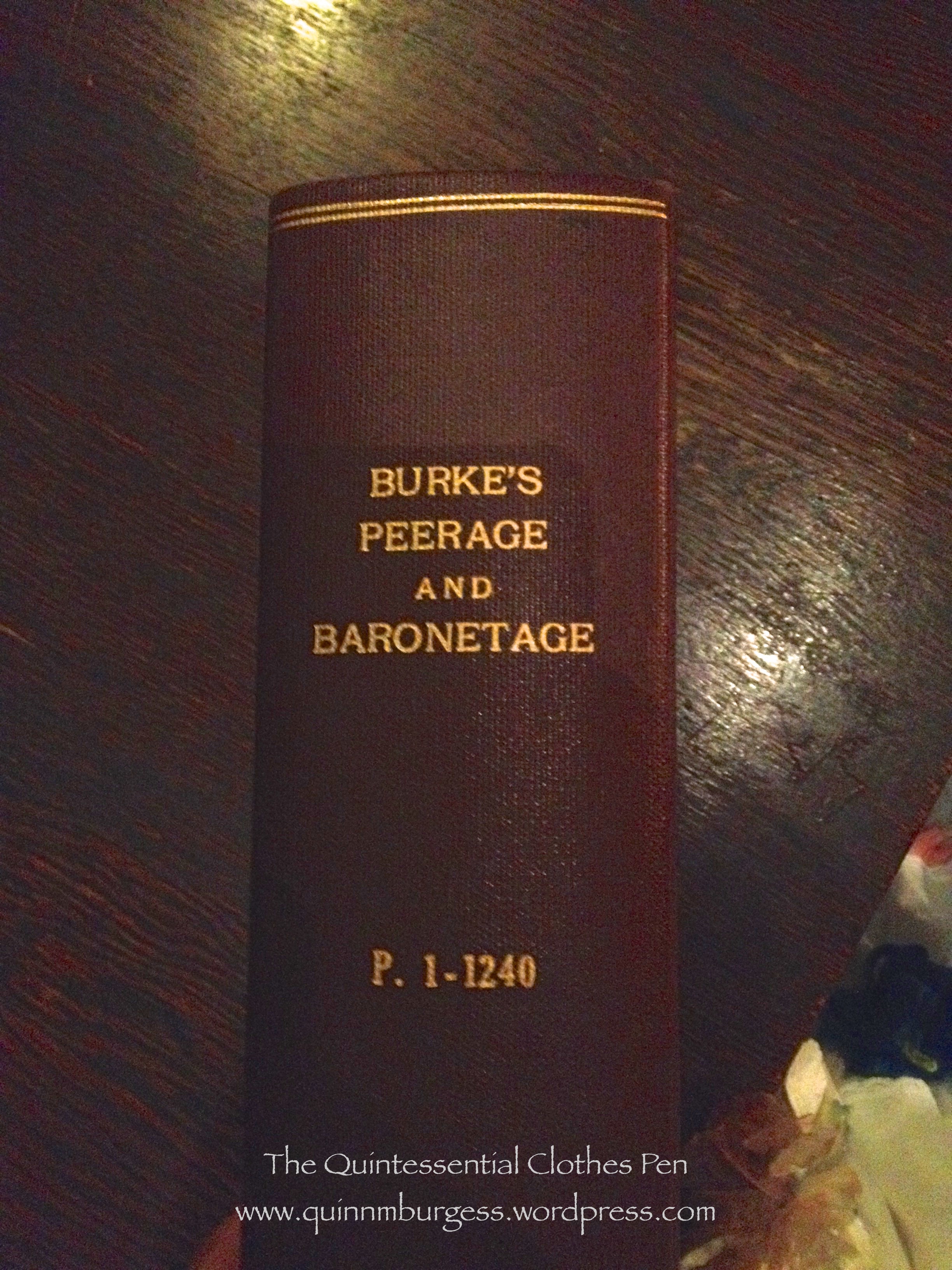
As I mentioned, this event was held at The Down Town Association in New York, which was established in 1860 (perfect for my fancy dress!). As far as I can tell the association is still housed in the same building they’ve been in since 1860. It was quite lovely inside, with detailed architecture and beautiful rooms. One room was a library full of a rather random collection of books. I enjoy perusing books and so proceeded to examine the titles closely. And guess what I found? A volume of Burke’s Peerage and Baronetage from 1912!

This excited me quite a bit, not only because it was from 1912, but I think also because it reminded me of Persuasion, in which Mr. Elliot is described as putting Burke’s Peerage in a position of honor in his estimation of important things in the world. Regardless, I got distracted and insisted that I needed to take pictures and look through.

IMG_2122 2

IMG_2124 1

IMG_2131 1

IMG_2130 2

IMG_0604
Here I am, reading Burke’s Peerage!

Burke’s Peerage certainly is an undertaking, and this volume only covered the alphabet through letter L! Unfortunately, I didn’t spot a second volume in the library, but I hope it’s there somewhere.

HSF #13: Cotton Print Evening Bodice For Georgina

A few months ago, I had a master plan to use the leftover yardage from Georgina, my 1858 cotton print day dress, to make an evening bodice in addition to her current day bodice for versatility and washability. Luckily, I was able to complete the bodice and a new hair crescent before my life exploded in June and I was smothered under an immense amount of work. I am pleased to have work, don’t get me wrong, but I was so exhausted by the end of the month all I could do was sleep and be disoriented! I’ve just come back from a vacation and feel like I can peer out from under my rock and join the world again! So, to celebrate constructing historic clothing for myself rather than other people, here is a post about a really neat addition to my historic wardrobe! And it fits into the current HSF challenge #13: Under $10, a bonus since the HSF challenges haven’t lined up very well with a lot of my projects this year.

9357
c. 1855 new evening bodice, with previously constructed skirt. Worn with all the usual underpinnings (chemise, my new corset, drawers, stockings, hoops, and petticoat) and accessorized with gloves, fan, earrings, and a new hair crescent. Oh, and I’m wearing burgundy velvet shoes! No picture of that, though.

Fabric: Reproduction mid-19th century cotton print, also used for a day bodice, and plain white cotton.

Pattern: I began with Past Patterns #701 but altered it extensively to fit me, to have pleats and gathers on the exterior, and to have an evening neckline. The sleeve pattern was drafted by me.

Year: c. 1855

Notions: Thread, plastic wire ties for boning, hooks and eyes, and cotton cording.

How historically accurate?: Based off of historic examples, constructed with accurate details… I think the only compromise is the plastic boning, which I used because I didn’t have the right length in metal, and because plastic is easily washable (and I want this to be a garment that can be washed easily–that’s part of the goal in having a cotton evening bodice!).

Hours to complete: I have no idea… 32 hours maybe? I really didn’t keep track at all on this project.

First worn: To a mid-19th century ball in June (one of the few moments of respite in my crazy month).

Total cost: About $3 for approximately 1 yard of historic cotton print and a lot of stash materials, which count as free, since I have no idea what I paid for them at this point! Let’s call the total about $8.

IMG_0951 (1 of 1)
Inside of the bodice.

As you know, I like things to be tidy. All of the seam allowances are either hidden between the layers of fabric or nicely finished. There are plastic bones in the darts and the side seams. The bodice is machine sewn and hand finished. (One amusing mistake is that I cut the lining with a center front opening for fitting purposes (and left lots of seam allowance, as you can see) but then forgot to leave seam allowance in the back… So the lining doesn’t extend all the way to the folded edge of the print, but it’s all covered up so no one will ever know and it fits just fine… it’s just one of those amusing things!)

IMG_0953 (1 of 1)
From the back with the right side flipped open.

The bodice closes with hooks and bars. I wanted to use metal bars but make sure they wouldn’t been seen, so I let about ¼” of the print extend past the points of the hooks to create an overlap. I also left extra print extended past the bars, in addition to all the seam allowance, in case I want or need to adjust the size of the bodice in the future. The bars are especially hard to spot on the print, but if you look carefully on the left you can see them. The neck and armsceyes both have very narrow cording.

9347
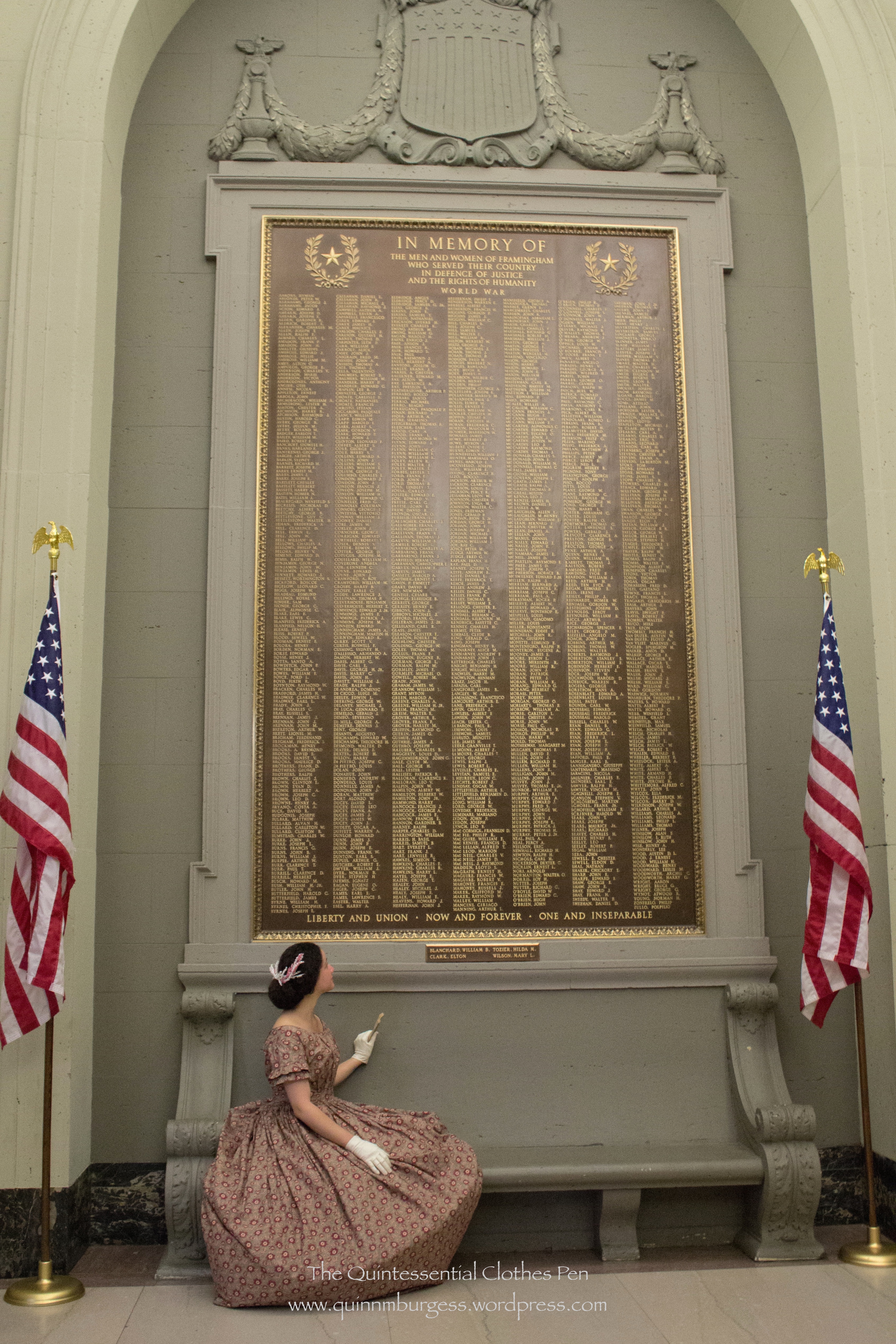
Appreciating those who have served our country. The ball was held in a local town hall which had lists for all the 20th century wars. I don’t think they have 19the century war plaques, but we thought it was a nice photo opportunity.

I had very specific inspiration for this dress, since you don’t see too many cotton ball gown bodices. Here the specific examples which I referenced: sheer white bodice, sheer peach bodice, blue and white striped bodice, yellow and white bodice, floral print bodice, and purple print bodice (this last has a matching separate pelerine shown worn over the bodice, but the “off the shoulder neckline” in the description tells us that underneath is an evening bodice).

The defining design details were obviously the low neck and short sleeves, but there were other common details as well, such as double puffs or pleats to trim the sleeves, tubular sleeves without very much fullness at the top or bottom, 1.5″-2″ waistbands sitting on the outside of the skirt waistband, and gathered or pleated fullness on the fronts and backs (no darts on any of these cotton bodices). Some of the bodices have a yoke around the top so that only the bottom portion of the bodice is gathered, but this look says “young girl” not “grown woman” to me, so I opted for a bodice without a yoke.

In terms of construction, to have enough fabric in the print for the pleats and gathers on the print fabric, I first constructed and fit the lining. Then I separated one side of the lining to use as a pattern and added width to have space for the pleats I had planned. Once I had cut the print, I reassembled the lining and mounted the pleated print on top. From there on I treated the two layers as one.

9359
Bodice closeup and a nice view of my successful 1850s round hair style!

As I’ve looked at 1850s images and fashion plates in comparison to early 1860s, especially, what I’ve noticed is that the 1850s really attempted to make a woman’s head look round or wide, whereas by the early 1860s the styles begin to grown upward and become vertically elongated. Here are some great examples of the round 1850s hair look: from 1851-53, c. 1855,  from 1857, another 1857, yet another 1857, one more from 1857, and one from 1859. Here’s a super wide 1850s style and here is an example of the different shape of the early 1860s. The very round shape is what I was attempting to complement my 1850s bodice.

How? Well, I put gel right at the roots of my hair while it was still wet and then encouraged it to stand up from my head rather than being pulled back. I let it dry like that and it stayed all day. Later in the day, I styled it for my 1940s Anne Adams dress photos by brushing it out (and brushing my hair when it’s dry makes it big!!!). There was lots of added hair spray for that style, so when I went to restyle it there was plenty of fullness and air in my hair.  I puffed the fronts and pinned them up and behind my ears then did a big roll with the rest.

The finishing touch was a new hair crescent that I made specifically to complement the colors in the cotton print. The crescent is made up of fully wired millinery flowers in ivory, some of which I dyed to be pinkish. Each extension is a singular stem and I just twisted them together until I liked the result. Lastly, I sewed a hair comb in the center to help attach it to my head and stabilize the wires. Each side also has a bobby pin to secure it to my head so the extended bits don’t flap around while I’m dancing.

9360
Back view, and new hair crescent.

I’m super pleased with the end result: the bodice, the hair style, and the hair crescent! Oh, and the pictures (thanks!). And I had a marvelous time at the ball–it was one of the class of events which makes me feel radiant and at which I really enjoy myself (compared to those when I’m grumpy and grouchy at the world). And all the smiling and dancing gave me a lovely natural rosy glow in the pictures. The aloof face is my attempt at a 19th century portrait face (it took a long time to capture a picture then, which is my rationale for why everyone has a generally serious face!). You had to pick something you could keep still for a long time, and a big smile is hard to maintain without movement or looking staged.

A Floral Headband For Annabelle (Returning Heroes Ball 2014)

Not too long ago, I was again able to be part of the annual Returning Heroes Ball hosted by The Commonwealth Vintage Dancers. I decided to wear Annabelle again this year, even though I’d worn her last year, because I’d just worn Evie and Belle at the 1860s Dance Weekend in November.

IMG_7853
Annabelle at Returning Heroes Ball 2014.

Each time I’ve worn Annabelle, I’ve been slightly disappointed with the various incarnations of flower hair wreaths I’ve attempted to match her: the first wreath and the giant mass of flowers. So this year I decided to try again to see if I could get something I like. There are quite a number of evening dresses decorated with flowers right about 1860 and many of them are depicted in fashion plates and portraits with matching flowers in the hair. Here are some examples: 1859 fashion plate, another 1859 fashion plate, a third 1859 fashion plate, 1861 fashion plate, 1861 portrait, 1862 fashion plate, and 1863 fashion plate. For this new incarnation, I decided to try a different style from what I have for my other two evening dresses (Belle has a crescent and Evie has a hair wreath).  The style I settled on I’m calling a headband. It creates a halo around the face and extends down towards the ears, but does not connect across the back of the head. Instead, the hair must be interestingly arranged to fill in the back of the head. Here’s an example of the headband style using flowers that match the dress from 1862. And here is the fashion plate that Annabelle is based on which shows a headband style hair wreath worn with the dress.

IMG_7827
Here is Annabelle’s new floral headband. 
IMG_7953
Back view of my hair style. I needed something dramatic to fill in the base of my head. I wanted to do a sideways oval surrounded by rolls, but that didn’t work out and this is what I ended up with. I was dubious at first, but I think it worked. (It’s hard to see, but there’s one big central roll/puff and one smaller one above and below that.)

In addition to my new headband, I was also able to wear my new ca. 1860 corset and my still rather new purple paste jewels (a matching collet necklace and drop earrings) from Dames a la Mode. They worked wonderfully with my outfit (of course, I did pick the purple knowing it would match multiple outfits…!) and I enjoyed wearing them again.

The ball was lovely, as usual, and filled with well dressed people and more uniformed gentlemen than we have seen in recent years. The dancing was well executed and the intermission boasted a lavish spread of refreshments that both looked and tasted scrumptious.

IMG_7809
Bowers, during the Grand March.
IMG_7930
Bowing at the end of a polka.
IMG_7848
One small portion of the refreshments table.
IMG_7937
Looking lovely and dashing.

You can see more pictures of the event at Raven’s Plaid Petticoats blog post about Returning Heroes.

1860s Dance Weekend: Part II, Sunday

This is part two of a series of posts about a recent 1860s dance weekend hosted by The Commonwealth Vintage Dancers. The first post, which was about the Saturday of the weekend can be viewed here. This post is about the second day, Sunday. Unfortunately, we didn’t take as many pictures of dancing on Sunday as we did on Saturday. We did, however, continue our tradition of taking lots of pictures of us not dancing, but doing other things. So you’ll just have to humor me during this post filled with a little bit of dancing and a larger proportion of other things.

Before I get started on pictures of dresses and dancing, I’m going to share a few pictures of the building the event was held in, so you can get a sense of the atmosphere. Think cold New England winter… blue sky and a cold breeze… no leaves left on the trees…

IMG_7372
One of the lovely tall windows reflecting the slightly cloudy blue sky, with leafless branches joining the scene.
IMG_7376
Looking through bare trees at the lovely windows of the hall.
IMG_7375
I’m sort of cheating here. This pictures is from Saturday, when we were in a hall next door to the one pictured above. But I just loved the berries on the bare tree and the very New England style window and building behind them!

Now that you’ve got a sense of the venue, let’s proceed to the ball:

IMG_6619
Sewing a friend into her dress. I include this because it is an excellent shot of my hair!

I tried to do something different than my usual 1860s style for this ball, and I must say that I like the results. The more you try out different hair styles, the easier they become! I’d brought my curling iron and I wanted to make use of it for this ball. (I have naturally curly hair, so it’s quite ironic when I use a curling iron. My curls are quite frizzy, a bit wild, and untamed rather than cork screw like, so the curling iron acts as a taming agent.) In the end I had two curls, one hanging on either side of my head. I wouldn’t do this for every ball, but it worked well with the amount of crazy bling I had and with the heavy quality of my dress.

IMG_6798
See? Crazy borrowed bling! (The necklace is much more sparkly in person than in pictures!) I was quite dazzling, or blinding, depending on your perspective.

Anyway, in addition to the curls, I did my usual poofy side roll on either side of my center part. I tried to be imaginative in the back but ran out of time. It’s hard to remember now, but I’m pretty sure I braided the back section and made a bun  with the braid. Or perhaps I wrapped my braid around a bun that was made with the ends of the poofy side rolls. Either way, there was a bun and a braid. My Belle hair crescent was mounted over the result. I rather like that it was a little higher on my head than in previous wearings. It was a little more visible from the front.

As you can see, I wore Belle. She was my first historic dress, ever. I wore her more often when I first began vintage dancing a few years ago, but I got a little tired of wearing her and so she’s been living in my closet for over a year. She’s super heavy, which I remembered, but I hadn’t remembered that the weight of the skirt pushed my hoops into an awkward diagonal elliptical shape. I have a bum pad that fixes the problem, but since I’ve been wearing Evie so much and she doesn’t need it I’d forgotten to bring it! Oh well. It was exciting to bring Belle out again, and though I’m not the same size I was about 7 years ago when I made her, she still fits and is still stunning.

Here are some dancing shots from the ball:

IMG_6665

IMG_6695

IMG_6708

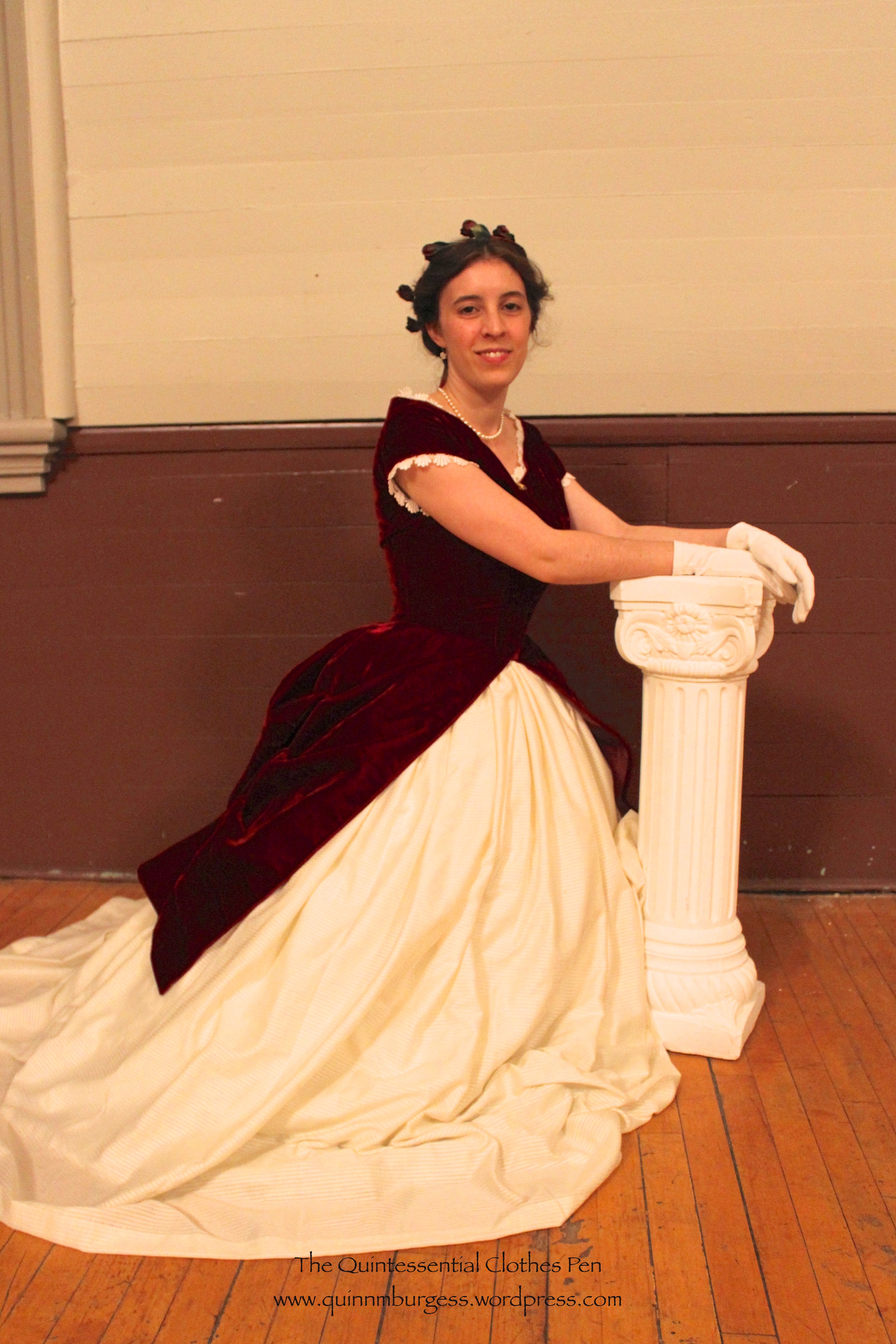
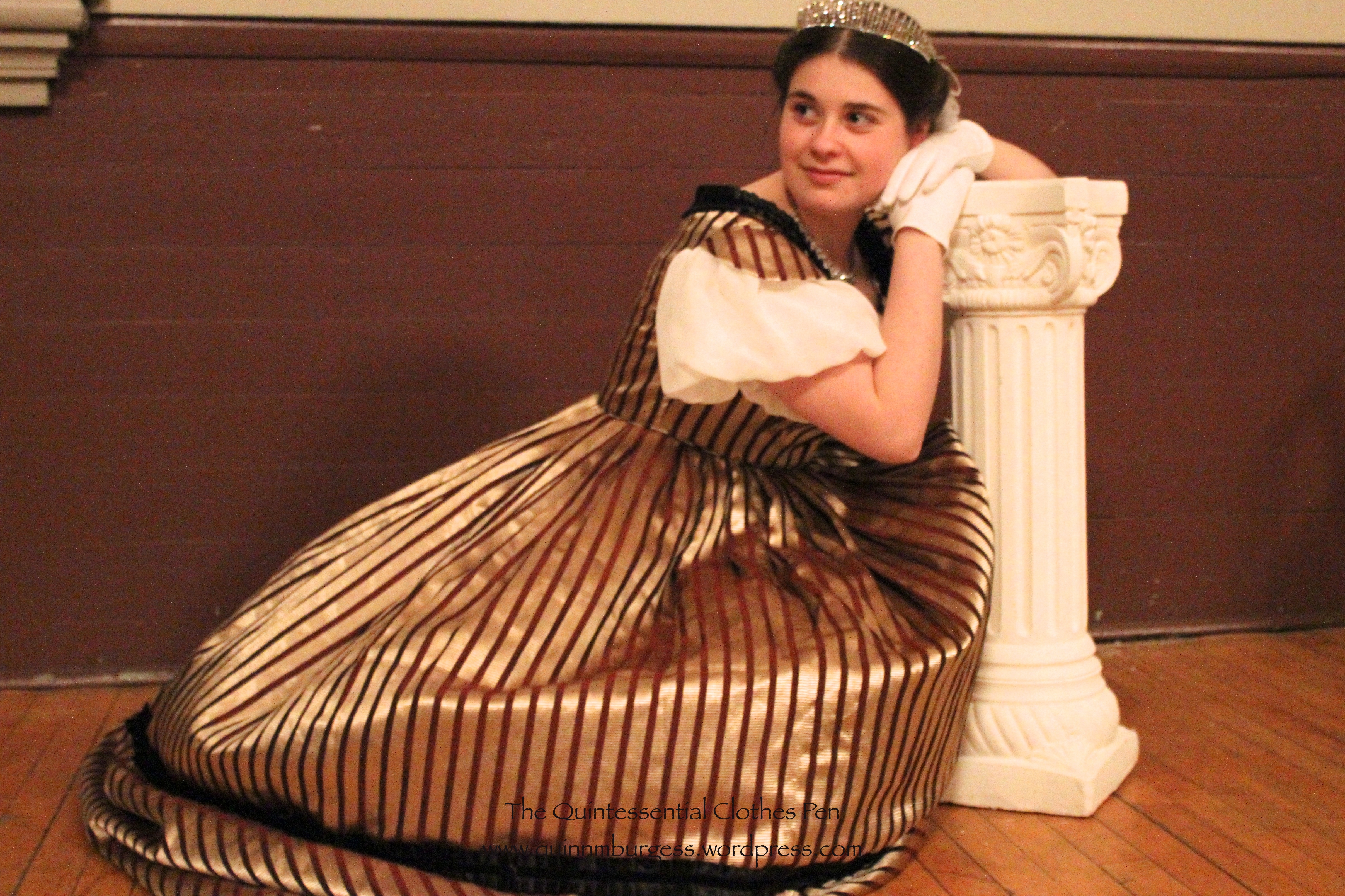
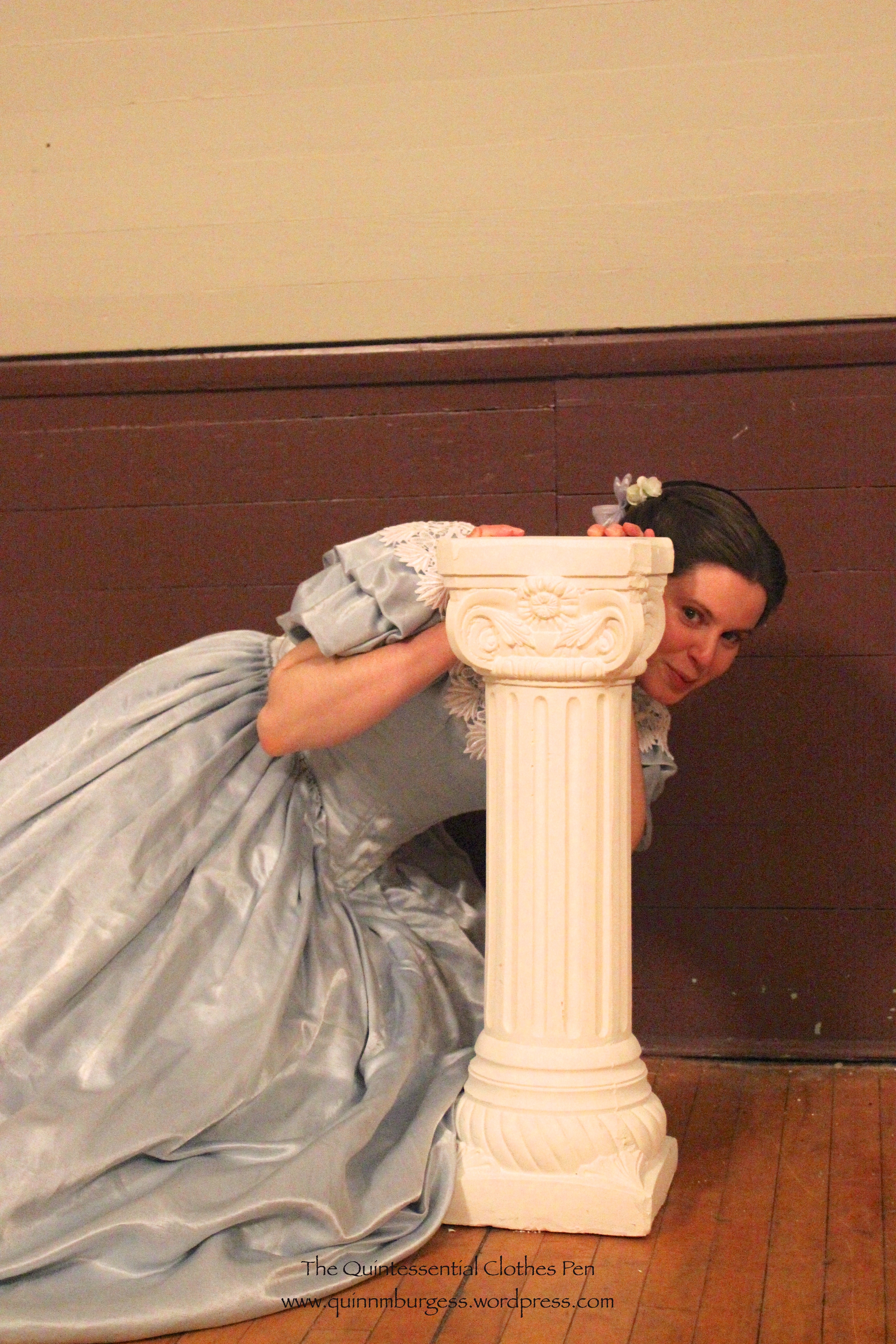
After the ball we took some more not dancing photos. Our prop for the night was a rather short column. And so I present to you a series of column shots:

IMG_6820

IMG_6802

IMG_6835

IMG_6860

IMG_6840

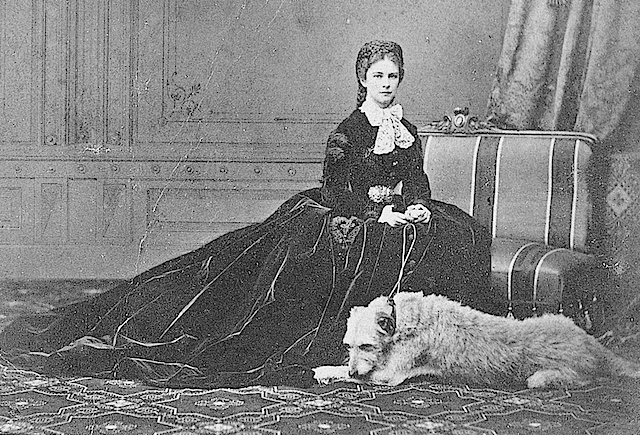
This is my end of the weekend “I’m tired” pose. I love how my tiers fan out and create an elongated effect. It’s quite regal! (The heavy fabric flowing across the floor reminds me of the image below of Sissi–Empress Elisabeth of Austria.)

82ebec13a5b1628c811b5637a04537b7
1867 Sissi in famous pose with her dog ‘Shadow’ by Emil Rabending

Well, there you have it. An 1860s dance weekend. I do hope you enjoyed it!

1860s Dance Weekend: Part I, Saturday

December is going to be a whirlwind of HSF posts and posts about events, so I need to hurry up and get started by sharing pictures of an event that actually happened in November but which I haven’t shared pictures of yet. The event was a 1860s Intensive Dance Weekend, hosted by the Commonwealth Vintage Dancers, featuring two days of dance classes, two evening balls, and a German (an after ball party of fun dance games). I’ve got lots of pictures, so I’m going to split this up into two posts. In today’s post, I’ll share pictures of the Saturday of the dance weekend and Part II will be pictures of the Sunday of the dance weekend.

IMG_5809
Taking some photos before the ball.
IMG_5814
I wore Evie. This is a nice photo of the bodice with recently added sleeve trim.
IMG_5849
Plaid dresses!
IMG_5864
Something exciting was being said, though I don’t remember what! This is good proof, though, that my Evie hair wreath does often take on a very green hue in contrast to the sometimes gold-ish brown that it looks in pictures.
IMG_5874
In lines, dancing Le Tourbillion.
IMG_5977
Dancing in a large circle. This is either Spanish Dance or Soldier’s Joy. I always get them confused since they start out similarly!
IMG_6022
Lines of ladies and gentlemen dancing Gothic Dance.
IMG_6117
Ladies passing under the “Gothic” arches!
IMG_6266
Wondering what this odd scene is? This is one of the dance games in the German. You’ll have to forgive me for not remembering the names of them. In this one, a lady sat in the chair with a mirror and cloth. She could see the gentleman standing behind her in the mirror. She would wipe the mirror to dismiss them until she found one she wanted to dance with.
IMG_6282
In this dance game, the lady presented one of the two gentlemen with a glass of “wine.” She then danced with the other gentleman.
IMG_6351
For this dance game, the gentlemen were blindfolded (I was dancing as a gentleman…). We all stood in a circle with ladies in between gentlemen and then would begin to give hands, right then left, around the circle. Because the gentlemen were blindfolded the ladies had to be sure to catch their hands to keep them from wandering out of the circle. At the sound of a whistle, you would dance with the person whose hand you were holding. Something must have been mixed up, because two of us blindfolded “gentlemen” wound up dancing together, to the great amusement of all onlookers. Lucky for us we’re both proficient waltzers, and being blindfolded isn’t much of a challenge. People were quite impressed and amused.
IMG_6294
Another dance game, with 5 each of ribbons, ladies, and gentlemen. Once the center of the ribbon was released each person found the person holding the other end of their ribbon and danced with them.
IMG_6397
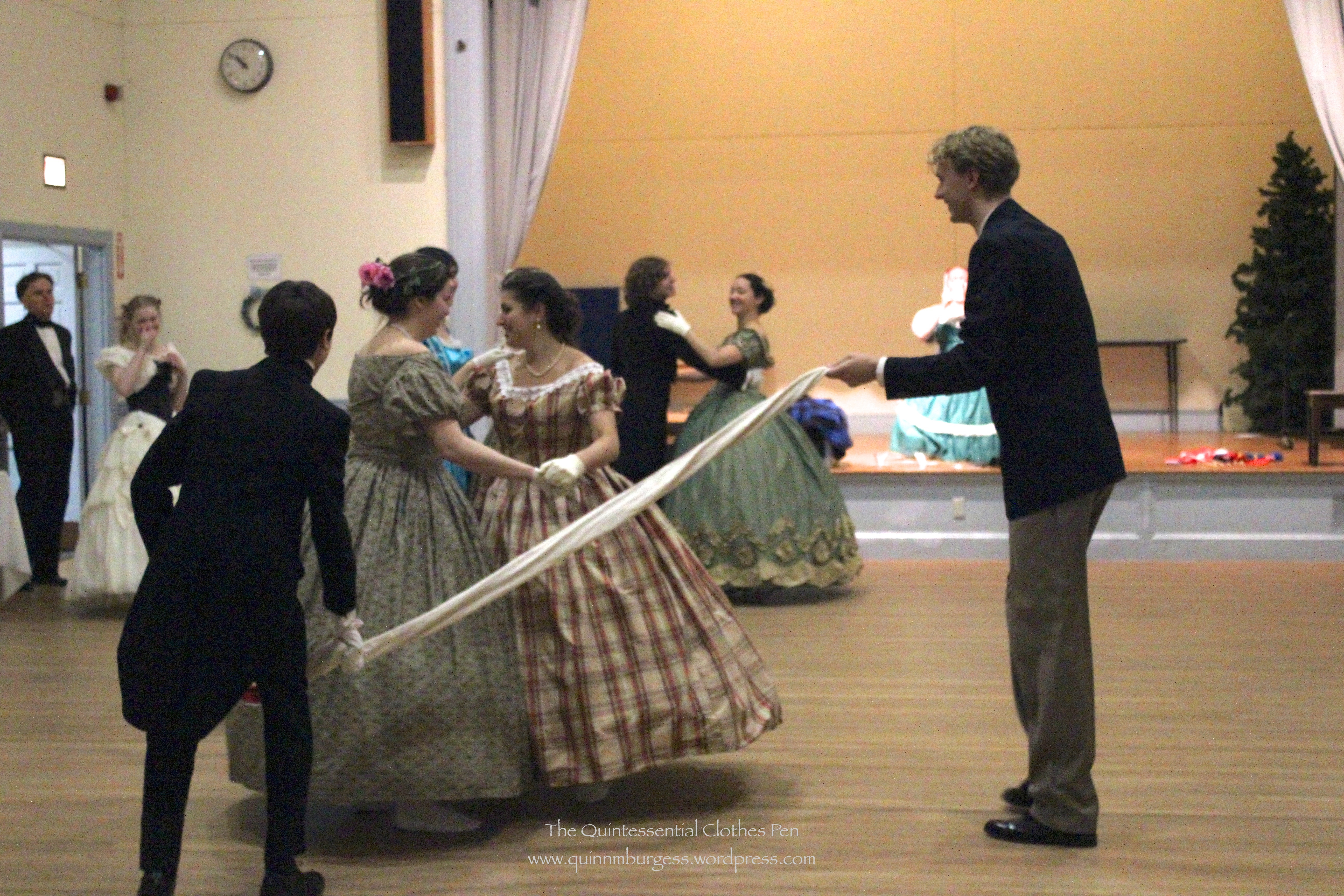
This dance game involves two people trying to capture one of the dancing couples in the sash. When they’ve caught someone they switch around so different people are the ones holding the sash. The people dancing have to try to dance away from capture.
IMG_6508
It’s hard to see, but the couple with the plaid dress is holding a top hat. The object of this dance game is for the second couple to dance close enough to the couple with the top hat to drop a glove into it. When that happens then the couple with glove becomes the couple with the hat. Only dancing, not running, is allowed to elude the couple with the glove.

All in all a fun and energetic day and night of dancing, especially with the German that was directly after the ball. I hope you enjoyed these.

HSF #21: Trim For Evie In Time For A Ball

I’m taking a quick break from the 1950s adventure posts to insert my HSF #21 post into the mix. More 1950s coming soon!

It’s been on my sewing list for a few months to add a bit more trim to the sleeves of Evie, my most recent Civil War era dress, but I’ve been working on knitting my sweater and completing other projects, like my 1822 Walking Dress, so I hadn’t really been inspired to complete the trim. However, the Commonwealth Vintage Dancers were asked to run a ball as part of recent Civil War reenactments in Worcester, MA, and that gave me the perfect incentive to finish up trimming Evie! She also happens to be green, so this is my entry for the HSF Challenge #21: Green.

Oh yes, I forgot I had some other minor changes to make to Evie since I last wore her in March as well. Boring things, like changing out the boning at center back, and enlarging the armsceye a bit under the arm, and adding hooks and bars to connect the bodice to the skirt. I got all those things done, too, though they don’t get their own photographs. I really like the added trim. It gives the bodice a little bit more interest and helps balance out the immense skirt.

IMG_4987 - Version 2
Here is Evie, with her new sleeve trim.
IMG_4988
Another view. The sleeve trim is a smaller scale version of the trim on the skirt.
IMG_4988 - Version 2
A cropped version of the picture above. I can’t decide which way I like it better, so I’m including both.
IMG_0138
And here is what the bodice of Evie looked like before I added the sleeve trim.

Most of the trim on this dress is based on two images I discussed in this previous post: a fashion plate from 1864 and a costume made by Tirelli Costumi. The sleeve trim is based off of yet a third inspiration source: the painting, below, of Princess Helena in the Royal Collection. It’s perfect that it’s from 1864, just like my inspiration fashion plate. It’s even better that it echoes the bertha trim I already had and the zig zag on my skirt.

b5e346822ebb9589dd64aca144479f35
This is a copy by William Corden (1819-1900) of the portrait of Princess Helena by Albert Graefle (RCIN 403988). The original was painted for Princess Helena as a birthday present for Queen Victoria on 24 May 1864. Princess Helena (1846-1923), nicknamed Lenchen, was the fifth child and third daughter of Queen Victoria and Prince Albert. She was lively, outspoken and something of a tomboy. In 1866, two years after this portrait was painted, she married Prince Christian of Schleswig Holstein and in 1916 they celebrated their Golden Wedding anniversary; she was the only child of Queen Victoria to do so. Queen Victoria recorded in her Journal that ‘Lenchen’s picture by Graefle, is extremely good & pretty’.

Now, the facts:

Fabric: small bits of leftover gold silk shantung and green silk taffeta from the construction of the dress.

Pattern: none.

Year: 1864.

Notions: only thread.

How historically accurate?: Well, shantung is not accurate, but silk is (and this doesn’t look very shantung-y). I give this trim a 98% on accuracy.

Hours to complete: 4? All hand sewn.

First worn: With the new trim, on October 11, to a Civil War ball.

Total cost: $0, because it’s leftovers!

Now for the bonus part of this post where I include pictures from the Civil War ball.

IMG_4993
The entrance to the building had these fabulous doors.
IMG_4991
Each section looked like this.
IMG_4941
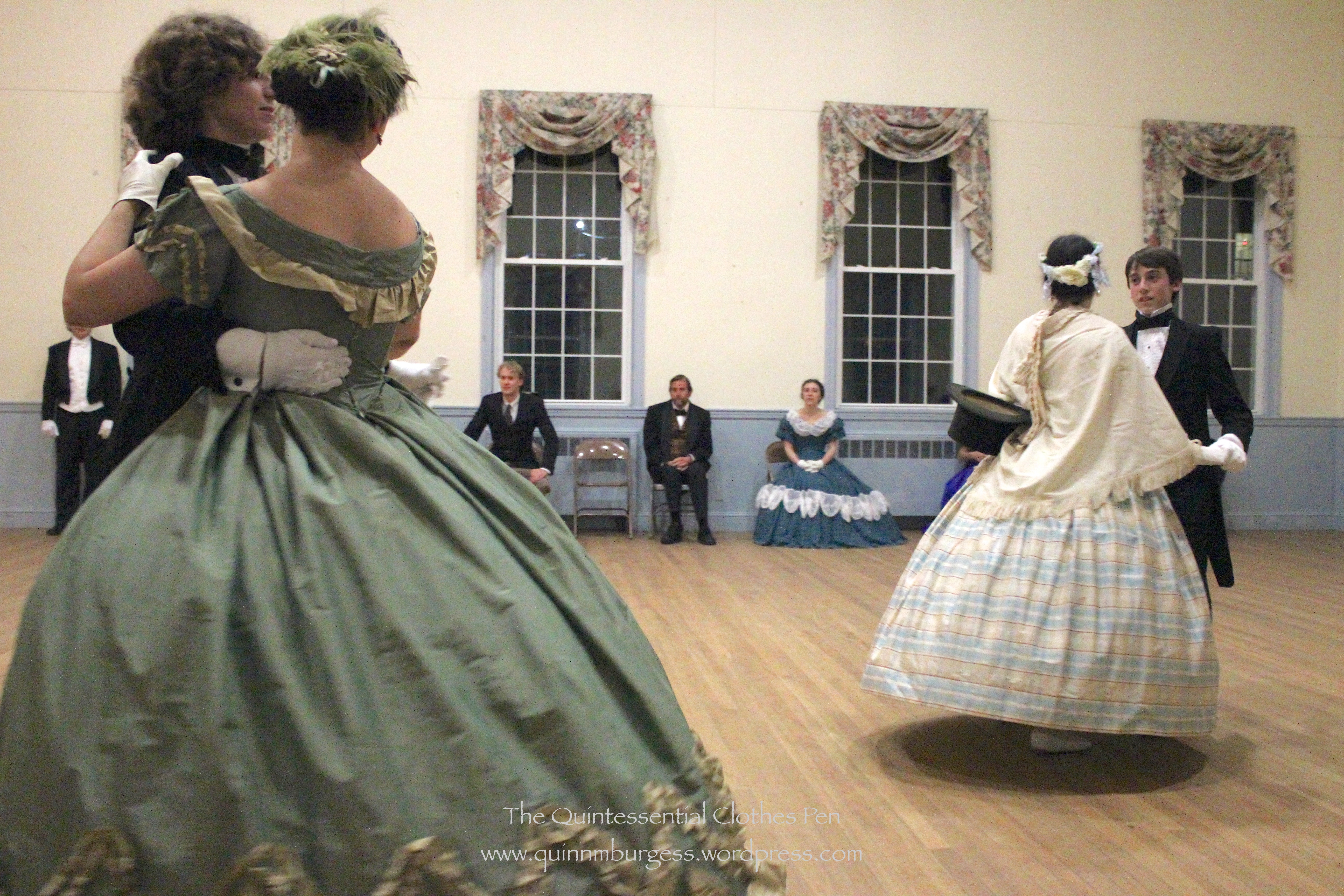
Dancing a waltz.
IMG_4934
Swinging skirts are fun!
IMG_4943
People looked very nice.
IMG_4946
And it was nice to see unfamiliar faces and meet new people.
IMG_4947
There was a constant swishing sound of skirts brushing against one another.
IMG_4961
The Commonwealth Vintage Dancers interspersed short performances throughout the evening.
IMG_4964
This is the Triplet Galop Quadrille.
IMG_4955
The ball room had large, dark, seriously-faced portraits around the perimeter. I’m not sure they approved of all the dancing!
IMG_4954
There were also Civil War era flags that the reenactors had brought to help decorate the room. And here’s a full length shot of Evie with her new sleeve trim.

I had a lovely time. This ball was nicely different than our usual evening balls with all the new faces. My senses were most struck by the abundance of rather more sturdy and thick wools worn by the military gentlemen than I am used to feeling at most balls, when there are more gentlemen in smoother wool tailcoats. The occasional feel of the thicker wool on my left arm was a tangible, and rather transporting, connection to the past. It seems quite likely that at a ball held during the Civil War a lady would have felt more thick wool on uniformed gentlemen than she might have felt at a ball pre or post war when there would have been more civilian tailcoats at a ball.

Have I inspired you to want to learn 1860s dancing and attend a ball? I’ll end with this small encouragement for your attendance at the Commonwealth Vintage Dancers’ next Civil War events. The Commonwealth Vintage Dancers have a Civil War Dance Weekend coming up in November, 2013. It’s super reasonably priced and includes lots of dance classes, two balls, and a German. There’s no experience necessary. If you’re at all interested and in the New England area you should check it out, because we’re doing lots of awesome Civil War dancing in 2014 as well (they are listed at the bottom of the Civil War Dance Weekend link, above), and why not get started learning or brushing up sooner rather than later? I’d love to see you there!