1933 Dress & Hat In Green & Gold (HSM #10)

The summer was incredibly busy and the things I was making unfortunately didn’t fit into the HSM challenges, but I’m hoping to get back to it for the end of the year. In that spirit, I finished a dress that qualifies for the HSM Challenge #10: Out Of Your Comfort Zone. I’m a bit late posting about it because it took me two tries to have a successful photo shoot and then a bit of time to edit my photos, but nevertheless, the dress was completed within the deadline. It qualifies in that I’m expanding into 1930s daywear with the making of this dress.

Unlike some garments I make which have a specific wearing in mind, this was different in that I was trying the idea out to see if this 1933 shape would be flattering on me. I do like the silhouette a lot and so hopefully I’ll make more similar dresses in the future. The years right around 1933 are a great mix of awfully silly, with their big neck frills/bows and unusual sleeves, and wonderfully elegant, with long hems that look especially flattering on those of us blessed with height.

The inspiration for this dress came from looking through many books of 1930s clothing. I wanted to try out the longer length bias skirt and I liked the bust spray detail I found along the way in 1930s Fashion: The Definitive Sourcebook (page 308). It’s not as crazy as some early 1930s neck frills, making it a good starting point for getting into this decade. (Look at these examples of neck bows from 1934, for example. They make my dress look subdued.) I did add some interesting sleeves though, based on a 1933 pattern for different sleeve types.

As I mentioned, I did two photo shoots for this dress. The first one failed pretty horribly, as I was out in public, pressed for time, and my phone camera wasn’t cooperating with me. But the second photo shoot was much more successful! It may have taken over 300 photos to get ones that I like, but because I was using a timer with burst photos on my camera I could run back and forth across my yard to my heart’s content, practicing all my best dramatic poses and facial expressions. Unfortunately, my phone camera isn’t outstanding enough to have taken great photos with the slanting afternoon sunlight. I’m calling it ‘artsy.’ (What I really need is an event to wear this to in a good-picture-background-setting, so that I can get better quality pictures…)

Anyway, here are the facts (just for the dress, as the hat doesn’t really qualify for the HSM):

Fabric: Green and gold small windowpane mystery (but likely polyester) fabric and gold silk scraps.

Pattern: My own. I draped the bodice and skirt pieces and referenced images to flat pattern the sleeves.

Year: 1933.

Notions: Thread, zipper, hooks, and hug snug.

How historically accurate is it?: Let’s say 95%. It’s entirely recognizable in its own time and made in a way that is straightforward and consistent with historic garments. The materials are not 100% accurate.

Hours to complete: 5-10 sounds likely, although I spread making this out over about a year, so it’s pretty hard to remember!

First worn: October 2017, for pictures.

Total cost: $1/yard for the fabric and all the notions from the stash, so let’s say $4. Win!

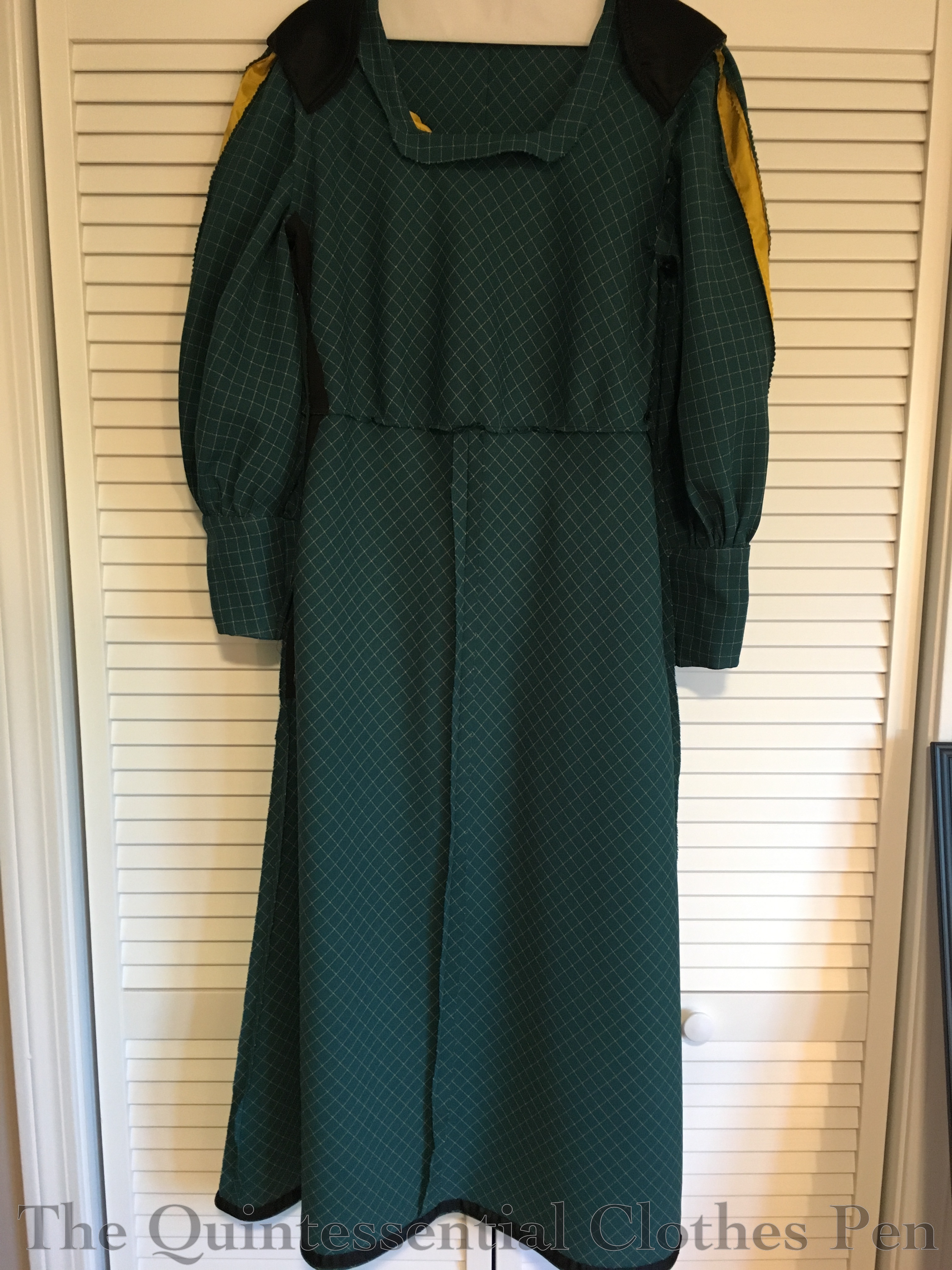
The back of the dress is pretty plain. All the interesting details are on the front. But here it is, for the sake of documenting all of the angles.

On the inside, the dress looks like this. The seam allowances are either left raw if they are on the bias or pinked if they are on the straight of grain. The neck is finished with a facing which is tacked in place. There are moderate shoulder pads to help achieve the correct silhouette. The bottom edge is finished with hug snug and an invisible hem. The dress closes on the side with a hand sewn zipper. There is a self fabric belt as well.
Now for a bit about my hat and hairstyle. First, the hat is a remake of a wool velour hat I purchased for $5 at a theatre sale. It was a bowler shape originally. I cut off the brim, cut down the crown, reattached the two, and then took some tucks in the crown to give it a more unique shape.
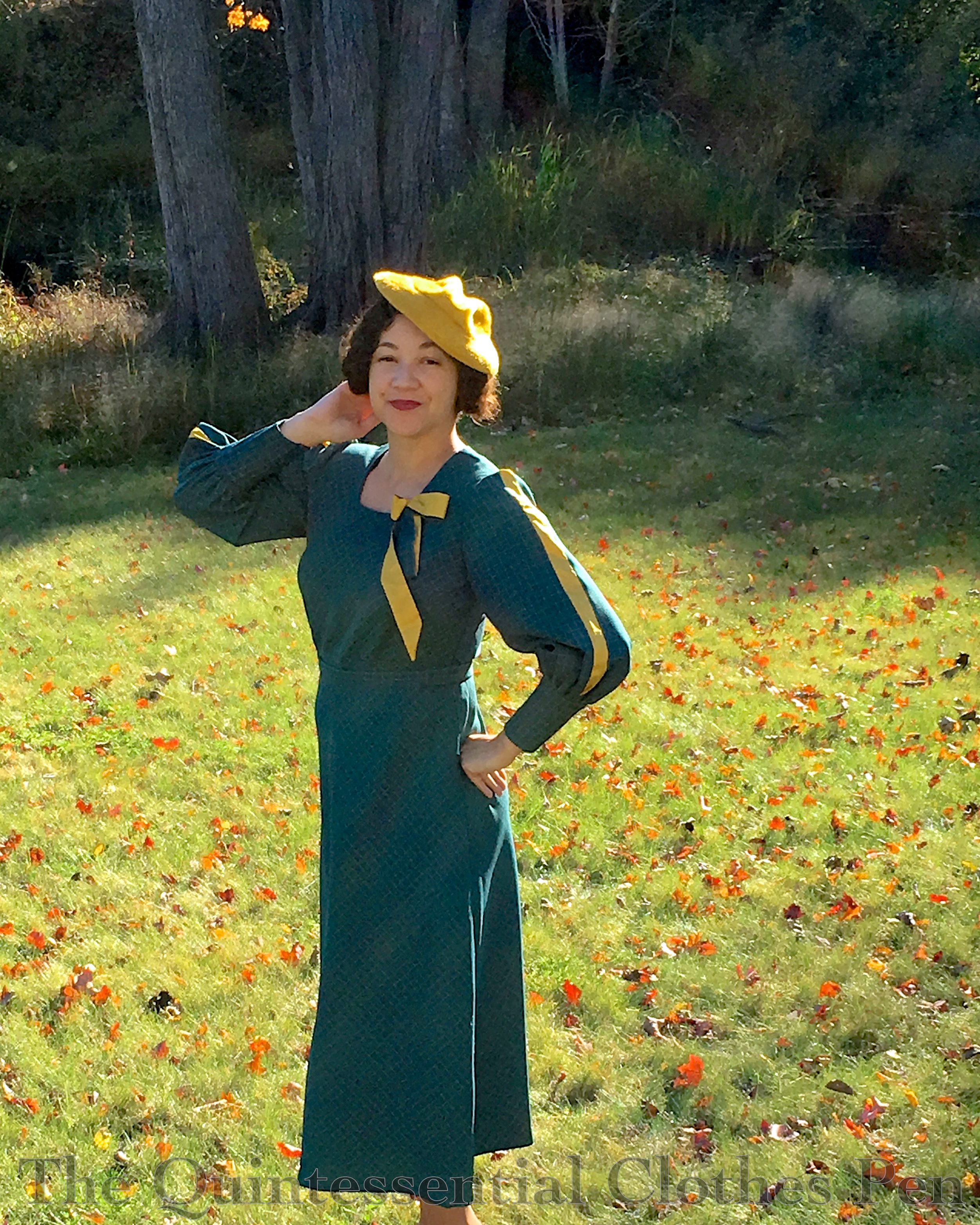
Hair-style-wise, I was going to do my usual close to my head 1920s/30s style (I explained and documented it in this past post) but it didn’t seem to compliment my hat, so I decided to try a more down around the chin, lightly curled bob style.

My method for this is as follows: I started with wet hair and a bit of Tigi Small Talk. I parted my hair on the side and added wave clips (3 on the longer side and 1 on the shorter side). Then I braided the rest of my hair to keep it damp while the front dried. A few hours later, I removed the wave clips and ran my fingers through the front sections to loosen them up a bit. To create the chin length look, I looped up large sections of my hair and pinned them to the top of my head. The hat hid all the pinned up bits nicely. My hair has much less volume when it’s damp (and even after it’s dried in a not-voluminous way if I don’t touch it at all), so the chin length curls had a nice close to the head look to them.

I’m pretty pleased with this hairstyle. It will definitely get tried out again someday. The outfit is fun, too! I love that the hat matches perfectly and ties the whole thing together. Plus, it reminds me of autumn, my favorite season.

SaveSave

1930s Beach Ensemble

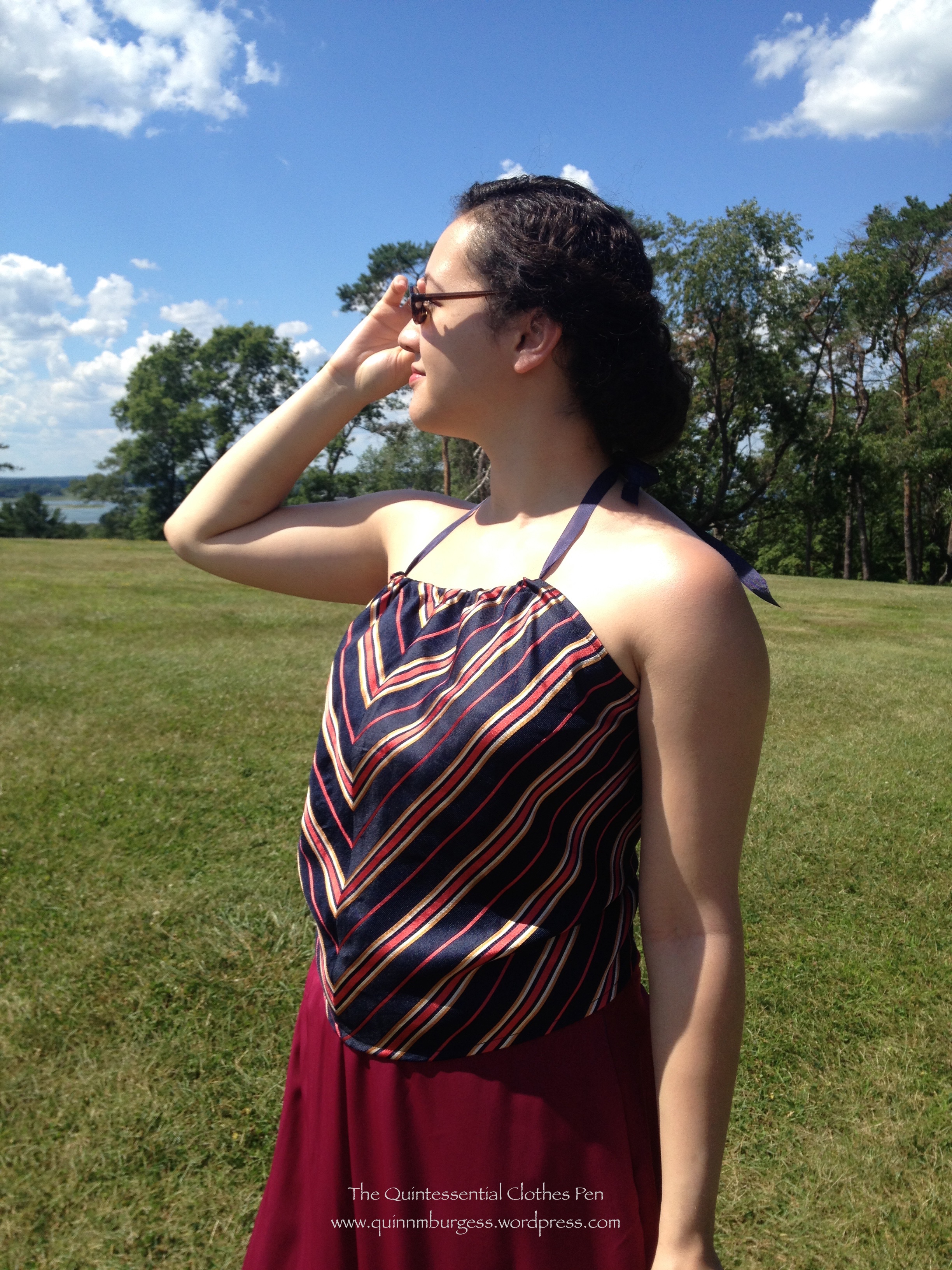
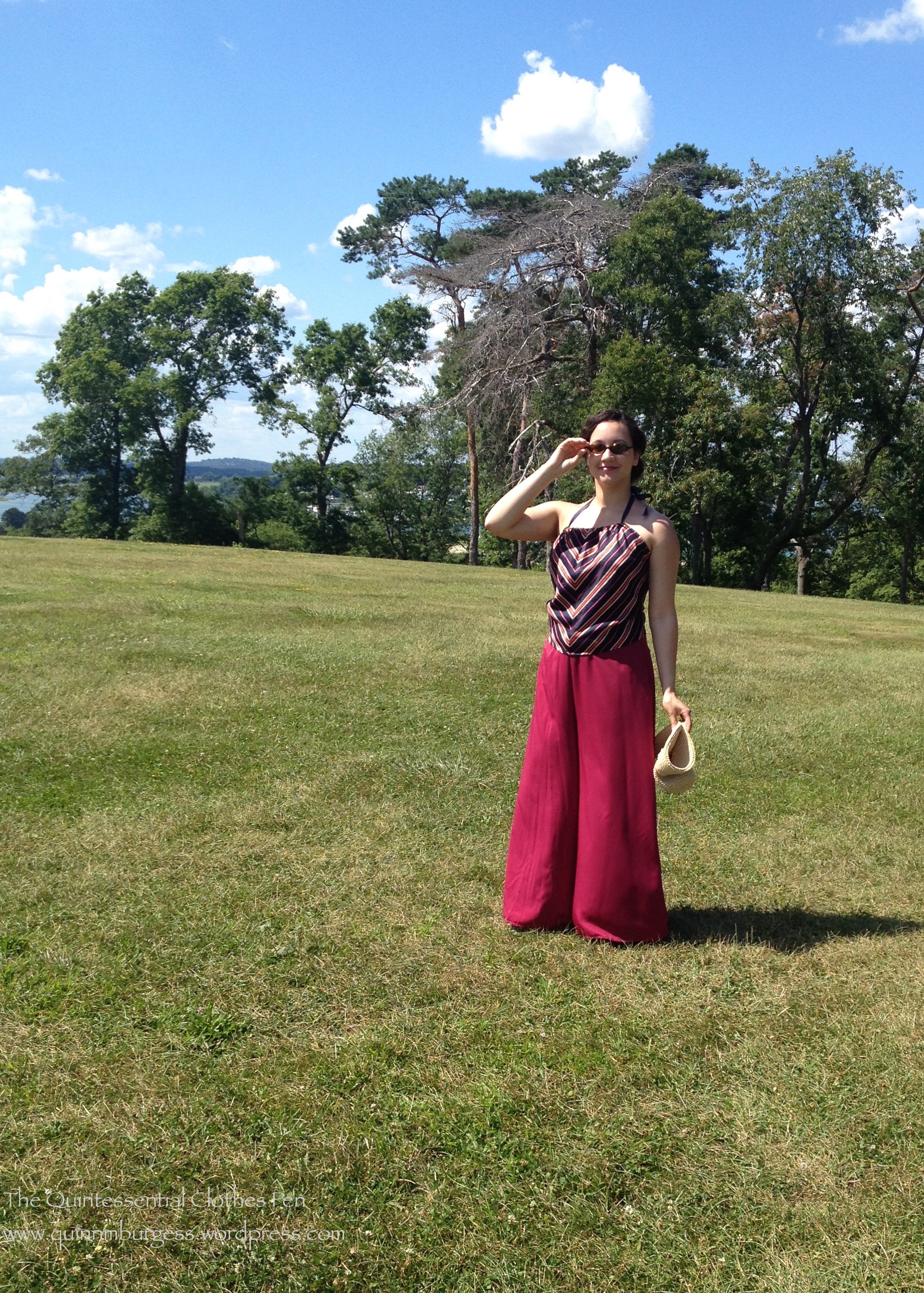
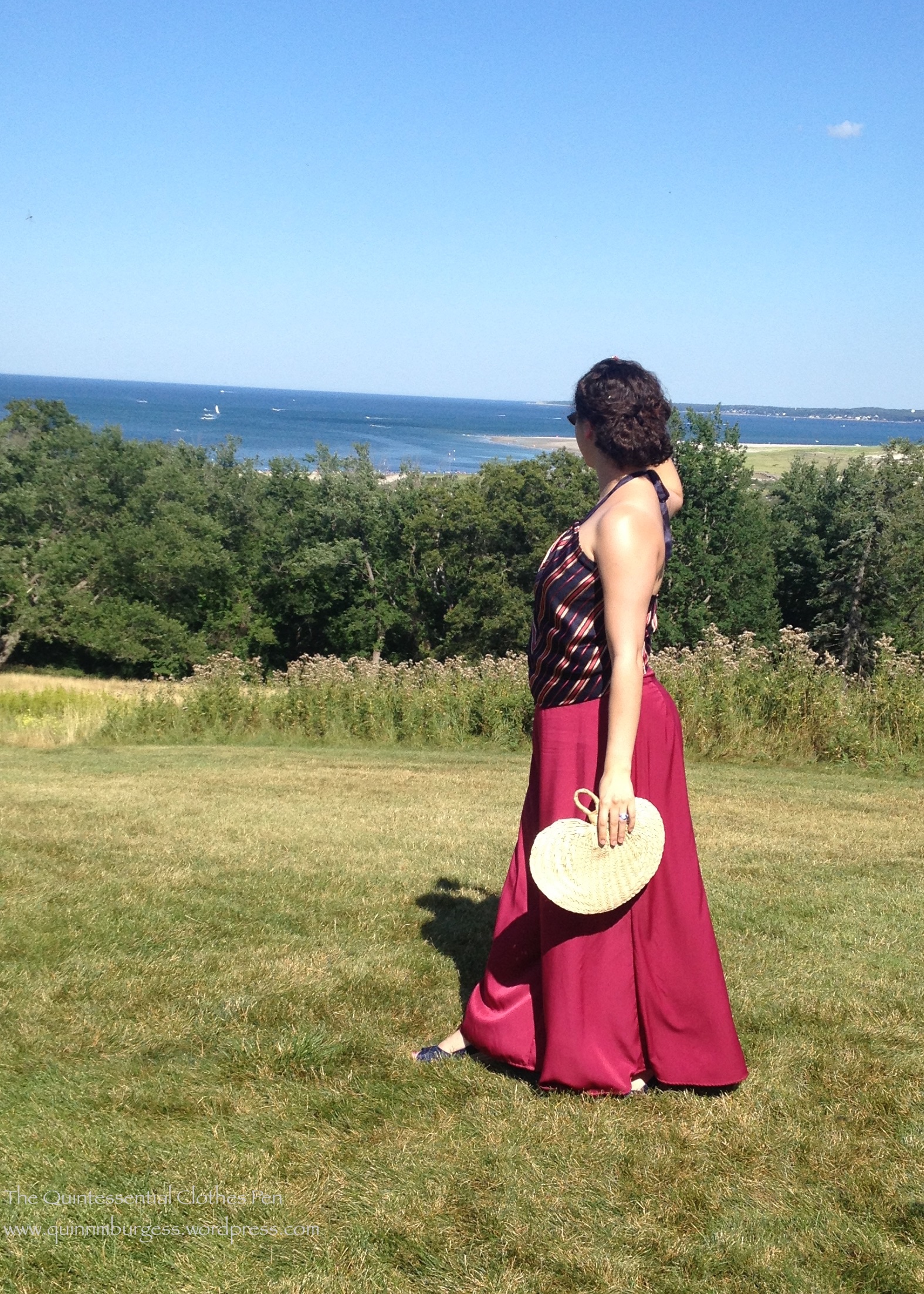
In August, I attended the 1920s Crane Estate Lawn Party again for it’s 3rd year. The last two years I’ve worn dresses (my 1926 sailor dress and my 1922 blouse, hat, and parasol ensemble), but this year I had hoped to go to the beach prior to the lawn party and I really wanted a more beachy ensemble than a dress. It was also on my to-do list to make a 1930s beach ensemble, so I bent the time period of the lawn party a bit and decided to make and wear a new 1930s beach ensemble despite not actually making it to the beach.

It was a super hot day, unfortunately, so I spent a lot of time huddled under an umbrella in the direct sun before we got smart and moved to the shade. Before we hunkered down to avoid the sun I did get some good pictures, though! My hair turned out very well–I’m quite pleased with it, though I can’t remember what I did to get it to look like that!

IMG_2658

unnamed

The halter was made using Leimomi’s tutorial “How to make a 1930s style handkerchief halter top“. I used an old striped silk twill fabric remnant rather than a handkerchief, so I had to finish my edges, but I also had to piece the fabric to get the right beginning square rather than rectangle shape. I also made my square a bit bigger than a scarf’s dimensions so that my lower back would be totally covered by the halter. And I used hug snug for my tie, because it was all I had on hand that matched. The halter was pinned around my body to a comfortable point on each side.

IMG_2647
Front.
IMG_2649
Back.
Colorized-early-30s-postcard-of-fashionable-beach-pyjama-wearing-holiday-ers-on-the-Cote-DAzure-2
My inspiration: one of the images that Leimomi includes in her tutorial post (just like the lady in the middle, I decided to make my center front seam decorative and do a chevron–it makes me very happy!). Beach pyjamas on the Cote D’Azure, colourized postcard, 1930s
IMG_2443
Cutting and piecing to get the chevron.

The pants I drafted myself. They’re actually based on the same pattern I made my dotty tap pants from, adjusted to have a waistband, full length legs, and much more fullness in the width of the legs! The pants close with an invisible side zip. They are constructed from soft washed crepe-like polyester fabric that is super comfy to wear while lounging around on picnic blankets. And bonus, both of these fabrics have been in my stash for years: the stripe for about 7 or 8 years and the pants fabric for about 4 years. Free, and yay for using up stash fabrics!

IMG_2645

IMG_2642

IMG_2651

There are more very fun examples of wide leg beach pajamas on my 1930s Sportswear Pinterest page. I’m looking forward to finding other opportunities to wear these again and hopefully getting pictures of them on a beach at some point!

Cute Claremonts!

claremont-1930s-suede-oxford-brown-2
1930s Claremonts from American Duchess

Lauren of American Duchess just keeps rolling out lovely new shoe styles! This most recent one is super cute and tempting! There have been hints that black and maroon might be coming in the future so I’m going to hold out for those. Because how awesome would these be in maroon??? But don’t let me stop you from ordering the brown ones… they’re seriously tempting, right???

SaveSave

Patterned Stash Additions!

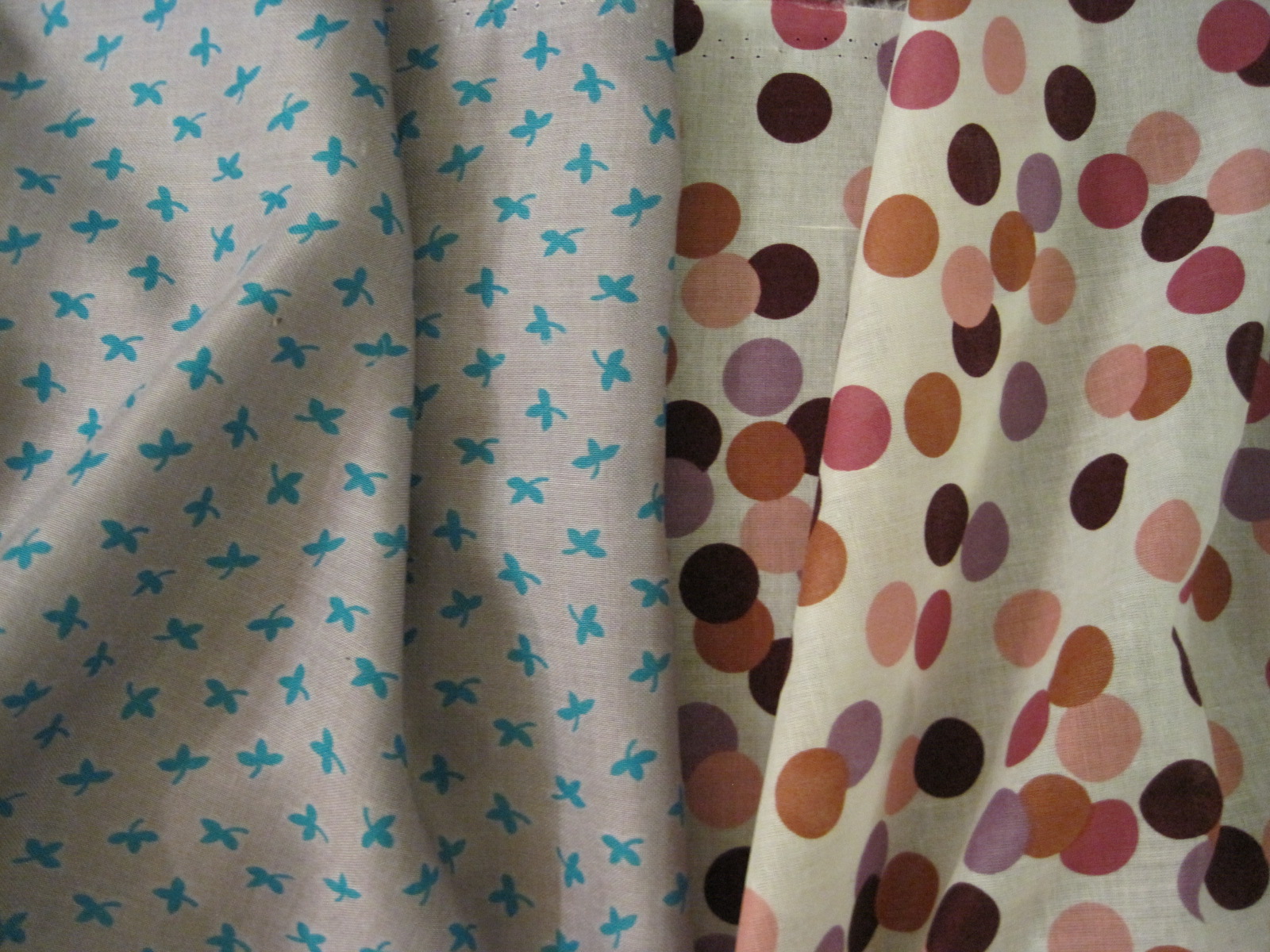
If you look at my clothes, modern and historic, you might notice that I usually wear solid colors. Yes, I do mix solid colors in outfits. But there it is: I hardly ever wear patterned fabric. I want to branch out a bit, at least in my historic wardrobe, so when I saw these patterned fabrics on sale I couldn’t resist.

IMG_4196

So here they are: my most recent stash additions. On the left, a rayon challis with a slightly lilac tinted grey background and little teal clovers all over. On the right, a super lightweight cotton lawn with dots in shades of purple and pinkish/redish/orange. What for? I’m thinking 1930s or 40s for the challis and a 50s summer dress for the lawn. I’m pushing the envelope, thinking outside my normal eras! Of course, these projects are pretty low on the list of things to get done… so don’t expect to see them again soon. But maybe this summer the 50s dress could be a fun project. We’ll see. In the meantime, I’ll know I have patterned fabric in my stash, and that’s enough for me!

Bolero jackets in the 20th century: 1930-1950

Evening Ensemble designed by Elsa Schiaparelli 1938

A few posts ago, we took a look at Bolero and Zouave jackets from the mid-19th century and Bolero jackets from the 20th century: 1900-1909. While I was looking at images related to those posts I found a few amusing boleros from the mid-20th century and decided to share those with you as well!

Let’s start here: with this evening ensemble designed by Elsa Shiaparelli at the Metropolitan Museum of Art. My first thought about this was something along the lines of the following: “The dress has a lovely shape. What’s the abstract embellishment on the bolero?”

Gymnast bolero designed by Elsa Schiaparelli 1938
Well, look carefully at the Bolero picture. It’s decorated with gymnasts!
Evening dress by Elsa Schiaparelli 1938

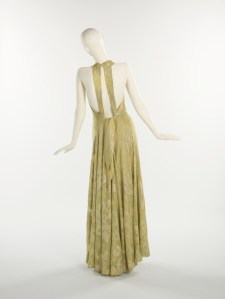
Here’s the back of the dress without the bolero over it. Such lovely lines. In the picture on the right, you can also see the texture of the dress fabric. It’s difficult to discern what it is. Looks to me like it might be a jacquard  or watermarked fabric. Do you have other ideas about what the fabric is?

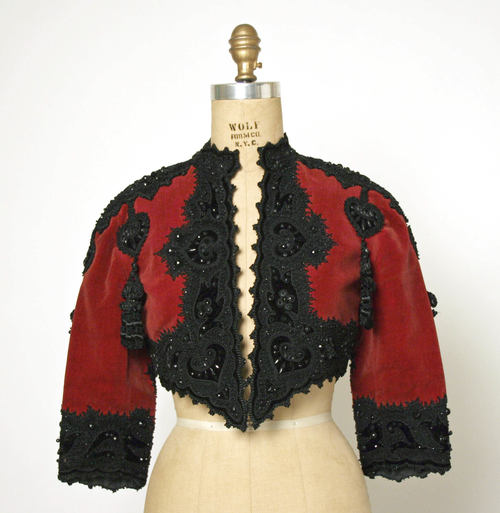
This next bolero was designed by Balenciaga in the 1940s. Its style is much more traditional than Schiaparelli’s gymnast bolero. The beading and other trimming on this Balenciaga bolero is exquisite!

Balenciaga Bolero 1946-1947
The Oxford English Dictionary includes these quotes regarding boleros in the definition. They are good context for the style and use of boleros in women’s clothing during the mid-20th century.
1941    ‘R. West’ Black Lamb I. 407   The boleros the women wore over their white linen blouses.
1968    J. Ironside Fashion Alphabet 35   Bolero, a short jacket reaching to the waist, worn open over a blouse‥sleeved or sleeveless‥worn by Spanish dancers and bullfighters.
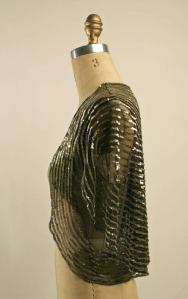
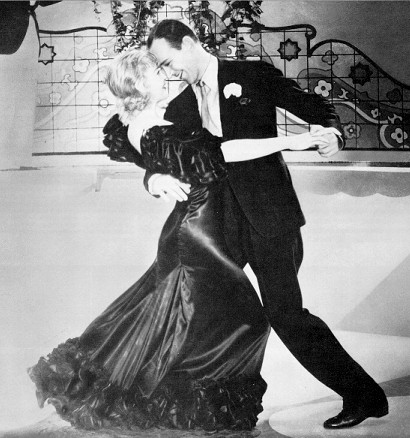
I’m including this final bolero just for fun. I can envision it with a slinky black bias-cut 1930s evening gown with a low cut back… It even has a matching belt! This bolero strongly reminds me of the style of Ginger Roger’s dresses in her videos with Fred Astaire. I’ve also included just a few fun pictures of Ginger’s fabulous dresses below so you can see her general style. Beautiful!
Evening Bolero 1933
Evening Bolero 1933
Belt to go with Bolero 1933
Top Hat 1935
Carefree 1938
Flying Down to Rio 1933