The Gibson Shoe!

The latest shoe from American Duchess: the Gibson.

S3701-01

Lauren has all sorts of cute shoes planned for 2013, so I’m pretty sure this is only the beginning of what will be more shoe posts this year. Aren’t these cute though? I’m trying to decide between black and brown… If you are at all interested, pre-order-time is the time to make your decision, because if Lauren doesn’t receive enough orders, the style (or certain colors) might be cancelled. And that would be  sad! You now have no excuse. At the very least you should go check them out

Product links in this post contain an affiliate code, which provides a small benefit to my shoe fund. This does not affect my impressions and reviews of this product.

SaveSave

Newport Vintage Dance Week Part III: Formal Tea on the Lawn at RWU

As I was in a bit of a hurry when I posted pictures of the Seaside Dance at Easton’s Beach, I failed to include some interesting information that I am going to include here, now! Other ladies in the fabulous young set at Newport maintain their own blogs and have also posted pictures of the Newport events with their own unique commentary. If you’re vicariously enjoying the fun of the week, I encourage you to check out their posts and extend your fun! #1: Antonia’s Experiments in EleganceSpeed Virginia Reel at Ochre Court,” for example; #2: Raven’s Plaid Petticoats “Project Newport,” for example; or #3: Barbara’s Recreating the Nineteenth Century BallroomThe White Ball at Rosecliff,” for example.

On this blog right now, however, we are going to continue the marathon of awesome-ness that was Newport and reminiscence about the Formal Tea on the Lawn at Roger Williams University. This event, being an afternoon event, did not have a specific time period, so you’ll see a variety of clothing styles. Here we go!

On our way to the official lawn for the tea, we stopped to take pictures here by the boats.
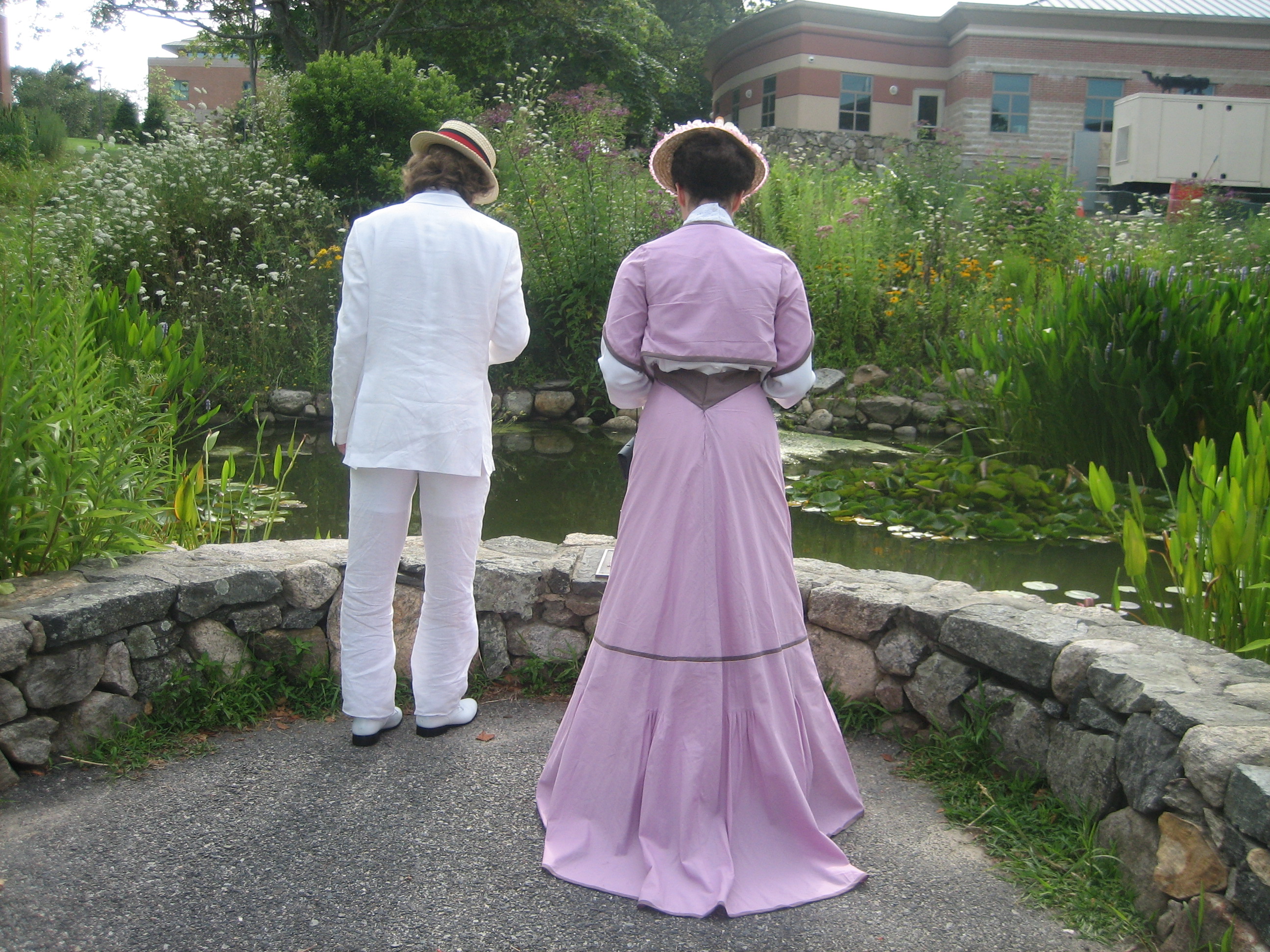
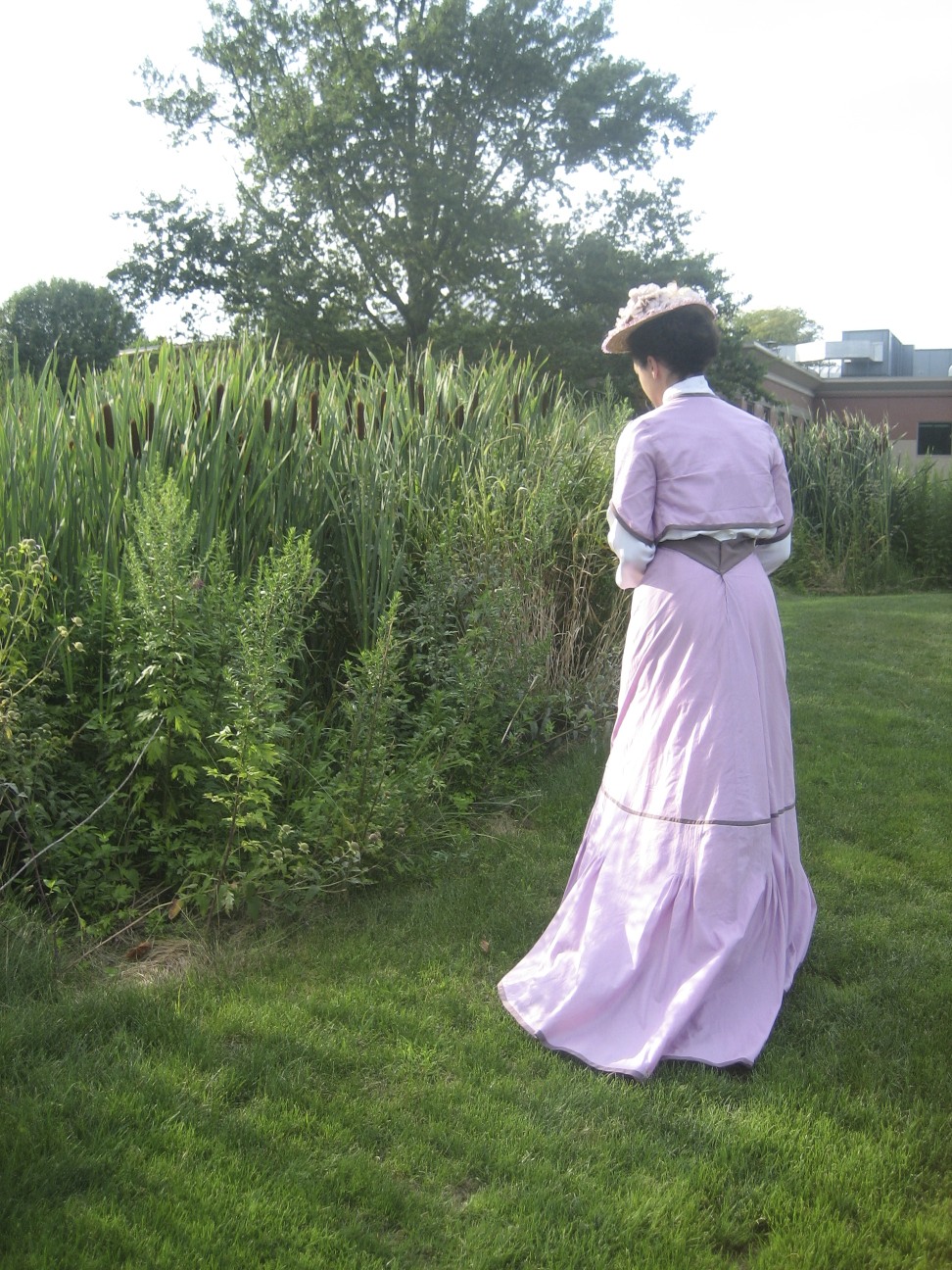
Here I am: 1903. The blouse was made last year and the skirt earlier this summer (though I haven’t posted about that yet…). The bolero and hat were additions to complete the look.
A side view. You can really see the silhouette.
It’s like Where’s Waldo. Can you spot one of our faithful photographers caught on camera? He blends in with the boats.
Another beautiful distraction before we even made it to tea.
I wish there weren’t modern buildings behind the pond… but there were fish in pond!
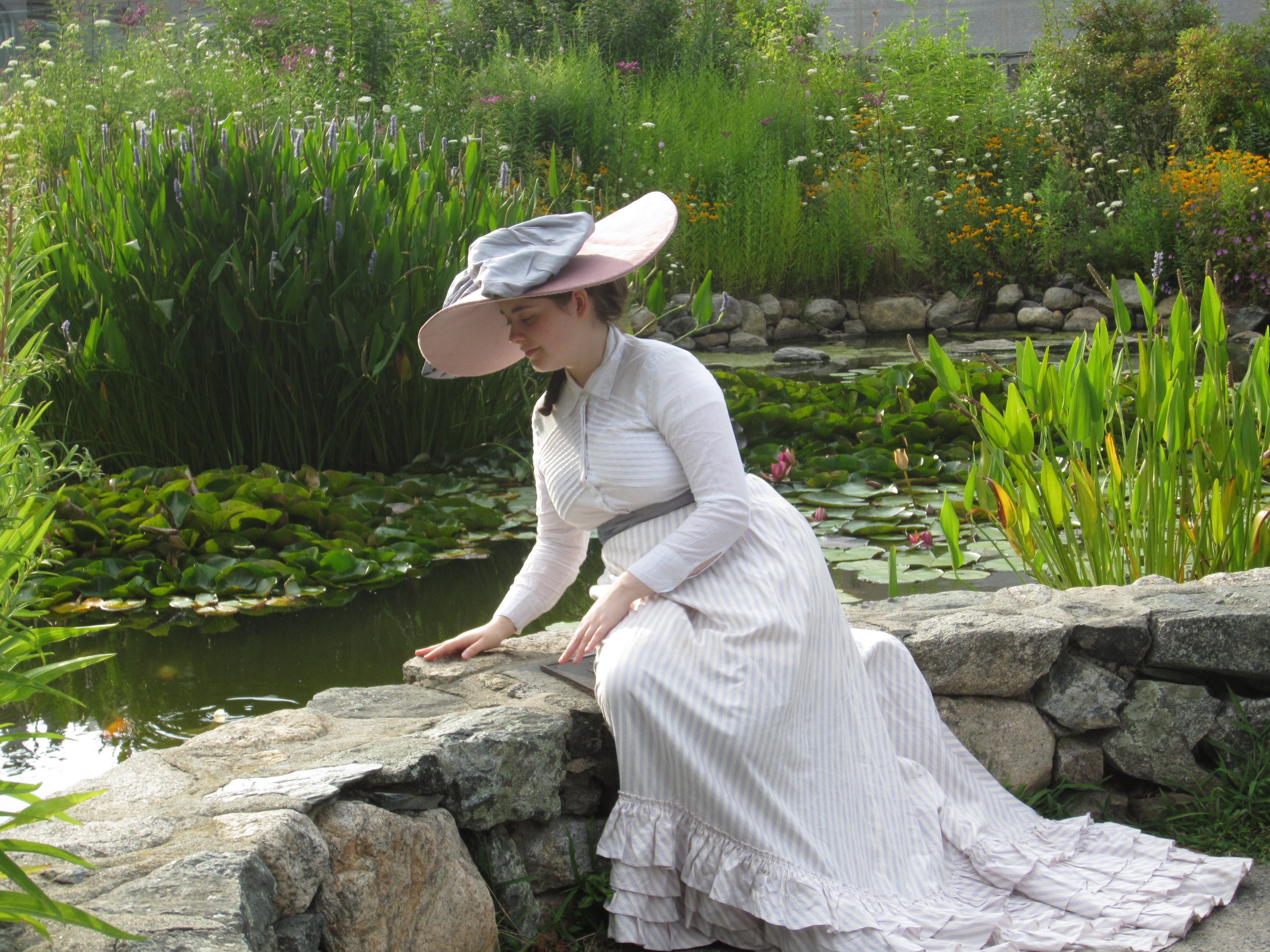
Looking picturesque. Again with the modern buildings…
Close up. Such a lovely line with the skirt and all! And the buildings are much less obvious.
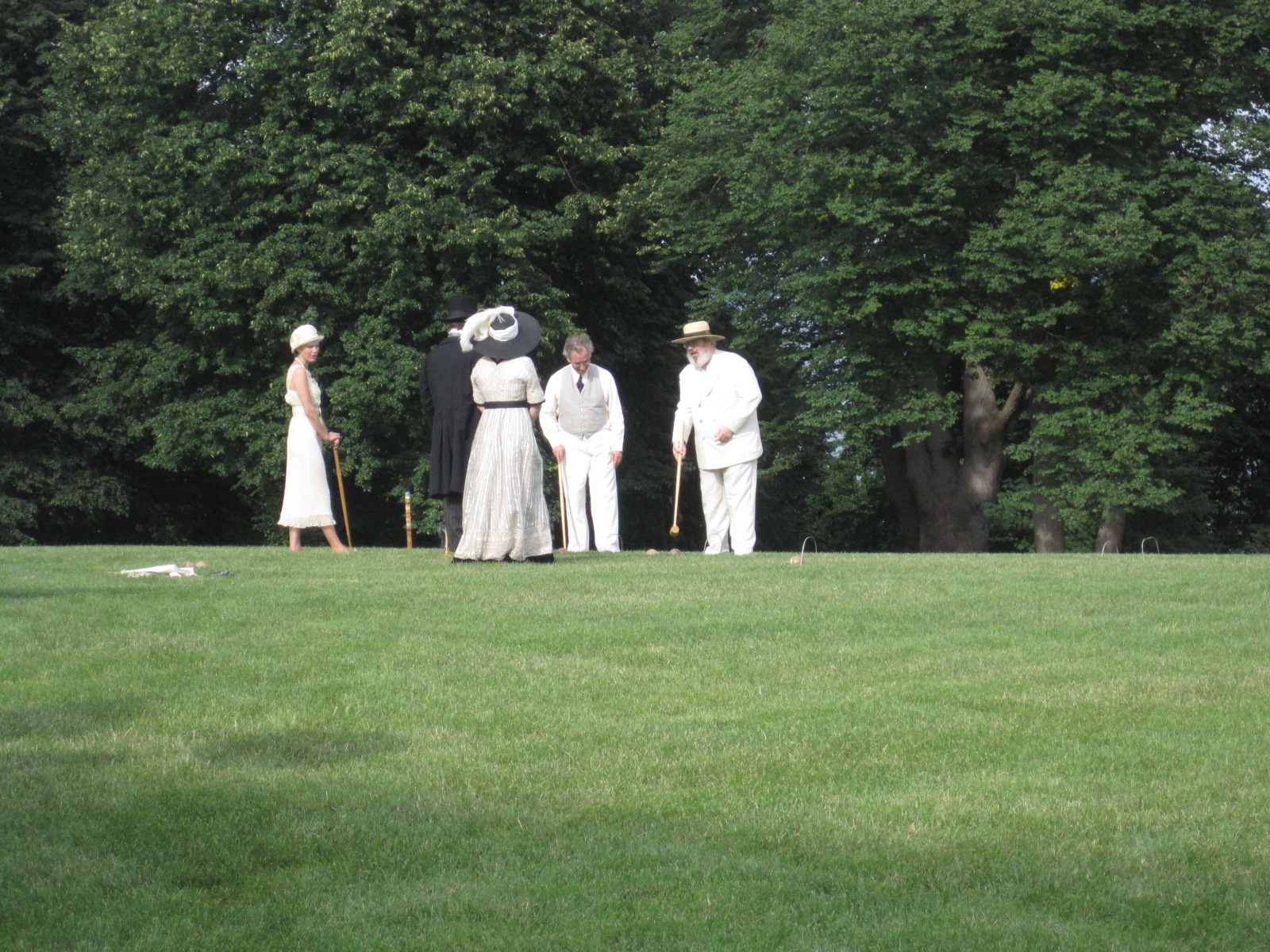
Finally we stopped getting distracted and made it to the tea, where we saw this lovely group of people playing croquet!
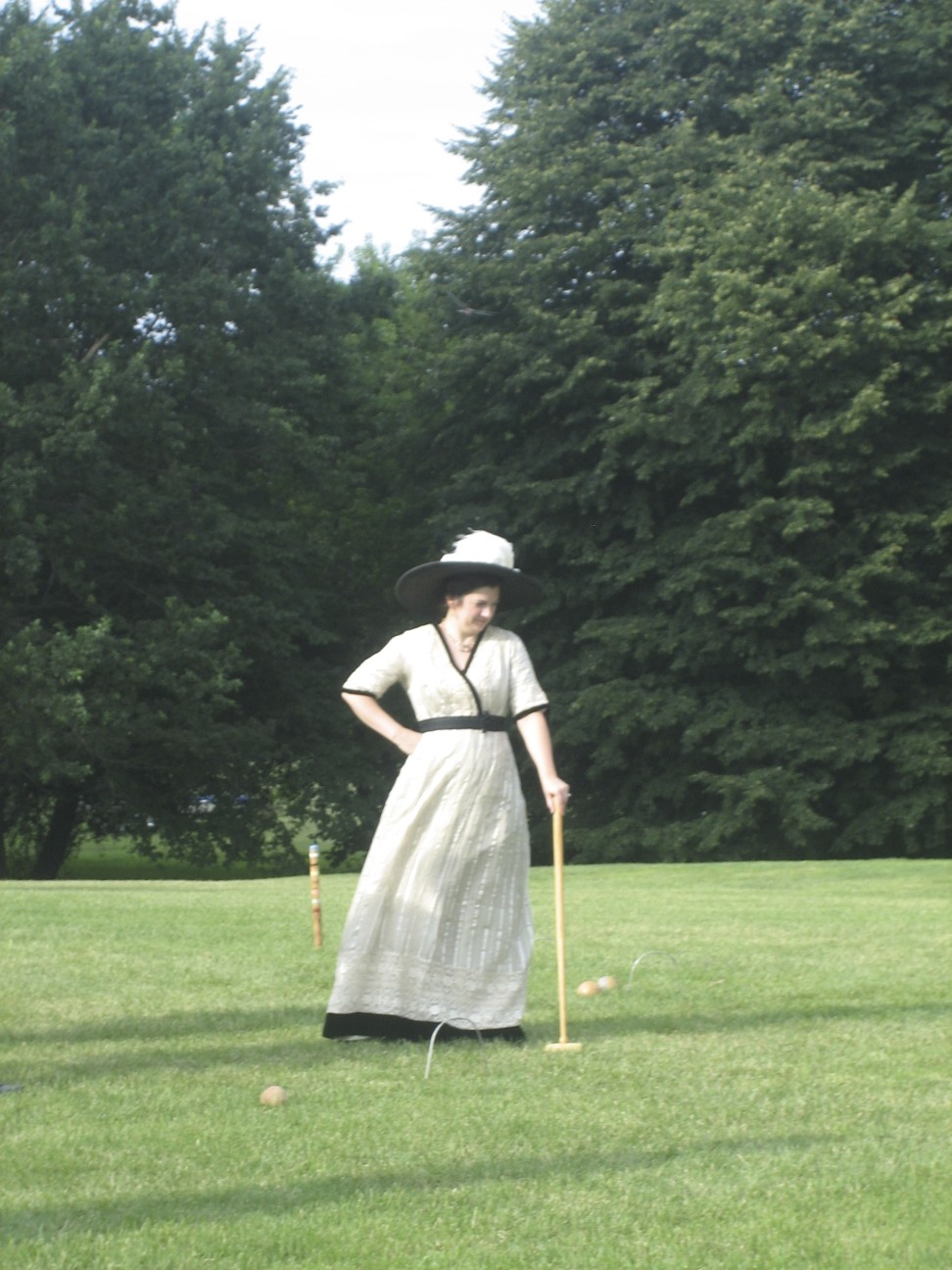
This is only the beginning of the croquet poses…
So we didn’t actually play croquet… we just borrowed the mallets for our photos!
Throw them over your shoulder?
Hard to see that they are different lengths in the last photo, but not in this one!
The long one was great for striking a pose that didn’t involve bending over.
I rather like this pose.
I’ve whittled it down to just this one close up hat picture…
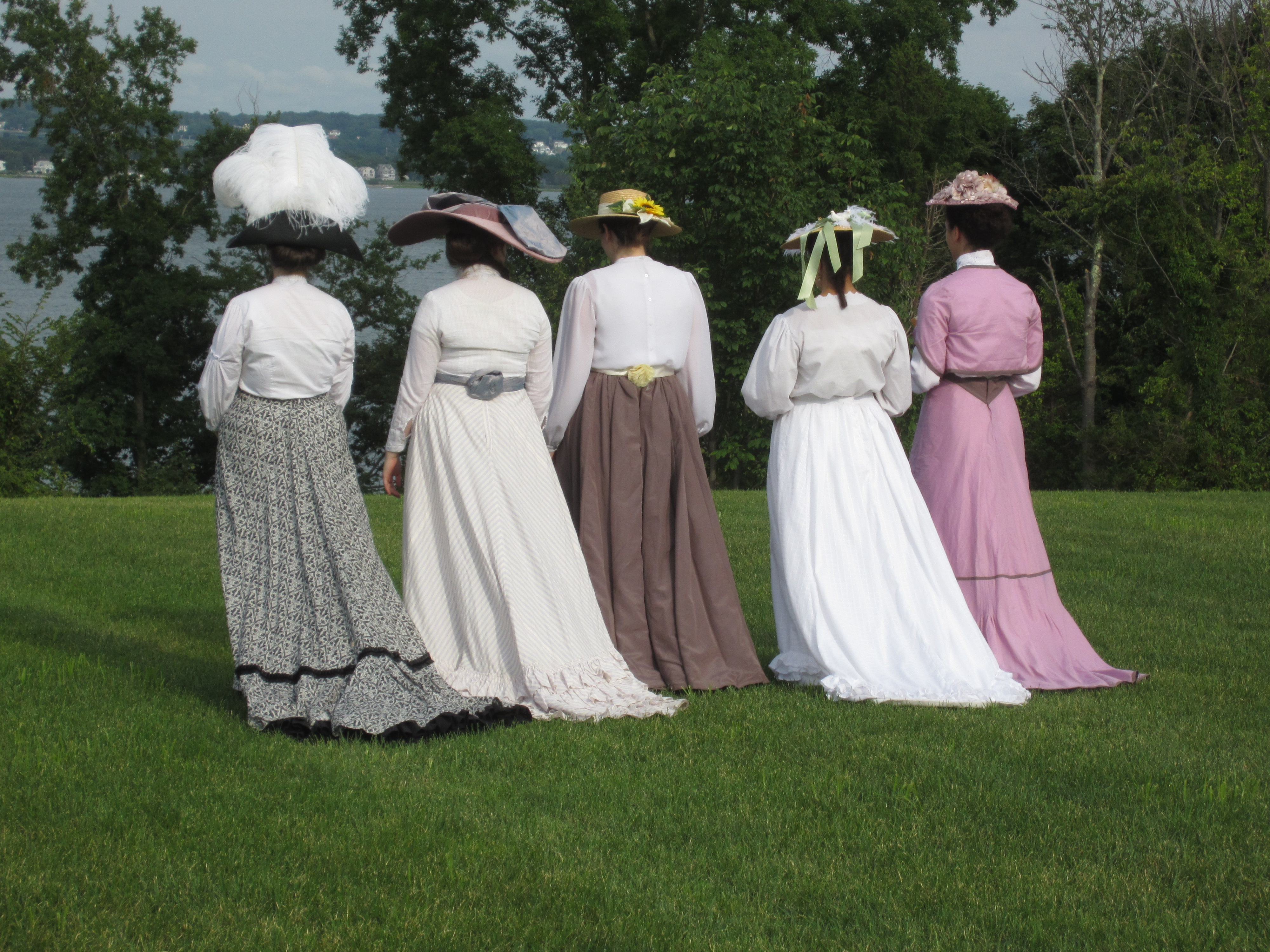
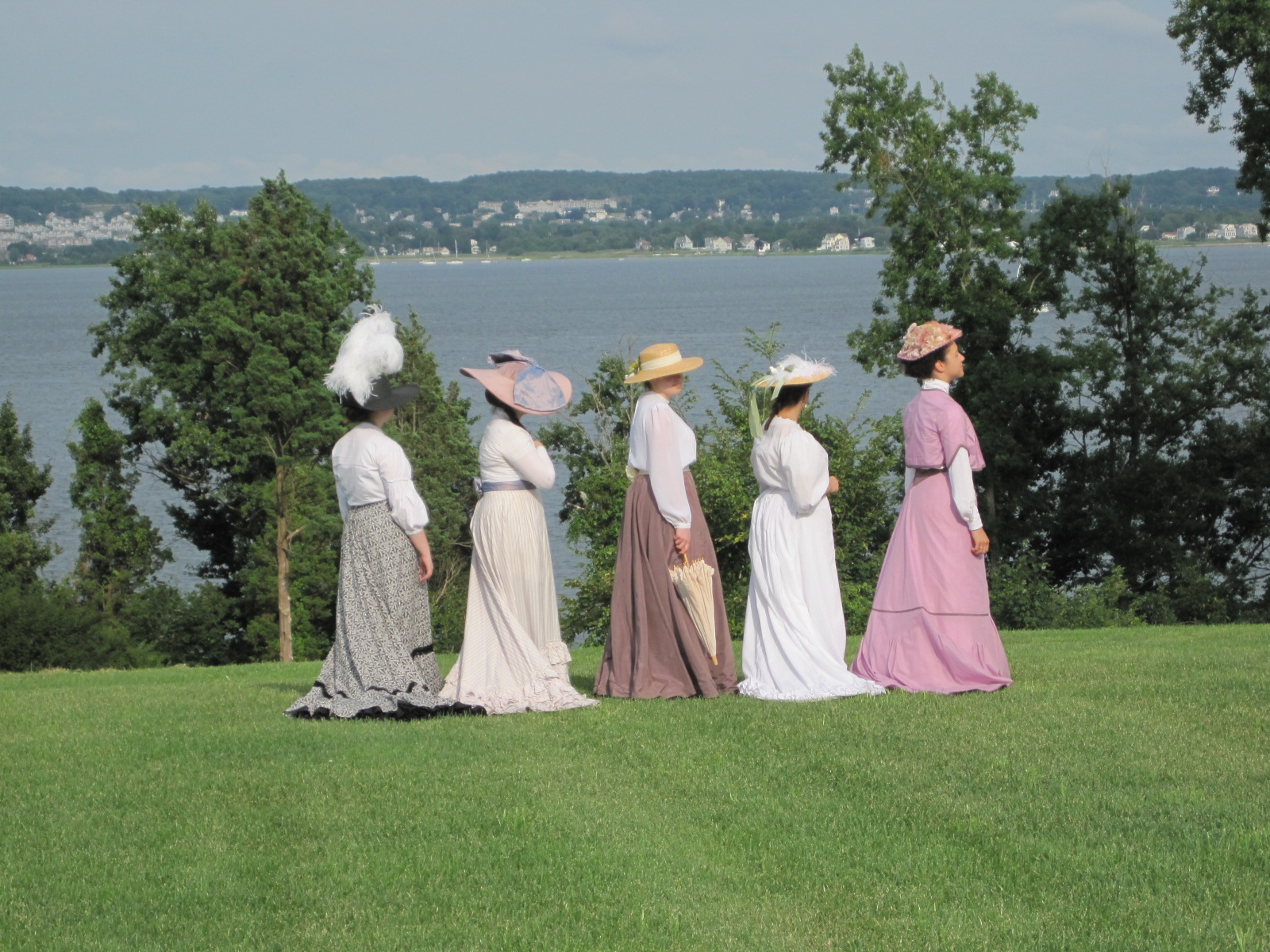
We got our young ladies together to take pictures in a line. We do love back side photos!
Swirling skirts and stunning backgrounds. What more could we ask for?
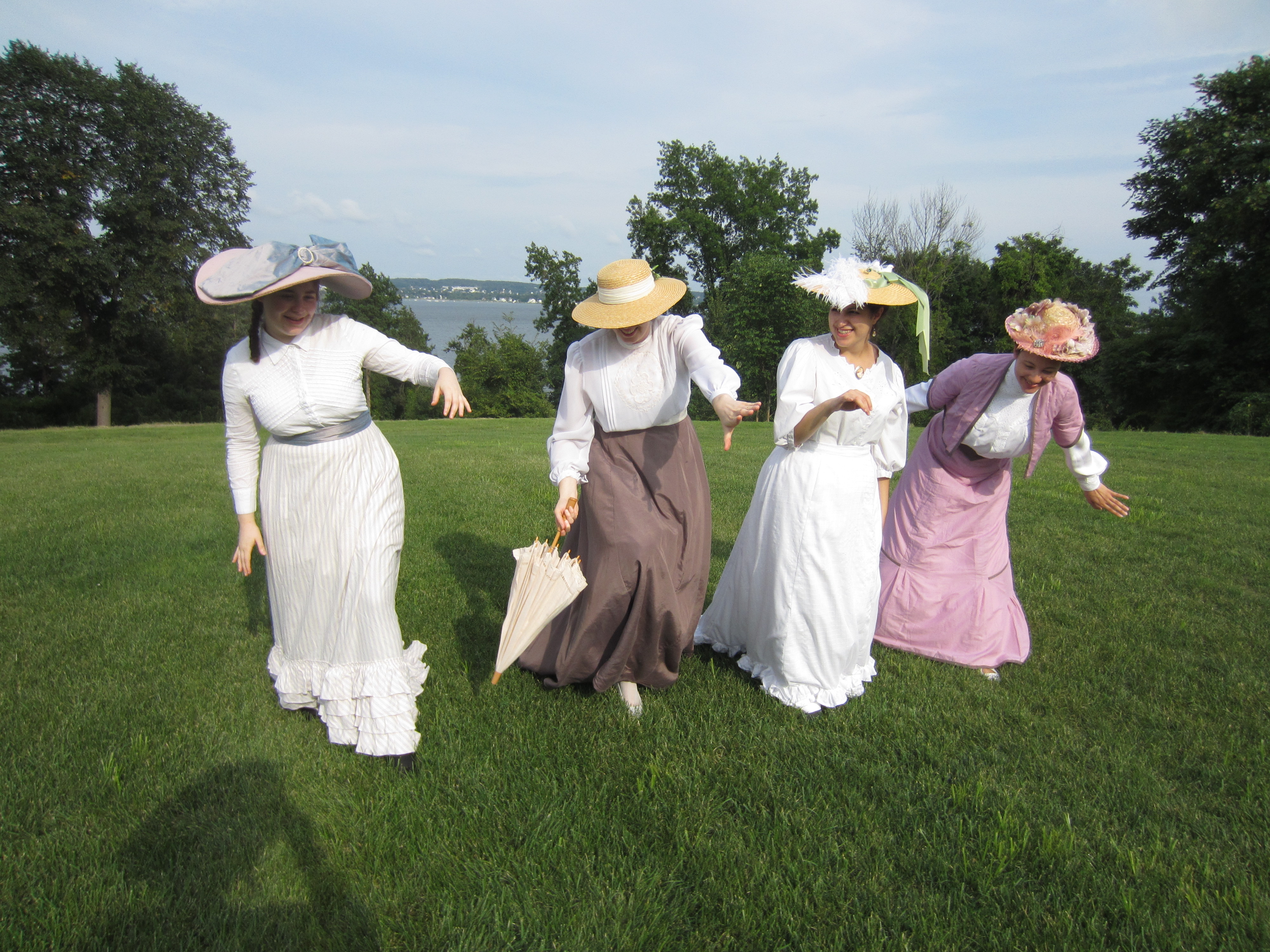
Silly moment! We like to try and walk toward the camera slowly, which always means walking like we’re either zombies or underwater, depending on your inclination.
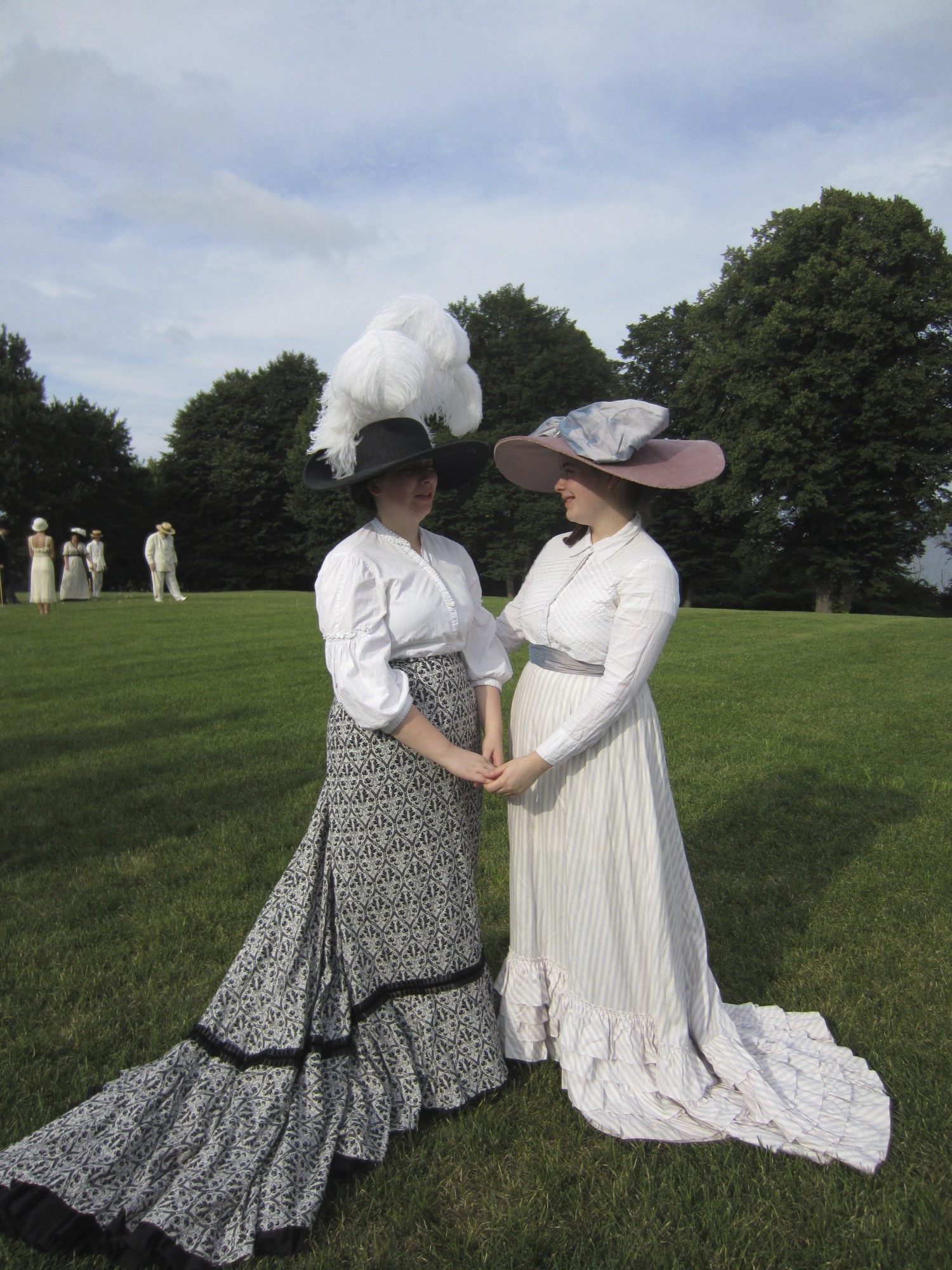
Awww. Aren’t they lovely together? Look at those trains!
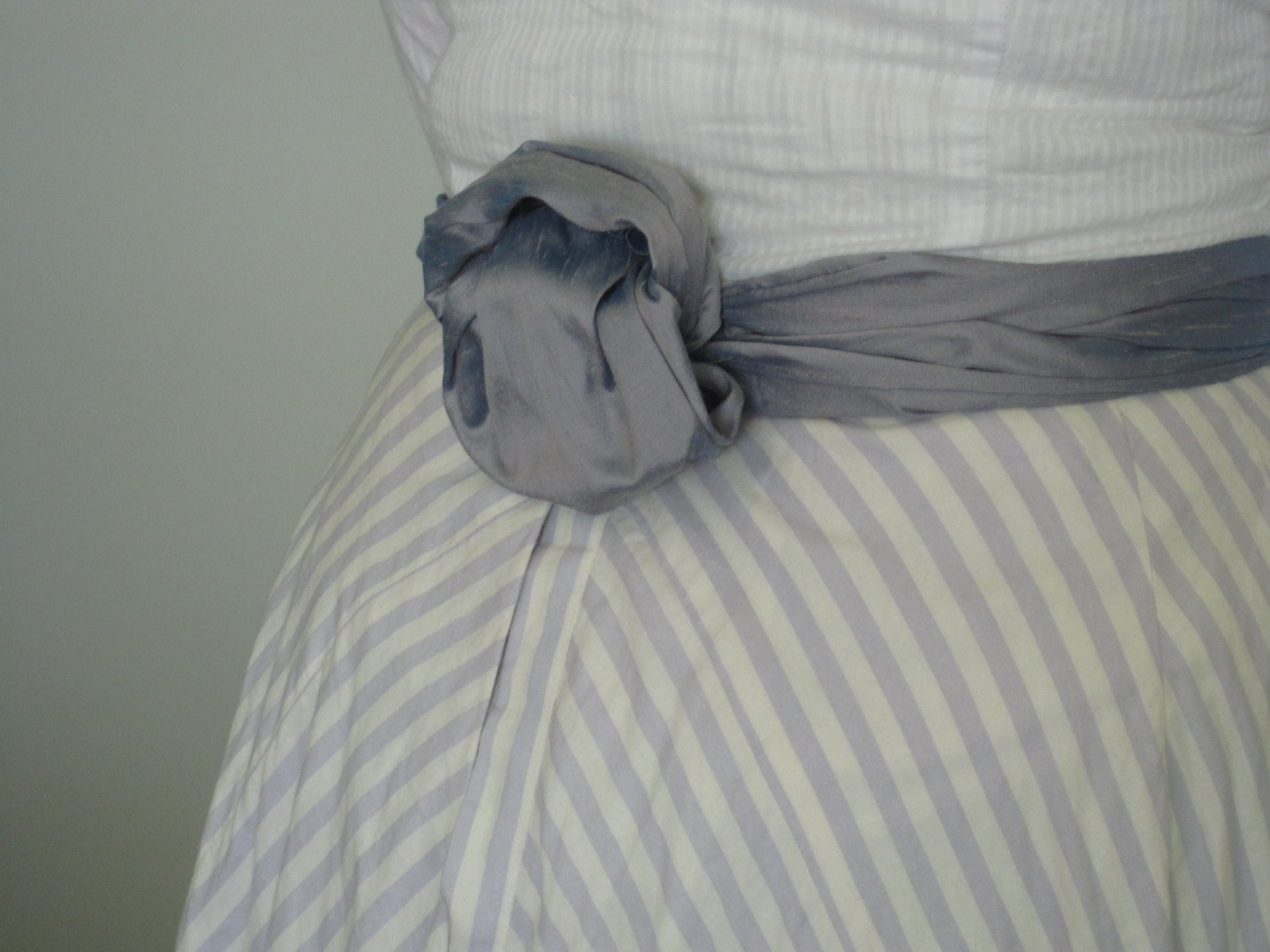
The neat looking knot-thing to finish off this particular sash–finishing off sashes in neat ways this was a theme of the week for me!
Sitting with one of the little girls for a photo. We had to bribe her with lemonade… shhh!
It’s possible that we were also distracted by cattails on our way out…
I really wanted to reach them, but they were just out of reach.
So lovely!
We had to return to reality–the modern world. But did we walk on the sidewalk? NO! Up the middle of the road is the only way.
More silly! Lifting the skirts and walking is always essential for sillyness. We are on our way to get ready for the evening 1860s ball at Ochre Court!

Final tally for this event: 27 pictures out of 298 total. Whew!

Newport Vintage Dance Week Part II: Seaside Tea Dance at Easton’s Beach

Here we are again, for the second installation of the Newport marathon of awesome-ness. If you missed it, you can view the first installation, the 1920s Gatsby Ball at Rosecliff, here.

The Seaside Tea Dance took place on Tuesday. It was held at a venue right on the beach that also houses a operational carousel! In fact, the carousel was shut down for the public so that those of us at the ball might ride it with our other costumed companions. If you’ve ever been to Newport, this beach area is the one just down the hill from Bellevue Avenue (where many of the mansions are). Actually, many of the mansions along the left side of Bellevue Avenue actually have a view of the beach area where this event was held. The day events did not have specific time periods, thus you’ll see a variety represented in the pictures. It’s nice to be able to choose, but I enjoy the atmosphere most when everyone is wearing clothes from a short time span (as is the case at the formal evening balls).

It wound up being a rainy afternoon, which caused some stress, but we managed to overcome our various situations and have silly, fun time anyway. You’ll have to look through the pictures to see the adventures! Onward!

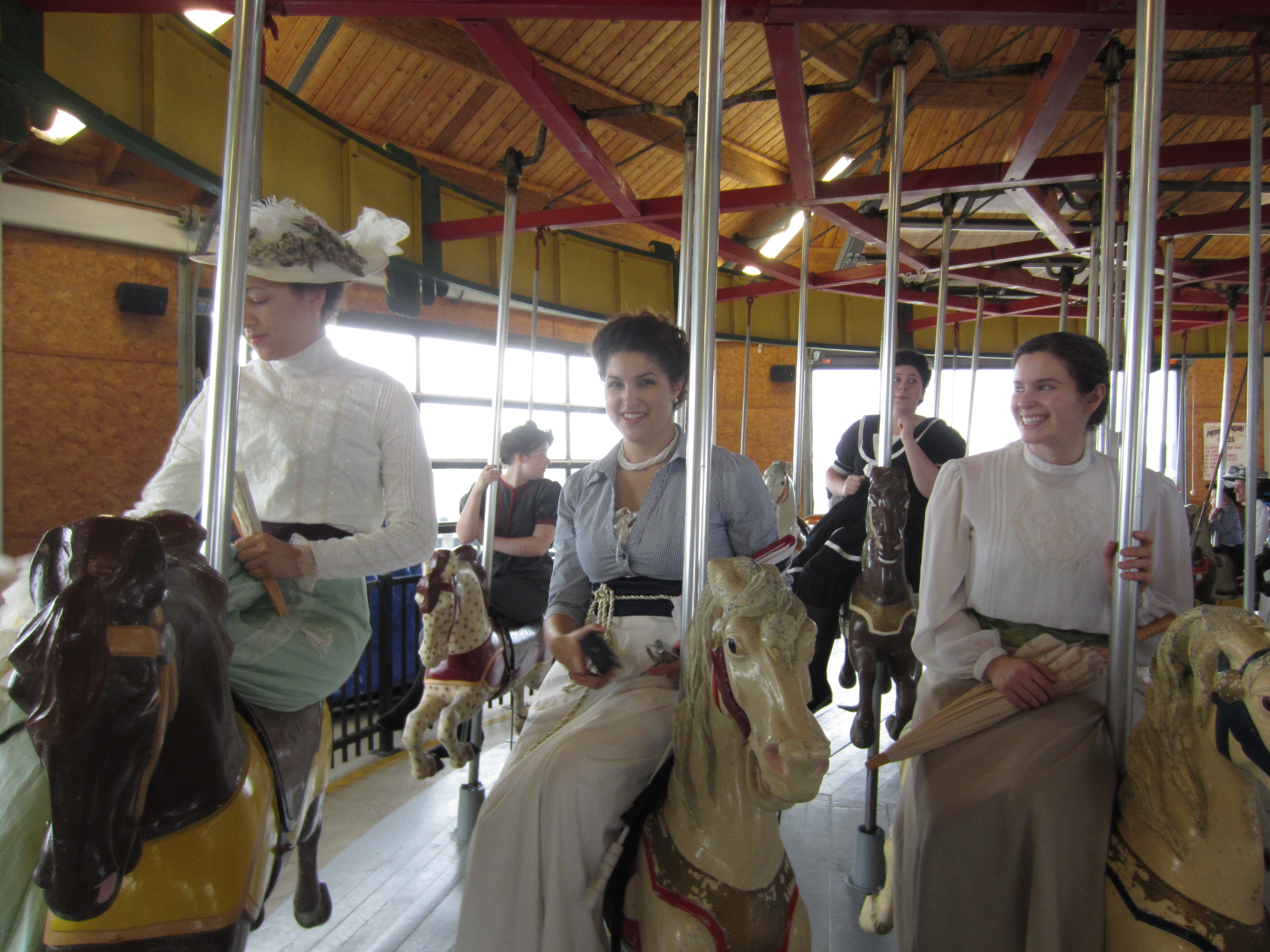
I hardly danced at this event–I wasn’t in the mood. BUT, I did ride the carousel!
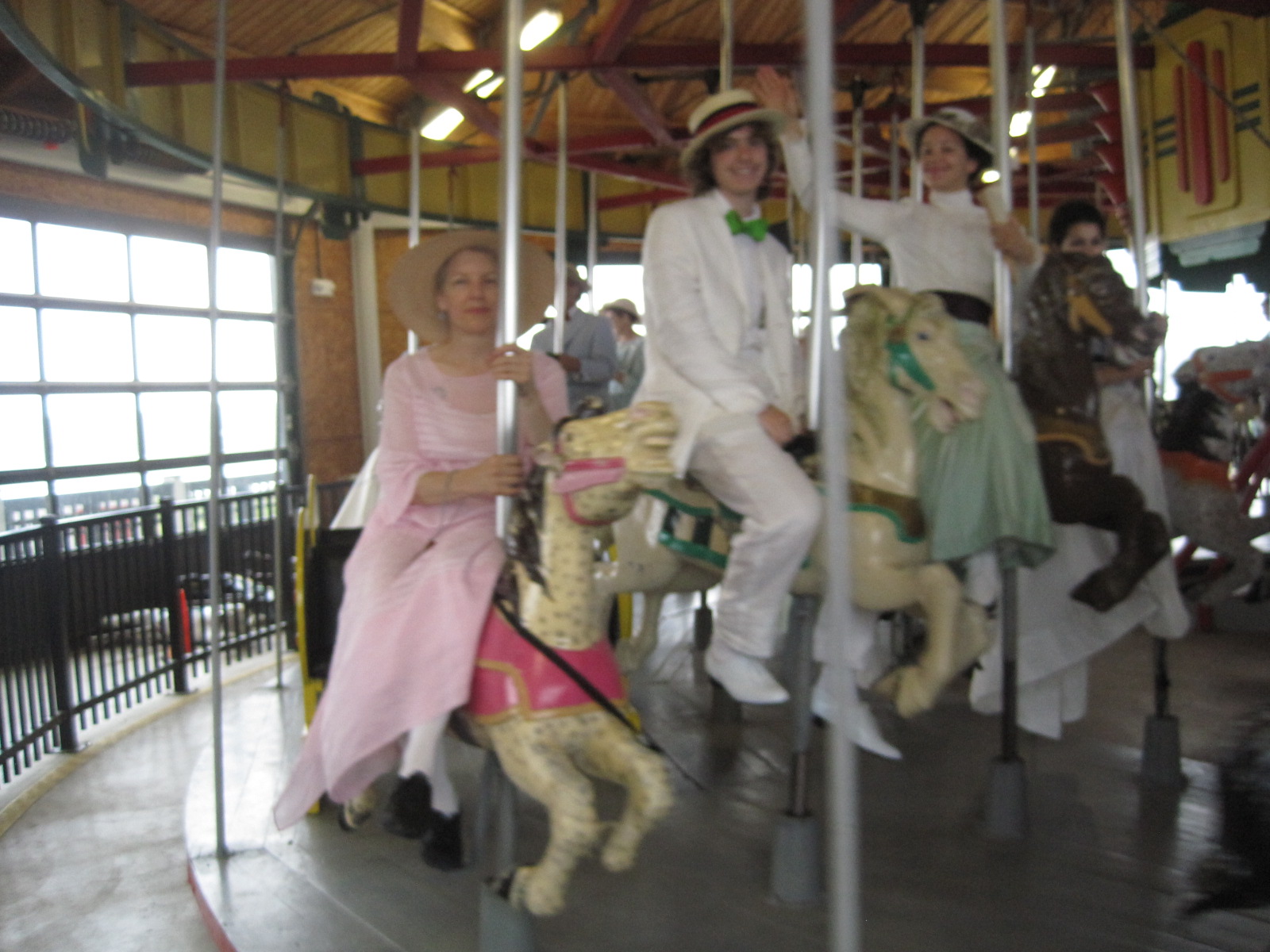
Carousel!
Hm… not actually smiling, but with the same look on their faces.
More of the fabulous young set…
Being proper ladies, we were obligated to ride side saddle! (And you can see the back of my newly decorated hat.)
Now you can see the front of my hat.
This was ride number two. I was practicing my princess wave.
As I mentioned in an earlier picture: we didn’t dance much. We did spend a lot of time sitting and discussing things (I don’t remember what things… I think mostly that we didn’t feel like dancing…). You can also see the fabulous knot I made on the blue belt! It was all pinned in place at the last minute, but I do like it.
We, the young set, might not have been dancing, but that didn’t stop other people!
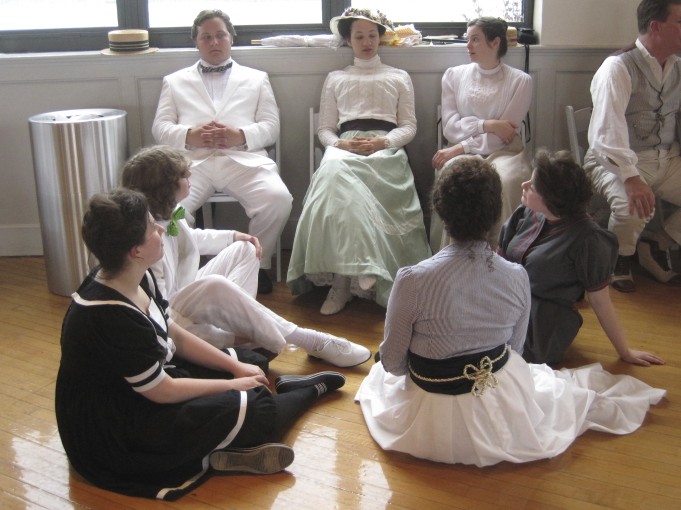
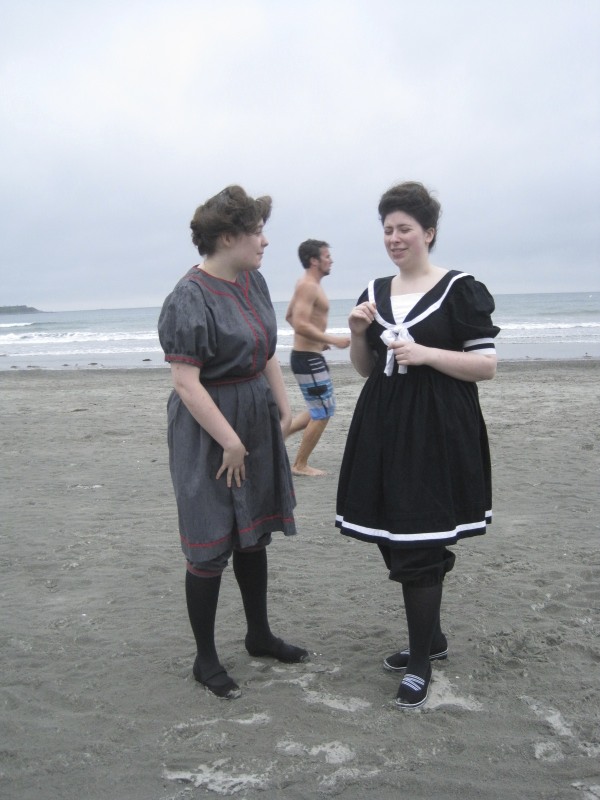
If you’re going to wear matching bathing suits, you must take pictures on the beach!
Oh no! The picture has been crashed by a random modern guy! Eep!
Single occupant pictures are always essential.
Here I am: 1900. New skirt, blouse from 1913 (shhh…), new belt, and newly trimmed hat (that appears to be listing to one side… oh well, it’s jaunty, right?).
From the back.
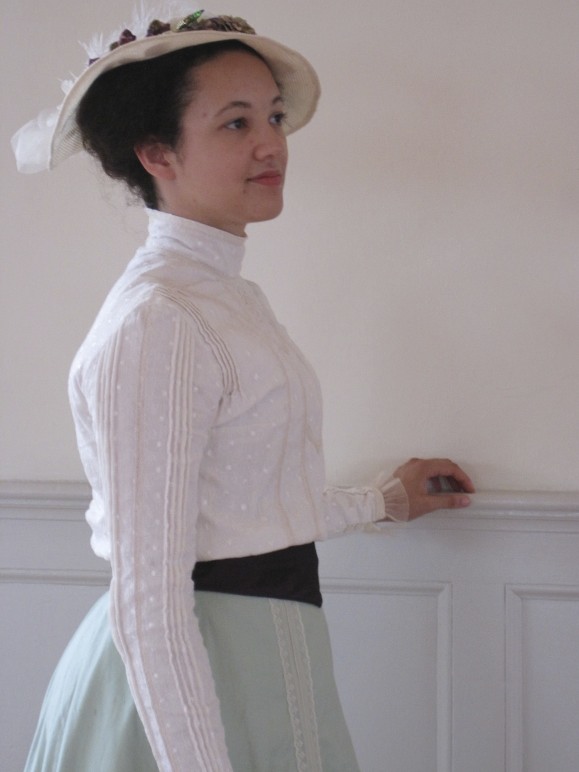
Close up. I love that I finally have a picture of this blouse that shows the details!
Another good blouse shot. I can’t resist including lots of pictures of new clothes!
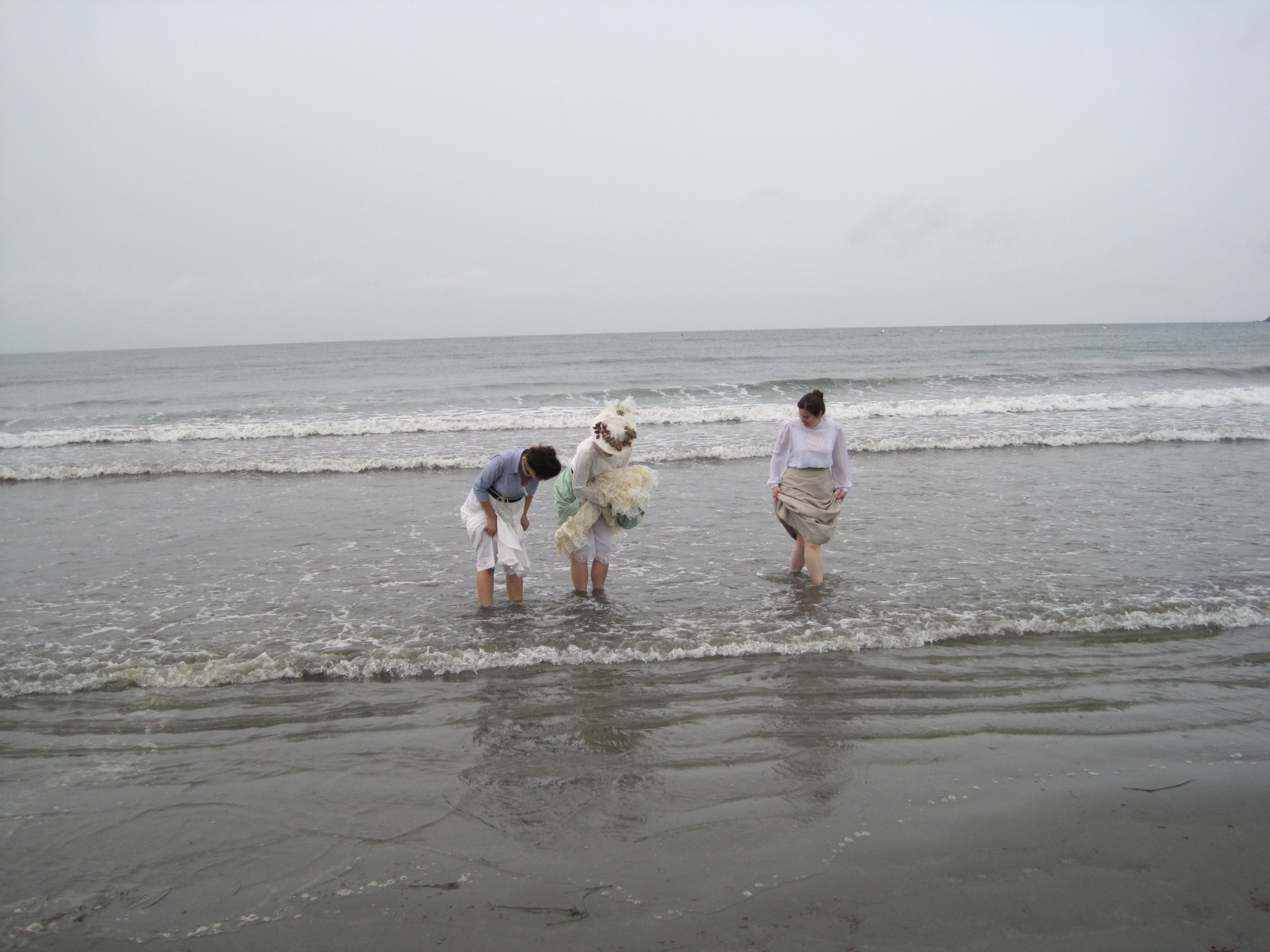
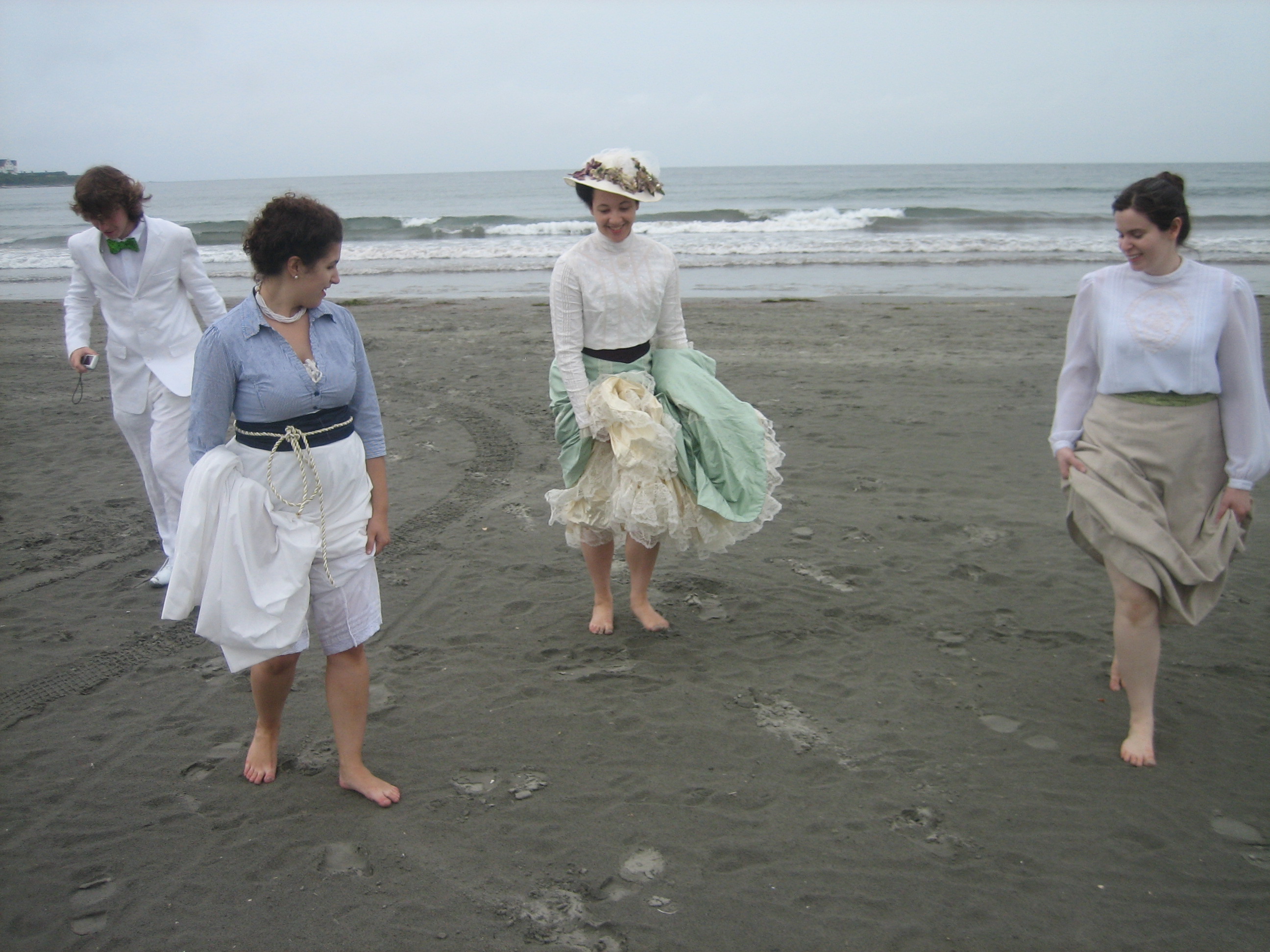
Silly fun! We went wading in the ocean, in the rain! It was pretty warm, so the water didn’t feel cold.
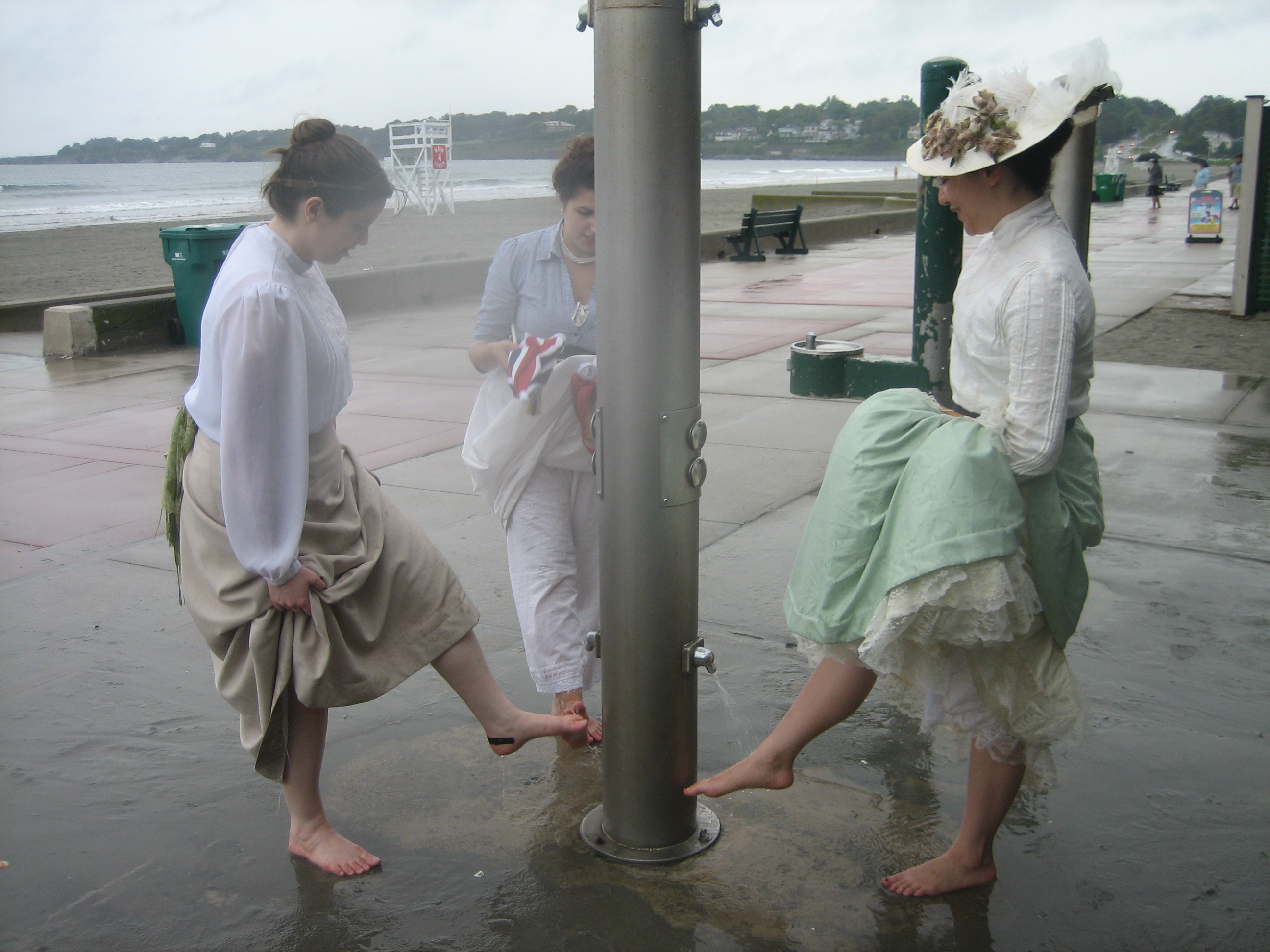
It is for spur of the moment events like this that it is always useful to wear historic underthings… You never know when your combination legs might be seen!
Look, you can see one of our faithful cameramen!
After getting our feet all sandy, we had to hose down a little bit.
My ostrich feathers were rather bedraggled when we finally went inside… but I fluffed them and they dried looking just as wonderful as before the rainy sea adventure.
Walking to the car. More petticoat ruffle is always better!

Final picture tally: 22 pictures out of 655 total from this event… You made it!

Edwardian shoes from American Duchess!

Well, Christmas wishes do (almost) come true!

When American Duchess announced the Pemberley Regency style shoe around Thanksgiving I was super excited… but I am even more excited about the most recently announced shoe that is nearing the end of production.

Yes, an Edwardian shoe! It will be for sale before April, when I know we will all be attending Titanic-themed events. I have plans to make Edwardian clothes for some of these events and I have been looking for modern shoes with a historic aesthetic to match; however, it is quite challenging to find a modern shoe with the right heel shape, top detailing, and heel height, just to name a few features of this Edwardian shoe. I am so excited!

New “Astoria” Edwardian shoe from American Duchess
This link contains an affiliate code, which provides a small benefit to my shoe fund. This does not affect my impressions and reviews of this product.

American Duchess has other shoes in development as well: a 1920s t-strap (super cute) and court heels c. 1680-1740. You can check out the designs here, just scroll down.

I say Christmas wishes (almost) come true because when I posted about the Pemberley Regency shoe I wished for a late Victorian shoe from American Duchess. Well, Edwardian is not quite late Victorian, but it is just as exciting! And such perfect, well-planned timing! SO EXCITED!


SaveSave

Bolero jackets of the 20th century: 1900-1909

A few posts ago, we took a look at Bolero jackets from the mid-19th century. Let’s look at them  in another context: Boleros from the early 20th century, with a hint of information from the 1890s as well.

1904 Dress with Bolero

What exactly is a Bolero jacket? The Oxford English Dictionary defines it as “A short jacket, coming barely to the waist; worn by men in Spain; applied to a similar garment worn  by women elsewhere, usually over a blouse or bodice.” This definition condenses the influence and origination of the Bolero down quite eloquently (of course, it is the job of the OED to eloquently distill all words down to a concise definition… but still, I do like this definition). The men’s style Spanish Bolero, with elaborate braiding and bright colors, influenced the style of women’s Boleros from the Victorian period. The following quotes from the OED provide more insight into the history of the Bolero (they also mention other styles of short jackets including the Zouave and the Eton).

“1892    Daily News 14 Nov. 6/3   The Zouave is as great a favourite as it has been for some seasons, and though it varies in form—being sometimes a bolero, sometimes a toreador, and sometimes a cross between an Eton jacket and a Zouave.
1893    Daily News 1 Apr. 2/4   The Zouave is quite as popular as it was last year.‥ Sometimes it is pure bolero.
1893    Lady 17 Aug. 178/1   Zouave Bodices are a feature of autumn gowns. (in the Zouave definition)
1899    Westm. Gaz. 6 July 3/2   Robbing the coat of its basque has created‥the bolero corsage, really an actual bodice, though appearing a bolero coat and skirt.”

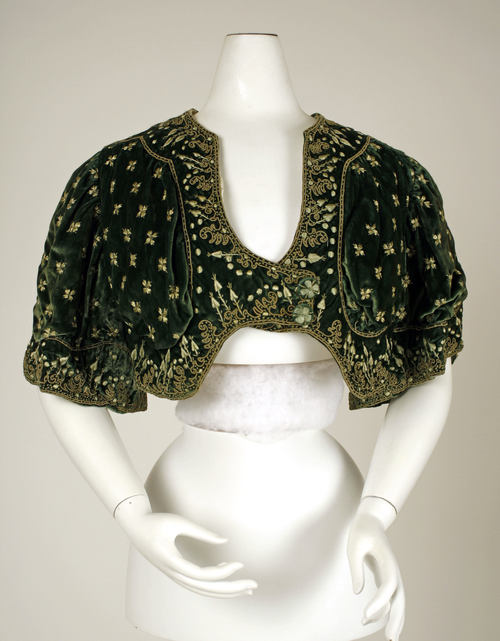
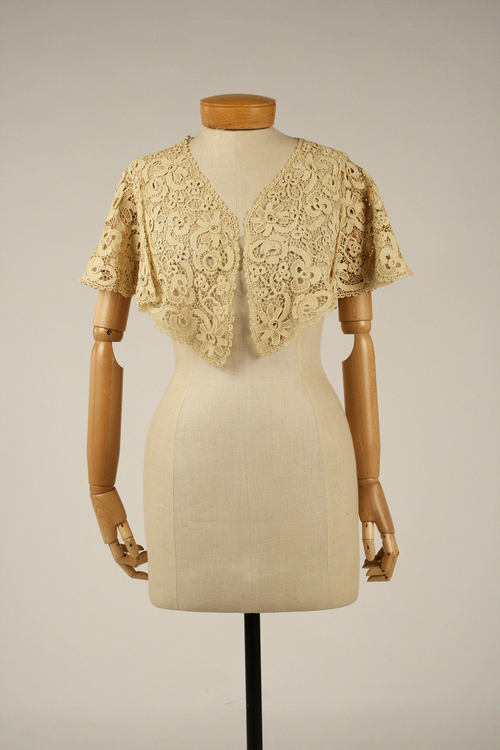
The flared skirt and small waist silhouette of women’s clothing during the first decade of the 20th century was well suited to the style of Bolero jackets, as they could help to visually balance the figure by adding just a small amount of width across the chest and shoulders.  Here are a few Boleros from the Metropolitan Museum of Art. One is silk velvet, elaborately trimmed. The other is lace. Can you imagine the dresses that would have accompanied these Boleros? Clearly, they were intended for different purposes. Perhaps the first was intended for evening wear and the second for an afternoon stroll or visiting friends?

c. 1905 Bolero from the Metropolitan Museum of Art
c. 1907 Bolero from the Metropolitan Museum of Art

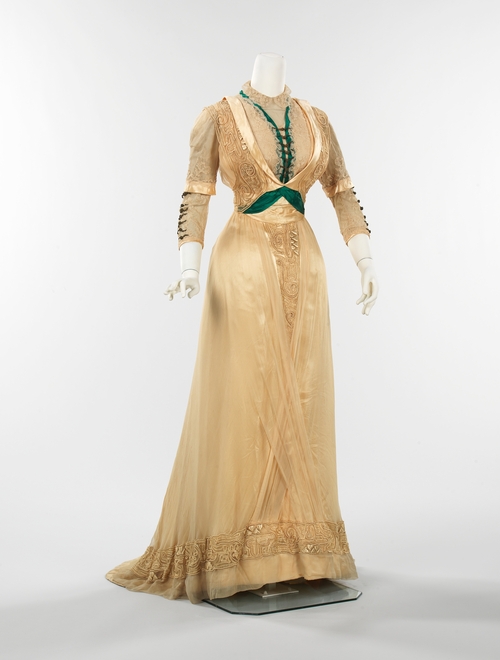
1901-1911 Dress

This dress is fabulous! What a wonderful piece of inspiration! It’s beautiful!

1901-1911 Dress at the Metropolitan Museum of Art

I absolutely love the subtle use of vibrant teal! It really spices up the dress. The cream satin and chiffon as well as the detailed trim are especially wonderful.  The carefully arranged layers are fascinating–they keep your eye moving while managing to not distract from the fabulous fit of the whole dress.

I think this must be one of those Edwardian dresses that has a complicated closure that is hidden under crisscrossing layers. I just can’t imagine any other closure that wouldn’t detract from the beauty of the dress!

I think this is also one of the dresses that has faked layers. It seems to be an illusion that there is a blouse then a vest then a jacket. I think it is probably just one layer with trim and then the outside jacket. It’s so hard to tell from the picture! That’s the beauty of these Edwardian confections… it’s so hard to figure out how they are made and how they close without actually being able to see its inside construction!

I simply adore this dress! I just keep repeating its praise… Beautiful!

Project Journal: Victorian Women’s Tailoring Part XI: Time to celebrate!

As a finishing touch to my Women’s Tailoring Project, I thought I’d share some silly pictures from my photo shoot with you! We received many strange looks and even had strangers whipping out their cameras to snap photos… I’m sure they were very confused about what was going on!

How many people fit behind a bustle???
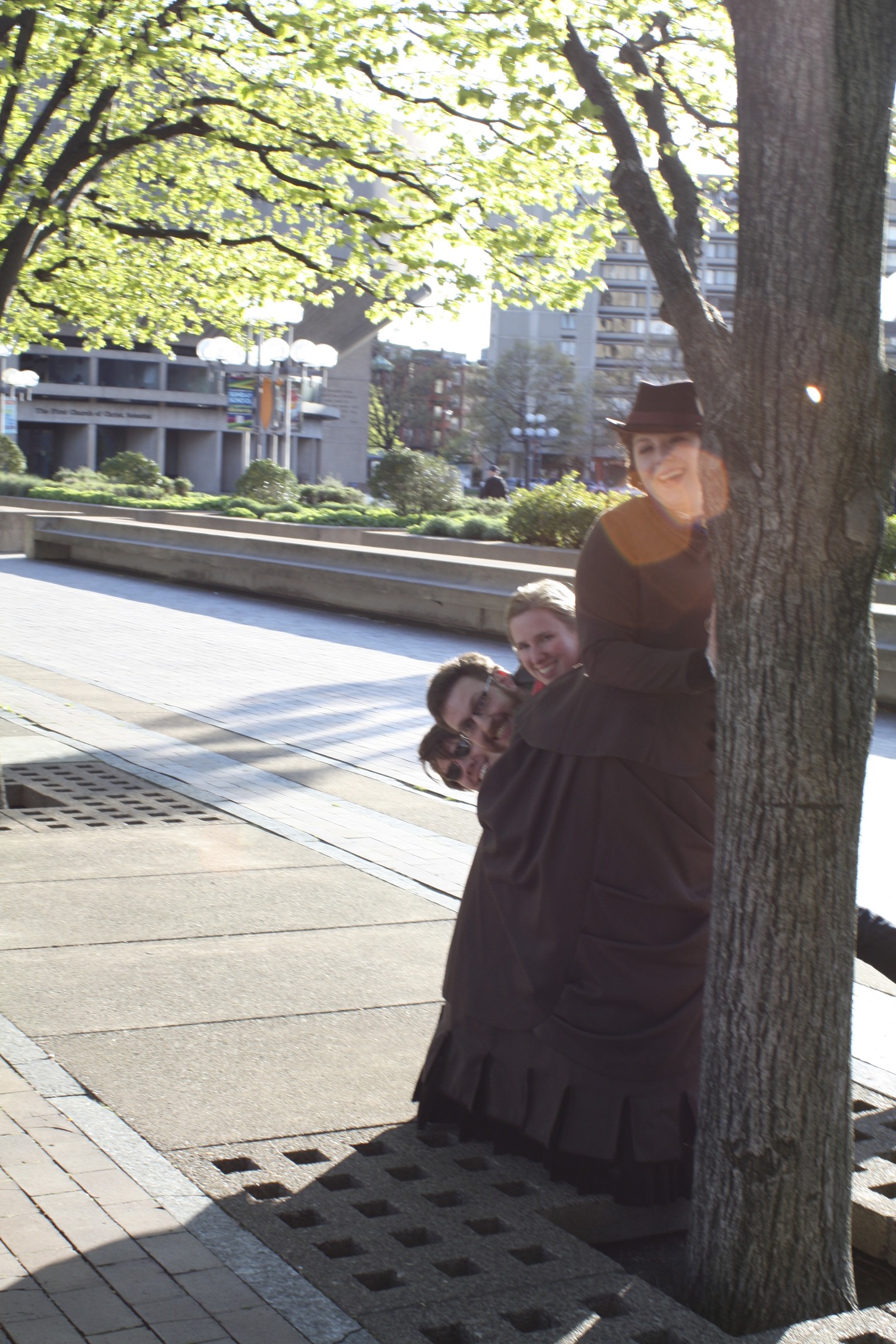
Can a bustle hide behind a tree???
Waiting to cross the street...
Squeezing between cars (...I mean carriages...)
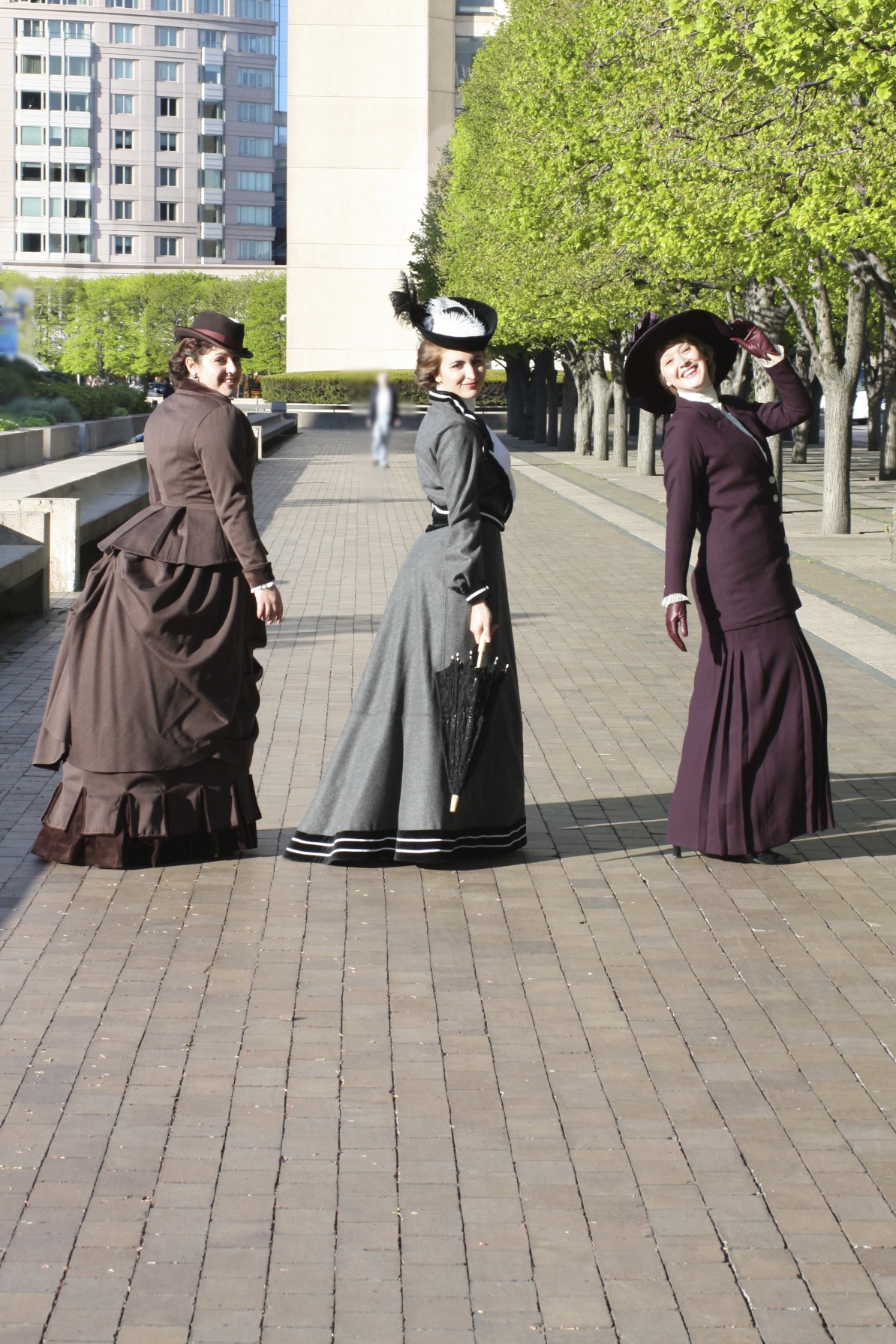
Let's all promenade!
Laughs are good, too!
Wait for me!
Strike a pose!
Don't forget to smile!
Trading hats and looking great.
Cut! I DID IT!!! Time to celebrate!

Project Journal: Victorian Women’s Tailoring Part VI: Fitting 1903 Garments

Well, if you remember from a few posts ago, I completed my mockup undergarments and exterior garments for this 1903 look in muslin (the same fabric I used for the 1883 and 1913 mockups). But now I’ve completed first fittings for my garments in their actual fabrics!

Let’s start at the outside and work our way in. The exterior “suit” is two pieces: a jacket and walking skirt. Both layers are constructed of fairly heavy wool, so tightly woven it is almost like melton. Melton is a felted wool frequently used for outerwear and constantly used historically for it’s water resistance and ability not to fray–thus allowing tailors to leave their cut edges raw and not finish them with time intensive seam finishes. The walking skirt is intended for use out of doors: specifically for talking walks (hence the name) and promenading about in the public eye.

Under the jacket is a silk crepe blouse with a lace yoke, collar, and cuffs. If you look closely you can see the three points of the lace yoke on the blouse. The blouse is pulled off-center in this picture because of the alterations I needed to make-only one side has the alterations pinned.

Under the skirt there is a cream colored lace edged silk shantung petticoat. The petticoat has two circular, gathered ruffles at the bottom. The top ruffle has a wavy hem edged in lace and the bottom ruffle is edged in matching lace. There are also arches of lace above the ruffles.

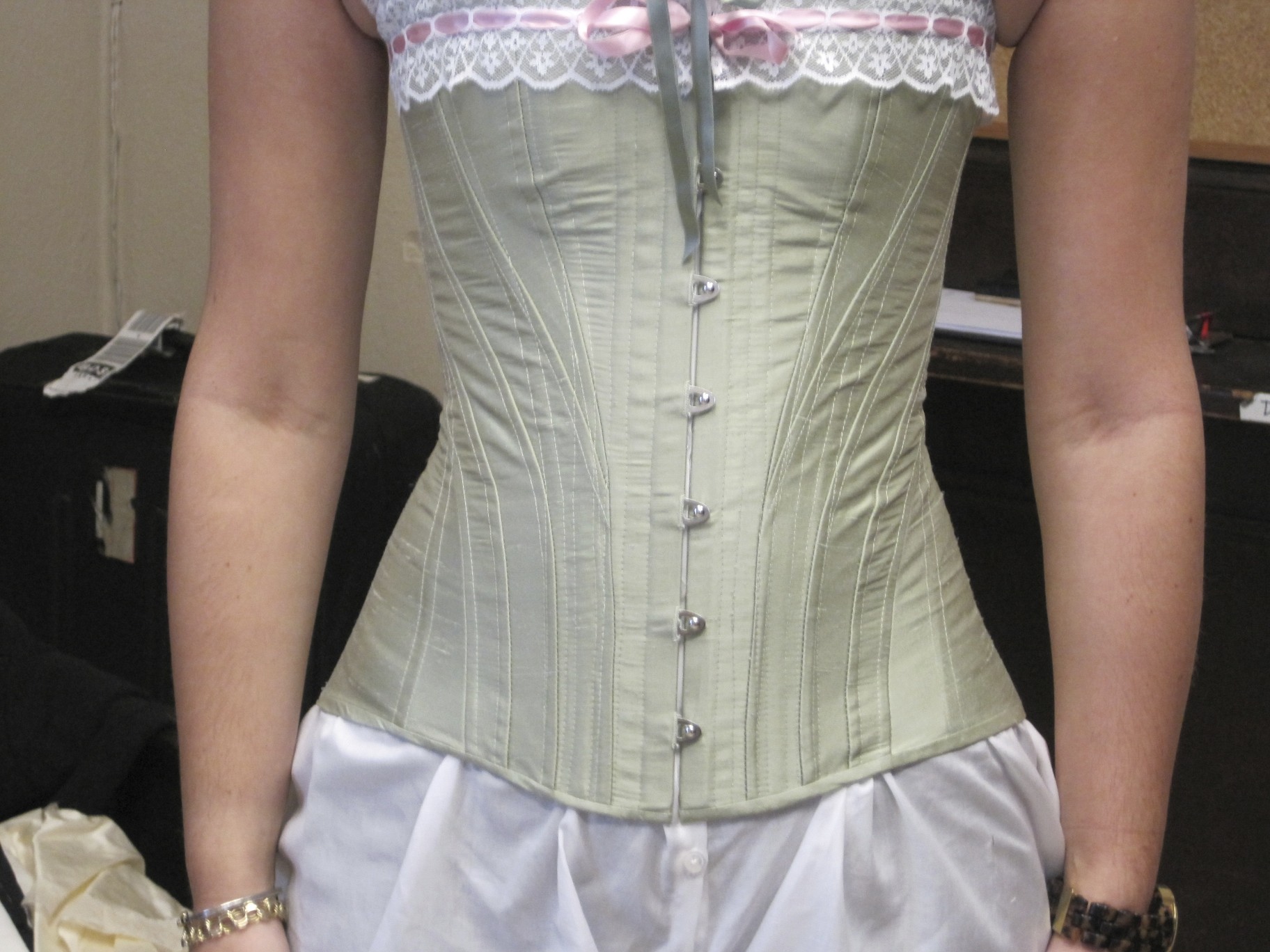
There is also a cream colored corset cover that is not pictured in these photos. This s-shape corset is made of green silk shantung flat lined with coutil. The seams are flat felled on the inside. The edges are bound in bias cut shantung and the top is also edged with white lace threaded with pink silk ribbon. Under the corset is a cotton combination that buttons up the front. A combination is an undergarment that is functions as a chemise but has bifurcated leg openings, like drawers. This pair is edged in white lace at the leg openings and neck edge. The neck opening is threaded with a green silk ribbon to coordinate with the corset.

Project Journal: Victorian Women’s Tailoring Part III: Mockups

I reached a point where all my patterns were complete! The next step was to make a mock-up, or toile, of each garment. My mock-ups are made out of muslin: their goal is to determine what changes I need to make to my patterns so that the garments will fit well before I cut and sew the garments out of my fashion fabrics.

By eliminating major fit issues in my mock-ups I am able to achieve a better fit in my final garments with fewer alterations. In these photos you can see the pins that mark the areas of the garments that I need to go back and change on my patterns so that the fashion fabric garments will fit better.

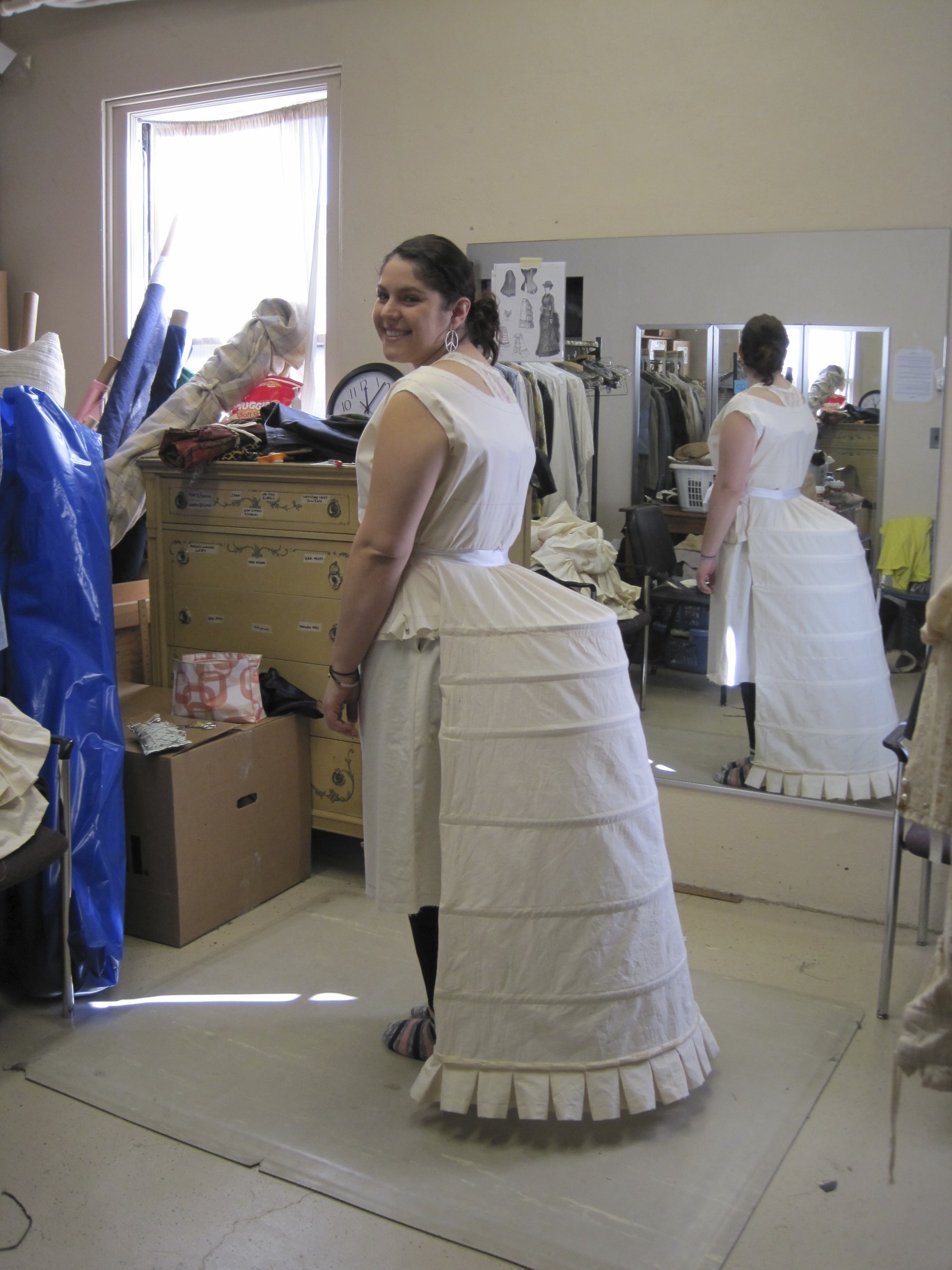
Look 1: 1883. In my brain this is the “bustle dress.”

1883 mockups--including the bustle!
1883 mockups.
My inspiration "cheat sheet" for this look.

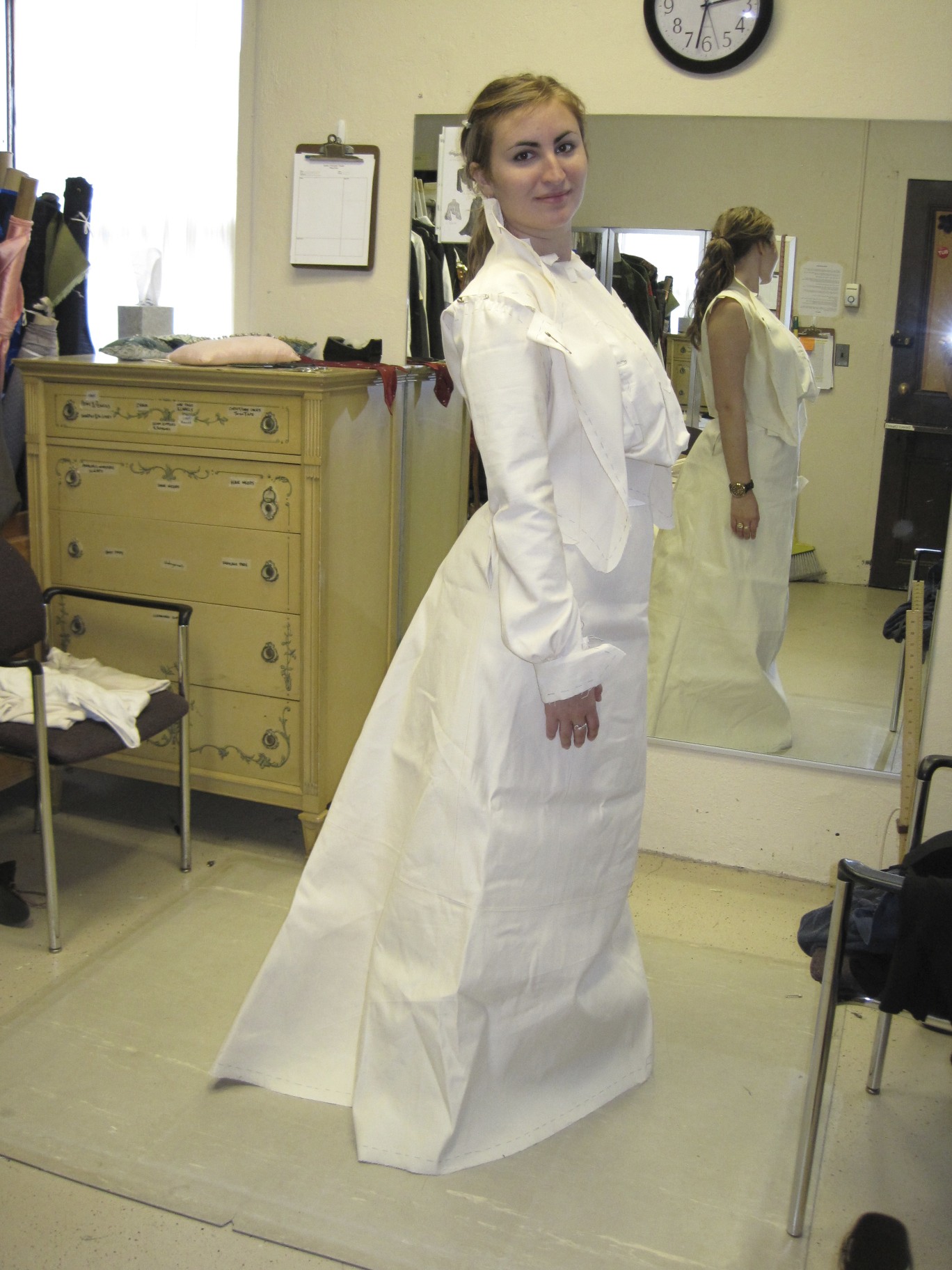
Look 2: 1903. This is the pigeon breast dress.

1903 mockups.
1903 mockups.
1903 garment inspiration "cheat sheet."

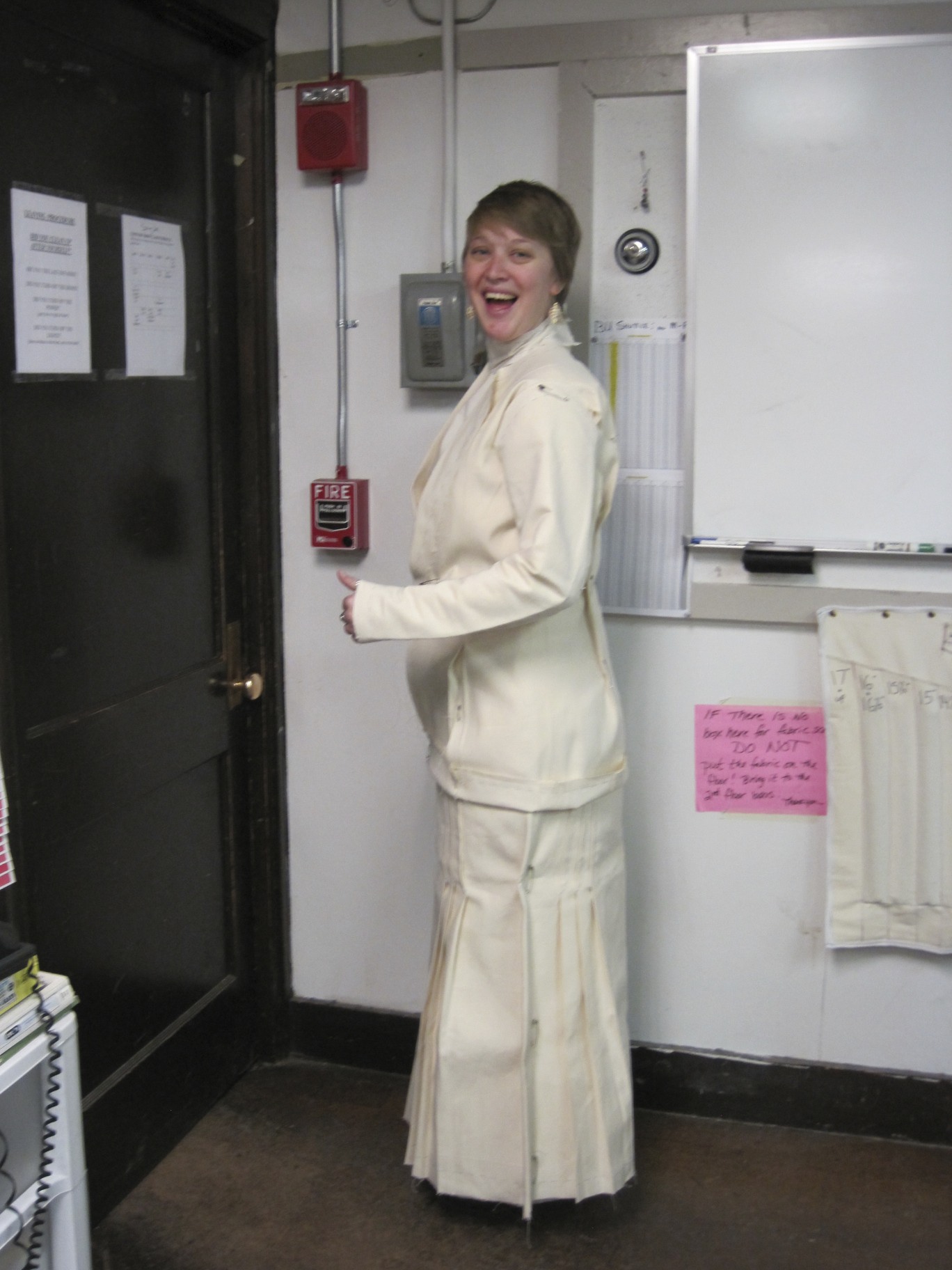
Look 3: 1913. This is the tubular suit look.

1913 mockups.
1913 mockups.
1913 "cheat sheet" for garments.

Yay! My project is on its way to becoming actual garments. There’s still more work to do, but it’s inspiring to see it beginning to take shape!

Project Journal: Victorian Women’s Tailoring Part I: Overview

My current historic sewing project is reproducing three tailor-made garments and their undergarments from the end of the 19th century. The project aims to show the development of women’s tailoring from the 1880s to the 1910s–essentially the turning point between a tailored dress and a suit.

Look 1: 1883.

This garment is characterized by its bustle. The bustle goes in and out of use, changing shape and size, throughout the 1870s and 1880s. In 1883 the bustle is at a point where I call it the “shelf bustle,” extending from the back at an almost ninety degree angle once being covered by the voluminous skirt layers. During the 1880s, in particular, “tailor-made” garments were fashionable, but these were essentially dresses, not suits.

Look 2: 1903.

This garment is characterized by its romantic figure, featuring “pigeon breast” blousing and gracefully flaring skirts. The foundation of this shape is the new corset design introduced at the turn of the century, augmented by extra padding at the bust and rear. Tailored looks of this period separated jackets from skirts, but still these do not qualify as suits.
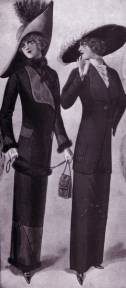
Look 3: 1913.

This garment stands between the corseted Victorian woman of the 19th century and the independent, working woman of the 20th century. Just a few years after this the rigid corset disappears in favor of new, lighter undergarments such as brassieres, knickers, camisoles, and girdles. Clearly, this garment is a suit, not a dress, but its undergarments remain in the past where dresses, not suits, were what women wore.

More journal entries will be coming with more information about each look as well as updates on the actual construction of these garments. Stay tuned!

Sources of Images:

1883. http://www.digitalchangeling.com/sewing/periodResources/Delineator-July1883/

1903. http://people.virginia.edu/~sfr/enam312/fashindx.html

1913. http://www2.uvm.edu/landscape/dating/clothing_and_hair/1910s_clothing_women.php