1812 Guerriere Weekend Part IV: A New 1812 Gown

My favorite picture of my new 1812 gown, from the Guerriere weekend at the Commandant’s House at the Charlestown Navy Yard in Boston.

Ok, I admit that it is not a very clever title, but it fits the subject matter perfectly!

First, some details. This 1812 reproduction gown is constructed from 100% cotton curtains from Ikea. Yes, Ikea. You never know where you’re going to run across fantastic fabric. In fact, these Matilda curtains were made in India, which is very fitting for a Regency gown, because cottons in the early 19th century were being imported from India. It is very lightweight, sheer gauze with a 1/8″ vertical stripe spaced every 1″ across the fabric and with woven in dots every 1″ vertically. I bought a package of two curtain panels, each 55″ wide by 98″ long.
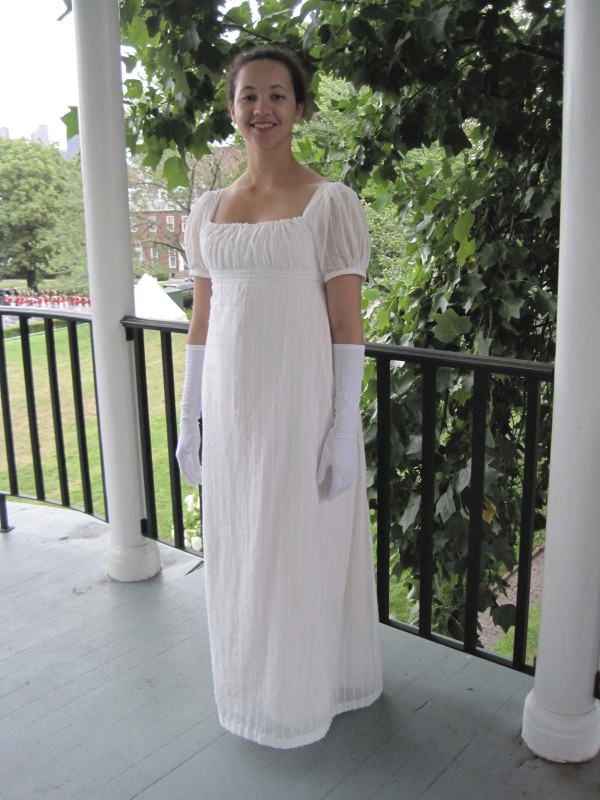
Does it look like a curtain dress? I’m sad to report that Mr. Q didn’t realize, until I explained it to him, that the idea of a curtain dress is a famous theme from Gone With The Wind… How could I have attached myself to someone who doesn’t know that? Opposites attract?

The skirt for the gown is a two panel tube, 43″ long by 110″ circumference. The front is stitched flat to the waistband and the remaining fabric is tightly gathered into the back across 13″. Center front and center back are actually the middle of the panels, so that the two seams are lost in the back gathers. The gown opens center back with hooks and eyes on the bodice and a narrowly hemmed slit that extends 8″ down the center of the back panel. The slit is also lost in the gathers. The waistband is 1″ wide. It was cut on the cross and has long tucks taken all around it so that it has three stripes spaced close together.
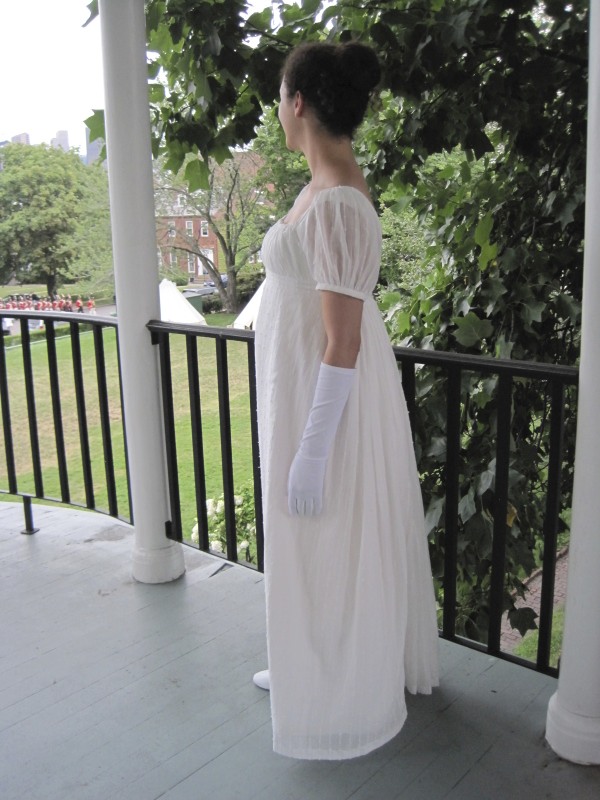
You can really see the difference between the flat front and the gathered back in this side view.

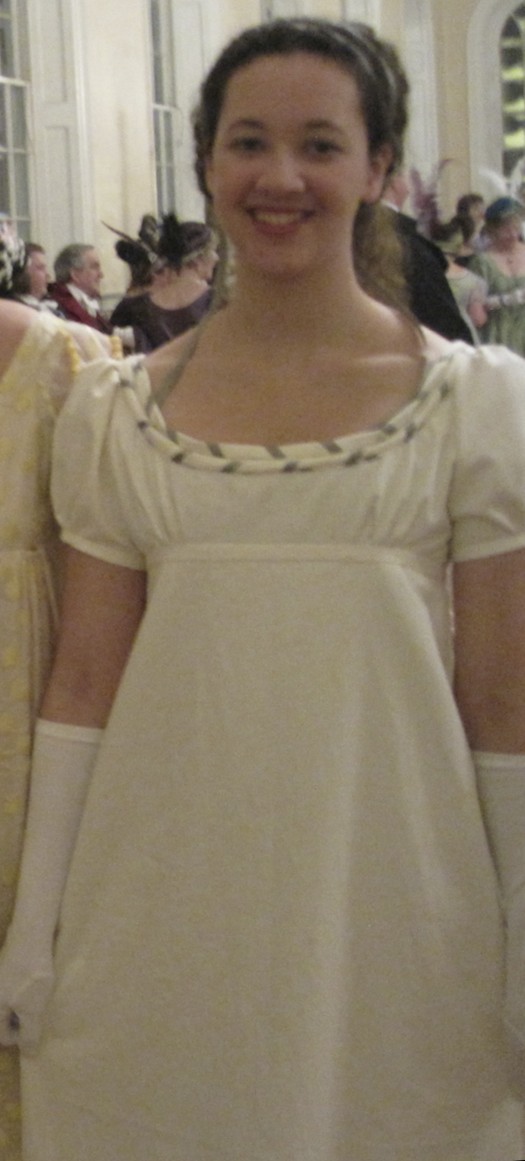
The bodice pattern is taken from Janet Arnold Patterns of Fashion I “c. 1806-1809 frock” and adjusted for fit and so that the entire front panel has a 2:1 gather ratio at the top and bottom (essentially, just more gathers than the original dress). What I really love about that pattern is the simplicity of the neckline. The bodice is cut separately from the straps, and the straps are cut on the straight grain, thus they fit really well with a wide square neck that stays square and doesn’t fall off your shoulders! GENIUS! Sometimes those historic tailors and dressmakers really amaze me with their sensible-ness. The bottom gathers are sewn to the waistband, but the top gathers are adjustable with a tie at center front. The ties are stitched to the armsceye seam allowance and can be tightened from center front then tucked inside the gown. The shoulder straps are folded in half with the fold towards the neck so that I didn’t have to finish that edge (another 19th century smart trick!). There is a stripe in the middle of each strap.

Oooo, wait, I love this picture too! Sometimes I think my smile is dorky, but not here! And the leaves make a lovely background. Anyway… you can also see the bodice details better in this photo.

The sleeves are a conglomeration of various patterns… essentially they are just a normal Regency short sleeve pattern with about 6″ extra fullness at the top and bottom which is gathered into the armsceye and the sleeve band. The sleeve bands are cut on the cross, like the shoulder straps, and on the fold. They are placed so that the stripe runs around them. I wanted them to puff more, so after these pictures I took a few tucks in the underarm seams of the sleeves so they can’t hang as low on my arms. We’ll see how that looks next time I wear the dress.

With regard to inside finishing… The skirt seams didn’t need anything, because they are selvedge edges. The hem is 1″ turned twice and stitched down with a small running stitch (stitches every 1/16″ to 1/8″). The waistband is faced on the inside with a second waistband (without worrying about having three stripes running around it) that encloses all of the gathers on the top and bottom. The armsceyes are bound with self fabric bias strips. The few bodice seams are flat felled. The top edge of the back of the bodice has a narrow hem.
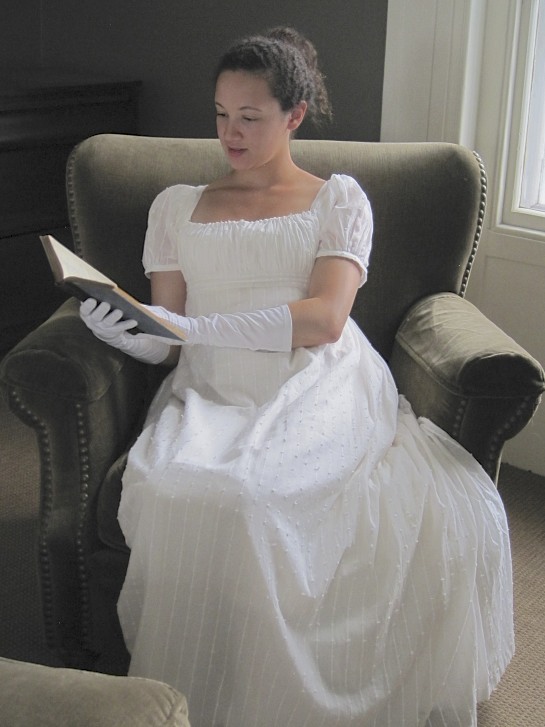
You can see the fabric pretty well in this photo.

The best part about this dress is that it is the first entirely hand sewn reproduction garment I’ve made (I think). I’ve come pretty close in work I’ve done in the past, but I’ve always used a sewing machine for inside seams and things that won’t be seen. Not so with this one. There were two reasons for hand sewing it: 1-I wanted to have the satisfaction of it 2-I had a week to make the dress and a long road trip for about half of the week I had… you can’t use a sewing machine in a moving car as far as I know… but you can hand sew! So the second best part about this dress: I whipped it up in one week, with undergarments!

I hadn’t mentioned that part yet. To accomodate the wide, square neckline and sheer sleeves of this gown, I had to make three other new pieces as well! A sleeveless chemise to accommodate the square neck and sheer sleeves, an underdress/petticoat to add some opacity which also needed to have a square neck, and a new pair of stays in white (because my only other regency pair are pink… and that would have not been subtle at all!). To be fair and honest, I didn’t get all the inside finishing done on these four garments the first time I wore them, and I did use a sewing machine for the undergarments. I was saftey pinned into the stays… I was madly hemming the underdress the day of our final dress rehearsal… and the chemise had unfinished edges… but you couldn’t tell once I put the dress on! I still need to finish some of the undergarments, actually… so hopefully once I do that I can take some pictures of them and do a post detailing their construction! Also in the works is another underdress that can be worn under this white dress. It will be a nice medium Regency-like blue.

Project Journal: 1815-1820 Regency Ensemble Part IX: Completion of the Re-made Dress! (1812 Ball 2012)

I am so pleased with my re-made 1819 dress. You can get the background here or read the sewing update here! In short, the new style shares only the skirt with its former self. The new ruffles are all hand hemmed and hand sewn on. The dress seams are a mix of machine and hand sewing, depending on if I felt like digging out the sewing machine or not. All of the bodice seams are flat felled by hand. The dress closes in the back with 4 mother of pearl buttons. Oh, and let me not forget that the dress no longer has built in petticoats. Part of the re-make was to create a separate petticoat from one of the two petticoat layers built into the dress. The petticoat ties under the bust and has a single button to close the top of the bust. It is just a sleeveless, simple version of the gown. I’ll have to take pictures sometime so I can share them. But the dress… It fits! It is ruffly! It has so much more style than it did before! Just to compare, the first picture is your first glimpse of its current style, and below that is from before the re-make.

The re-made 1819 dress, with ruffles!
The 1819 dress in its first incarnation.

Isn’t it more stunning than it previously was? I wore it to the Commonwealth Vintage Dancers’ 1812 Ball (ok, so my dress was a little forward thinking… maybe I have a time machine?). I had a lovely time, as expected. I made some new acquaintances and renewed some old ones, I was able to wear my recently purchased kid leather opera-length (which means over the elbow) gloves and a beautiful shawl one of my aunts gave me a few years ago, I got to practice my historic hair styling techniques (more to come on that point soon), and I danced! But let me stop writing, because really this post is about sharing pictures.

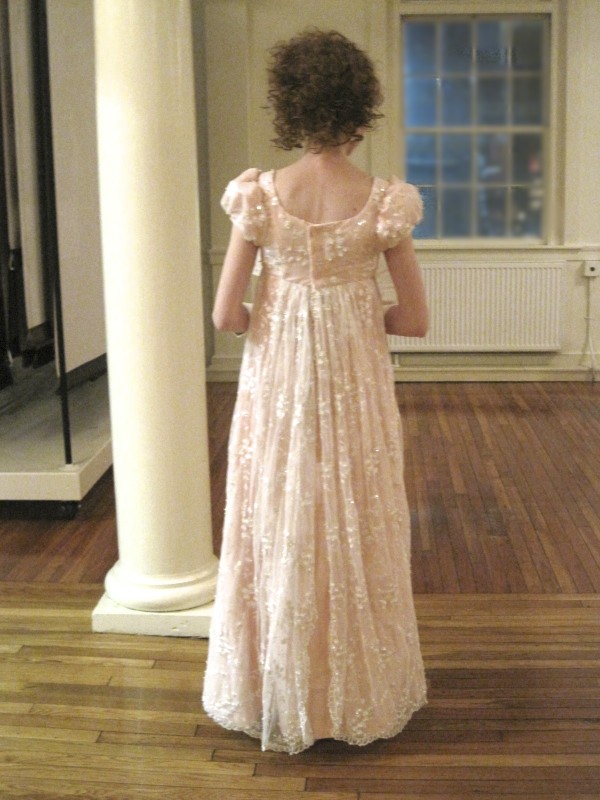
The back view of the re-made dress.
Friends: don't we make a lovely group? Ok, wait, but there's a funny face...
How about this one? Same group, but now I'm making the funny face. Rather a severe expression, don't you think?

 I’d just like to insert a comment here: looking again at these pictures, all the ruffles on the bodice of my dress really manage to make me look much more busty than I actually am… Hm… there are a lot of ruffles going on there!

My friend made this beautiful fan to go with her dress! It's hard to see the detail in this picture, but it's absolutely lovely.
Front of her new dress. She also has the super cute tiara, that is much more sparkly in person...
Back of her new dress.

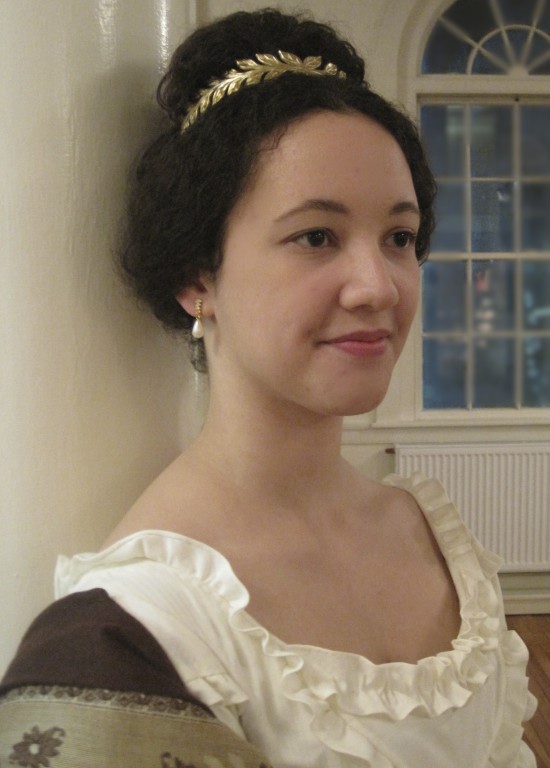
I’ll leave you with this image: a teaser for a soon-to-come post about the creation of this hair style!

Quite picturesque, I think. Thanks for taking the photos, Carly (and Mark)!

Project Journal: 1815-1820 Regency Ensemble: Part VII: Gown Progress

I’ve been stitching away at the re-make of my 1819 Regency gown. The progress:

  • the bodice and skirt ruffles are all being hemmed by hand and there is only one skirt ruffle left to complete
  • the bodice has been put together, with the exception of sleeves and the finishing of the neck edge
  • the seams on the bodice are finished by hand (each seam is flat felled to hide the raw edges on the inside)
Skirt ruffles in progress: I've actually completed more than is pictured
The hem and join of one skirt ruffle
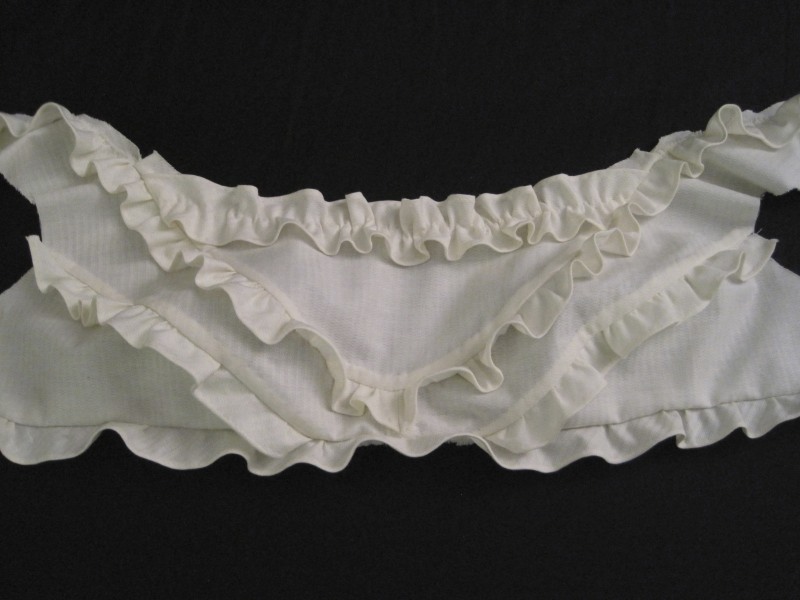
The bodice seams with ruffles inserted
The rolled hem on the bodice ruffles
Center front on the bodice has a double edged ruffle
The flat felled seams on the inside of the bodice
The flat felled seam used on each seam on the bodice and the hand sewn top stitching (which is only along these curved back seams)

Here is a refresher of the bodice inspiration image. My bodice looks like a reasonable interpretation to me. I am quite pleased with the progress and overall look so far. How do you think my interpretation compares?

The inspiration for my bodice

Lastly, here is the image of the sleeve I plan to use. I described the sleeve in my last post, an overview of my planned gown updates. The sleeve is on a page with many other sleeve variations from the 1830s, but I think that it will suit my 1819 Regency (pushing 1820s) dress quite well. I am debating the possibility of outlining the triangular inset with piping. Do you think that would suit the dress and be a faithful representation of the double line delineating the inset in the image? Alternatively, there is a possibility that I might use green piping or ribbon (the same shade of green used  in my 1819 spencer) to delineate that line. But then must I also use the green somewhere else to create visual harmony? Hmm…

From the first few pages of Janet Arnold's early 19th century pattern book