1797 Watermelon Sleeveless Bodice, Part II: Patterning & Construction

This story begins in my previous post (which you can read here) in which I share the backstory and inspiration for this garment. I’ll be carrying on from where I left off. But first, a quick side story!

Mr. Q saw the title of this post and asked “What is a watermelon sleeve?” An excellent question, I think! I explained that watermelon is my description fpr the colors of the garment I’m discussing. But… I do rather wonder what a “watermelon” sleeve might look like…! After all, there are many historical sleeves with fun names (bishop, bell, pagoda, beret, gigot, and mameluke all come to mind quickly, though I can’t think of any that are named after fruit. If you can, let me know!).

Leaving that tangent behind… back to the story!

Patterning

The pattern started with the lining pattern for the dress that I knew fit and would be worn under the sleeveless bodice as well as the bodice of “A Robe c. 1795 – 1803” on pages 44 and 45 of the original printing of Janet Arnold’s Patterns of Fashion 2. I liked the idea of the pleats on the exterior to provide interest on my otherwise solid fabric. It didn’t occur to me until very late in the process of making this garment that most of the pleats would be covered by the neck trim. Oops! Oh well! Below, a photo of the front of the bodice. The pleats are the topstitched lines running downwards from the shoulders.
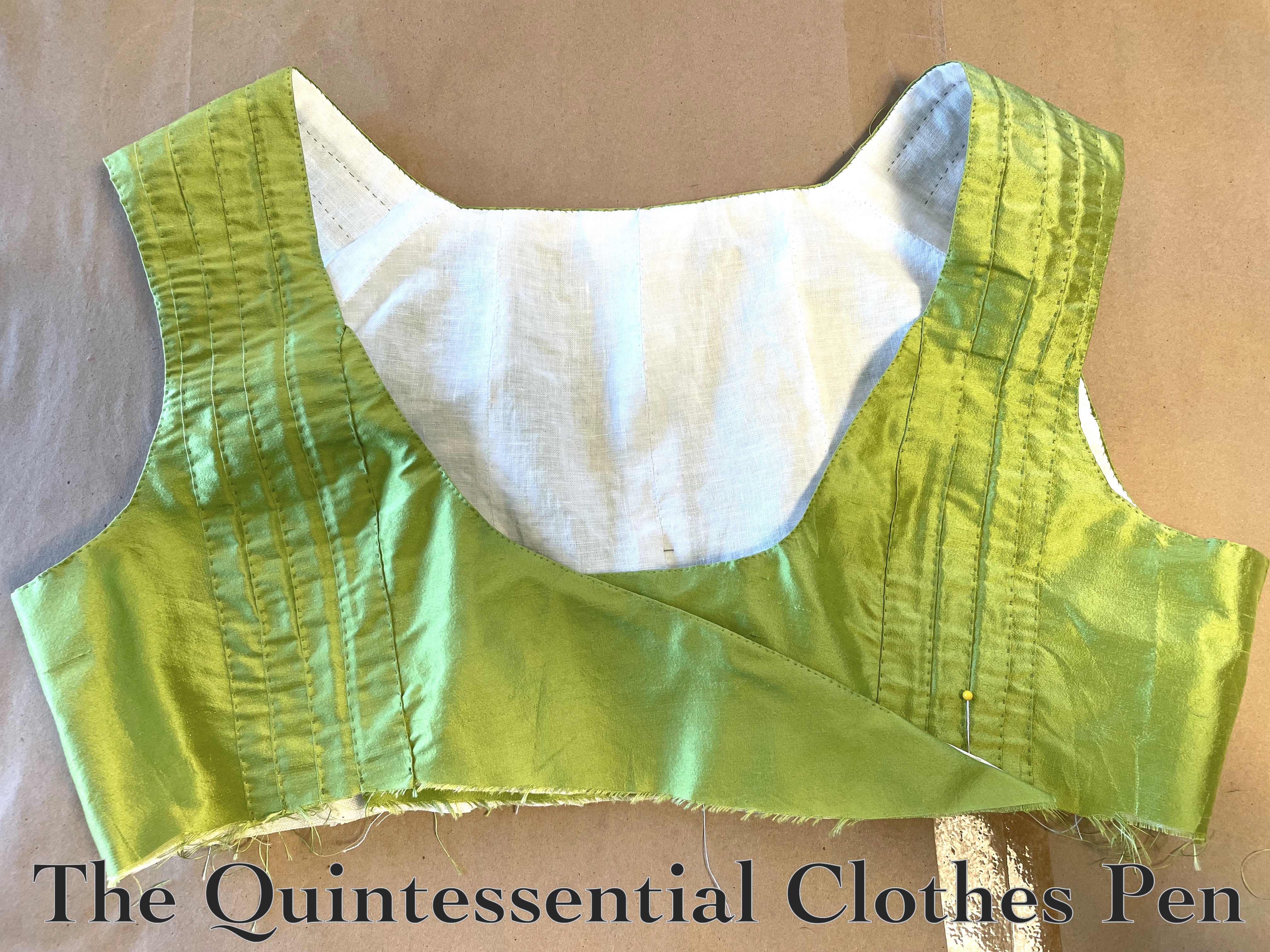
I ended up with separate patterns for the exterior and lining front pieces, but the side back and back pieces were cut from the same pattern. I’ll explain how I made them.

For the front lining piece, I started with the dress lining, as pictured below. By starting with this, I knew that the sleeveless bodice would easily fit over the dress and have similar seam lines.
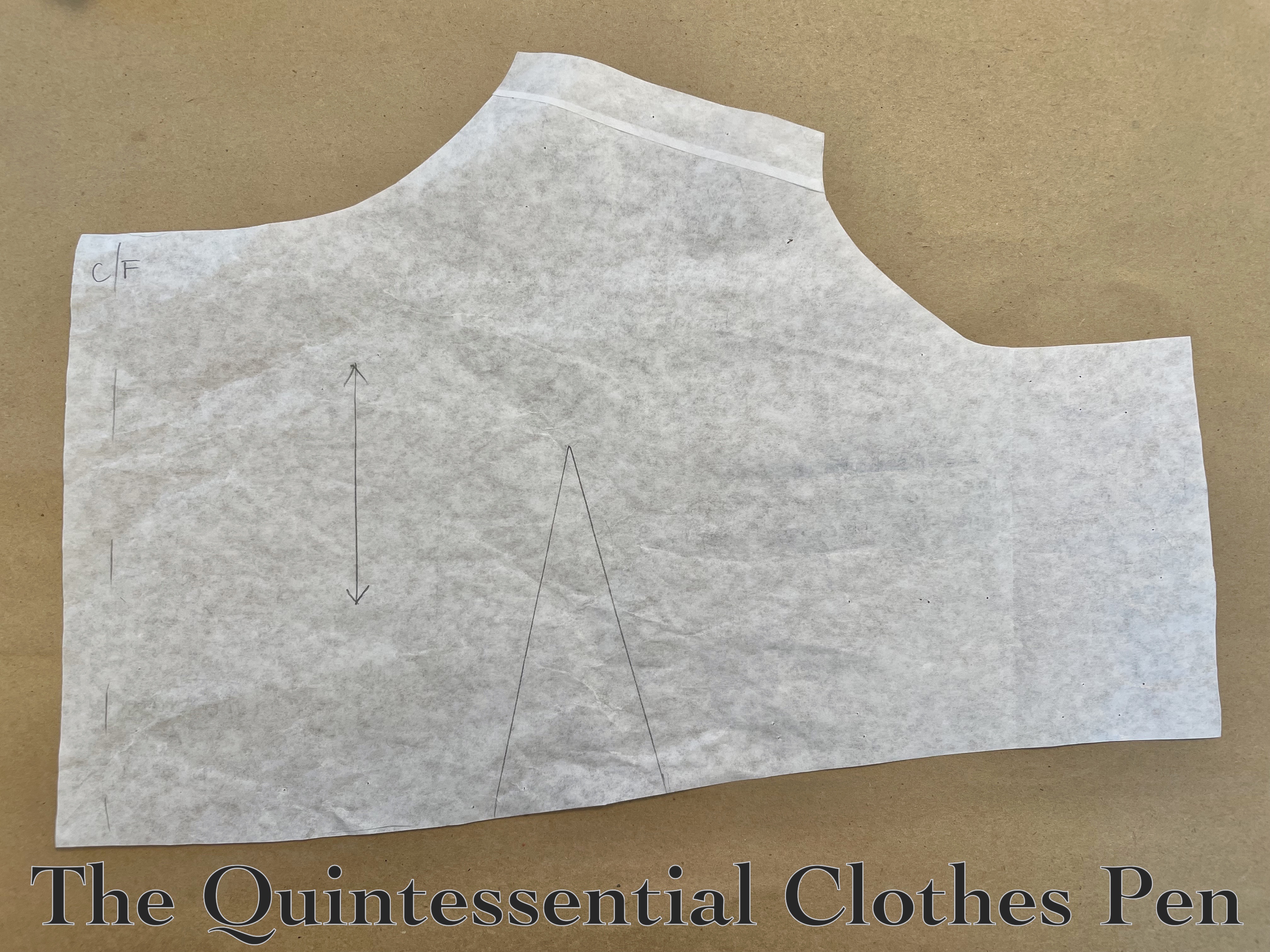
I adjusted this pattern to have a little bit of wearing ease by adding ¼” to the bottom edge, ¼” to the neck edge, ½” across the center back piece, and ¼” across the side back pieces.

To that, I superimposed the PoF robe because it had a very low front bodice (clearly intended to be worn with a dress underneath) and it had a front pattern piece that curved downward towards the front, with a separate side front piece. Ah ha! I could create a dart going towards the waist in the area between these two pieces and have a one piece lining while also easily having a two piece exterior to make the pleats easier! This would reduce bulk in the finished garment and allow for the necklines of the exterior and lining to be exactly the same.

The photo below shows the front pieces I ended up with. On the left is the lower part of the front lining (the shoulder area is extended with a separate shoulder piece in the lining) and the center front part of the lining. For the lining, these were cut as one piece (with the dart marked).
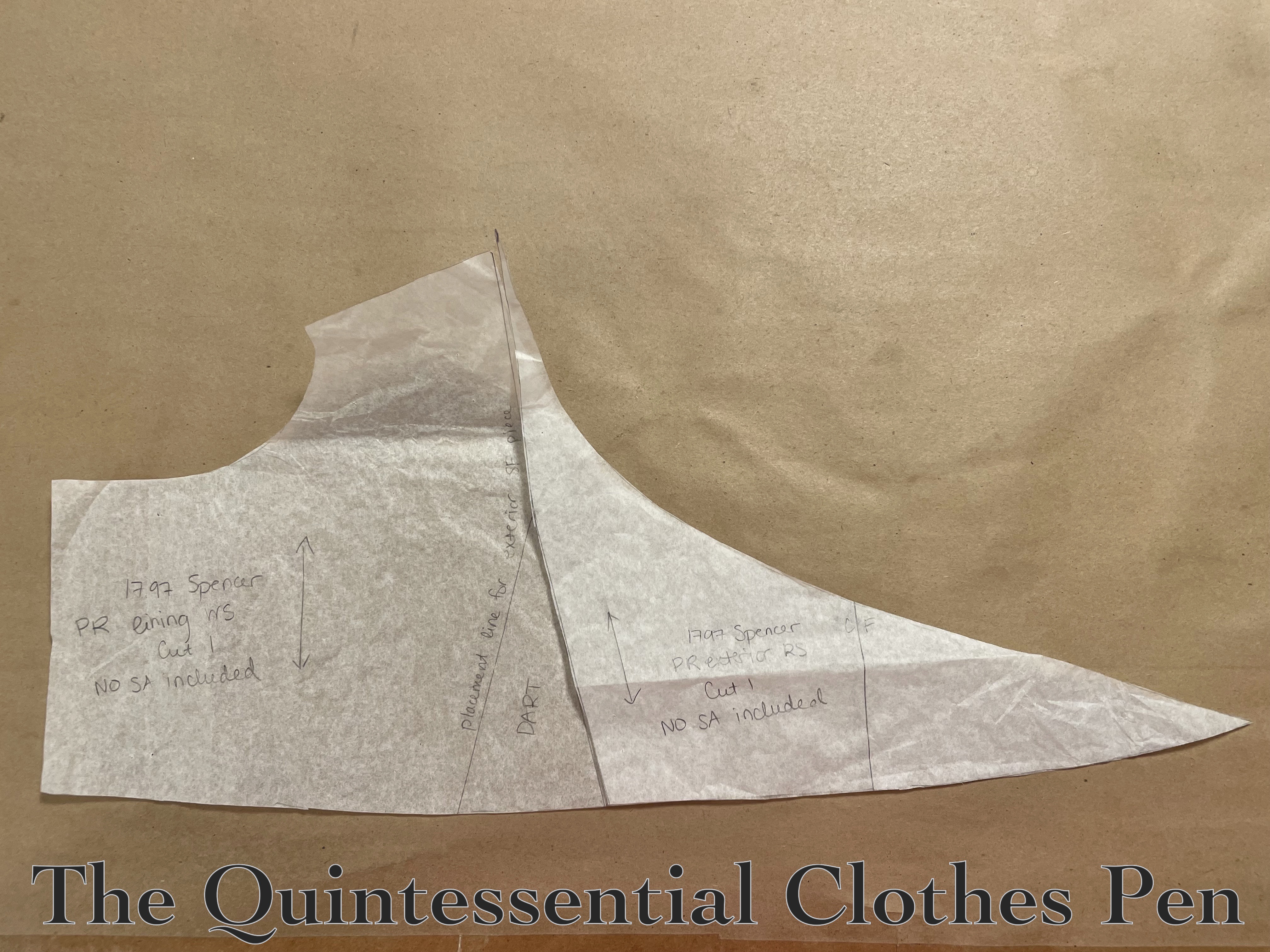
If you look carefully, you might notice that the grainline on the center front piece is off relative to the side piece. Why is that, you might wonder?

Well, for the front exterior I started with the lining piece but changed the single dart to be the pleats I’ve previously mentioned. I didn’t see bust darts in my inspiration fashion plate or observations of 1790s overdresses, but in 18th century dresses pleats are used used in varying depths to adjust a flat piece of fabric to fit the curves of a body, so I used that method.

First, I traced the lining pattern onto a new piece of paper, including the dart. Then, as you can see in the photo below, I cut along the dart edge closer to Center Front, then up a line that continued to the neck edge I wanted. (I also cut down to the bust point from two other points along the neckline, but later realized I didn’t need those cuts.)

Next, as you can see in the photo below, I rotated the center front piece down towards the dart, making that area a little narrower and creating space (essentially another dart) going up towards the shoulder. Then I drew my new grainline on the front piece for the exterior, heading up towards the shoulder. This is why it looks off relative to center front. When worn, those ‘darts’ are closed when the exterior is fitted over the lining and center front is pulled into its proper place on the body.

These exterior darts — hidden in the seam line — are what creates that downward curve to the pattern pieces that I observed in PoF.

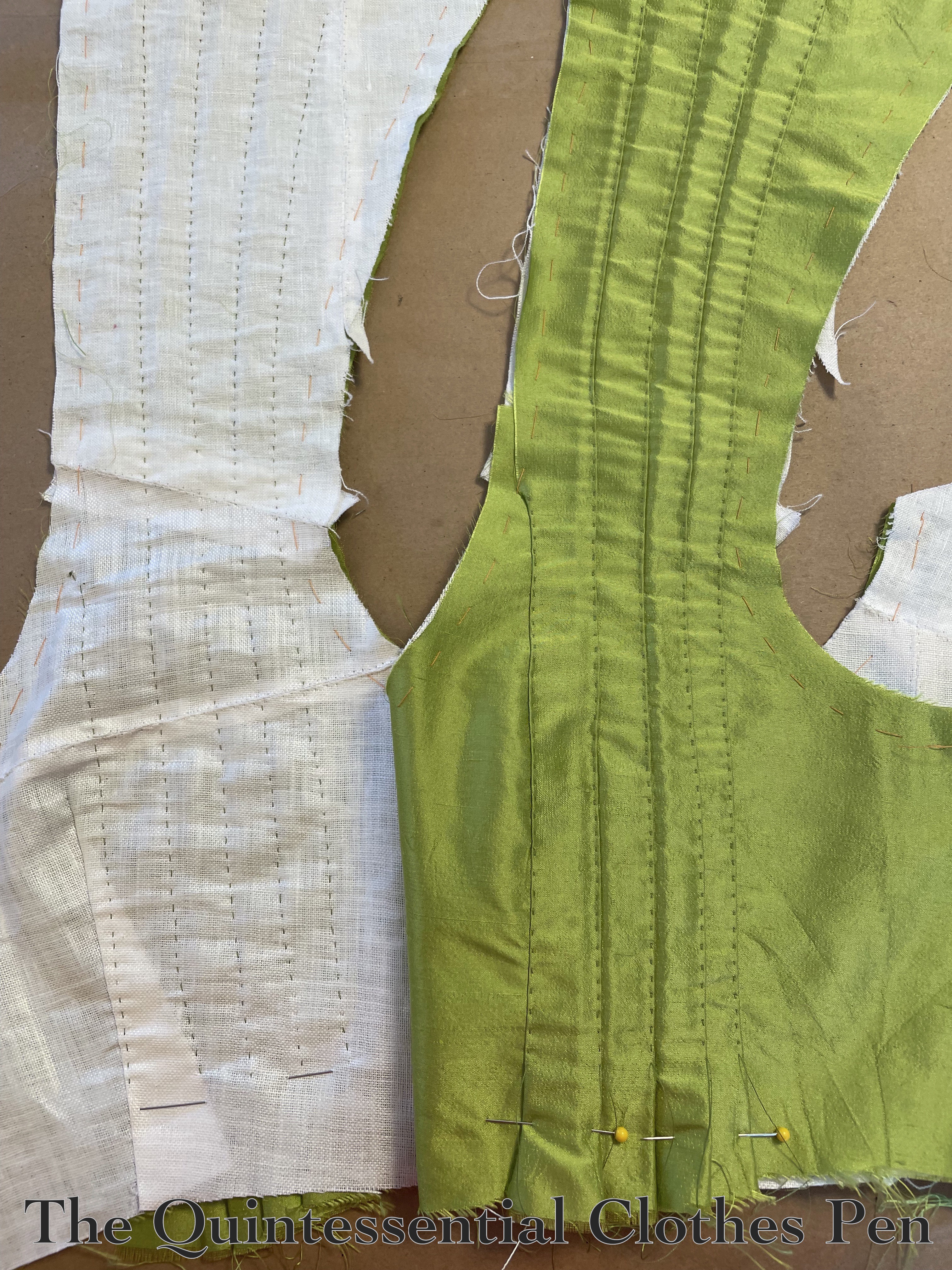
The two ‘darts’ are taken up in the pleated side front piece of the exterior, which is fitted over the center front piece and the darted bodice lining. In the photo below, the dart in the lining is visible on the left and the silk is pleated to fit and visible on the right.
After creating the paper pattern, I made a mockup and did a fitting to see how well my adjustments worked. They were pretty good, but I did have a few notes — I extended the bottom edge by a little more across the front, set the overlap shape I wanted (based on the fashion plate), set my armhole seam allowance, decided on the height of the peplum, and adjusted the front neckline to sit nicely over the dress.

I made these adjustments to my paper pattern and then moved on to cutting out my pieces in real fabric:

  • A proper left front lining
  • A proper right front lining
  • Proper left side front and center front exteriors
  • Proper right side front and center front exteriors
  • Straps in lining fabric
  • Side back pieces for lining and exterior
  • Center back pieces for lining and exterior

The Backstory: Construction

With a pattern established, I went down the rabbit hole of figuring out construction methods.

I had been reading Patterns of Fashion 6: The Content, Cut, Construction & Content of European Women’s Dress c. 1695-1795 and my mind was full of details and excitement about 18th century construction methods, so I happily went down a path of sewing in an 18th century manner! But… at some point in the middle of things I realized that I would need to combine some early 19th century construction methods into what I was doing, too, since my sleeveless bodice idea does span two different eras of construction styles.

For example, from an 18th century perspective turning seam allowances of the lining and exterior towards each other and whipping the pieces together made perfect sense. From a 19th century perspective, however, finishing the armholes with this method seemed odd (usually in the 18th century the seam allowance would have been left raw on the inside when the sleeve was attached, but I wasn’t adding sleeves!) and inserting a peplum into the bottom edge seemed odd, too (often a ruffle was applied on top of an edge, rather than being sandwiched between the exterior and lining, but that wasn’t the look I wanted). After many brain somersaults, I wound up mashing these two methods of construction together to create a transitional garment (which does actually make sense, since this was a transitional period for construction methods!).

Actually Making The Spencer

I thought it would be fun to use up linen scraps for the lining, rather than cutting into yardage from my stash. The lining pieces weren’t that big, right? Well, it turns out they were bigger than I thought. I ended up using 3 or 4 different types of white linen and adding in a fair number of piecing seams to get the shapes I needed for these lining pieces (you can see some extra seams in the lining in the previous photos). It definitely added time, but I had time while making this garment, so it was fine.

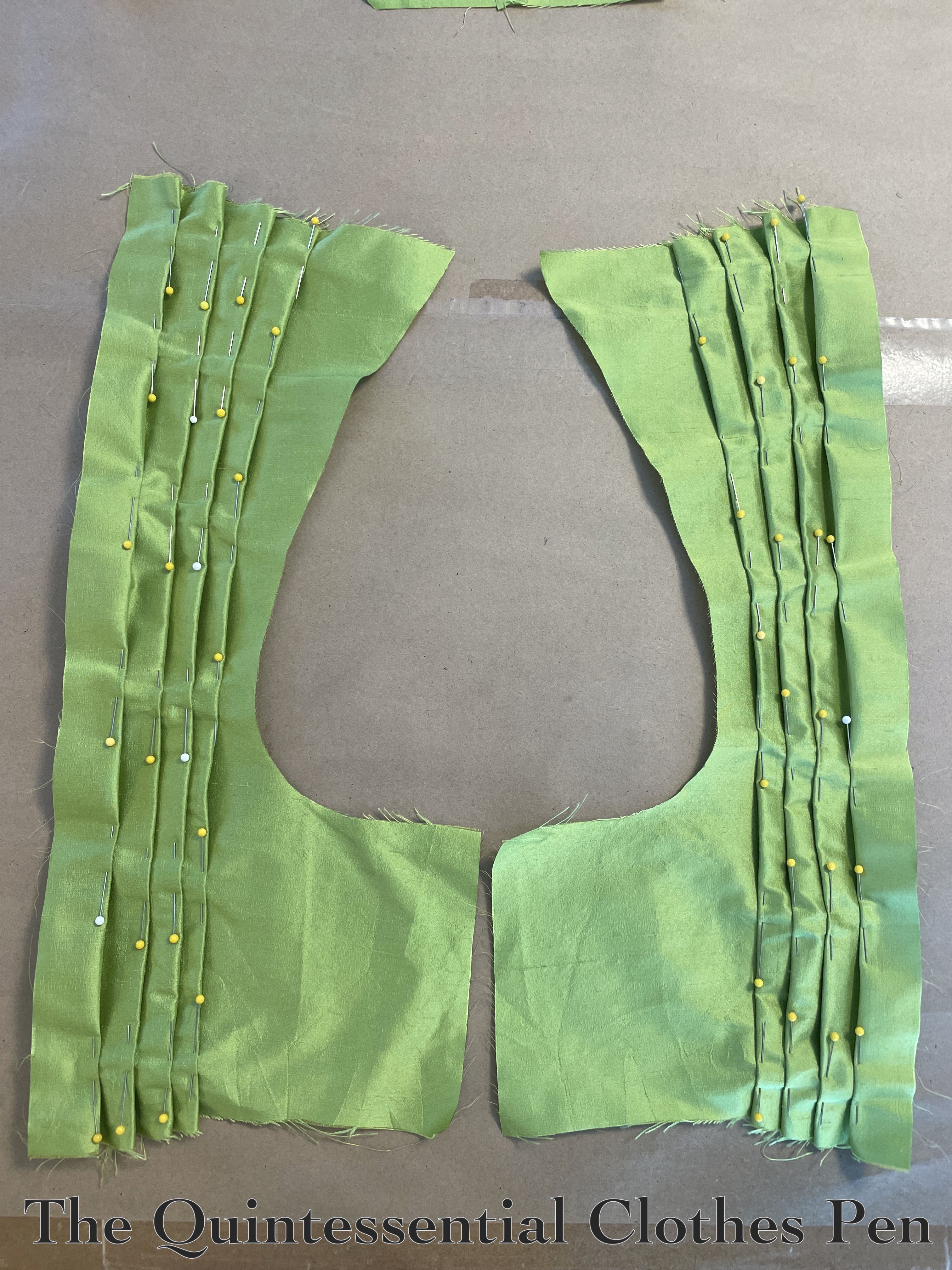
Once the lining pieces were ready to go I could cut the silk layers. The side front of the silk exterior had the shoulder straps included and was extra wide in order to create those all-important pleats. Below is a photo of what the pleats looked like before they were topstitched flat. They are not quite all the same depth and slowly spread out as they move towards the shoulder seam in the back (at the top of the photo).
Here is a summary of the 18th century elements I used in the construction of this garment: much piecing of the lining fabrics, whipping the lining pieces together along the seams, whipping the lining into the exterior around the edges, topstitched pleats in the front exterior for shaping over the bust, a shoulder seam that is topstitched onto the back piece, many edges bound in narrow strips of silk, and the neckline trim being tucked to shape around the neckline curve.

Here is a summary of the 19th century elements I used in the construction of this garment: gathering the peplum and sewing it to the bodice with right sides together then whipping the lining seam allowance on top and turning in the seam allowance of the armholes and whipping the lining into place.

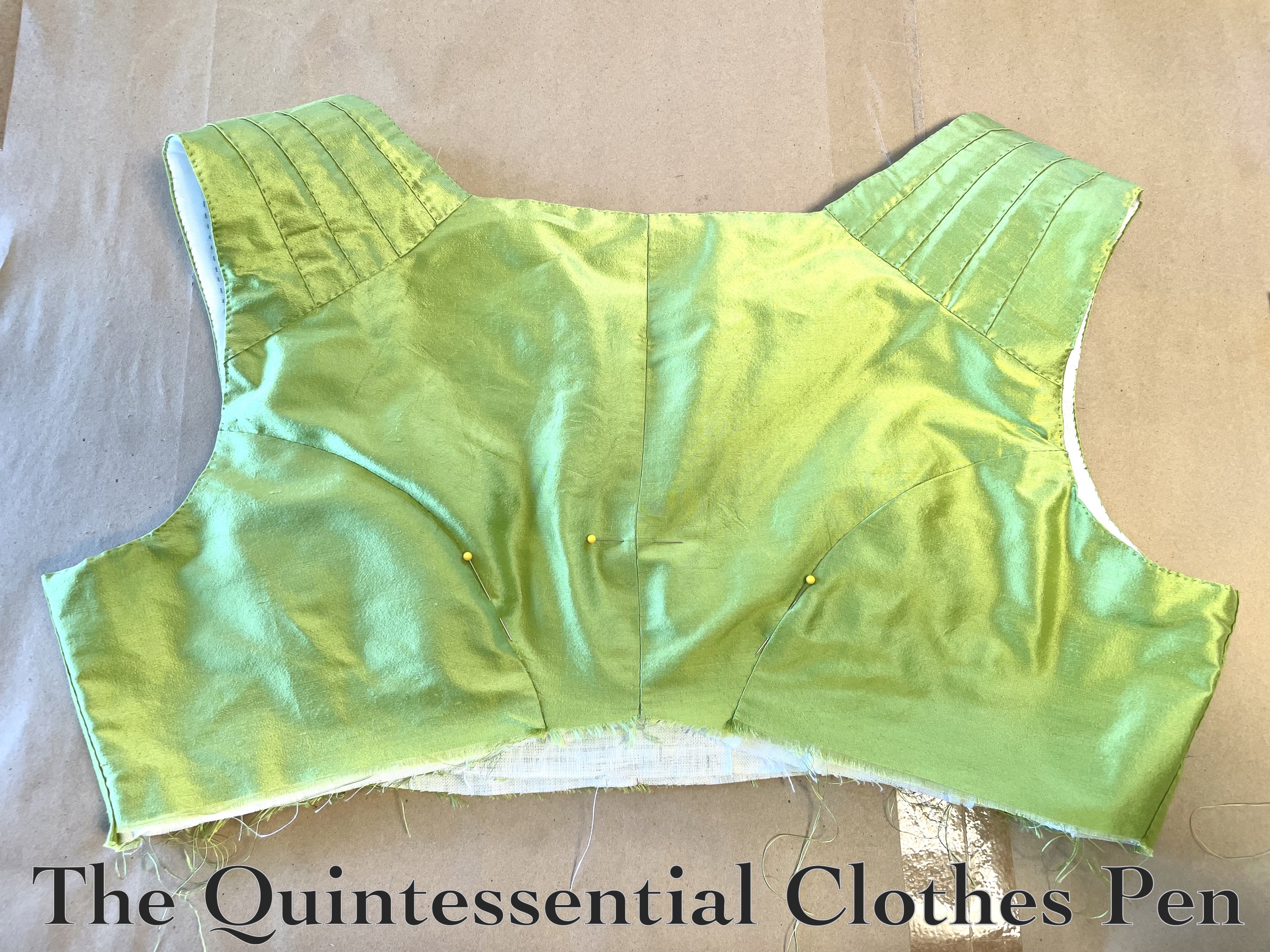
In the photo below, most of those methods have been employed to get the bodice to this state, which is basically finished aside from the peplum, neck trim, and closures.
The neck trim is a pieced strip of the green silk bound in running stitched ¼” wide strips of pink silk (hence the watermelon name!). The assembled band was running stitched along the outer edge and then eased into place around the neck edge. Below is the easing in progress. It took many pins!
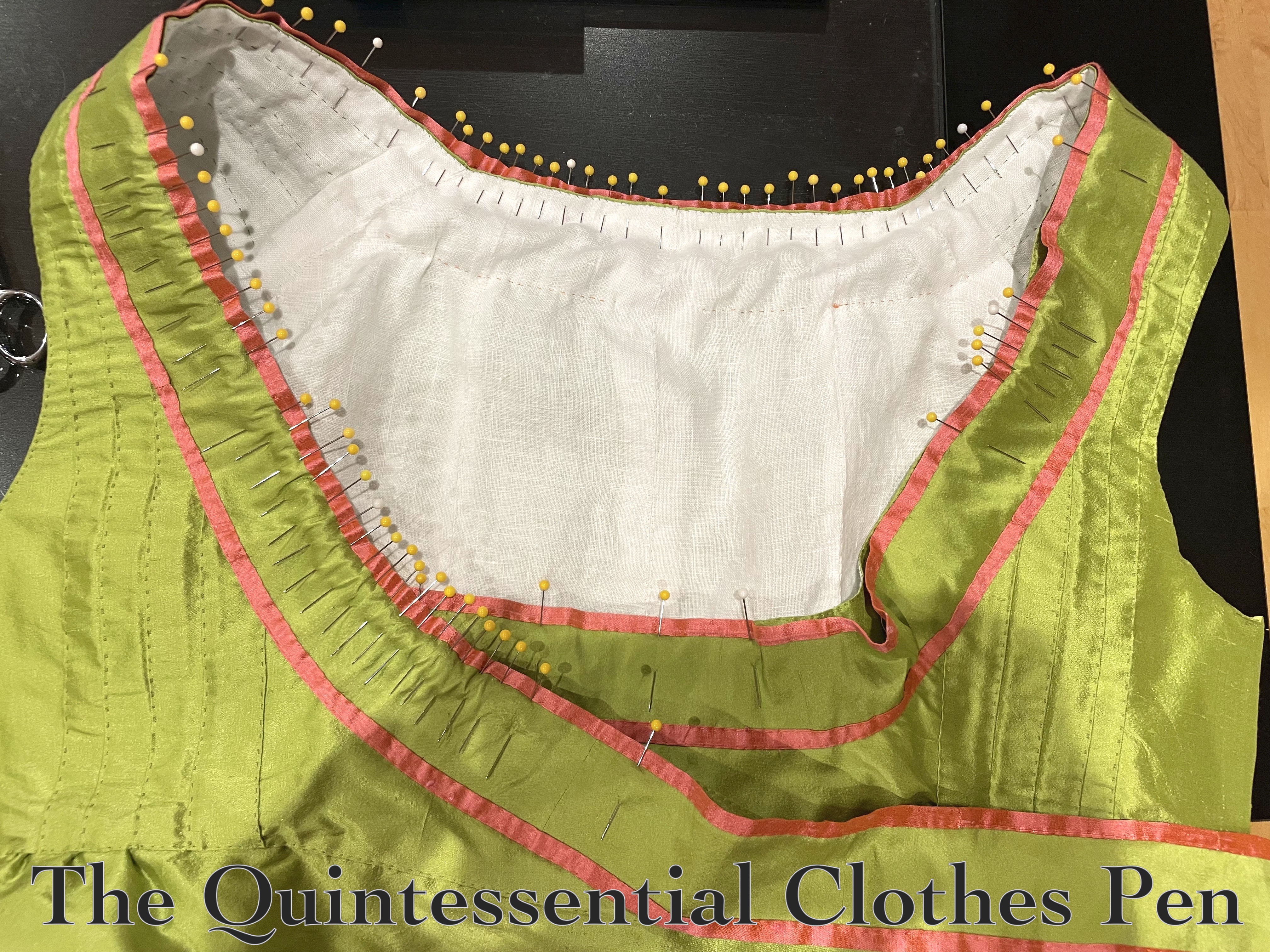
And here is a closeup. You can see some of the whip stitched piecing seams in the lining and the minute easing of the neckline edge of the trim.

And that was it…! Entirely hand sewn, with many small details, lots of justifying and research, and, in the end, a relatively small garment! Next time, photos of the finished garment being worn!

c. 1785 Stays (Of Fail), Part II: Fitting Update

In March 2022, I had another fitting on the pair of stays I started posting about recently. I tried a few different things and some seemed to work. It gave me hope!

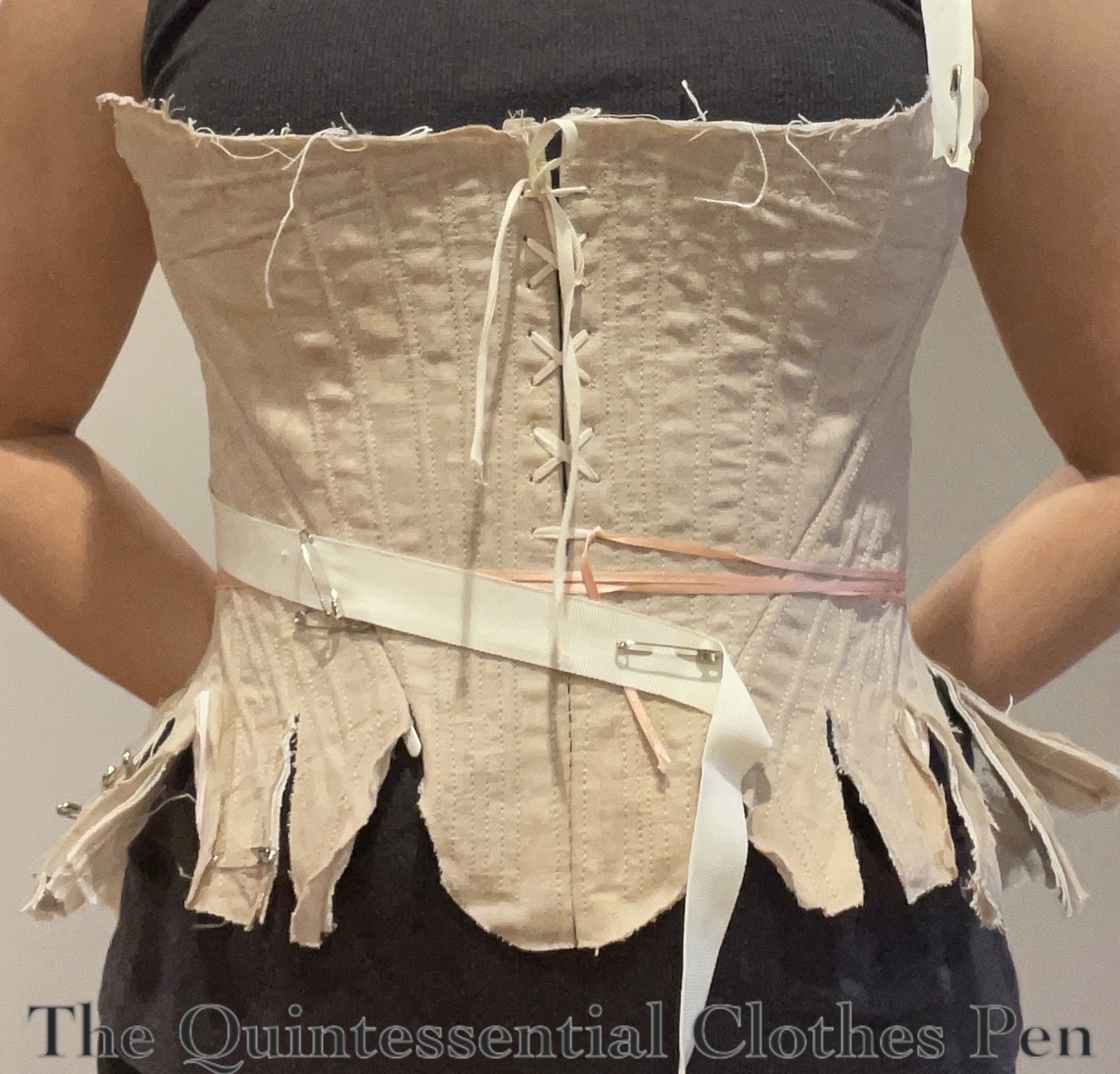
I decided to add tape straps to these stays, partly to help counteract the back pulling away from my shoulder blades and slouching in towards center. This method of straps comes this pair of stays at the McCord Museum (accession number M969X.26), which is dated 1785-1790.

The idea has intrigued me for awhile and specifically appeals for this project because I didn’t like the fit and feel of the attached fabric straps and had already cannibalized them to make gussets, anyway.

Adding the tape helped the stays feel better, but the gussets were still a problem. I decided to move the gussets up higher by about 3″. I didn’t have quite enough fabric length to do that but I decided to piece on additional sections at the bottom. Piecing is completely period and seemed like a better idea than not having stays that I could wear!

Additionally, I maxed out the seam allowance on both sides of the gussets and the abutting pieces. I’m hoping those things will help narrow the back gap. I’ll also add a new boning channel in the gusset.

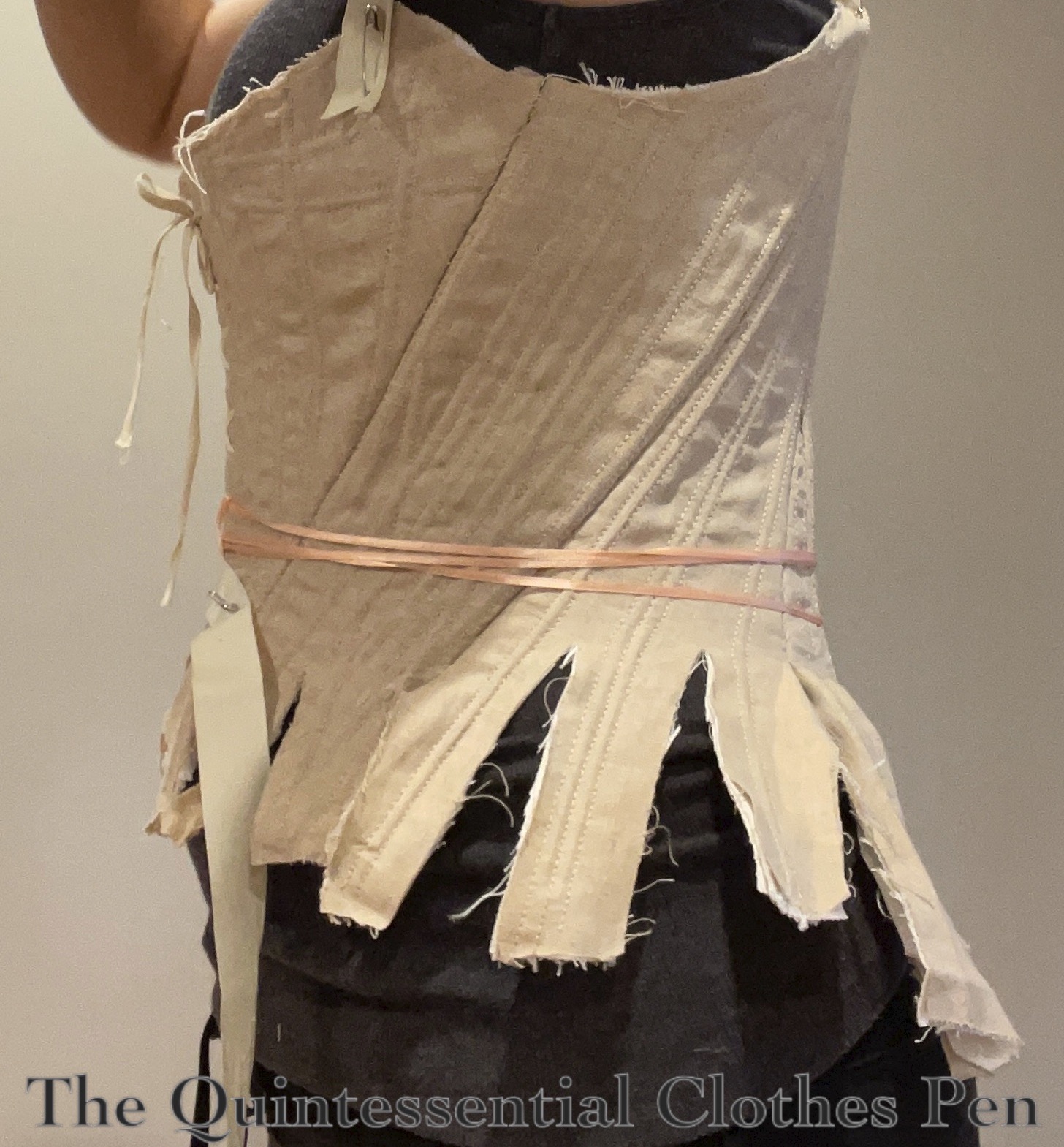
In terms of fit, the side view actually isn’t bad with the added strap!

The tape shoulder straps wrap across the back and then will hook in the front. For the fitting the test strap is just safety pinned. Other pins are marking where the strap hits as well as the finished length of the tabs.

After this fitting, the to do list includes:

  • resetting/piecing the gussets and adding boning channels and boning to them
  • whipping the edges of the stays in preparation for binding them
  • binding the edges of the stays
  • adding the tape straps for a final fitting

I’ve been very busy, so those things are moving along quite slowly. I did update the gussets and start whipping the edges, so there is some progress.

That’s all for now. Next post, I’m going to go back to the early construction details of these stays.

Project Journal: 1880s Steam Molded Corset: Mockups/Patterning

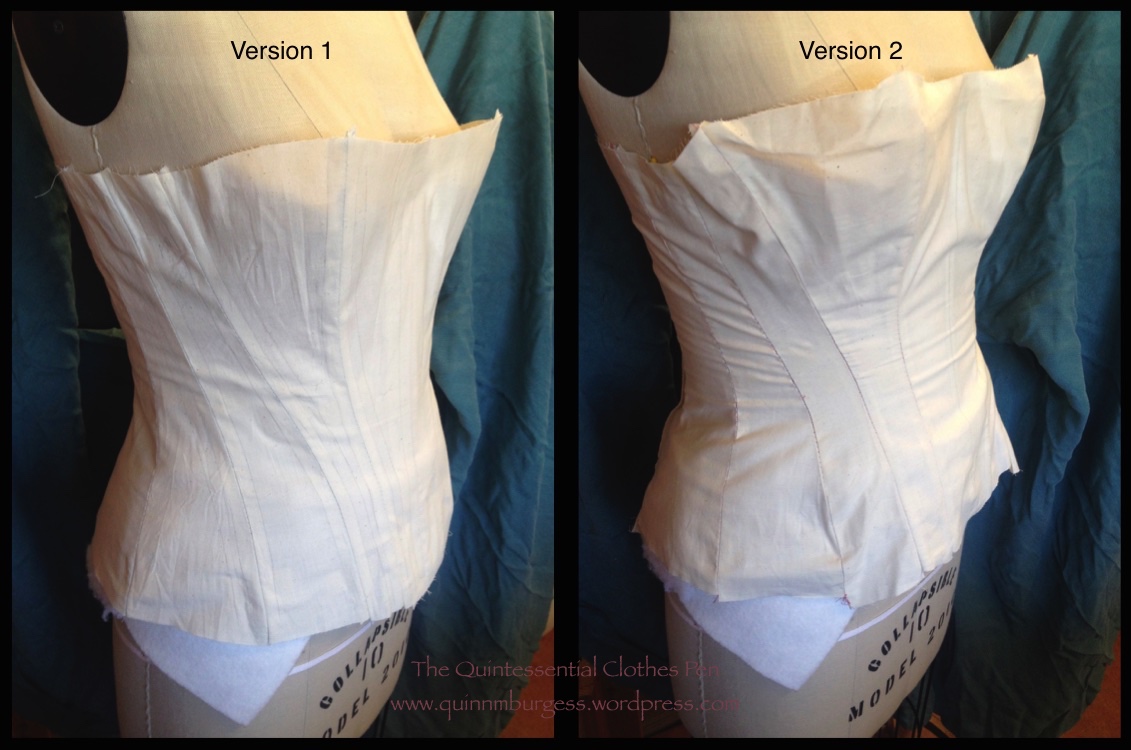
I began the patterning process for my new 1880s corset with the late 1880s corset in Norah Waugh’s Corsets and Crinolines. I immediately had to adjust the pattern for size, as is often the case when using scaled historical patterns. While doing that, I also made some initial guesswork at adjusting the pattern to get the curvy seam lines in my inspiration corset at the V and A.

The result was a perfectly usable pattern for an 1880s corset, but the pieces didn’t have the exaggerated curvy seams I was looking for. So I started playing with the pattern pieces from the first iteration and came up with a second mockup that was satisfyingly curvy. The back pieces didn’t change, so I’ll only show a comparison of the fronts and sides. The noticeable differences are in the silhouette of the bust and hips. (I roughly padded out the dress form to be shaped like me, but being rather un-squishy, as dress forms often are, the corset mockups aren’t really filled out as they would be by a squishy body.)

Untitled 2
Front.
Untitled 2 (1)
Side front.

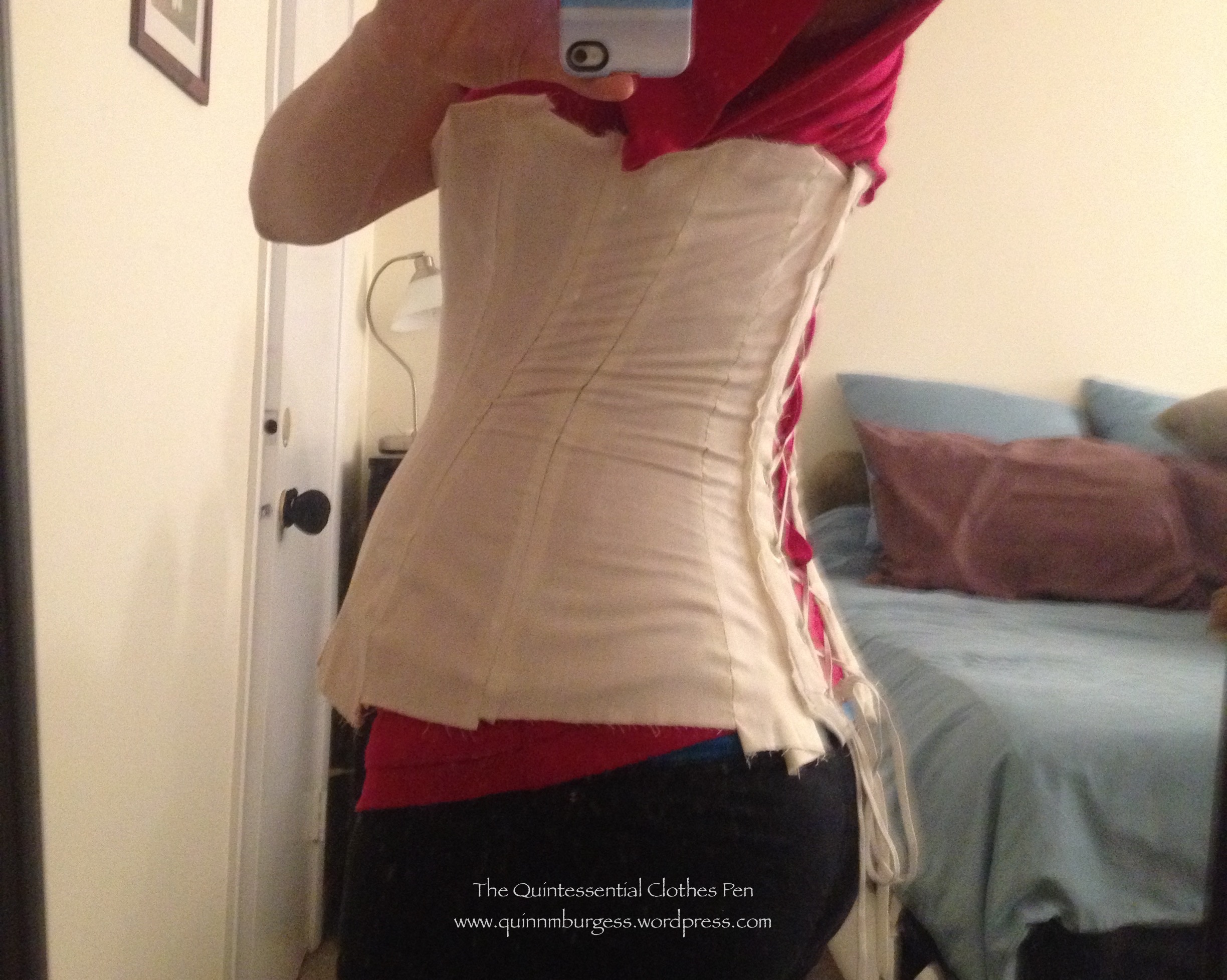
I didn’t take pictures of the first corset mockup on me, but I did take pictures of the second one, to give an idea of how it fits onto a squishy real body. The mockup corset is made from a single layer of muslin, with spiral bones taped onto the seams and a wide flat bone at the front to simulate a busk. The back has lacing strips basted on. I didn’t have help taking the pictures, so you’ll have to forgive the awkward angles!

IMG_2211
Front.
IMG_2210
Side front.
IMG_2214
Side.
IMG_2217
Back.

After the second mockup/pattern I still made a few changes, such as truing the pattern pieces so the edges that meet are the same length and some other small adjustments such as taking in the bottom front pieces a little to keep them from standing away from my body. The largest change I made was to change the seam closet to the back grommets.

You can see in the back picture how the seam lines are rather vertical once the corset is on my body, which didn’t seem to match the curvy seams on the front of the corset. Unfortunately, the V and A doesn’t have any pictures of the back of my inspiration corset online that I have found, so I had to turn to other extant 1880s corsets to look at seaming (and bone placement, but I’ll discuss that in my next post). I settled on the image below as my inspiration for the back of my new corset.

8af42269aeecc4fb8255d408c916c8d5
1884, French, The Met

As with the front pieces, I noticed that the curviness of the seams is distinct as the corset goes over the hips and up the torso, but my second mockup didn’t have enough curve in these areas for my taste. So I went back to my pattern and made new pattern pieces for the two back pieces to adjust the seam line.

And that’s a great place to end this post. The next post in the series will be a comparison of the two patterns, looking at the pieces themselves.


Trouble In Curtain Land

A few weeks ago, I was super excited and motivated that I had time to work on my Curtain Along jacket. I made the changes I had deemed necessary from my last fitting and was feeling good about getting it done and how much I liked it… but then I tried it on again to determine center front and decide about trim… and there were new problems, and I was so discouraged!

The problems sum up in the following way:

Problem #1- The sleeves that go with the jacket in Janet Arnold just do not work for me without serious alteration. The crown isn’t large enough for me to be able to move or be comfortable, and the sleeve is at least 4 inches too short. With the sleeves set in the jacket was pulled all over the place and was so unbearably uncomfortable! And the annoying thing is that in the mockup the sleeve worked!

After ripping the sleeves out, and being thankful that, at least, they were what was causing the bodice to do all sorts of wonky things, I bounced back and came up with a solution. I’ll use the sleeve pattern from my 1780s Robe A La Anglaise and recut the sleeves. I’ve got extra Mineral Felicite fabric, so that’s no problem. On the other hand, I have only tiny matching linen scraps left. Of course, it would be totally period correct to use a different linen to line the sleeves than what I used to line the bodice. But piecing is also period correct, and I decided to use all my tiny matching linen scraps to piece together pieces big enough to cut out the new sleeve pattern.

IMG_4850
Extreme piecing. I’m amused by it at this point. This sleeve is only partially completed (there is more piecing to be done!) but you can see the original pattern shape.

I haven’t finished piecing, or cut out the new Mineral Felicite sleeve, or sewn the new sleeves in… but I think that my solution will work, so we’ll call that problem solved. Whew!

Problem #2- After my initial fittings, I had to add an extension to my center front pieces to get the jacket to close comfortably and without wrinkles. It barely closed in my mockup and I thought it would be enough, but in the real fabric it just wasn’t. So I pieced on extensions. Piecing is totally period correct, but this piecing is so… obvious and symmetrical.

IMG_4841
Center front piecing. The yellow headed pins are my center front line. I haven’t done anything about center front since I put those pins in!

This problem is still unresolved. Plus, I can’t decide how I want the jacket to close, anyway. Pins? Hooks and loops? If you have any thoughts about the piecing problem or the closure indecision, please do share!

Problem #3- Trim! I was going to trim the jacket with box pleated blue silk ribbon around the neck, front, hem, and cuffs. I thought I had enough ribbon (6yds), but in the end I think I have not quite enough to trim all of those edges. AND, the blue didn’t seem to pick up the blue in the print as much as I originally thought it did, and I’m worried that even if I do less pleated trim (say, not the sleeves, or something) the trim will look super costume-y and not 18th century. I also have a gold silk ribbon (5 yds). Not enough to trim the whole jacket, but what if I scrap the idea of trimming the edges and instead do some sort of center front bow trim/something of some sort to hide the piecing using the gold? I think the gold looks nice… but what sort of trim would I do that wouldn’t look made-up and costume-y???

IMG_4847
Blue silk ribbon. There’s blue in the flowers, but perhaps not enough blue to make the blue ribbon make sense???
IMG_4848
Gold silk ribbon. Too match-y?
IMG_4844
Blue and gold together, for comparison.

I  have no idea what I’m going to do about the ribbon issue. Bows at center front seem to be used on stomacher front jackets, and stomacher front jackets seem to be exclusively pet en l’air styles. This jacket is not a pet en l’air, though it could be altered to have a stomacher front (thus eliminating the piecing issue). Sigh. I just think myself around in circles. So again, I appeal to you! If you have any thoughts, please share!

Help! I’d really appreciate it!

Project Journal: Victorian Women’s Tailoring Part VII: Fitting 1913 Garments

Finally, here are some pictures of my fitting for my 1913 tailored look!

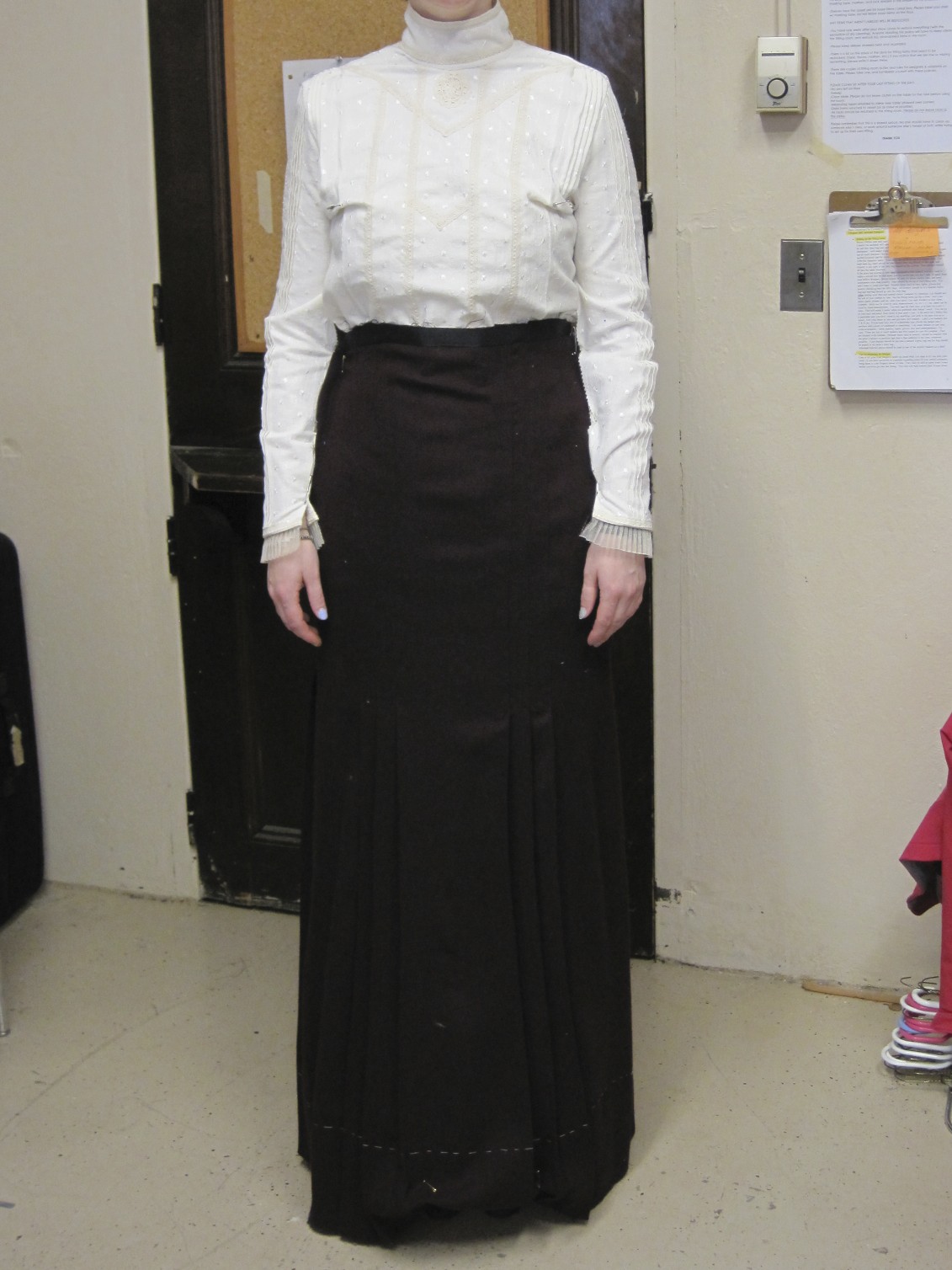
We’ll start here, where you can see the mostly dressed view. This look is a tailored suit from 1913. In the picture you can see the pleated skirt. I actually wound up making the finished length longer than I originally thought I would.

The skirt is worn with an Edwardian blouse featuring cluny lace, pin tucks, pleats, and pleated cuffs.

To the right you can see the look with the unfinished jacket and hat. The jacket still has a mock-up collar and at this point there is no facing, so the interior canvas is visible on the lapels of the jacket.

This period is a strange mix of Victorian holdover clothing (like the blouse) and 20th century clothing (the tailored suit).

Under the skirt are undergarments that have slimmed down since 1883 and 1903 while still remaining numerous and Victorian in principle. On the left you can see the full length chemise which still features lace, pin tucks, and silk ribbon. The silhouette has narrowed considerably from the Victorian shapes of the 19th century, but the whole look is Victorian, not modern. The corset is much longer at this time, but the bones stop about four inches above the bottom edge so that movement is not impaired. This corset is constructed of a silk/linen blend that is flat lined with coutil. The seams are flat felled on the inside. It is edged in the same fabric cut on the bias. The top edge is also edged with lace and silk ribbon. To the right you can see the corset cover for this look: simple and straight forward, with just a small edge of lace. There is also a matching fabric petticoat for this look. The petticoat (or underskirt) is edged with a pin tucked ruffle and finished at the bottom with matching embroidery. It closes at the waist with a hook and eye. The chemise, petticoat, and corset cover are all constructed of the same ivory cotton.

Project Journal: Victorian Women’s Tailoring Part VI: Fitting 1903 Garments

Well, if you remember from a few posts ago, I completed my mockup undergarments and exterior garments for this 1903 look in muslin (the same fabric I used for the 1883 and 1913 mockups). But now I’ve completed first fittings for my garments in their actual fabrics!

Let’s start at the outside and work our way in. The exterior “suit” is two pieces: a jacket and walking skirt. Both layers are constructed of fairly heavy wool, so tightly woven it is almost like melton. Melton is a felted wool frequently used for outerwear and constantly used historically for it’s water resistance and ability not to fray–thus allowing tailors to leave their cut edges raw and not finish them with time intensive seam finishes. The walking skirt is intended for use out of doors: specifically for talking walks (hence the name) and promenading about in the public eye.

Under the jacket is a silk crepe blouse with a lace yoke, collar, and cuffs. If you look closely you can see the three points of the lace yoke on the blouse. The blouse is pulled off-center in this picture because of the alterations I needed to make-only one side has the alterations pinned.

Under the skirt there is a cream colored lace edged silk shantung petticoat. The petticoat has two circular, gathered ruffles at the bottom. The top ruffle has a wavy hem edged in lace and the bottom ruffle is edged in matching lace. There are also arches of lace above the ruffles.

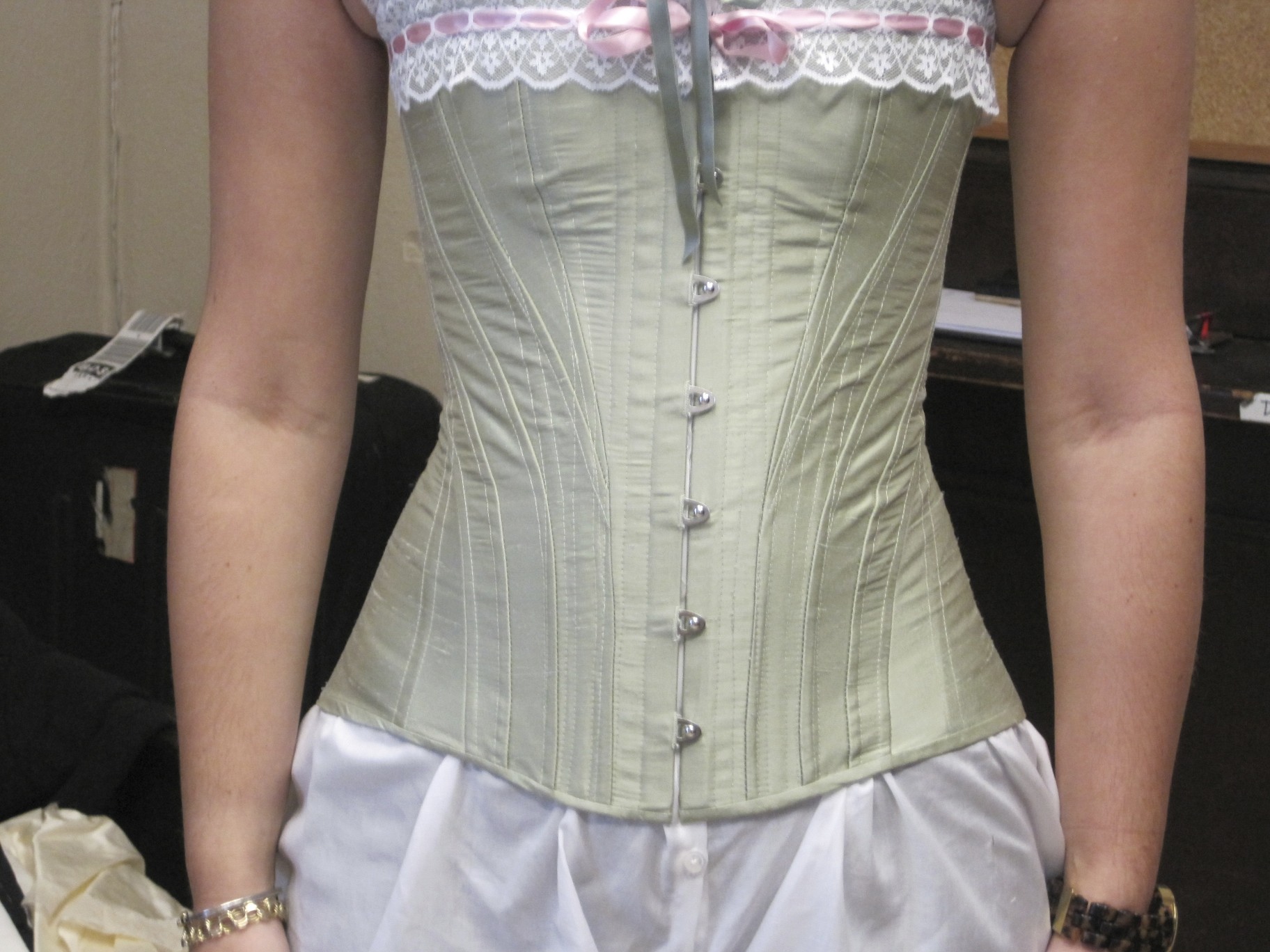
There is also a cream colored corset cover that is not pictured in these photos. This s-shape corset is made of green silk shantung flat lined with coutil. The seams are flat felled on the inside. The edges are bound in bias cut shantung and the top is also edged with white lace threaded with pink silk ribbon. Under the corset is a cotton combination that buttons up the front. A combination is an undergarment that is functions as a chemise but has bifurcated leg openings, like drawers. This pair is edged in white lace at the leg openings and neck edge. The neck opening is threaded with a green silk ribbon to coordinate with the corset.

Project Journal: Victorian Women’s Tailoring Part V: Fitting 1883 Tailor Made Suit

As you saw in my last post, the undergarments for my 1883 look are complete. The understructure, especially the corset and bustle, is essential to the creation of the silhouette in 1883: without these pieces the exterior garments would crumple and sag. The thing is, the exterior garment is tailored to fit this exact shape: if that silhouette is not created by the undergarments then the exterior garments just don’t fit!

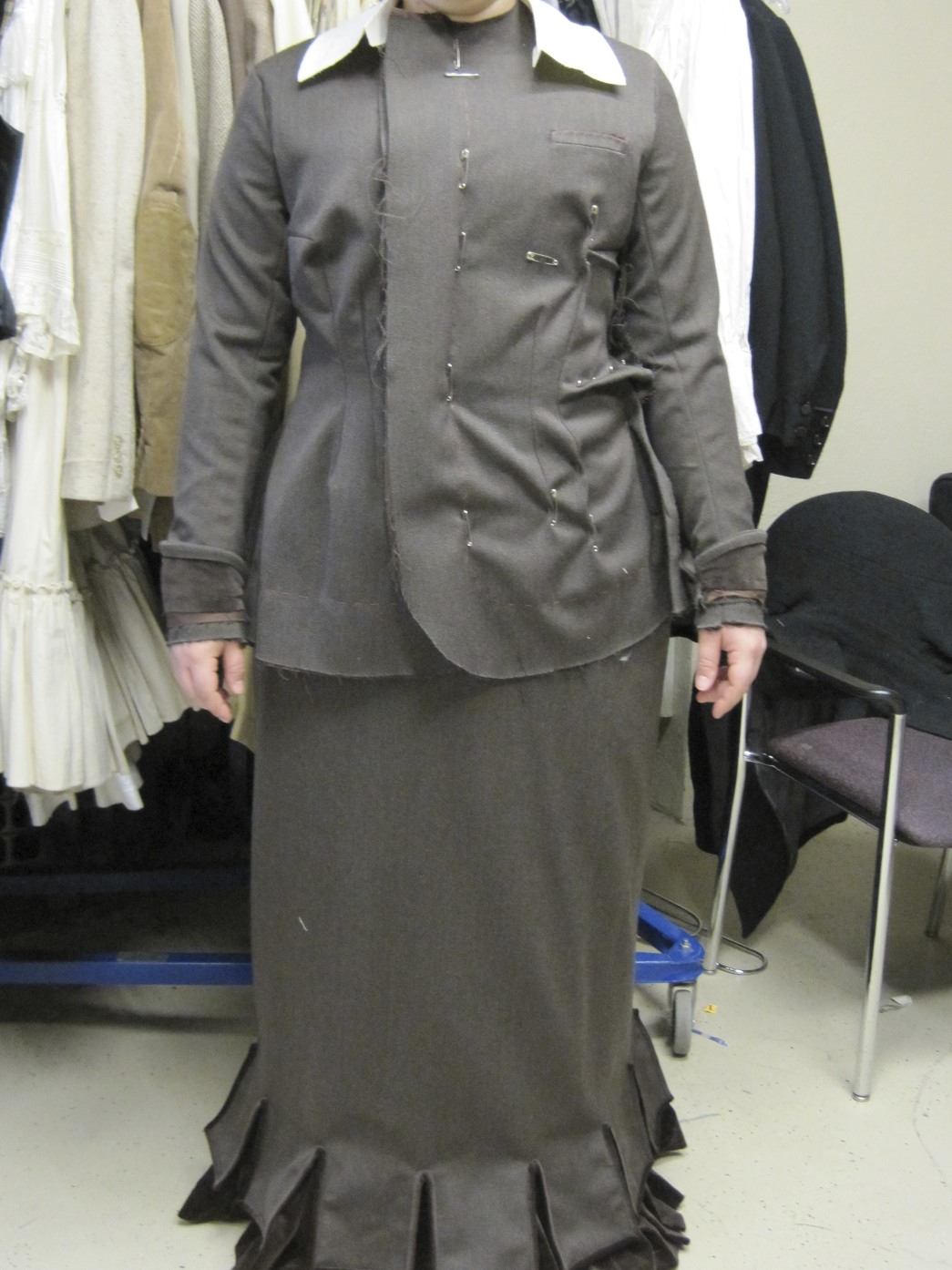
Let’s take a look at the exterior garments. First, the skirt. This skirt is many layers: the one you can see now I call the “foundation skirt.” It is the part of the skirt that hangs from waist to floor without any draping on it. In reality, the foundation skirt is actually made of two layers. The first layer is the one you can see with the velvet knife pleats along the hem–the knife pleats are 10″ high (ending just above the tabs in the wool)–but don’t be fooled, the knife pleats are attached to a cotton underskirt that extends up to the waist. Why? Multiple reasons: 1-this skirt is already super heavy with just one layer of wool and the velvet trim, and I haven’t even added the drapery yet; 2-the skirt is already super warm as well, it would be too warm with velvet all the way to the waist; 3-the Victorian mindset was to not waste precious money on beautiful fabrics that weren’t seen, so this technique of using cotton underskirts edged with fancy trim is very common; 4-velvet rather than cotton would add more bulk  to the circumference of the waist, and the goal is to make the waist as small as possible. You can’t see the pins, but I did have to make alterations at the waist, since the bottom edge was already finished. There are more skirt layers coming: a gathered and draped “back drape,” and an asymmetrically pleated “front drape.”

The jacket is the other exterior garment. This garment is actually a really good example of the alterations I almost always have to make before I am able to finish a garment. The left side is how the garment fit when I put it on my model. On the right side you can see all my safety pins moving and adding darts to make the jacket fit better. Although it looks wrinkly, once I stitch all those alterations it will actually allow the jacket to fit smoothly over the torso. You can also see my mockup collar on this jacket.

What comes next? Well, because I needed to basically take out all my front darts and seams and move them, I had another fitting with my model before starting to finish the garment. Unfortunately, I forgot my camera! I’ll try to finagle pictures, but they’ll be coming later. After the second fabric fitting I move on to finishing my garments completely!

Project Journal: Victorian Women’s Tailoring Part IV: Fitting 1883 Undergarments

I’ve put together my actual fabrics! First to fit is my 1883 undergarments. These garments are essentially finished and ready to be worn.

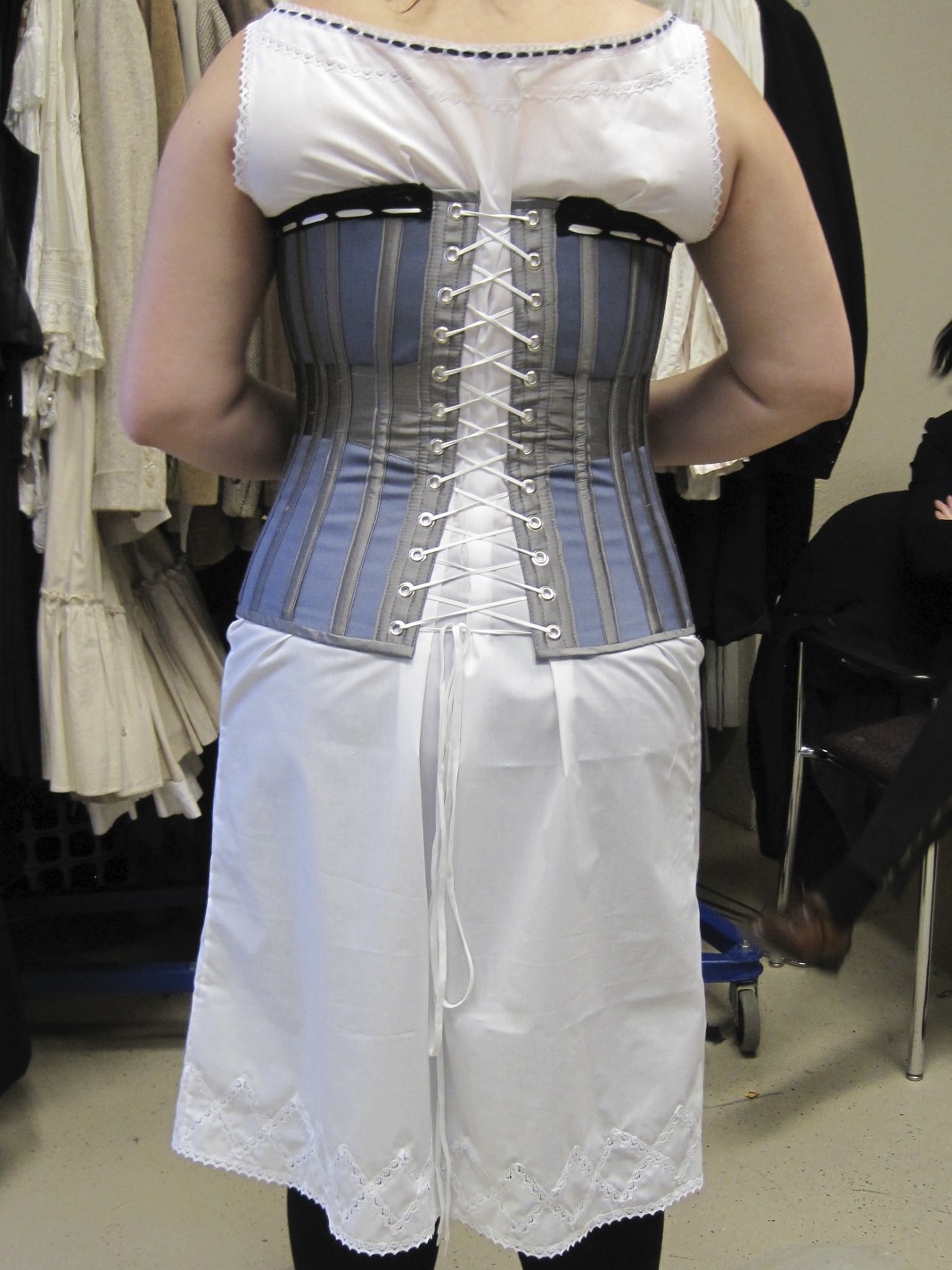
The first layer is a cotton chemise with intersecting zigzag pattern lace insertion at the hem and simple lace edging around the neck opening and armholes. The tie is navy silk ribbon.

The corset is blue cotton twill flatlined with coutil for stability and grey silk shantung boning channels. The top is edged with black lace and off white silk ribbon. The bust also features cording across the front panels as well as flossing at the top of the boning channels.

It’s hard to see the corset detail in the first picture, so here’s a close-up. You can actually see the cording in this picture. The waistband is decorative as well as helping to cinch in the waist. The top and bottom of the corset are bound in bias silk shantung.

Here’s a small back view as well. It looks like I could have laced the bottom half a little tighter!

The next layer is the cotton corset cover with pin tuck decoration and navy silk ribbon threaded through lace around the neck. The front closes with pearl buttons down the front. You can see the corset cover detail in the two pictures below

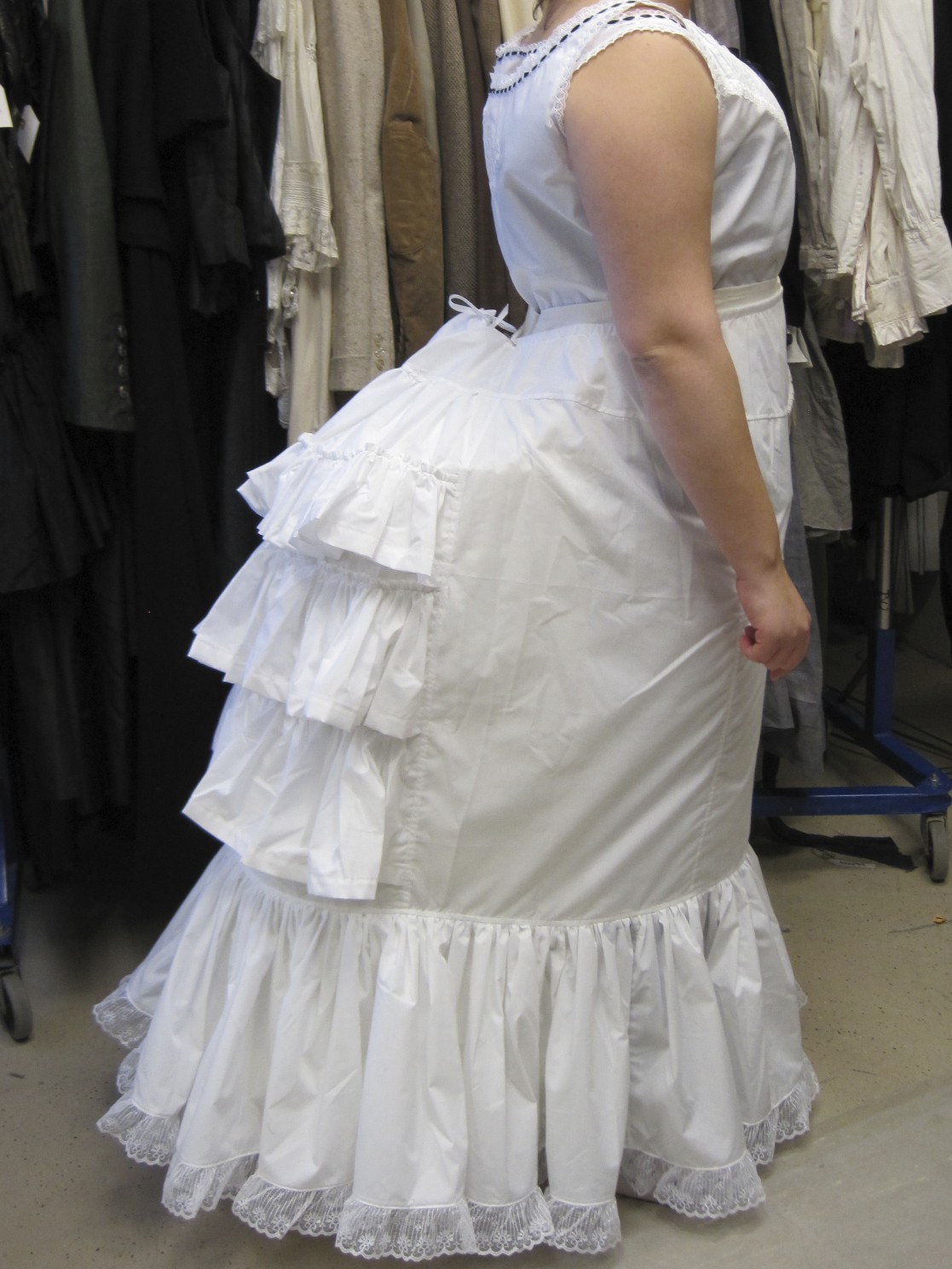
After the corset cover is the bustle itself! It is constructed of off-white striped cotton with hoop steel bones inserted into the horizontal channels. The bottom is finished off with a nice box pleat.

Back bustle view on the left!

On the right you can see the pin tuck detail on the corset cover.

After the bustle comes the petticoat! It is constructed of cotton with lace edging. Here’s a front and side view. You can also see the pin tuck detail on the corset cover in the front view bustle picture.