Project Journal: 1780s Ensemble Part IV: Construction of Stays

c. 1780 Corset at the Metropolitan Museum of Art

As I mentioned in my last post in this Project Journal, I decided to make a pair of stays like the one to the right. I like the unique features of these: specifically the use of colorful fabric, the fact that this is fully boned, and the cording in each seam as well as the absence of shoulder straps and tabs. I adapted a pattern from Corsets and Crinolines by Norah Waugh. The pattern I started with had straps and tabs but I eliminated those elements to reproduce the pattern of these inspirational stays.

Cane boning

I decided to use cane boning for these stays for a few reasons: 1) I wanted to try a new material for boning 2) cane boning is period correct for the 1780s 3) given the amount of boning needed for a fully boned pair of stays the cane boning was much more cost effective (you can see the quantity on the left–it was about $15 from Wm. Booth, Draper) and 4) the cane boning seemed like it would be super easy to manipulate and, most importantly, to cut (and it was! normal scissors easily cut the correct lengths needed and it was easy to round the ends a little bit as well!). I actually only wound up using approximately half of the cane boning that I bought, so that means that I have plenty to use for another future project!

The silk that I decided to use as my exterior fabric is a fabulous damask. I originally thought about stitching my boning channels through the exterior fabric (as in my inspirational piece) but decided against that idea on this fabric, because it would really have just been way to much going on with the pattern and so many stitch lines. You can see the silk pattern a few pictures father down.

Stitching the boning channels

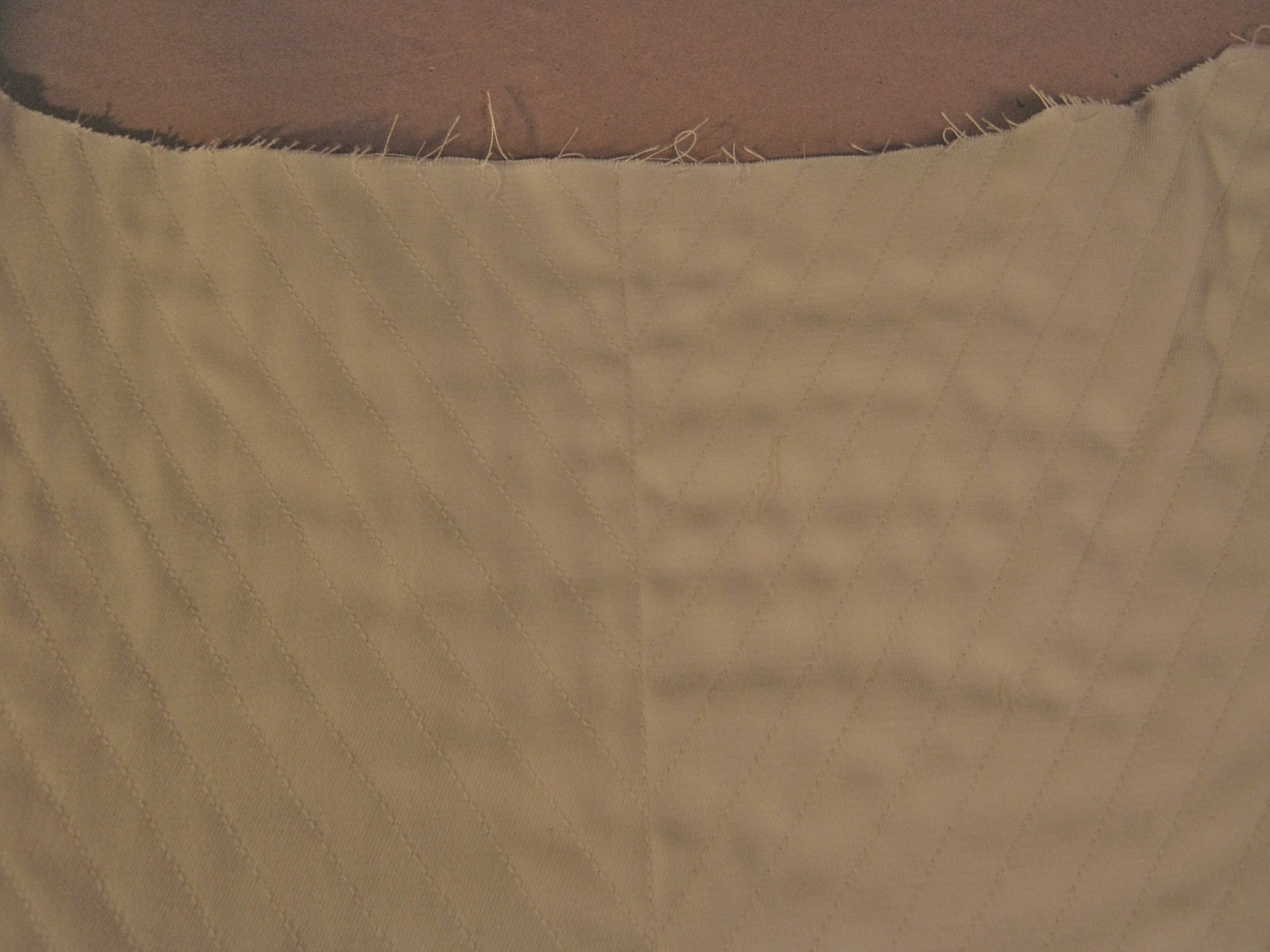
I didn’t want to stitch boning channels through my silk so I started the construction process by stitching the boning channels through two layers of cotton. You can see that I drew lines on the fabric so I could make nice, straight lines. The nice this about this is that I covered the pencil marking side with the silk, so on the inside of the finished corset all you can see is the stitching with no indication of pencil lines!
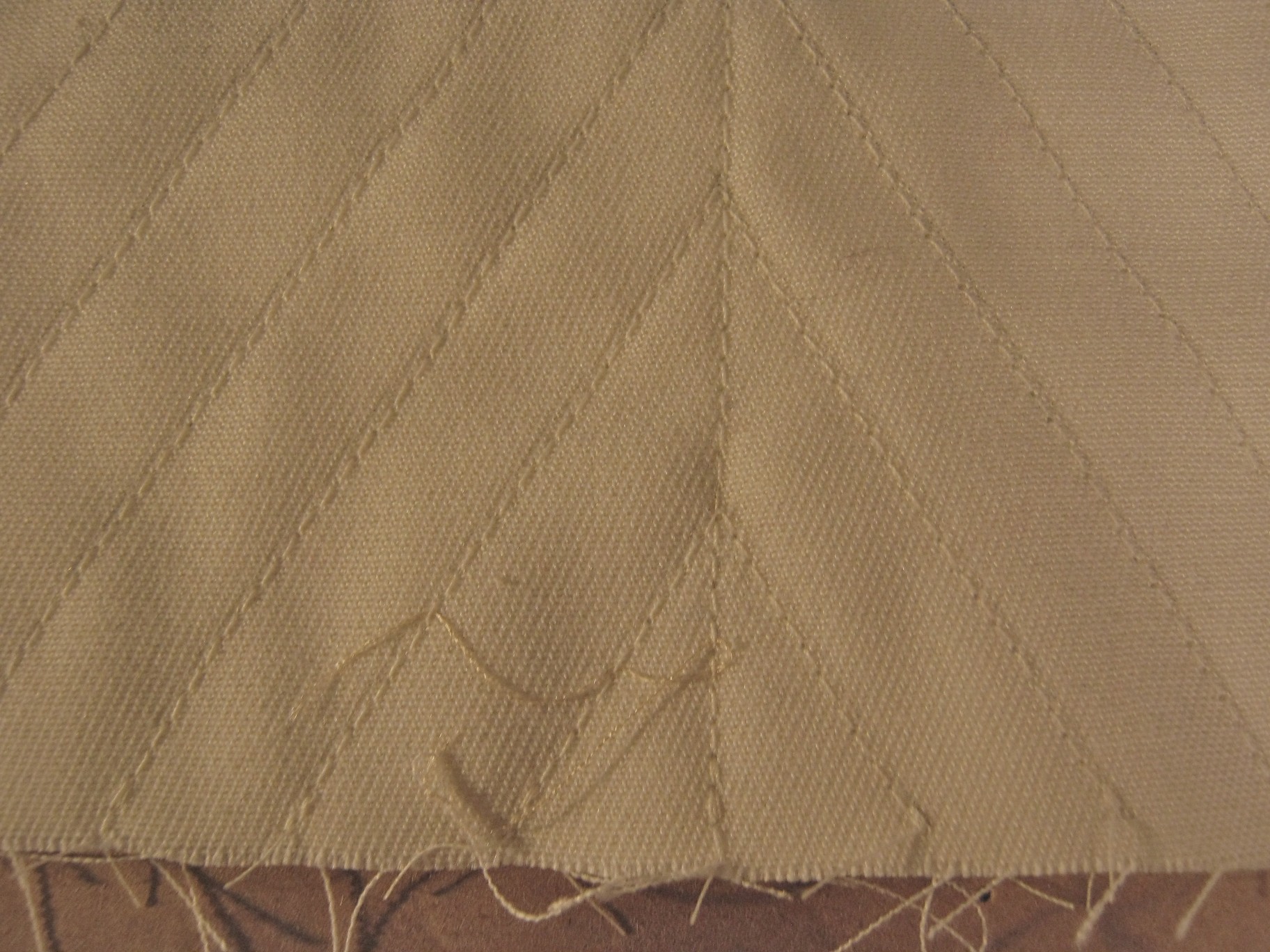
You can see the pencil guide lines on this side of the corset
On this side there are no pencil lines!

I did want my silk to roll around the center back opening on each side and then be included in the seam attaching center back to the next piece, so I stitched those silk pieces into the seams of the cotton. I just kept the silk out of the way while sewing the boning channels. Then, once the boning was complete, I stitched the remaining silk pieces to the flapping center back pieces and turned the whole thing so that the silk was on the outside with the seams facing the side of the cotton that had the pencil lines drawn on. Thus, the silk is just a covering for the cotton, it is not actually attached into the seams of the cotton except on the inside at the side back seam. You can see what I mean in the pictures below.

Stays with the boning channels sewn (you can see that only the center back silk pieces are attached at this point)
Stays with the cane boning inserted, before the silk is sewn on
The silk has been attached (you can see the cording and the pattern on the silk in this picture)

At this point the stays are almost finished! The last few tasks are to bind the edges (I’ll be using bias strips cut from the same cotton as the cording and lining) and work hand sewn eyelets along each side of center back. More pictures to come!
Project Journal: 1780s Ensemble Part II: More Research

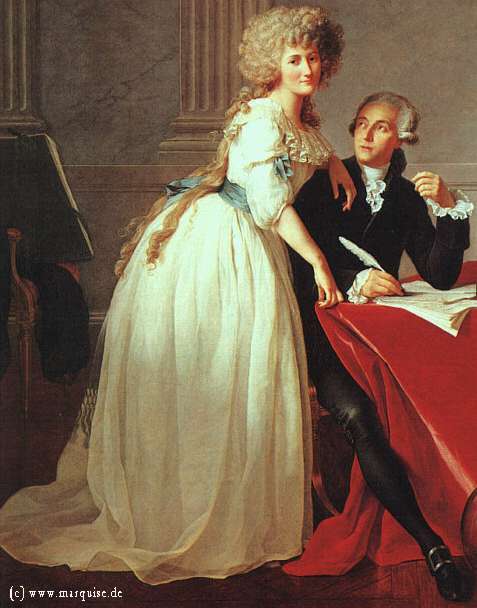
As I mentioned in a recent post, I have decided to attend 2 events this month that will require clothing from the period 1775-1799 which I do not currently own and from a period I am not intimately familiar with. Thus I began this project in a flurry of research. After thinking of the popular styles, Robe a l’Francaise, Robe a l’Anglaise, Robe a la Polonaise, and Skirt and Jacket combination, I am left with one more possibility that was particularly popular in the late 1780s and 1790s: the Chemise Dress or Chemise de la Reine.

Les Lavoisiers by Jacques Louis David, 1788

The Chemise Dress is a descendant of the style of dress first worn by Marie Antoinette, called the Chemise de la Reine. This quote does a fantastic job of relating the social values surrounding this style in a quite amusing fashion! Aren’t you as amused as I am by this quote?

1784. When down dances my ribbon white, but so bepuckered and plaited, I could not tell what to make of her: so turning about, I cried, ‘Hey, Sally, my dear, what new frolic is this? It is like none of the gowns you used to wear.’ ‘No, my dear,’ crieth she, ‘it is no gown, it is the chemise de la rein’. ‘My dear,’ replied I, hurt at this gibberish, which I was half ashamed to own I did not understand; ‘What is it? You know I am not like you, master of French; let us have the name of your new dress in downright English.’  ‘Why then,’ said she, ‘if you must have it, it is the queen’ shift.’ Mercy on me, thought I, what will the world come to, when an oilman’s wife comes down to serve in the shop, not only in her own shift, but in that of a queen. (From Lady’s Magazine: Printed in The Cut of Women’s Clothes: 1600-1930 by Norah Waugh)

Well, at first I was thinking “Ah! This is the dress for me! It is fairly simple (and therefore quick) and looks very elegant.” But then I thought about three big deterrents: 1-the similarity of a simple white gathered dress to the clothing from the turn of the 19th century, when afternoon dresses were white and somewhat similar in character and style, 2-the amount of extra fabric needed for petticoats to achieve the soft draping of the skirt and 3-the two events I plan to wear this to (#1: a vintage ball, for which an elegant train would be entirely impractical and #2: an American Revolution colonial fair, for which I would be cold, have a train that would just get dirty, and a style of dress that is about 15-20 years in the future). Those arguments eliminated this style as a possibility, but I wanted to share it with you anyway, because I think it is lovely.

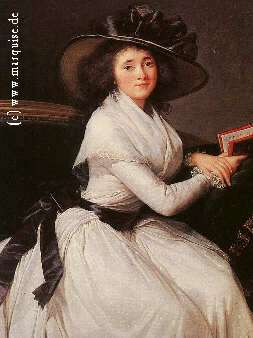
Here are some more examples of Chemise Dresses in various other paintings. (Also, take a look at the hats, aren’t they fabulous? They remind me of the scale of hats in the early 20th century. Can you see the resemblance?)

Comtesse de La Chatre by Elisabeth Vigee-Lebrun, 1789
Mme Seriziat by David, 1795

Project Journal: 1780s Ensemble Part I: Initial Research

I’ve decided to attend 2 events in September which require clothing from the last quarter of the 18th century (1775-1799). This decision is rather at the last minute when it comes to building new historic clothes: I now have exactly three weeks to make a decision about what to wear, pick out fabrics, make patterns, and complete the construction of the garments. Yikes!

So I’ve been busy researching this period because it is not within the realm of my previous historic clothing projects, which have generally focused on the 19th century. Unlike women’s clothing in the 19th century, for which I can recall silhouette, construction details, pattern shapes, and fabric choices and colors with far less research for each garment (because I’ve already done all that research and it’s all in my head…), I really need the research to be able to consider reproducing historic clothing from the 18th century. Here are some inspirational images I thought I would share!

Here’s how this conversation went in my head: “Where do I start?” I asked myself. “Silhouette?” I replied. “Ah, yes. That sounds good. But… what is the silhouette during this period? Hopefully not panniers!” because panniers, you see, require a lot more effort to produce and a lot more fabric to cover. “Well, let’s start by looking for some images,” I suggested. And here we go!
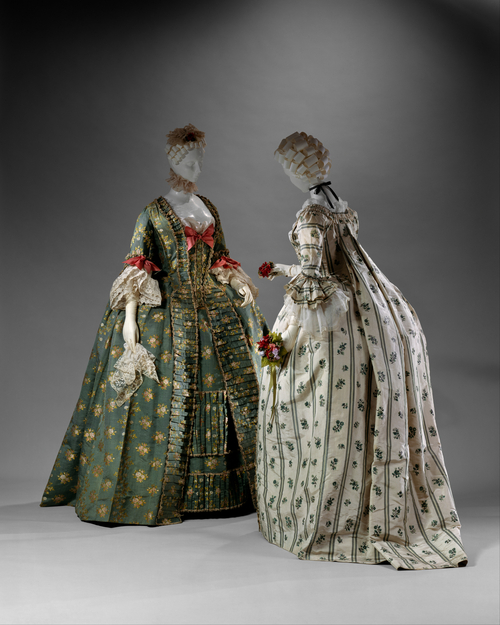
c. 1770 Silk Robe a l'Francaise at the Metropolitan Museum of Art

Now, you can see by looking at the above image that these gowns require panniers to achieve the exaggerated hip shape. You can also see that these gowns are Robes a l’Francaise, meaning robes in the French style. This style of gown has the characteristic pleating at center back that falls from the back neck line to the floor in one piece. This style, with the panniers and the Robe a l’Francaise, is not what I have the time to make in three weeks. So we move on!

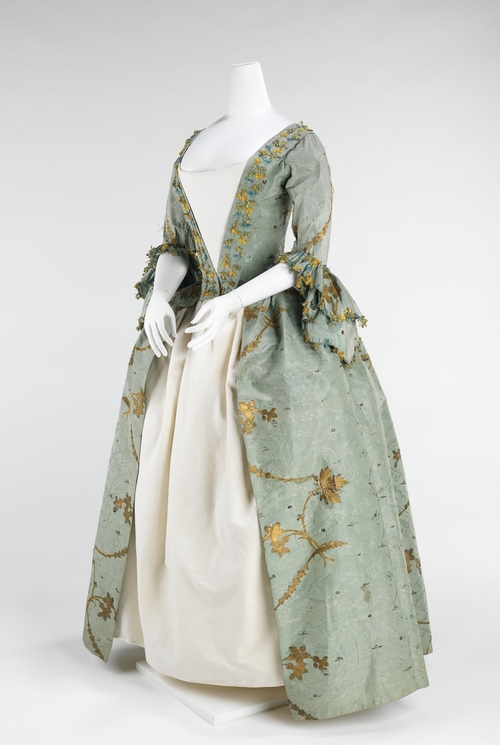
1770-1775 Silk Robe a l'Anglaise at the Metropolitan Museum of Art

In contrast to the Robe a l’Francaise, I am actually interested in the style of dress on the left: the Robe a l’Anglaise, or English style robes. This style evolved from the Robe a l’Francaise: over time the side back seams of the Robe al’Francaise were cut close enough together that the characteristic pleats were no longer used.

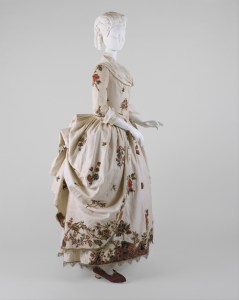
Below, you can see another two examples of gowns in the style of a Robe a l’Anglaise. These two are from the 1780s and you can see that the width of the hips has diminished from the 1770s. Note that all of these gowns have open fronts that show the petticoat underneath.

c. 1780 Cotton Robe a l'Anglaise at the Metropolitan Museum of Art
c. 1780 Cotton Robe a l'Anglaise from the Metropolitan Museum of Art
1780-1785 Cotton Robe a l'Anglaise at the Metropolitan Museum of Art
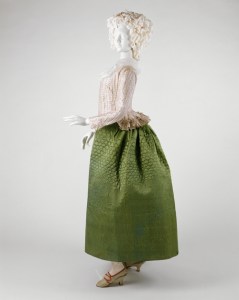
There are other options for this period as well: there is the style Robe a la Polonaise, which has a characteristic  bunching of fabric across the back side as well as the skirt and jacket combination. I’m not interested in making a Robe a la Polonaise at this point, but a skirt and jacket combination is a possibility. You can see these styles below. There is another style as well: the Chemise Dress, but you’ll have to wait for my next post to see and read about it!
c. 1780 Linen Robe a la Polonaise at the Metropolitan Museum of Art
c. 1785 Silk Jacket at the Metropolitan Museum of Art
      

Bolero jackets in the 20th century: 1930-1950

Evening Ensemble designed by Elsa Schiaparelli 1938

A few posts ago, we took a look at Bolero and Zouave jackets from the mid-19th century and Bolero jackets from the 20th century: 1900-1909. While I was looking at images related to those posts I found a few amusing boleros from the mid-20th century and decided to share those with you as well!

Let’s start here: with this evening ensemble designed by Elsa Shiaparelli at the Metropolitan Museum of Art. My first thought about this was something along the lines of the following: “The dress has a lovely shape. What’s the abstract embellishment on the bolero?”

Gymnast bolero designed by Elsa Schiaparelli 1938
Well, look carefully at the Bolero picture. It’s decorated with gymnasts!
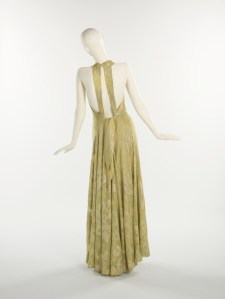
Evening dress by Elsa Schiaparelli 1938

Here’s the back of the dress without the bolero over it. Such lovely lines. In the picture on the right, you can also see the texture of the dress fabric. It’s difficult to discern what it is. Looks to me like it might be a jacquard  or watermarked fabric. Do you have other ideas about what the fabric is?

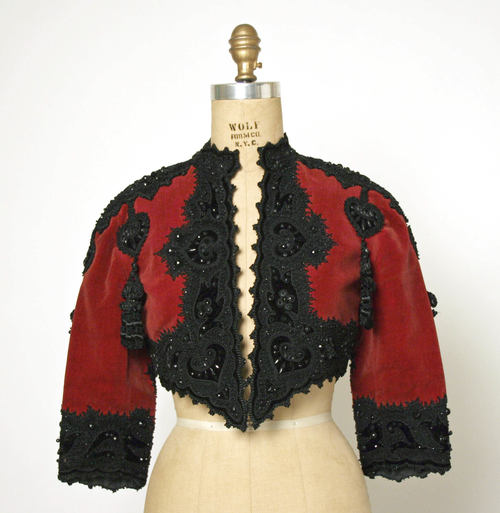
This next bolero was designed by Balenciaga in the 1940s. Its style is much more traditional than Schiaparelli’s gymnast bolero. The beading and other trimming on this Balenciaga bolero is exquisite!

Balenciaga Bolero 1946-1947
The Oxford English Dictionary includes these quotes regarding boleros in the definition. They are good context for the style and use of boleros in women’s clothing during the mid-20th century.
1941    ‘R. West’ Black Lamb I. 407   The boleros the women wore over their white linen blouses.
1968    J. Ironside Fashion Alphabet 35   Bolero, a short jacket reaching to the waist, worn open over a blouse‥sleeved or sleeveless‥worn by Spanish dancers and bullfighters.
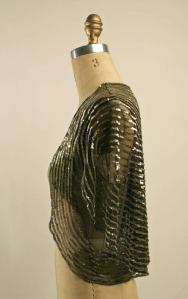
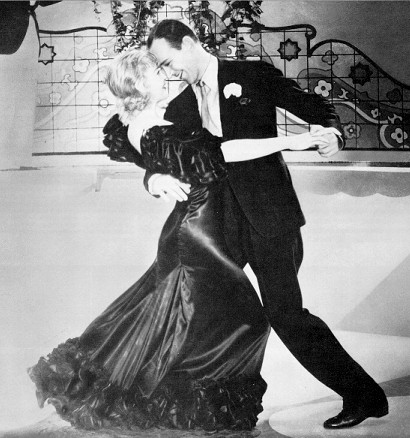
I’m including this final bolero just for fun. I can envision it with a slinky black bias-cut 1930s evening gown with a low cut back… It even has a matching belt! This bolero strongly reminds me of the style of Ginger Roger’s dresses in her videos with Fred Astaire. I’ve also included just a few fun pictures of Ginger’s fabulous dresses below so you can see her general style. Beautiful!
Evening Bolero 1933
Evening Bolero 1933
Belt to go with Bolero 1933
Top Hat 1935
Carefree 1938
Flying Down to Rio 1933

National Museum of American History First Ladies Exhibition behind-the scenes video

This video is a behind-the-scences look at the creation of the First Ladies Exhibition at the Smithsonian National Museum of American History.

It’s a really neat video! You get to see some insight into how the dresses and other pieces are displayed, how the dress forms that display them are created, as well as some great pictures of First Ladies and some very lovely dresses!

Of flounces and dance cards: Part II (Nahant Victorian Day 1860s Ball 2011)

Part II: …and dance cards

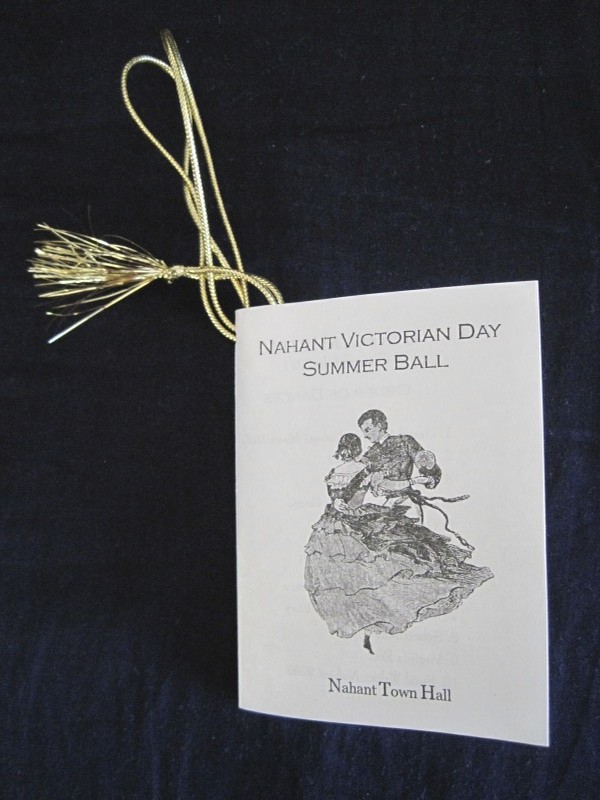
Dance Card from the Nahant Victorian Day Ball 2011

Last post, I shared with you my latest 1860s gown: Annabelle. This gown just recently had its debut at the Nahant Victorian Day Ball hosted by Vintage Victorian.

This ball included the use of dance cards, a practice I am aware of but have never participated in. It turns out that they are much more complicated than one thinks they might be! Why are the so complicated?

Well, it all sounds quite glorious and sophisticated. The Oxford English Dictionary defines a “dance-card” as “a card bearing the names of (a woman’s) prospective dance partners at a dance.” In stories and books, a dance card is a memento one can keep so that after the ball is over she can muse about beaus and flirtations. Practically, a dance card might help a person remember who his or her next partner is, what kind of dance the next dance is, or allow a gentleman to ask for a dance later in the evening.

But wait! There are complications and confusions! Does everyone have a dance card, men and women? Does a person take off his or her gloves before writing in a dance card? (I attempted this both ways: it is quite challenging to write your name while wearing gloves…) Does one exchange dance cards with a prospective partner or ask the name of the person and write it herself? (It seems more effective to swap dance cards with your intended partner to allow for ease of spelling, etc. and, in a more romantic sense, so that you have that person’s handwriting in your dance card.) How does one attach the card to her wrist so that it doesn’t get lost? How does one attach the card to her wrist without the pencil sticking out (so that her white dress isn’t marked!)? Really, a lot of questions popped up that would not have made themselves apparent without practical application. Also, at least at this ball, not having a prearranged partner did not necessarily mean that you were not able to dance. I was able to dance most of the dances of the night, despite my somewhat empty dance card.

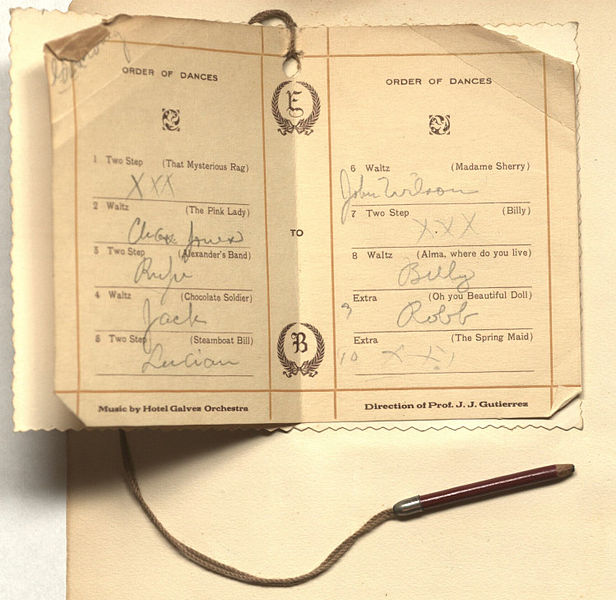
Interior of my Dance Card from the Nahant VIctorian Day Ball 2011

Below you can see a few historic dance card images and below that some images of the ball! If anyone has any research on the use or history of dance cards, please share. I’d love to learn more about the etiquette of dance card use!

1884 Dance Card
1912 Dance Card
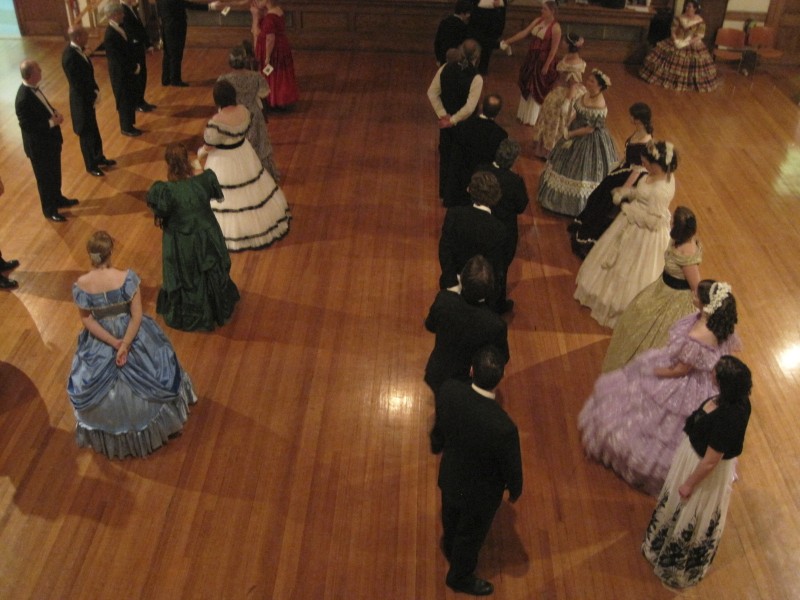
I believe this dance is the Contradance: Hull's Victory. (Nahant Victorian Day Ball 2011)
A different view of the same dance as above.
The Grand March. (Nahant Victorian Day Ball 2011)
More Grand March.

Here’s a video of the Grand March in action!

Bolero jackets of the 20th century: 1900-1909

A few posts ago, we took a look at Bolero jackets from the mid-19th century. Let’s look at them  in another context: Boleros from the early 20th century, with a hint of information from the 1890s as well.

1904 Dress with Bolero

What exactly is a Bolero jacket? The Oxford English Dictionary defines it as “A short jacket, coming barely to the waist; worn by men in Spain; applied to a similar garment worn  by women elsewhere, usually over a blouse or bodice.” This definition condenses the influence and origination of the Bolero down quite eloquently (of course, it is the job of the OED to eloquently distill all words down to a concise definition… but still, I do like this definition). The men’s style Spanish Bolero, with elaborate braiding and bright colors, influenced the style of women’s Boleros from the Victorian period. The following quotes from the OED provide more insight into the history of the Bolero (they also mention other styles of short jackets including the Zouave and the Eton).

“1892    Daily News 14 Nov. 6/3   The Zouave is as great a favourite as it has been for some seasons, and though it varies in form—being sometimes a bolero, sometimes a toreador, and sometimes a cross between an Eton jacket and a Zouave.
1893    Daily News 1 Apr. 2/4   The Zouave is quite as popular as it was last year.‥ Sometimes it is pure bolero.
1893    Lady 17 Aug. 178/1   Zouave Bodices are a feature of autumn gowns. (in the Zouave definition)
1899    Westm. Gaz. 6 July 3/2   Robbing the coat of its basque has created‥the bolero corsage, really an actual bodice, though appearing a bolero coat and skirt.”

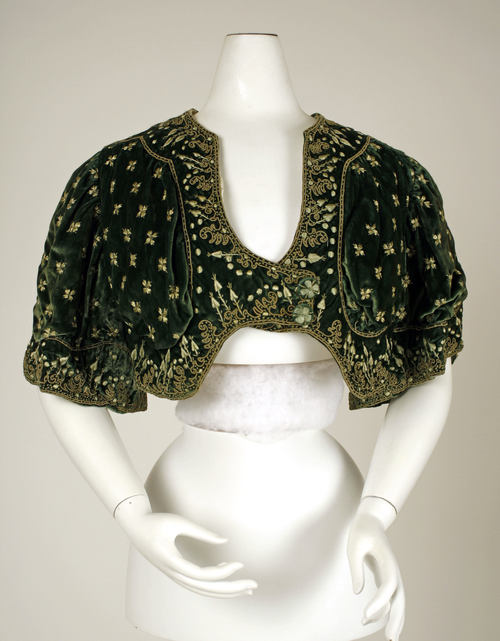
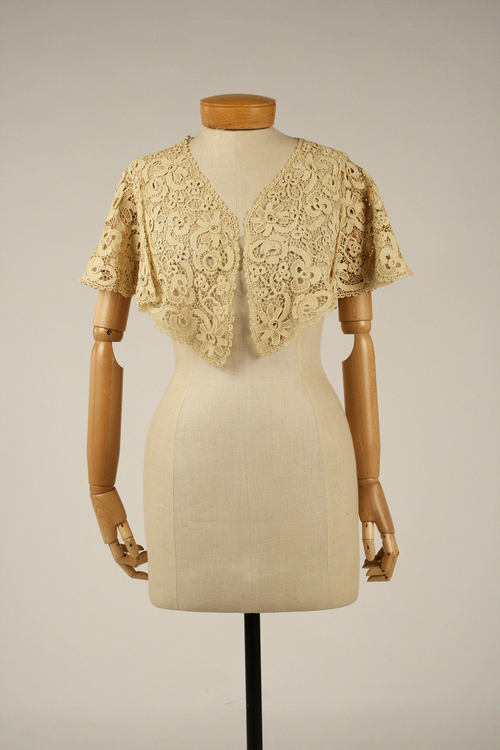
The flared skirt and small waist silhouette of women’s clothing during the first decade of the 20th century was well suited to the style of Bolero jackets, as they could help to visually balance the figure by adding just a small amount of width across the chest and shoulders.  Here are a few Boleros from the Metropolitan Museum of Art. One is silk velvet, elaborately trimmed. The other is lace. Can you imagine the dresses that would have accompanied these Boleros? Clearly, they were intended for different purposes. Perhaps the first was intended for evening wear and the second for an afternoon stroll or visiting friends?

c. 1905 Bolero from the Metropolitan Museum of Art
c. 1907 Bolero from the Metropolitan Museum of Art

Bolero and Zouave jackets of the mid-19th century

Throughout the 19th century, civilian clothing for men and women imitated all sorts of military uniforms in cuts, trim styles, and names. Let’s look at some women’s styles from the the mid-19th century inspired by military wear.

First: the Bolero style jacket

From Peterson's Magazine August 1865

Popular during the mid-19th century, the Bolero is simply a short jacket, usually worn open in front, often fastened at the neck. In the mid-19th century Bolero jackets were worn in all sorts of colors and with all sorts of trim; however, they were often seen in military uniform colors and with trimming styles reminiscent of military trimming, especially braiding.

1863 Bolero from the Metropolitan Museum of Art
c. 1860 Dress with Bolero Jacket and braid trimming

Second: the Zouave style jacket


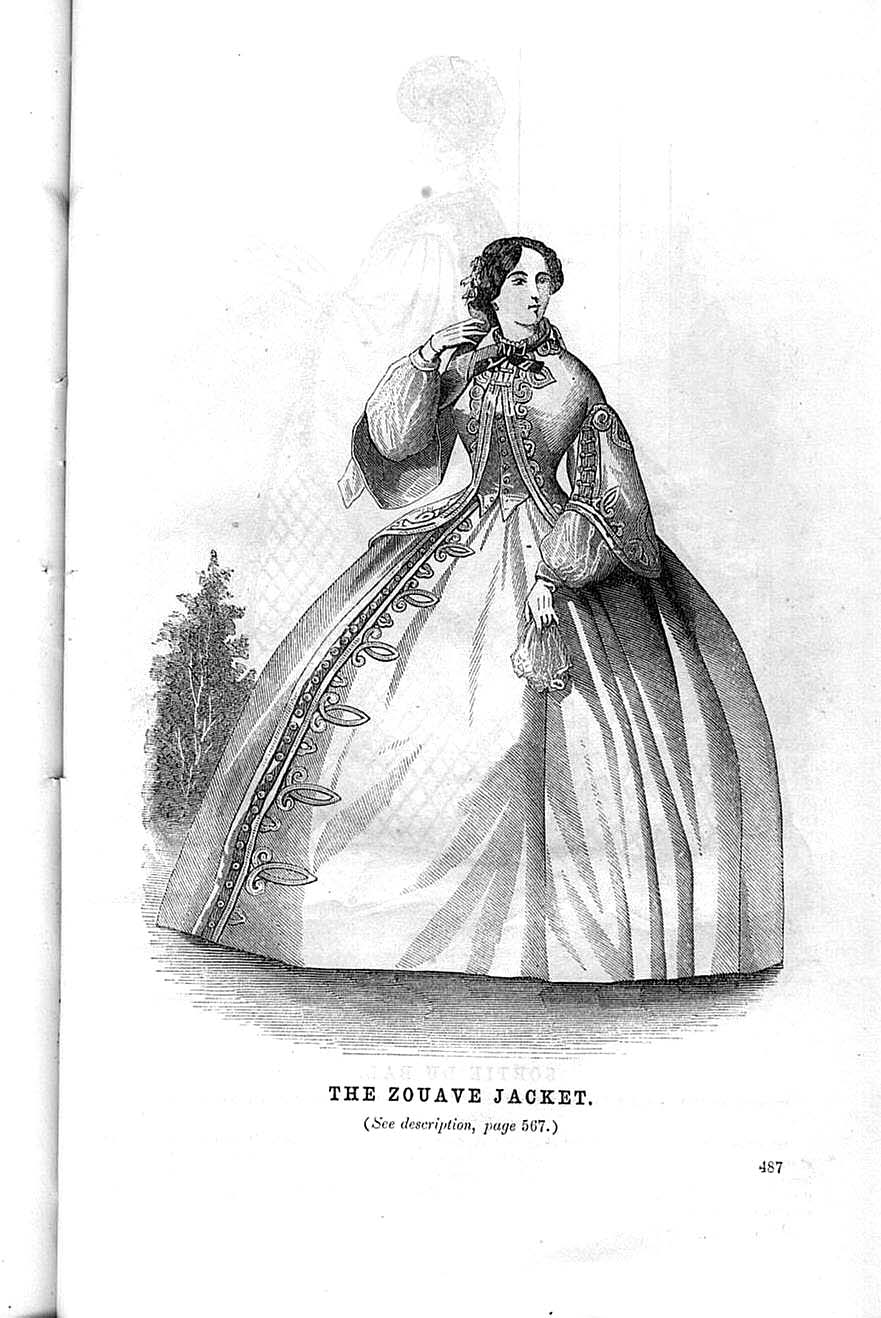
From December 1859 Godey’s Lady’s Book

The Oxford English Dictionary defines a Zouave jacket as follows: “A woman’s short embroidered jacket or bodice, with or without sleeves, resembling the jacket of the Zouave uniform.” The following quotes are included in the OED definition:

1859    Ladies’ Treas. Sept. 285/1   One of the most decided novelties of the present season is the Zouave jacket.
1859    Ladies’ Cabinet Dec. 335/1   Nothing can be prettier for the interior than the little oriental jackets which we call to-day Zouaves.

During the 19th century, this style gained the most popularity during the 1850s, when French Zouaves were fighting in the Crimean War, and during the American Civil War in the 1860s. You can see a few images of Zouave uniforms by looking at this post from a few weeks ago.

The description of the above image from Godey’s is as follows: “Morning-dress for young ladies, of plain merino or cashmere; the skirt trimmed by an inserting of velvet, several shades darker than the dress, with a row of buttons passing through it, and bordered by a rich braid pattern, known as the Greek. The Zouave jacket, which we have before spoken of, forms the waist. It is modelled from the Greek jacket, and has a close vest, with two points; the jacket, itself, rounding over the hips, and fitting easily to the figure. A Gabrielle ruff, and neck-tie finish it.”

Further information about this style was included in the Chitchat section of the same issue of Godey’s: “The Zuoave jackets may be made in black cloth or velvet, for home wear, with skirts whose waists have “outlived their usefulness.” They are especially suitable with dark silks, and a waist of this kind with a black silk skirt will do any amount of street service. Black silks are trimmed with a combination of black and crimson, black and purple, etc. when intended for dress occasions.”

c. 1862 Dress with Bolero from the Metropolitan Museum of Art

Given the description (above)  from Godey’s about the Zouave jacket fashion plate, I think this c. 1862 dress from the Metropolitan Museum of Art falls into the category of a Zouave jacket rather than a Bolero. Clearly, this yellow dress has a jacket with a double pointed vest silhouette, rather than the Bolero style of the jacket with a blouse underneath. Regardless, this dress is quite fabulous! The pattern matches the trimmings exceptionally well in terms of style, and the whole ensemble is quite wonderful (including the crisscross braiding and tassels!).

The quotes are from the digital Godey’s excerpts at the University of Vermont, which can be viewed here.

A waltzing Zouave?

In my last post (Returning Heroes 1860s Ball 2011) I mentioned that one of my favorite moments of the night was dancing a waltz with a Zouave. First of all, what is a Zouave? Secondly, why would I be dancing a waltz with one at at 1860s ball???

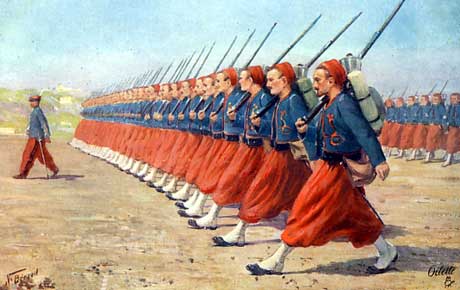
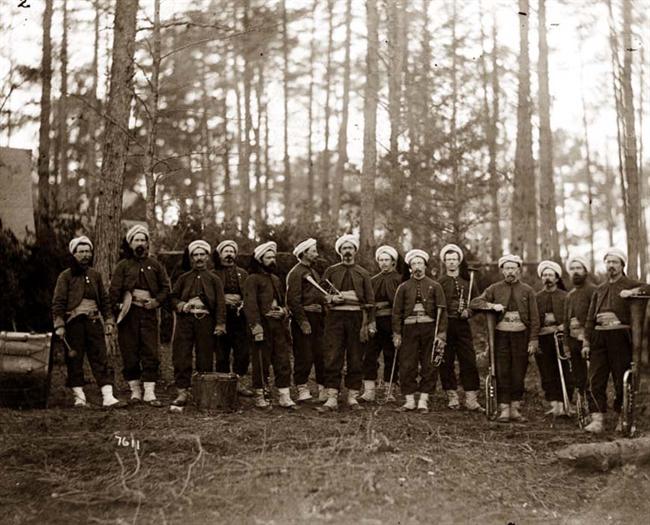
In the 1830s, the French military fighting in North Africa incorporated a tribe of fierce fighters into their ranks. These original soliders were renowned for their skills. In fact, in 1852 the French created three units of Zouaves to be entirely of Frenchmen. These French Zouaves achieved legendary status for themselves during the Crimean War (1854-1855). More detailed information about their involvement can be found in this history of Zouaves (this site also has some great pictures of Zouave regiments). The French Zouaves were quite inspirational to American forces during the American Civil War: both the Confederate and Union armies formed Zouave regiments who wore imitations of the French uniforms.

114th Pennsylvania Infantry (1861-1865)
Zouave Music Sheet 1850-1865

Now we know what a Zouave is. Why would I be dancing with one? Well, the idea of the Returning Heroes Ball is that “Gentlemen in uniforms of both sides of that great conflict are welcome.” So it is perfectly reasonable for a Zouave be dancing alongside the formally clothed men at the ball. Fun!

Returning Heroes 1860s Ball 2011

I was reminiscing recently and realized that I neglected to post about the Returning Heroes Ball hosted by the Commonwealth Vintage Dancers in March 2011! I had such a fantastic evening that I decided that late is better than never!

I have been dreaming of being in a room full of people all wearing crinolines and period menswear for years: the 1860s are my most favorite period! The night started out with all the ladies helping each other get dressed: lacing corsets, donning hoops and petticoats, fluffing skirts,  and securing bodices. Of course, it does take some time to get dressed, so while we were dressing the band was warming up and the men were standing around looking important and discussing… well, who knows what?

We were supposed to be using dance cards, but I was disappointed in that part of my dream as we wound up not using the dance cards that had been prepared. But that didn’t dampen my spirits for more than a minute or two, because the band started playing and we began to dance!

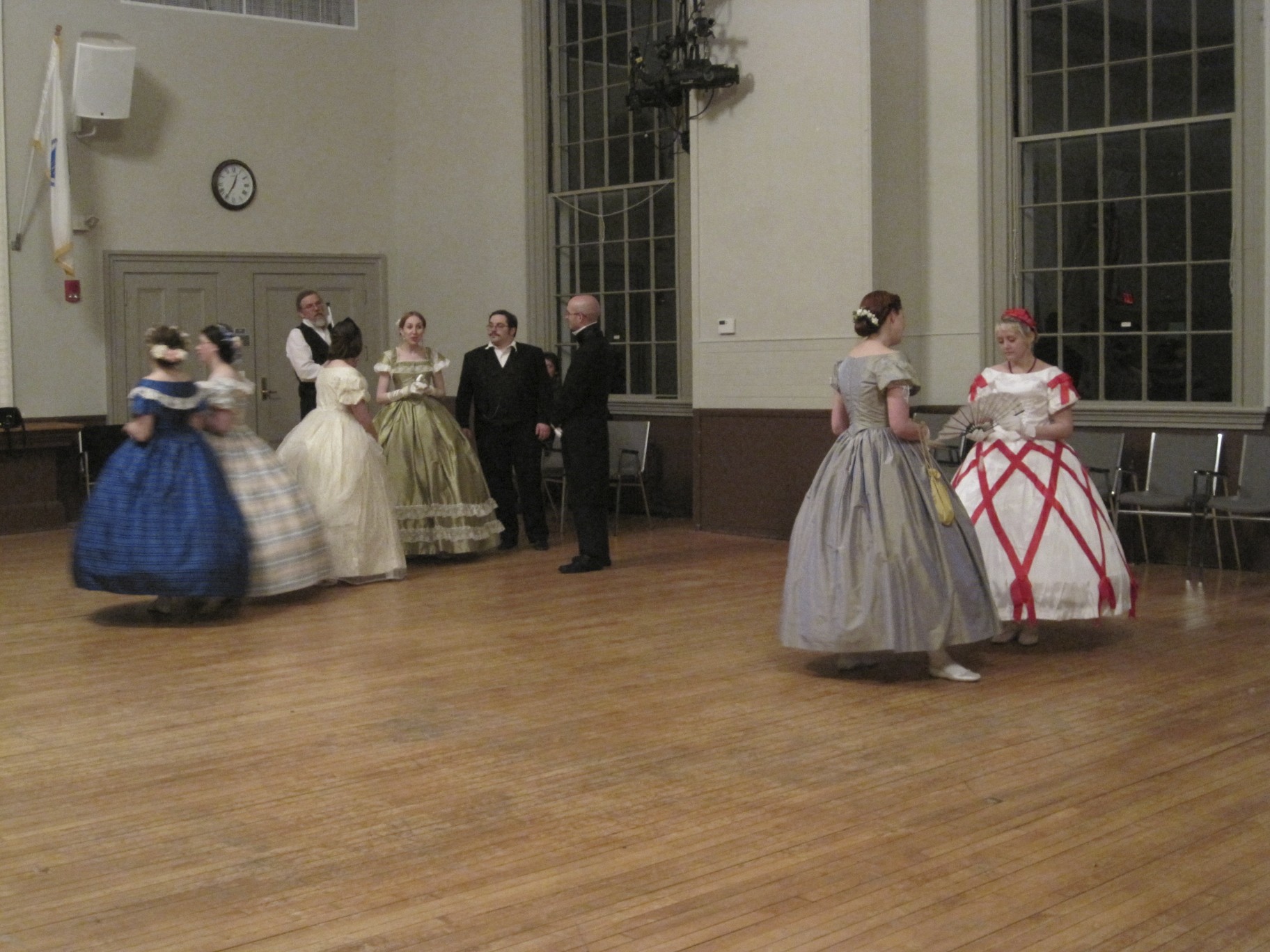
I have two favorite moments from the night: 1- dancing the Grand March in which every lady was wearing hoops (there was a lot of friction as well all spiraled around each other), the best part of which was joining in lines and progressing down the hall to “Dixie” and 2- dancing a waltz with a Zouave (see picture left).

Here’s a few more pictures (I should have taken more, but I was busy dancing!). I’ll just end with this video from the Returning Heroes Ball in 2007. It starts with a Grand March and starting at about 60 seconds “Dixie” is playing! Enjoy!