(I thought I was very clever when I came up with the name for the post… and then a few days later I couldn’t remember what I was thinking the content should be! I guess if I confuse myself that easily I should certainly explain my cleverness so you can appreciate it, too!)
“It is recommended that the lady, when waltzing, leave herself to the direction of her partner, trusting entirely to him, without in any case seeking to follow her own impulse. A lady who should endeavor to avoid an encounter with other dancers, would risk interfering with the intention of the gentleman, to whom alone should be trusted her security amid the crowd surrounding and crossing her in every direction.”
I thought, “Hm! Trusting myself entirely to my partner’s care is something I rarely do! I’m often giving non-verbal hints about my opinions on where we should go, how much we should rotate, etc… and depending on the ability of my partner, my hints sometimes come down to downright back-leading.” I’m sure this partly comes from eight or so years of competitive modern ballroom dancing, in which the leader is in charge, but the lady has the duty to do her part to see what’s going on around the floor and help ensure that crashes, etc. don’t occur, as well as my independent-modern-woman mindset. However, despite these reasons, I imagine Hillgrove would have taken exception to my dancing style!
I started thinking about whether it made sense for me to attempt Hillgrove’s method while dancing historical dances. I dance in three settings, at private rehearsals when the dance troupe I am part of is practicing for performances, during performances with said dance troupe, and at public balls when I am dancing with guests of varying abilities or with members of the dance troupe.
I think it boils down this way: when dancing in a performance there are goals of elegance, nice spacing between couples, etc. that we are aiming for, and my interpretation of our artistic directors’ instruction in addition to my own feeling is that every person dancing should contribute to these goals, so a bit of hinting makes sense for the context. I feel similarly about hinting while dancing at balls depending on the ability of my partner, and if the goal is to ensure the safety of myself, my partner, or other people who might cut us off, etc. I also feel justified in back-leading a partner who needs some assistance to stay with the music, avoid crashes, or know how much rotation to complete in a given step, etc… but it sounds like I don’t really ever follow with trust!
With these thoughts in mind at a recent ball, I attempted to follow partners (whose abilities I have faith in) with trust. It was surprisingly uneventful! I think it really comes down to the ability of a partner in order to determine if I’m comfortable with that level of trust. Do you entirely follow your partners with trust at historical dance events? Or are you like me, picking and choosing when you feel comfortable doing so?
Success! Time to go home.
(As another side note, it’s been just about a year since my last 19CBRE post. If you’re not sure what that’s all about, check out this introductory post. You can see all of the posts relating to 19CBRE here. Perhaps this year I’ll get around to posting more of the interesting tidbits I’ve been thinking of posting over the last year!)
A while ago now, during the Journal Journey Into La Belle Assemblee series, Natalie over at A Frolic Through Time brought two similar ball/evening hair styles to my (and her other readers’) attention. These styles for October 1811 were pointed out by Natalie as being perfect for someone to attempt for a Regency event and I thought “Oh! These are neat! And they would go so well with my pearl trimmed 1811 Elusive Blue gown. Perfect!” So I saved the link to the post and have been meaning to go back to it for the last few months.
After returning to that inspiration earlier this year and comparing the two styles in Natalie’s post, I decided on a turban fillet (see end of post for a definition). February’s HSF/M Challenge #2: Blue was the perfect kick I needed to get to work. While I technically submitted finishing the trim on my elusive blue dress for the challenge, I also finished my turban fillet slightly after the deadline. I enjoyed having a small project: it was a nice change from the usually long and complicated projects I often take on and am constantly in the midst of.
Here, then, is the fashion plate to which I am referring.
No. 1. EVENING DRESS. A sea-green crape dress, vandykcd round the petticoat, and ornamented with large beads; a full drapery over the shoulders, and confined in to the back with a pearl band, ornamented round the neck and down the back with beads. A full turban fillet tapered, worn on the head. Pearl necklace, white kid gloves and shoes.
And here is the finished result of my labors.
Side.Back.And the full ensemble.
I attempted to follow the detail of the hairstyle from La Belle Assemblee, down to the curls around my face (lots of extra work since all my hair is long!) and the little braid on the side. It was a puzzle to figure out and enjoyable to wear.
The question is, how did I get the turban fillet to stay in place on my head? Well, I thought of making a gathered tube wound with pearls, as Natalie proposes below, but decided to make my turban fillet have a flat back instead for multiple reasons. #1: there has to be a seam somewhere, so why not hide it intentionally? #2: I only had so many pearls, and winding them all around a sample tube used them up far too quickly so that I would never have reached the end and still been able to have pearls. #3: the angle of the pearls when winding them around was very challenging and I couldn’t figure out how to arrange them pleasingly. #4: “why waste pearls against my head?” I thought, when they’re going to be slightly uncomfortable and slippery there anyway?
So here is what I came up with: a length of fabric about 40″ long, wrapped around a strip of hi-loft poly-fill batting (not period, I know, but easy and free!), turned under and sewn down on the back, gathered across the top, with rows of pearls sewn on at intervals, and finished with loops on the back every few rows of pearls in order to secure the whole thing to my head. The entire thing is hand sewn. I have no idea how you would use a machine to assemble this the way I did!
The top is the front of the turban fillet and the bottom is the back.
And yes, I was able to wear this to a Regency ball in April!
* Natalie notes the following about the description “turban fillet”. Please check out her post to see both fashion plates she refers to.
Turban fillet. For a change, just what you might imagine: a “fillet” is normally a narrow ribbon or wire wound round or encircling the head, while a turban is a, well, a turban. In this month’s evening dress hairstyle, we have a length of fabric well gathered to make a narrow, round, gathered tube, wound round the head. The turban is wound with pearls for extra measure. Handsome and I hope that someone will take up this style for a ball before long! The ball dress plate uses a similar design; it encircles the head more like the fillets we remember from Medieval fairy tales, but ironically, the effect is more turban-like to my eyes than the evening dress example, yet isn’t called a turban. Fashion, fashion.
Last post relating to witzchouras, we looked at basic definitions of the word, determining that the garment and its name developed from Polish and French influences, that the garment was popular c. 1808 to 1835, and that the chief qualifications are that it is an outer coat or mantle lined and trimmed in fur. But let’s not stop there: here are more references to the witzchouras from the early 19th century.
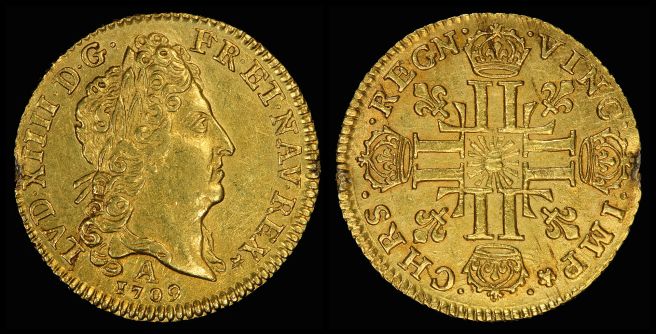
Side note: A Louis d’Or is a French gold coin first struck in 1640. These were promoted by the French kings to fill the need for a large denomination coin, since the franc and livre silver coins were greatly decreasing in value. In 1726, France developed monetary stability and the Louis d’Or was established as being worth 24 livres, a value that remained static through the French Revolution. At the time of this quote in 1817, a Louis d’Or referred to a 20 franc gold piece, also called a Napoleon, so named because Napoleon coopted the idea of the French kings before him. (Sources: Merriam Webster, the OED for louis d’or, Napoleon, and livre, and the Encyclopedia Britannica.)
Louis d’Or from 1709
Throughout the 18th century, a franc was similar in value to a livre, and about 20 of either of these coins equalled one Louis d’Or. La Belle Assembleé tells us that a witzchoura in 1817 was worth 30-90 Louis d’Ors. What I’m driving at here is the relative value of one of these garments.
The OED gives us an idea of the value of a livre over time: in 1746 one captain was paid 120 livres a month (6 Louis d’Ors). Extrapolate that for a year, and that captain was making 72 Louis d’Ors, just enough for a witzchoura or two and nothing else! Another example from 1797 sounds outraged that an English sea officer was charged 300 livres for eight days of lodging (15 Louis d’Ors). That’s almost 60 Louis d’Ors per month, which would easily be a witzchoura, though I doubt that sea officer would need a witzchoura instead of lodgings! The takeaway message is that, as La Belle Assembleé says, witzchouras were costly and worn only by the wealthy.
It is worth noting that there are fur lined pelisses mentioned which do not qualify as witzchouras in the eyes of La Belle Assembleé. I’ll be examining these almost-witzchouras in a later post.
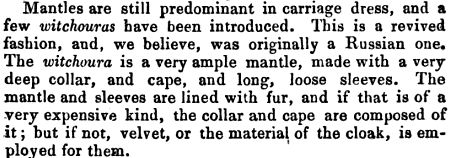
Moving along some years, The Ladies’ Pocket Magazine describes fashionable witzchouras in 1833 (the OED had quoted part of this in their definition of witzchoura that we looked at in my last post):
As we established before, by the 1830s the shape of the witzchoura had changed to accommodate the changing fashions of dresses under them: becoming more cape-like, with collars and loose sleeves rather than being fitted like a pelisse as they were in the earlier years of their popularity. Again, we are reminded that witzchouras are made from expensive fur, and the more expensive the fur the more likely to see it displayed as much as possible.
Moving forward once again, C. Willet Cunnington mentions witzchouras in his book English Women’s Clothing in the 19th Century referencing a year as late as 1849: “The Witzchoura Mantle, for the carriage, lined and trimmed with fur.”
This quote from La Belle Assembleé in 1849 could be the source for Cunnington’s mention of the style, as the phrasing is quite close to Cunnington’s description:
Here there is a mention of another garment similar to a witzchoura: in this case a burnous. According to the OED again, a burnous is a woman’s cloak or mantle from the 19th century resembling an Arabian upper garment of the same name. It is interesting to note that by the 1830s and 1840s a witzchoura is described as heavy, cumbrous, and very ample instead of the more fashionable and positive descriptions from the decades prior.
This is the second mention in this post of a similar (or possibly the same) garment of Russian origin. In addition to the specific evidence of the Polish origins of the witzchoura in name and relating to Napoleon himself, I’ve also come across multiple mentions of the witzchoura style being brought back to France from Russia by Napoleon’s forces. Both of these influences fit in with the dating we’ve established and lead me to wonder if these are two separate and unique garments. Perhaps, though I suspect that if they were indeed separate styles in name they would have been variations on a similar theme, just like the fur-lined pelisse mentioned earlier in this post.
It’s time for a little more information about witzchouras! Back in January, I shared my round-about journey to figure out what a witzchoura is. Now it’s time to look at witzchouras in more detail to determine what qualities define them.
In that last post, we left off with this enlightening sentence from the book Empire Fashions by Dover Publishers: “Around 1808, a high-waisted, fur-lined woman’s coat appeared, the witzchoura [wi choo ra].” Here is an example of what a witzchoura looks like.
Costume Parisien from 1813
My go-to source when I get geeky about word history is theOxford English Dictionary, and lucky for me, it has an entry for witzchoura! The OED tells us it as an obsolete noun from the French vitchoura and the Polish wilczura (a wolf-skin coat) that is defined as “A style of lady’s mantle fashionable c. 1820-35.” The OED also shares four uses of the word from period sources. Here they are, with slight edits:
1823 La Belle Assemblée Dec. Witzchoura pelisse of gros de Naples,..trimmed with a very broad border of swansdown. 1833 Ladies Pocket Mag. The witchoura is a very ample mantle, made with a very deep collar, and cape, and long, loose sleeves. 1835 Court Mag. [The mantle] is of the Witzchoura form, drawn close at the back, with large Turkish sleeves, and a deep falling collar. [1898 M. Loyd tr. O. Uzanne Fashion in Paris Witzchouras had not yet [c1806] come into vogue.]
So far, our qualifications for a witzchoura include: a high waist for earlier witzchouras (to correspond with the fashionable silhouette), fur lining, fur trim, the fact that a witzchoura is a coat or mantle (for outerwear, with another garment worn underneath), that it was most popular c. 1820-1835, and that it had not yet become fashionable c. 1806. Other sources add to a witzchoura’s qualifications those of its being full length, having large sleeves and a wide collar (or sometimes hood or cape layers over the shoulders) especially in the 1830s when the silhouette changed, as well as the general period of the “early 19th century” for its popularity, which makes sense since we’ve just looked at sources that mention dates between 1806 and 1835.
There is some information telling us that the garment became popular after Napoleon gained a Polish mistress in 1808 and other information that tells us that the garment was Russian in origin and became popular after the Napoleonic Wars brought the style back to France and England. (For more information about these early witzchoura influences, check out this post at the Sewing Empire blog.)
I’m excited the word has Polish or Russian origins, because “witz” sounds Polish or German to me. Also, I love that the last quote from the OED tells us that witzchouras weren’t popular just a few years prior to the year 1814. Oh, how fashionable is a merveilleuse!
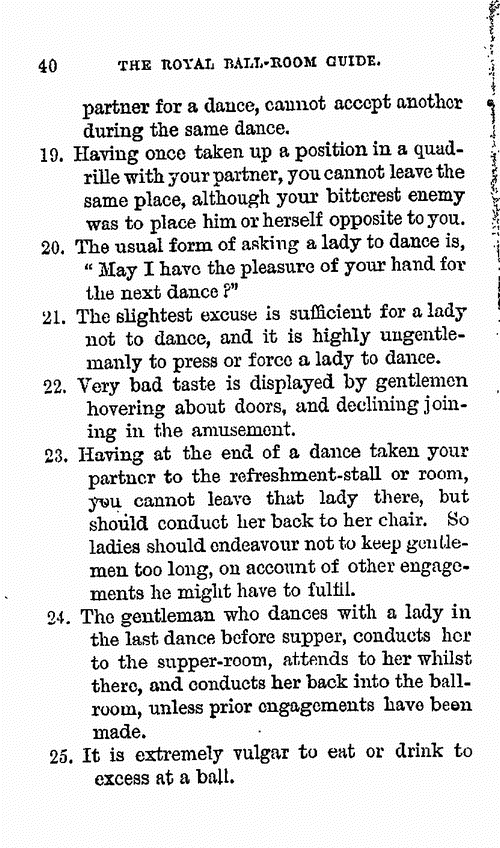
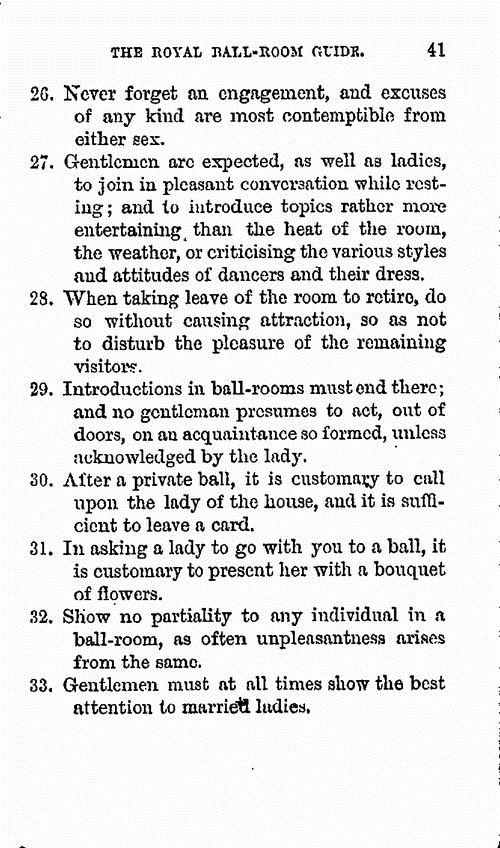
For your 19th century ballroom edification today, we have a list of etiquette points from The Royal Ball-Room Guide and Etiquette of the Drawing Room, 1877 (available through The Library of Congress). This is a great digest of lots of etiquette points on a variety of topics.
I believe many modern ladies and gentlemen could take note of many of these points when attending recreations of 19th century balls. My top choices for attendees and personal favorites are numbers 4, 11, 18, and 22.
Do you have a favorite (or two)? Did any surprise you? Have you been to a recreated 19th century ball and longed for any of these points to be adopted by modern ball guests?
Never anticipate the point or joke of an anecdote told in your presence. If you have heard the story before, it may be new to others, and the narrator should always be allowed to finish it in his own words. To take any sentence from the mouth of another person, before he has time to utter it, is the height of ill-breeding. Avoid it carefully.
…
Be careful always to speak in a distinct, clear voice; at the same time avoid talking too loudly, there is a happy medium between mumbling and screaming. Strive to attain it.
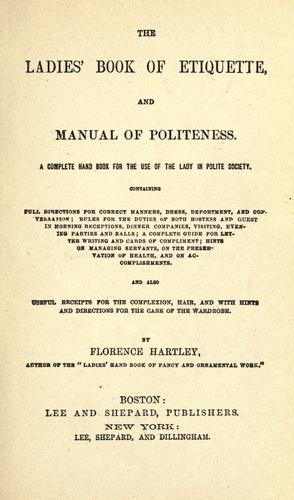
This particular quote is from page 14 of the The Ladies’ Book of Etiquette, and Manual of Politeness (1873), source here. Warning to all: avoid the “height of ill-breeding” in the new year! And, happy new year!
Life has been very busy of late and I haven’t any new sewing or event pictures ready to share, but I do have another installment of 19CBRE ready, so let’s go with that for now.
This one is following up on the last 19CBRE post about the use of those “I can’t remember the specific thing I’m mentioning” phrases. In a similar vein, this excerpt is also about what one should and shouldn’t say in conversation. It is from the same source, The Ladies’ Book of Etiquette, and Manual of Politeness (1873), page 14:
It is a mark of ill breeding to use French phrases or words, unless you are sure your companion is a French scholar, and, even then, it is best to avoid them. Above all, do not use any foreign word or phrase, unless you have the language perfectly at your command. I heard a lady once use a Spanish quotation; she had mastered that one sentence alone; but a Cuban gentleman, delighted to meet an American who could converse with him in his own tongue, immediately addressed her in Spanish. Embarrassed and ashamed, she was obliged to confess that her knowledge of the language was confined to one quotation.
A Trying Moment by George du Maurier
Good advice to follow in the 19th century and even today in many situations. Of course, our modern sense of etiquette being less strict than it used to be, a modern person perhaps wouldn’t be quite as embarrassed as a lady from the 1870s, but still it seems like a situation that is unnecessary and easy to avoid.
I’ve been inspired lately to read (and in some cases skim at the very least) 19th century etiquette manuals, especially those books and sections that pertain to 19th century ballroom etiquette. What got me started was perusing various posts at the blog Recreating the 19th Century Ballroom. Barbara posts tantalizing snippets from these sorts of manuals and I wanted to see the context and read more, so I went back to the original sources.
Looking for one thing leads to another, as you probably know, and so it was with etiquette manuals. Once you find one you are led to others and it’s just one big rabbit hole. In my perusal of these manuals, I’ve come across amusing and interesting sections that I’d like to share. In addition, I’ve also started thinking about 19th century ballroom etiquette and how much or little a modern historic ballroom atmosphere can replicate. It’s really quite fascinating!
I’m planning a series of posts relating to this general topic, exploring some of my thoughts as well as sharing quotes from the manuals. I don’t want to commit to any sort of regular posting, but I’m thinking I’ll just intersperse these posts amongst my usual parade of dressmaking and event pictures with the abbreviation 19CBRE (19th Century Ball Room Etiquette) to note what these posts are about. (It’s not a typo, in these manuals, the word we now spell ballroom was separated into two words “ball room.”)
To start, here is a short quote from The Ladies’ Book of Etiquette, and Manual of Politeness (1873), page 14, source here:
Never use the phrases, “What-d-ye call it,” “Thin-gummy,” “What’s his name,” or any such substitutes for a proper name or place. If you cannot recall the names you wish to use, it is better not to tell the story or incident connected with them. No lady of high breeding will ever use the substitutes in conversation.
I am so guilty of using phrases like this in life (and at historic events…). I forget what I’m talking about within a few seconds of finishing a sentence sometimes! So when I want to continue the conversation these phrases pop right up. According to these 19th century standards, I’m of low breeding and obviously not polite… but in our modern world these phrases, while being casual, don’t mark you as being ill-bred, at least to me. I’ve spent time thinking about the fact that this very casual way of speaking is probably not appropriate for a 19th century lady, but that goes back to my currently unexplored thoughts about how far we choose to go when recreating the past at a public event such as a ball (a topic I’ll be sure to post about, someday!).
But thin-gummy is just so amusing! I really feel like I need to work that into modern conversation just because I can. In fact, I worked it into the title of this post and I hope you can imagine the grin on my face because of it!
Do you use these sorts of phrases in your modern life or at historic events? Had it ever occurred to you that in the 19th century these sorts of phrases were to be avoided?
I know I promised pictures of the two balls at the Regency Intensive Dance Weekend in my last post, and I still promise that those are coming, but we’re going to take a quick detour before we get to ball pictures, to look at…
“A Dress Suited For Eve” (Elusive blue ball gown, 1811)
When dressed for the evening the girls nowadays
Scarce an atom of dress on them leave;
Nor blame them; for what is an evening dress
But a dress that is suited for Eve?
-1818
Quoted from page 42 of C. Willett Cunnington’s Fashion and Women’s Attitudes in the Nineteenth Century.
I came across this quote as I was either planning or starting this dress and I so enjoyed the curmudgeonly generation-gap thoughts expressed in it that it has stuck in my head as a sort of motto. I should explain that this quote occurs as Cunnington is discussing the new Classical style of gowns between the years 1800-1820. These dresses are usually not quite as scandalous to our modern sensibilities as they would have been to people at the time, especially those of older generations. Interestingly, this quote is from 1818 although in my opinion the often sheer muslin dresses from 1800-1810 are generally more revealing than those from 1810-1815, and especially more revealing than those from 1815-1820. Regardless, the idea of these dresses being so revealing that one is dressed as Eve would have been (i.e., wearing nothing!) is amusing to me.
This new gown is actually two separate gowns: a dark blue sleeveless underdress and a lightweight sleeved overdress in a color I call “elusive blue.” Both dresses are a mixture of hand and machine sewing, though all the finishing was done by hand on both pieces.
The underdress is simple and without a waist seam: it is gathered to a yoke in the back and gathered by a drawstring in front. The waist is created by tying the overdress. The overdress, however, is more complicated. The skirt is a simple rectangle with rounded front corners (two widths of fabric wide: there’s a seam at center back), but the bodice has front pieces, shoulder straps, and an interestingly gathered back piece, as well as sleeves. In addition to having more pieces, the overdress is edged all around with lace and faux pearls, as well as having puffs edged with lace and trim sewn on to the sleeves.
Back view (you can see the gathers on the back bodice piece).
I did indeed sew all the pearls on by hand, individually, and good thing, too! You see, if each pearl is sewn on individually then if the thread breaks you might loose a few pearls, but you won’t have your entire pearl job go spilling all over the dance floor (that could be catastrophic for the dancing and your hard work!). I did wear this to the Grand Ball on the Sunday evening of the Regency Dance Weekend, and by the end of the night I had lost a very small section of pearls along the back hem of my dress. Thanks to all my fastidious pearl sewing, that was all I lost and there were no comical/catastrophic scenes with pearls spilling on to the dance floor! If you look closely at the wavy lines you can see that they get a little wobbly at times, but I did do my best to be symmetrical despite the wobbles. I also did my best to estimate the wavelength of the pearls and replicate it as best I could while eyeballing as I went along. (In fact, I think my wavy lines of pearls are actually more regular than those on my inspiration dress.)
My dress is a direct interpretation of the ball gown at the Met from 1811 (pictured below). The most obvious difference is the colors I chose to use (partly because I found the fabulous elusive blue overdress fabric in the perfect light weight fabric for $1/yard!). I’m sure there are other small differences, too, but I did my best to follow the construction methods I gleaned from the zoom feature when making my dress. (The zoom feature on most of the Met’s pictures is so amazing! I love it.)
Ball gown, 1811, the Met.
As is usual with the first wearing of a new garment, there are things I am unsatisfied with and want to change. There are also things that didn’t quite get completed and need to be addressed.
First, the sleeves. My sleeves didn’t quite turn out like the ones in the inspiration photo, but they also didn’t get completed before I wore the dress (if you look closely, you’ll see that my sleeves are just raw edges on the bottom!). I ran out of time, but I also wasn’t sure that I would like how my sleeve puffs look and I didn’t want to spend time completing the sleeves if I was going to wind up disliking them in the end. Each puff is edged in the narrow bit I cut off of the wide edging lace and then also edged in a bit of trim that perfectly matches the elusive blue fabric (and that I purchased for about $2!). I don’t think my puffs look quite as elegant as the original, but they were a lot of work and I don’t have any more of that elusive blue trim to change things up. Also, if you look closely at the sleeves of the dress on the Met you’ll see that they are not displayed in the same way. I prefer the sleeve that is more puffed up (on the right), but I examined the pictures really closely and I think that it is just caught up on the mannequin and is intended to look like the other sleeve (on the left). So I have to decide, and that will help me determine how to finish the bottom of my sleeves.
Other things that bothered me were the length of my underdress (seems to have a similar length ratio to the inspiration, but I think I want my underdress to be about 2″ longer), the fact that I realized after sewing on all the lace that I had put in on with the wrong side facing out (oops! but I am absolutely not changing that!), and the fact that the blue underdress is a super bag without the overdress holding it in (I think part of the problem is my skirt shaping–I tried something new and it did not work–but the skirt kept wanting to poof out from between the fronts of the overdress, which I didn’t like). I’d like to address the underdress problems, but I’m not going to bother with that lace problem!
The lighting in this photo captures the colors of the dress much better than in the other photos.
I tried a new thing with my hair for this event which I think was quite successful. The poof is normal, but in front of it and my pearl hair “tiara” (it’s really a necklace!) are two narrow braids, one coming from each side of my head. I managed to hide the ends under the braids and my natural highlights allowed the braids to stand out from my front hair, in the right light (as with the picture, above). The only odd thing was covering up the points where the braids started. I liked it and I think I’ll try it again sometime. I also was able to wear some new earrings: green gems with little fake diamonds set around the edge of the teardrop shape. Despite not matching exactly, I think they suited the dress.
Ok, now the next post in this series really will be about the balls themselves!
This April, I was again blessed to be able to take a weekend and step out of my modern, incredibly busy life to join other like-minded individuals for a Regency Intensive Dance Weekend hosted by the Commonwealth Vintage Dancers. Here is the link to all of last year’s posts, which describe a weekend just as wonderful as this year’s turned out to be.
Saturday consisted of lots of dance class, followed in the evening by an informal ball. Sunday’s schedule had a little bit of dance class in the morning followed by a low-key afternoon of Regency non-dance activities and finished up with a reception and grand ball in the evening.
We took fewer pictures this year than last year, but we still captured the amazing essence of this wonderful event: Saturday’s ball really felt like an immersion into an intimate house party rather than a public ball, Sunday’s afternoon events were wonderfully relaxed and felt like an afternoon one might have while visiting Mansfield Park, and Sunday’s grand ball was amazing to behold and be a part of in terms of exquisite refreshments, companionable company, and excellent dancing.
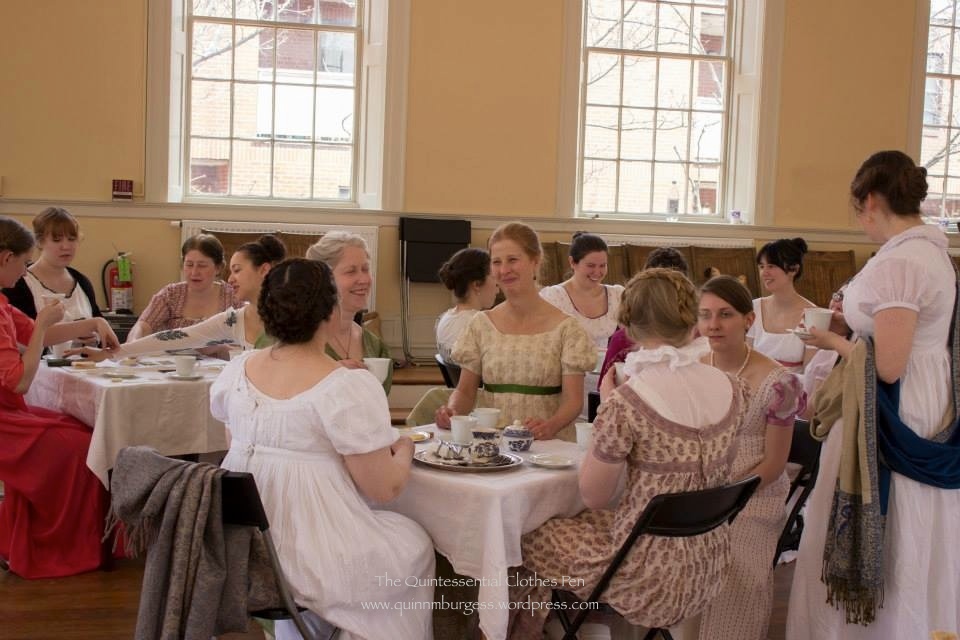
Having so few pictures of the Saturday evening informal ball, I’ve decided to just include them in a second post which will have pictures from both balls. So then this post will be about Sunday afternoon’s event. Activities included sword demonstrations, playing various period card games, participating in or watching a “theatrical,” listening to a short and impromptu piano interlude, and delighting in the delicious refreshments and tea. Of course, there was also lively conversation, as you would expect! (We had hoped to have some outdoor actives, too, such as playing graces in the park and taking a walk, but unfortunately it was raining all morning and things were wet, so we decided to stay inside. In the end, it turned out to be just fine and we still had a lovely time!)
Cards and counting chips laid out and ready to participate in a game.
The “theatrical” was staged for us by a group of interested and theatrically inclined ladies. They only had perhaps a portion of an hour to prepare a few scenes from The Rivals for us (a play first performed in 1775 and written by Richard Brinsley Sheridan). It was highly enjoyable and, we, the audience laughed a lot! Indeed, The Rivals is one of the plays that is dismissed by the party in Mansfield Park when they are thinking of putting on a play (hence why I’ve specifically mentioned that the afternoon felt like visiting Mansfield Park!). In the book, they decide on another play in the end (Lovers’ Vows, from 1798), but it was neat to see scenes from one of the plays mentioned in the book!
“All the best plays were run over in vain. Neither Hamlet, nor Macbeth, nor Othello, nor Douglas, nor The Gamester, presented anything that could satisfy even the tragedians; and The Rivals, The School for Scandal, Wheel of Fortune, Heir at Law, and a long et cetera, were successively dismissed with yet warmer objections.” From Mansfield Park by Jane Austen, in Chapter Fourteen.
Small props had been thought of ahead of time and provided extra amusement: the hat, cravat, and beard were a few of these amusing things!Really, the scenes were amusing and acted with conviction.Delicious refreshments (we had a variety of scones, cookies, and cucumber sandwiches). Tea is being poured out in the background.A portion of the party enjoying card games, conversation, and refreshments.
Our venue was built around 1816-1817 and provides a wonderful environment for Regency activities especially: beautiful windows, high ceilings, a lovely dance floor that lends itself to Regency style dancing, etc. I also like the creamy butter yellow walls with lovely white trim.
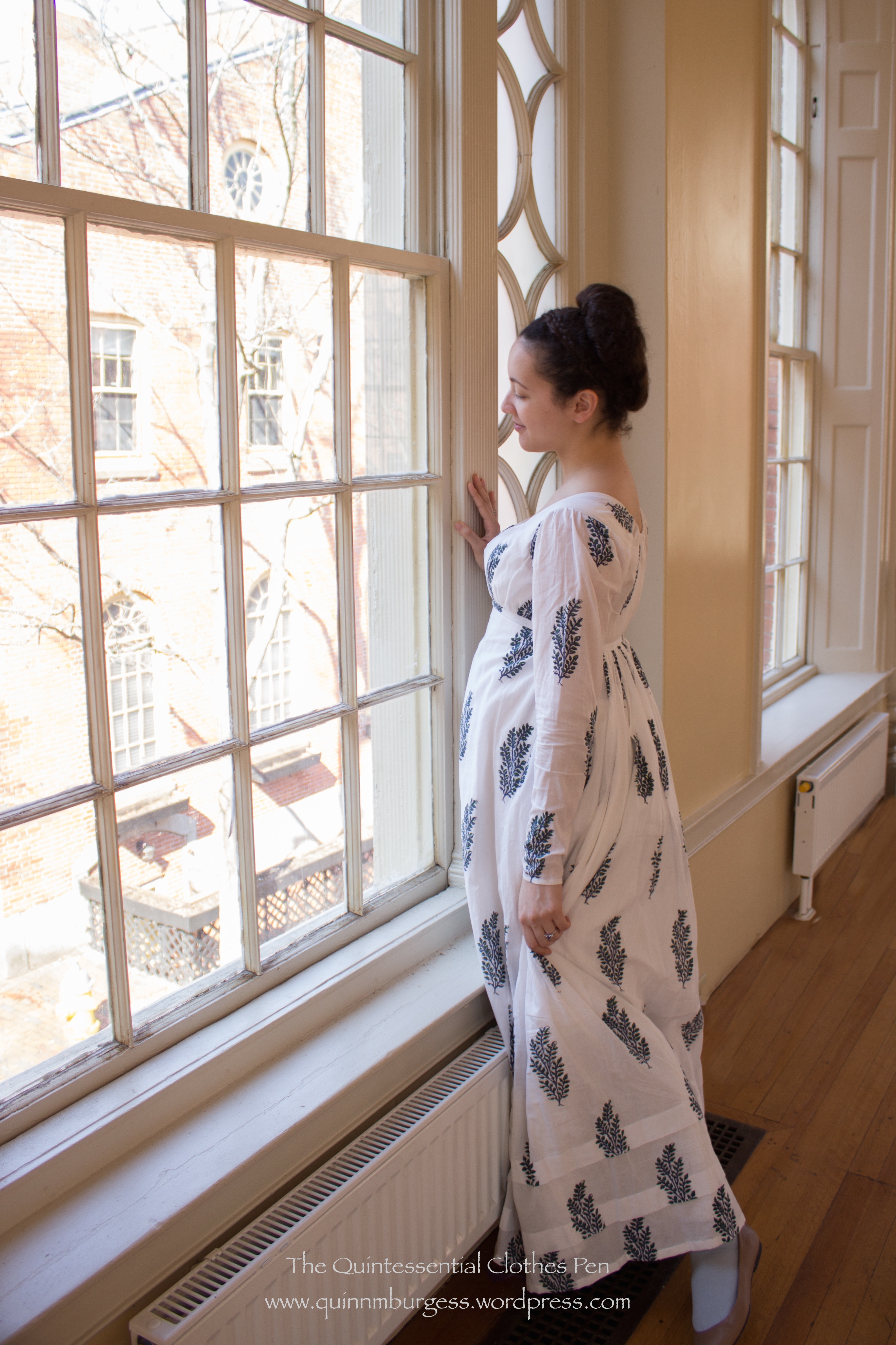
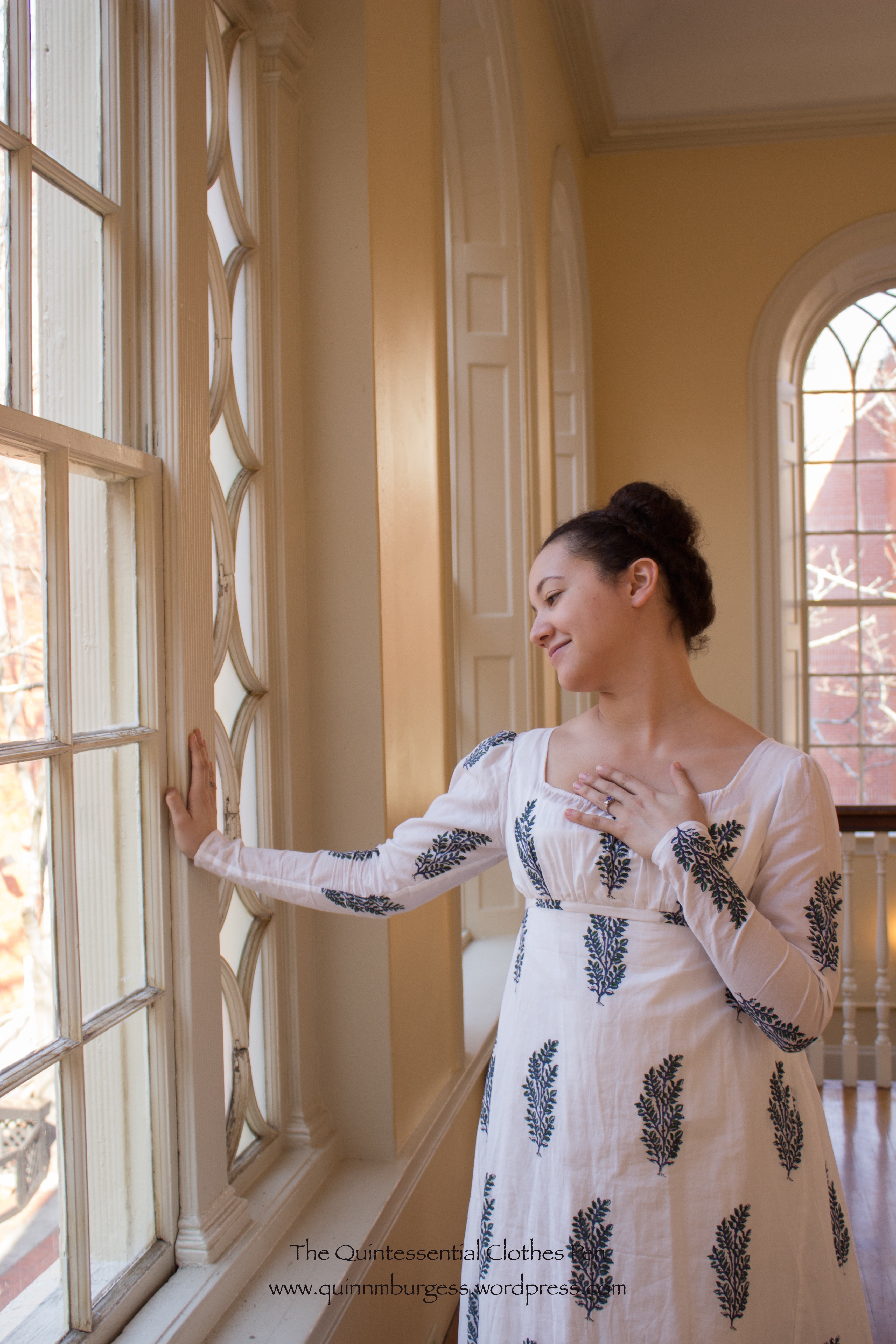
I wore my tree gown. I’m attempting to look pensively out the window hoping that Mr. Darcy will come by…I’ve seen him! Be still my heart!
Yes, I know I’m mixing my books here. Perhaps I should have thought of myself as Fanny Price waiting to see a glimpse of Edmund Bertram out the window. Ah, but I don’t identify with Fanny so much as Elizabeth Bennet, so you’ll have to cope with my mixing of books!












 The Quintessential Clothes Pen