

First:
The Backstory
As with last year, The Footwork and Frolick Society hosted a Bridgerton themed croquet afternoon this summer, which seemed like a great event to debut the 1794 dress I posted about making last fall (I did, in fact, wear the 1794 dress — you can see photos in this past post). My only hesitation about that idea was that the dress is all white, which didn’t feel quite as colorful as I might hope for given the Bridgerton theme. So I started brainstorming…
Prior to this brainstorming, I had happened across a 1 ½ yard piece of lime green silk in the discount bin at one of the local fabric stores for $6. Silk at that price felt too good to pass up, even in a very bright color and yardage too small for a dress. I figured I would find a use for it eventually!
During my brainstorming, I came back to the idea of the lime green silk… It seemed wonderfully bright and fitting for this particular intended purpose! And with a small yardage amount, it seemed perfect for a Directoire accessory.
What is Directoire? The Encyclopedia Britannica defines this style as the “Neoclassical style of dress, furniture, and ornament popular in France during the period of the Directory (1795–99).” Given that many of the inspiration images for my dress were French fashion plates from this period, or close to it, I think it is fitting to use the description of Directoire for this garment.
Choosing The Style
I first thought about making a sash (similar to the one I posted about in 2023 that hasn’t been worn yet), but decided I wanted something different to vary up my possible looks.
After looking at many fashion plates, books, and extant garments, I realized I was drawn towards spencers; however, when I really paid attention to dates it struck me that the popularity of those garments seems to be concentrated in the 1800s and 1810s when Neoclassicism had really settled in, dresses were not as fluffy as they still were in 1797, and the description of “spencer” was fully established. (I explain what a “spencer” is in this old post from 2011. There are many photos of extant examples included in that past post, as well.)
I really liked the idea of a sleeveless bodice. So I set about looking for specifically late 1790s examples of these over white dresses. It turns out that the sleeveless idea (in the specific date range of approximately 1794-1798) is unusual — though it is not uncommon to find long and short sleeved variations.
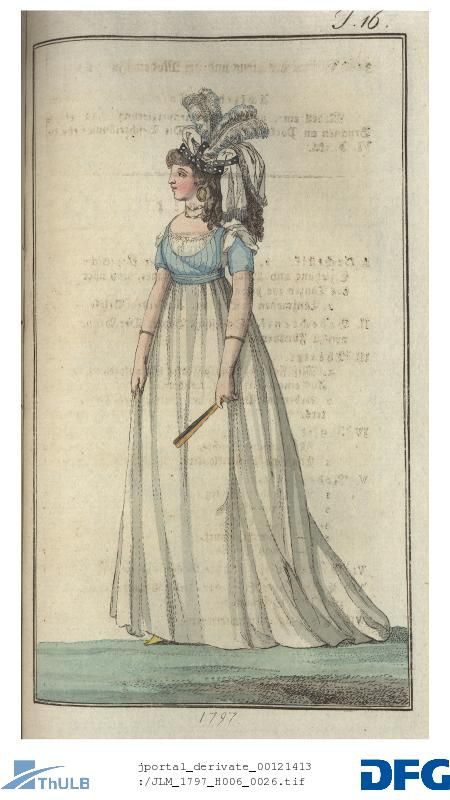
Below is an example of a short-sleeved bodice from the Journal des Luxus und der Moden (The Journal of Luxury and Fashion) in 1797. This German fashion journal was published in Weimar. You can click on the fashion plate below to go to the Rijksmuseum, where you can zoom in to see more detail!
Here is another example showing a long sleeved bodice (actually called a spencer in the description!). This was published in Costume Parisien in 1799. As you might guess from the name, this fashion journal was published in Paris.

Finalizing The Details
I decided to combine the crossover detail and vertical lines of the Luxus und der Moden style with a sleeveless variation visible on the left in this next fashion plate, which is from The Gallery of Fashion. This fashion journal was published in London by Nicolaus Heideloff. Clicking on the fashion plate will take you to the Metropolitan Museum of Art, where you can zoom in on the fashion plate and learn more about Heideloff.

I also borrowed a peplum idea from the extant spencer below, which was sold by Christie’s in 2008. I liked the look of a peplum and appreciated how this one rises at the center back, which is a nice feature to highlight the rising back design element on the 1794 dress I planned to pair with this garment.
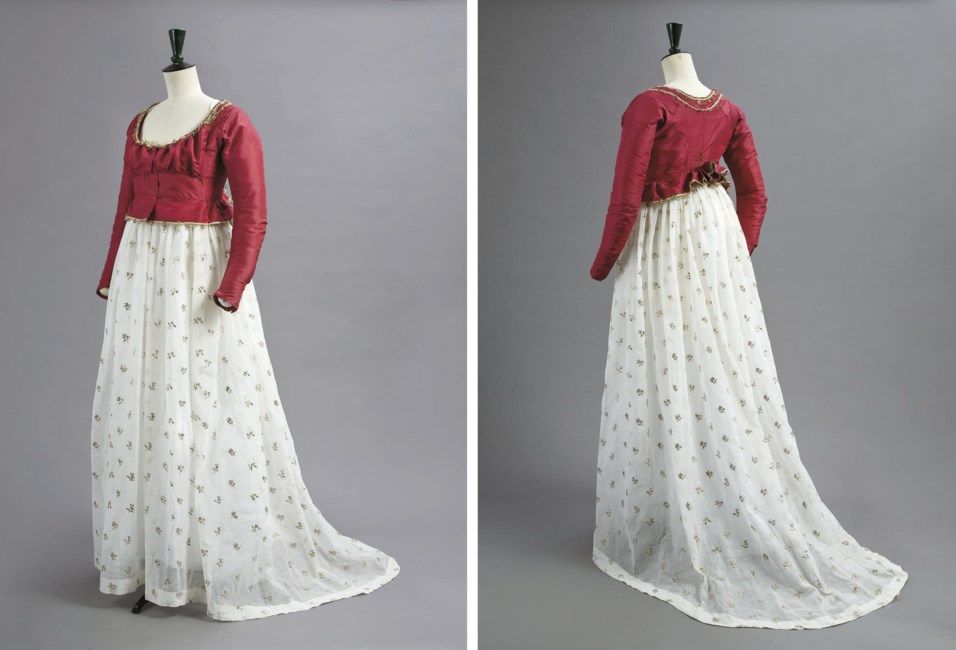
Many spencers have some sort of trimming around the edges. I was inclined to use something bright and silly to match the lime green silk and in the stash I found scraps of vibrant pink that went well with the green. I decided to use this as a edging, placing it in similar locations as on the Christie’s spencer.
And that means my plan was mostly in place! Next I had to think about how I would construct this garment and move on to patterning it. I’ll share about that in another post!
 The Quintessential Clothes Pen