

This is a continuation of my last post, which shared the background of why I created this black domino cape as well as research about what a domino is and its history.
Making My Mysterious Domino
Having decided on an idea, and probably conducted more research into its history than was strictly necessary for this purpose, I proceeded to figure out how to bring my idea to life. I had the additional goal of not wanting to spend money and therefore restricted my domino-endeavors to the stash.
I started by looking through my stash binder (I posted about my stash organization in this past post) to see what fabrics I had on hand that might be able to be made into a quick and easy domino. I came up with just one — a gifted-to-me three yard piece of a black synthetic sheer, with alternating satin and sheer narrow stripes and a bit of metallic thread woven in between each stripe. I liked the drape of the fabric, as I thought it would move nicely while dancing, and I liked that while being black, it was also interesting and had more to look at than a plain solid. Three yards was plenty of fabric to allow for a large hood and plenty of length!
I think this fabric might be fun to use for something else someday, so I was loathe to actually cut it to make a domino cape. From past experience (and my patterning books), I was aware of the general shape and construction of the hoods of 18th century capes, which I was more excited by than the shape of the main body portion of capes from this period. The hoods often have quite a bit of fabric pleated into a central spot on the back of the hood and the bases are often pleated into the neck area, as well.
I started experimenting with my fabric and safety pinned a central pleated area in the center of my three yard piece. Then, I safety pinned a center back seam in the two ends of the piece, which hung down below the ‘hood.’ The next step was to safety pin a row of large pleats around what would be the ‘neck’ area, to draw in the width of the fabric around the shoulders. And… I basically had a cape!
A bit rough and ready, but my safety pinning did create a cape with a hood!
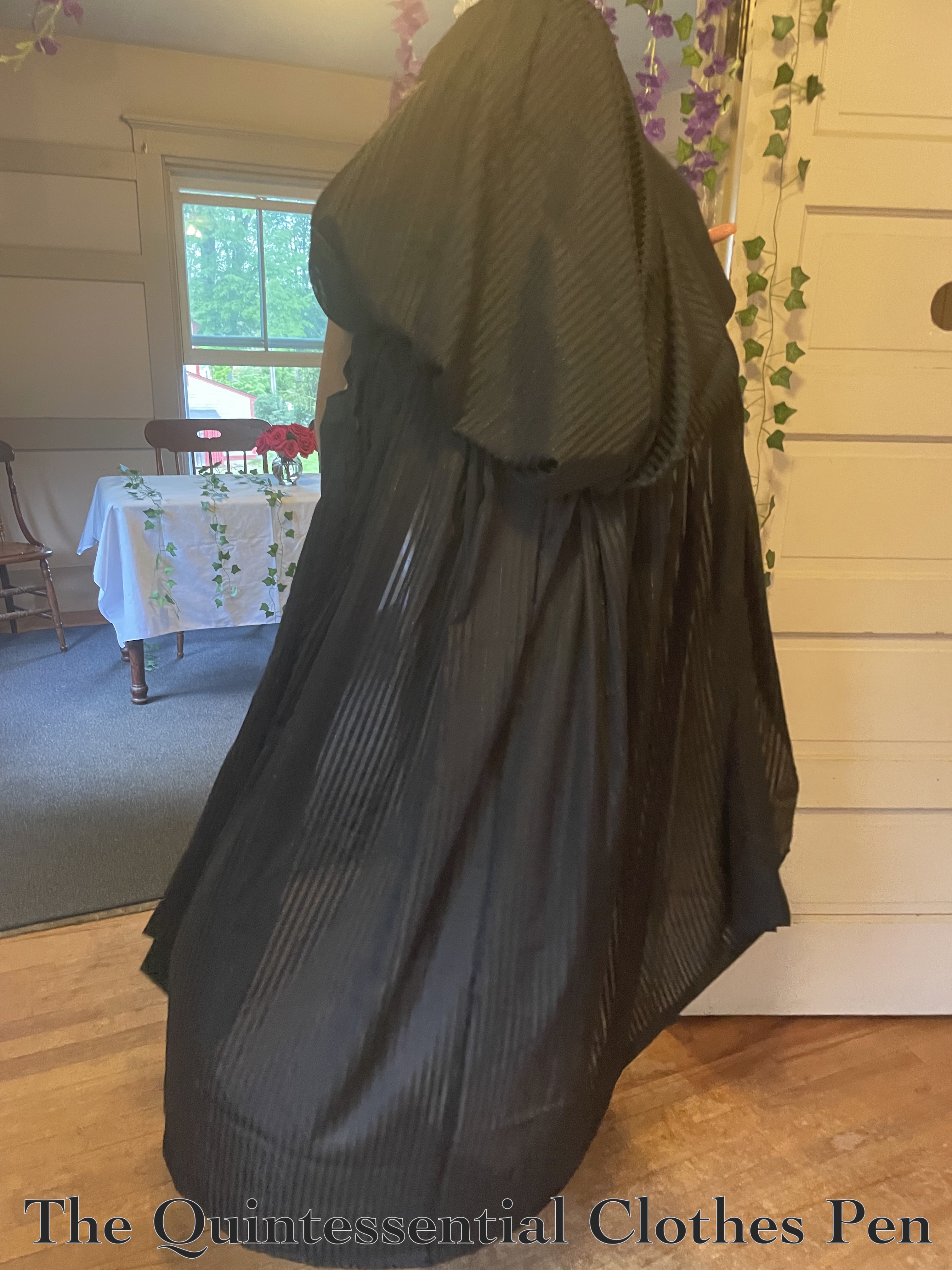
I fiddled a bit, by turning under some of the depth of the hood (and pinning it back near the central pleats) as well as pinning up swags at the front shoulder areas. I agreed with Erté (in the quote in my previous post)– that my domino should have a distinguished cut to keep me from looking like a shapeless bundle!
At that point, I realized that most of my pinned areas really didn’t need to be sewn… I could just leave in the safety pins, making it much faster to take apart if I wanted to do that someday! In the end, the only two things I sewed were the center back seam (with basting stitches by hand) and the hem (again, with basting stitches by hand). Calling it a ‘hem’ is generous, I think! I really just turned it up once with the raw edge left visible.

Wearing My Mysterious Domino
My historically plausible, mysterious looking domino cape was ready to go. I was all prepared for The Footwork and Frolick Society’s early 19th century themed Masquerade Ball!

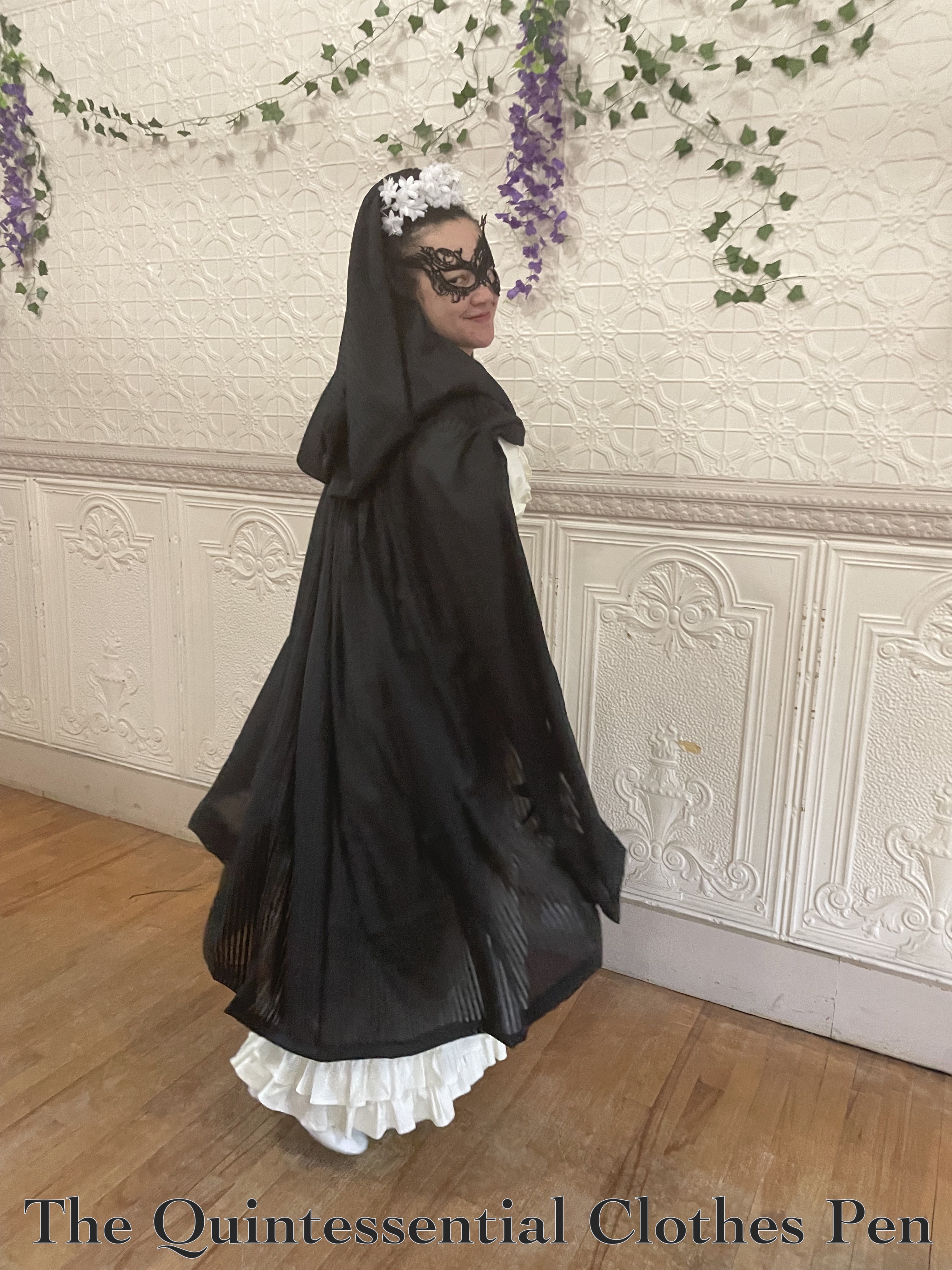
I chose to pin the cape to my dress rather than having it closed at my neck. It made the hood pretty long in the back, but it kept the cape from pulling backwards and feeling claustrophobic, while also opening up the front view and not covering my entire dress.
And, since I felt like black mask, dark hair, and black hood was all a bit much around my face, I put my hair up around a huge bun form to raise the hood and added white flowers in front to add some contrast and a relief for the eyes.
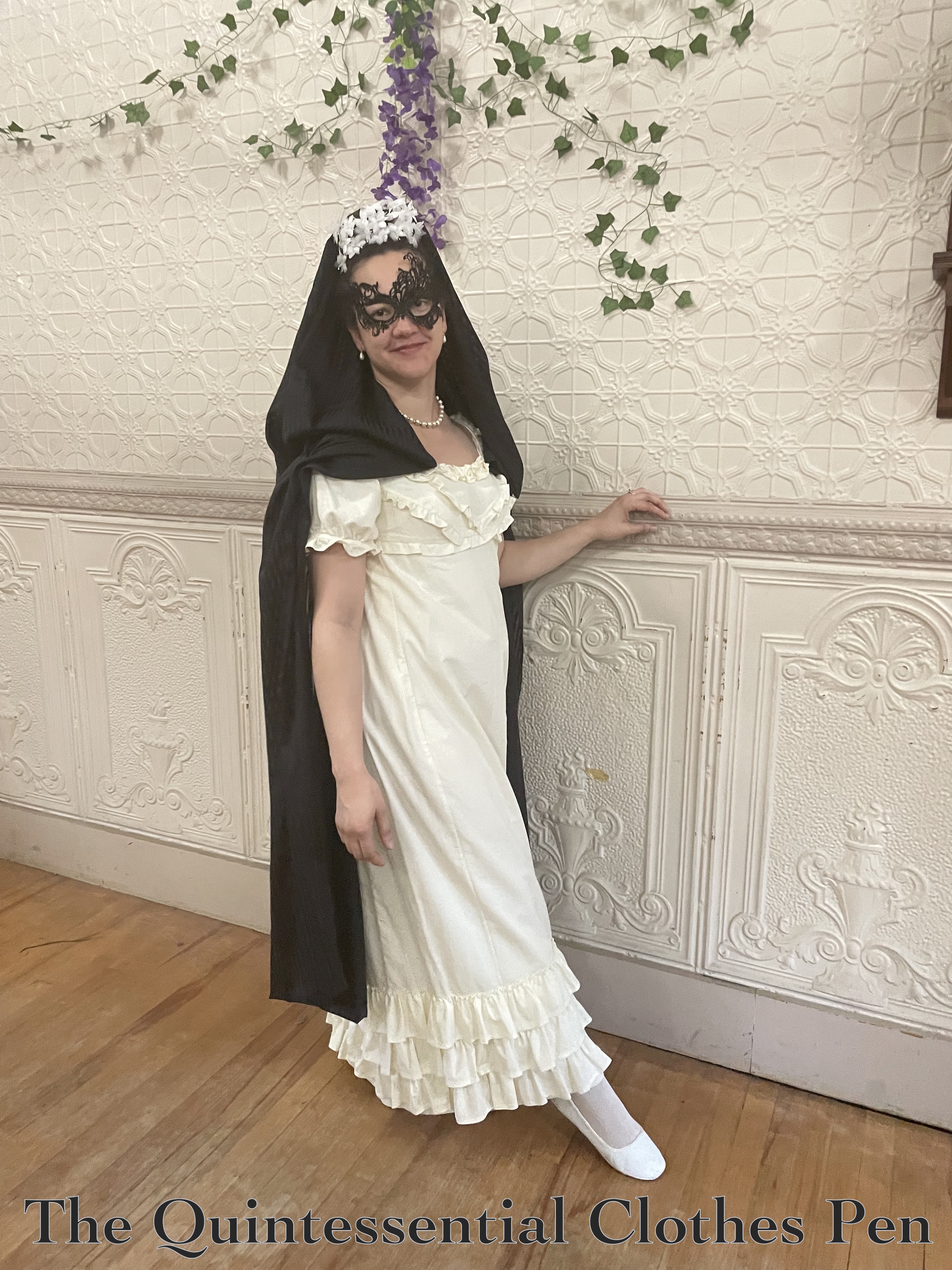
Paired with white, gold, and pearl accessories, I created a fun new variation on an old dress!
 The Quintessential Clothes Pen