

I’m trying to get in all of my Historical Sew Monthly 2024 posts before the new year! So in that spirit, here is another one!
 Above is a closeup of the fluff that makes up the arm openings of the new yellow sacque I mentioned in my last post (where I shared details about the petticoat for the new sacque) as well as my Versailles dress from 2016. Part of the fluff is the sleeve ruffles on the dresses and part of the fluff is the engageants — lace for the Versailles dress and a double layer of ivory silk for the new yellow sacque!
Engageants are sleeve ruffles. The Oxford English Dictionary traces the word back to the 16th century with its origins in French.
These new engageants are made of two layers of silk gauze, inspired by the ones displayed with the lovely yellow dress below by the Royal Ontario Museum.
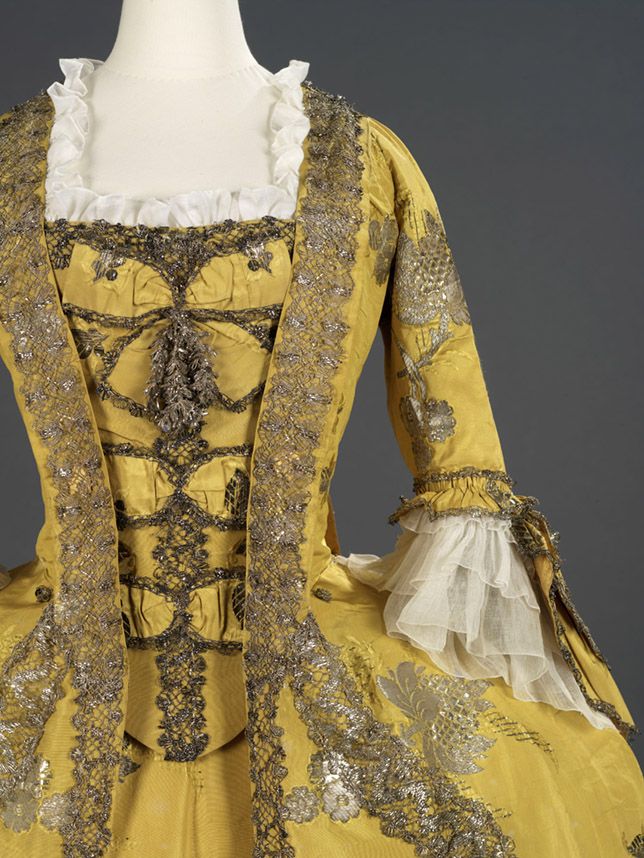
I specifically wanted the semi-sheer quality as a change from the lace engageants that accompany my Versailles sacque (which you can read about in this past post detailing construction information about that dress).
I looked through my stash and realized that the best fabric I had for this project was salvaged from an old ballroom dancing dress I’d made. Here is a blast from the past for you! The elusive Mr. Q is even hiding there, behind my head… But back to the dress. It was made pre-blog, so no photos of it have made it here before.

I was so proud of it! But after a fair bit of wearing this dress, I moved on to creating new ballroom dresses and sacrificed this one for parts. The rhinestoned lace was re-used in a dress that did make it onto the blog in 2013 (documented in this past post), but the float — that dangling piece hanging from my wrist that floats in the breeze while dancing — was simply put into my fabric stash, which is where I found it when looking for engageant material!
The float was an odd triangular piece, so I had to do some piecing (adding center seams, for example) to make my engageant pieces fit. But that’s fine! In all the fluff you can’t see the seams.
And in fact, the pattern I used, from 1769, was intended to create zero fabric waste, which intentionally added seams, as well. The scalloped pieces are stacked together with the scallops facing each other to efficiently use a single rectangle of fabric.
Completed engageants are below. The seams are not obvious!
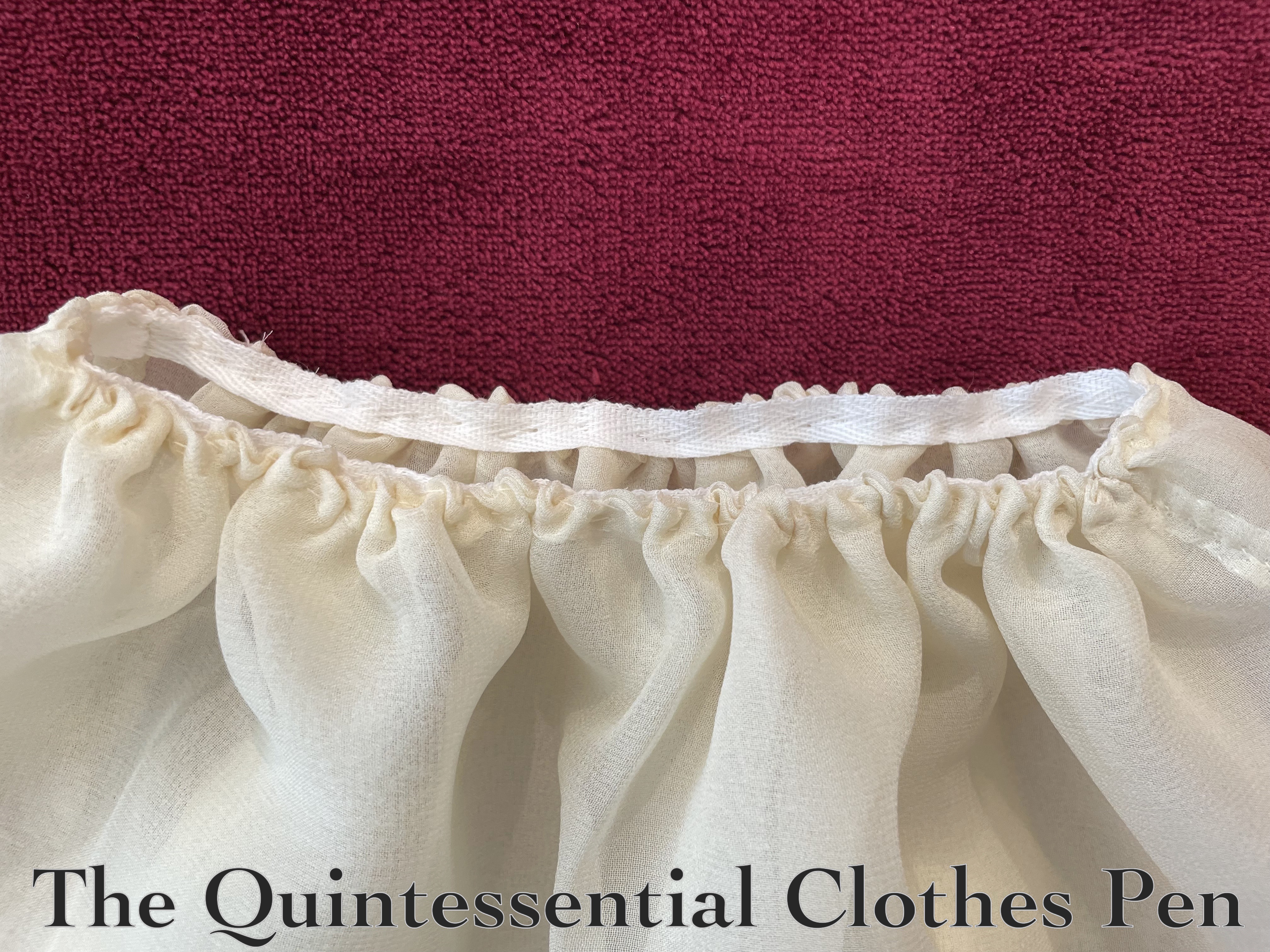
 Every individual silk piece for these was narrow hemmed on all the edges and then the seams were butted, whipped, laid flat, and pressed. Below is a close up of a seam and a scalloped bottom edge.

Once all of that was done, the two layers were laid on top of each other and whip gathered along the top edge. This was then sewn to a ¼” cotton tape. This allows for the engageants to be removed to be cleaned or used with another dress someday.
And that’s it! These qualify for the Historical Sew Monthly Challenge #6 Up Your Sleeve:
Level up your sleeve game by making a garment where the focus is on the sleeves.
Just the facts:
Fabric/Materials: Approximately ½ yard of ivory silk gauze.
Pattern: From page 14 in Patterns of Fashion 6 (written by Janet Arnold, Sébastien Passot, Claire Thornton, & Jenny Tiramani).
Year: 1769.
Notions: Approximately ⅔ yard of ¼” white cotton twill tape and thread.
How historically accurate is it?: 95%. Entirely hand sewn. The construction methods are historically sound. The fiber content and weave may not be perfect.
Hours to complete: 8 ¾.
First worn: October 5, 2024.
Total cost: I have no recollection of what I paid for the silk gauze many years ago. Plus, at this point this fabric is being re-used, so might be called free regardless. The twill tape was bought in bulk and cost less than $1 per yard. So let’s say approximately $5.
 The Quintessential Clothes Pen
Dear Quinn,
Doesn’t it make you happy to reuse materials? Yay!
The little peeks you’re letting through of the dress already have me saying it’s going to be wonderful 🙂
Very best,
Natalie
Yes! I greatly enjoy being able to make garments and fabrics last and find new uses and re-uses for them. It helps me feel connected to history as well as less of a modern super-consumer. It’s so wonderful to know that others also enjoy re-use, too!
Thank you for the in-advance compliment! Photos of the finished dress are coming soon (because I’m so very slow at getting to blog comments…). I appreciate your dedication to leaving them, despite being slow to respond! 🙂