Ice Skates! (And Polka Dot Soakers)

I bought ice skates! I was so pleased with skating in my 1895 Skating Ensemble that I really wanted to skate again this winter. I had plans to skate on a lake (so exciting!), but unfortunately we’ve had too much snow here in Boston and the lake was covered in huge drifts and unskate-able (also, we just had a day above freezing, the first in over a month, so it might also be unsafe to go out on naturally formed ice at this point). I’d still like to use my ice skates to skate on an outdoor rink like we did in January, it just means I’ll only have to pay to skate, not to rent the skates! We’ll see if these plans materialize…

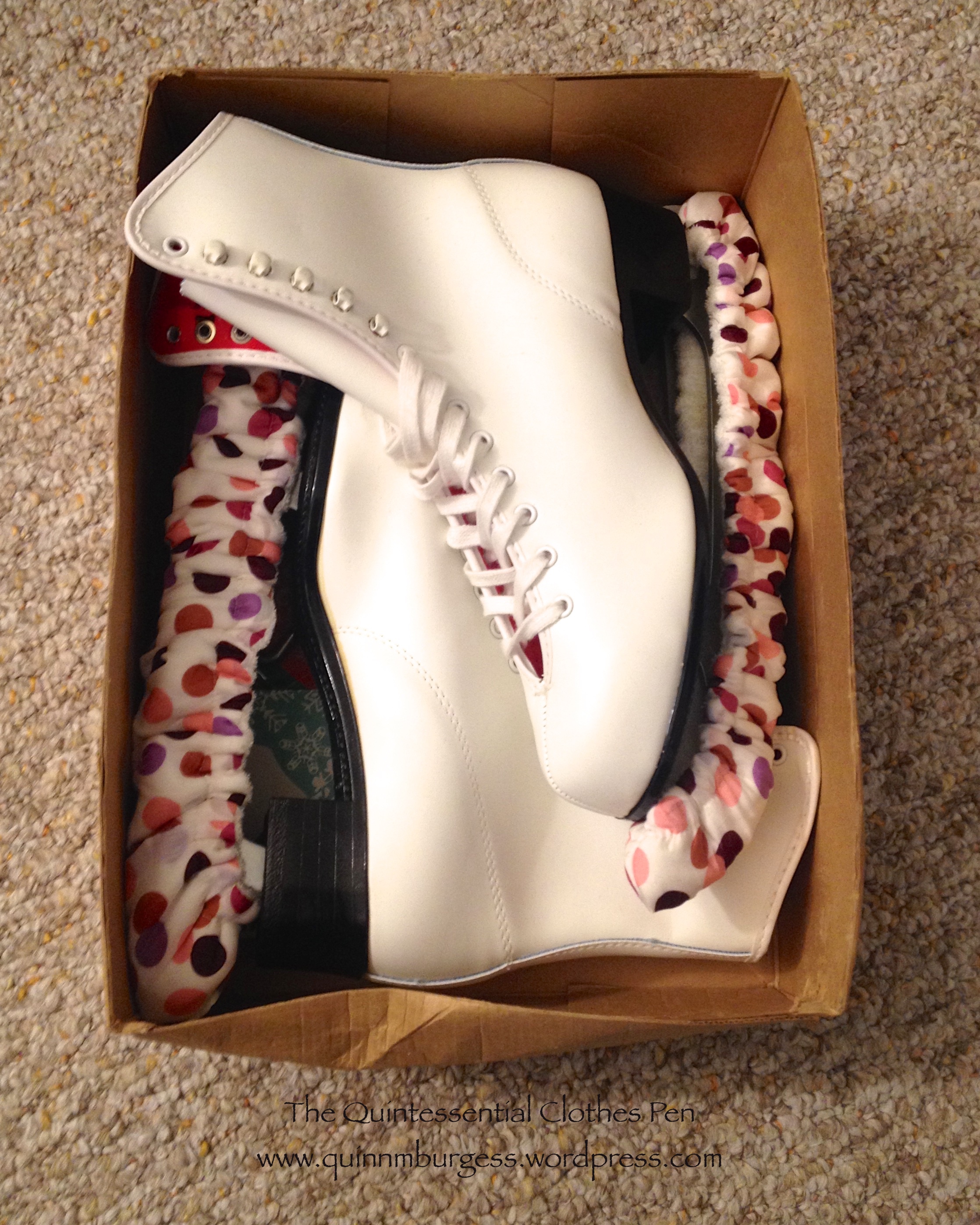
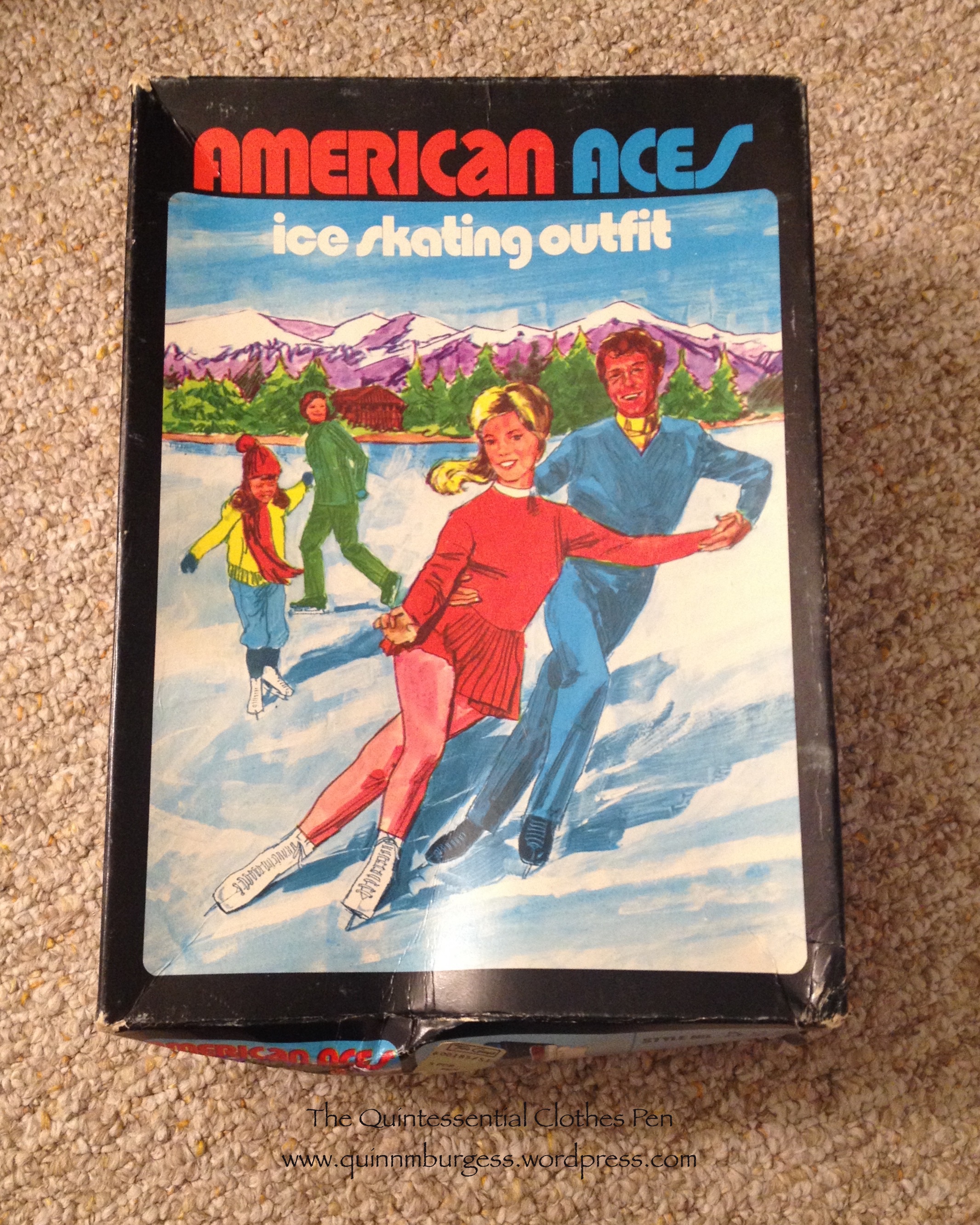
In the meantime, here are skate pictures! I bought vintage skates from Etsy. I’ve never bought ice skates before, so I was definitely guessing on the size. I gauged the size partly based off the size 8 skates I wore in January (too small) and also asked the seller for the length of the boot before purchasing to compare to my foot length (he sent me pictures with a ruler, very helpful!). It worked out and the skates fit! We’ll have to see how they work out once I’ve been in them for a bit while skating.
IMG_2023
I’m guessing these skates are from the 1970s based on the clothing of the illustrated skaters. If anyone has thoughts I’d be happy to hear them!
IMG_2025
They came not only in the original box, but also with their tag, skate scabbards (and packaging) and a hook-y thing. Does anyone know what the hook-y thing is used for or what it is called? Do I carry my skates with it? I feel a little silly not knowing what it is, but it’s a cool thing regardless, all wood and metal.
IMG_2024
These skates have never been worn! The only time-damage was on the tongue lining, which had been glued originally. The glue had entirely disintegrated, leaving a dusty foam behind. I cleaned it off and re-glued the tongue lining in place. So far it seems to have worked beautifully!

But those polka dotted doohickeys are not vintage. I made them! They’re called soakers and I understand that they are put on the skate blades after being used to soak up any excess moisture in order to keep the blades from rusting. I came across them while looking for skate scabbards (the doohickeys you wear around the rink while not on the ice to protect the blades from getting dull) while I was researching skates to purchase. The different pictures I found of them looked so cute that I wanted some for my new skates! (Ha, remember my post about thin-gummies? Yup, here I am using the word doohickey.)

IMG_2021
One soaker on, one soaker off.

This is the tutorial I followed for making my soakers. It was super easy. I had to piece my fabrics because the scraps I had were small, so that added some time, and I made my towel two layers thick since it was thin terry cloth, which added a little time and bulk, but those are the only things I changed. The polka dot exteriors are scraps from my 1953 Polka Dot Dress and the terry cloth linings are cut out of a failed robe I made years ago when I was first learning how to make clothes. Yay for repurposing! I love how silly and girly they are. They make me smile! Plus, I don’t use elastic for many projects of my own, but I happened to have just one piece in my bag of random scrap notions that was the perfect length, so the whole project was free and from my stash!

I have no idea if these skates are sharp. I assume that skates come sharp when you purchase them? They don’t feel very sharp… but I thought I’d try them and see what happens. It’s not like I’m a great skater, I sort of just putter around the rink, so if they’re not terribly sharp I expect I’ll be ok…

A Snowy Evening In The 1890s

In January, The Commonwealth Vintage Dancers hosted an 1890s weekend (the same weekend that included an ice skating party that I blogged about a few weeks ago). Despite some snow during the day and into the evening, people were not kept away and the ball on Saturday was packed with dancers. Please join me on a little jaunt back to a snowy evening in the 1890s.

IMG_1816
Arriving at the ball in the snow. (Well, sort of… I actually arrived in modern clothes, got dressed in my 1893 ball gown, borrowed a friend’s fur cape to keep the snow off my silk and the cold off my chest, and went back outside to take staged “arriving” photos.)
IMG_1802
The entrance hall’s view of the snow outside.
IMG_1803
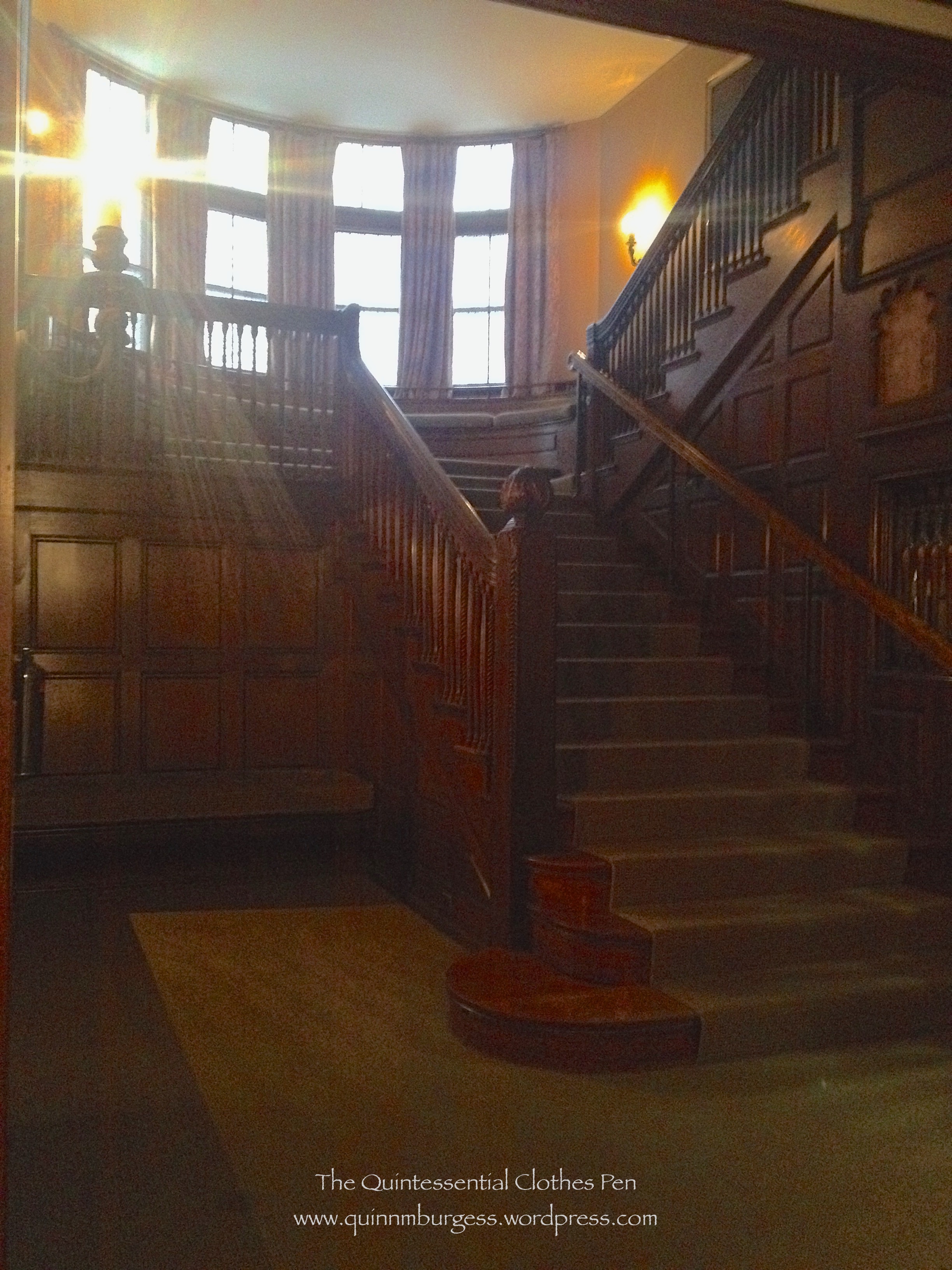
The beautiful main staircase to the upper floors. There were lots of lovely sitting areas and nooks throughout the venue.
IMG_1849
There were also bookcases everywhere full of elegant hard cover books (my favorite!).
IMG_1824
In the ballroom, couples danced round dances including waltzes and polkas.
IMG_1838
What strikes me in this photograph are the black and white evening suits of the gentlemen. Everyone is nicely lined up to dance what I believe was the Opera Reel.

Videos are even more immersive than photos, and with this you can actually step into the ballroom that evening. Keep a look out for me partway through the video dancing a polka and then dancing a waltz at the end.

IMG_1831
It became quite warm in the ballroom with all that dancing, so I stepped outside partway through to cool off and the snow had resumed in earnest!
IMG_1844
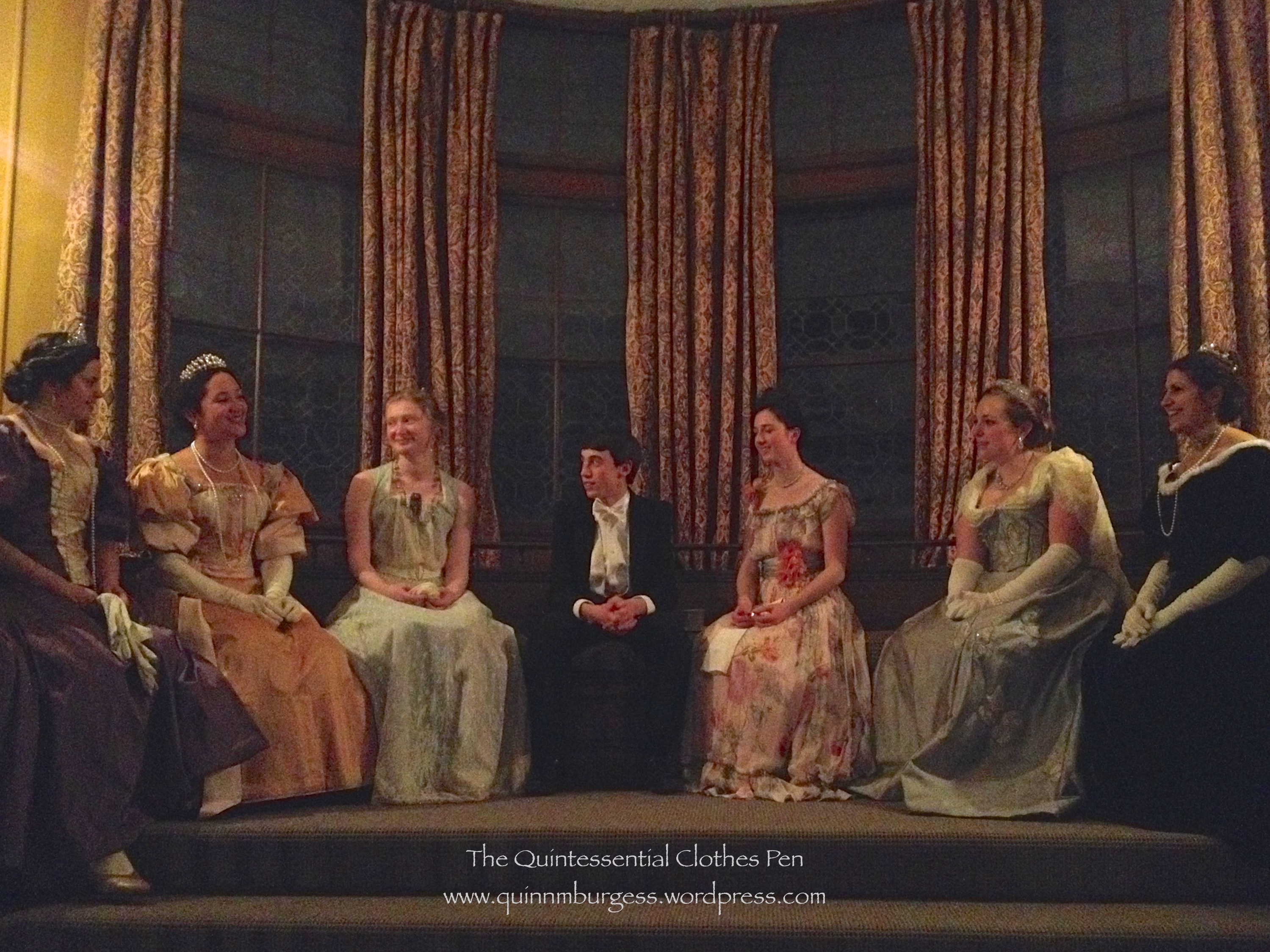
People spread through the house during the a break in the dancing. Here we are part way up the main staircase. Aren’t we well set up for a photo?
IMG_1851
And finally, being silly, because I blended very well with the curtains! Good night!

Subdued “Coeffure a la Chinoise” In Red And Gold

I attended a small Regency ball last weekend. It was charming and not nearly as packed full of people as I have grown accustomed to at these events in recent years. The smaller crowd made for a much more subdued (but still pleasant) evening than I was expecting.

The only downside was that the hall was exceptionally cold and not being full of people did not warm up very quickly! Few of us had planned for the situation and we were mostly scrambling to find any scarves or sweaters to wrap ourselves in. Many of us were resorting to items that we’d worn to keep ourselves warm outside, sacrificing fashion for warmth (it’s been below freezing here in Boston for at least the last three or four weeks consistently). I, for example, wrapped up in my pink cashmere scarf despite wearing a red dress. I thought it looked odd, though I was told that the colors looked good together. But there were a few lucky solutions that were both fashionable and warm: a large paisley shawl and a plaid scarf/wrap that looked very Scottish were the two most fashionable looks in my opinion. After some dancing and about midway through the evening, many had warmed up enough that scarves were being discarded, though I do believe I kept my scarf wrapped over my shoulders and chest throughout the entire evening.

IMG_1973
Elegant, fashionable lounging during the refreshment break.
IMG_1972
Delicious refreshments alluringly laid out.

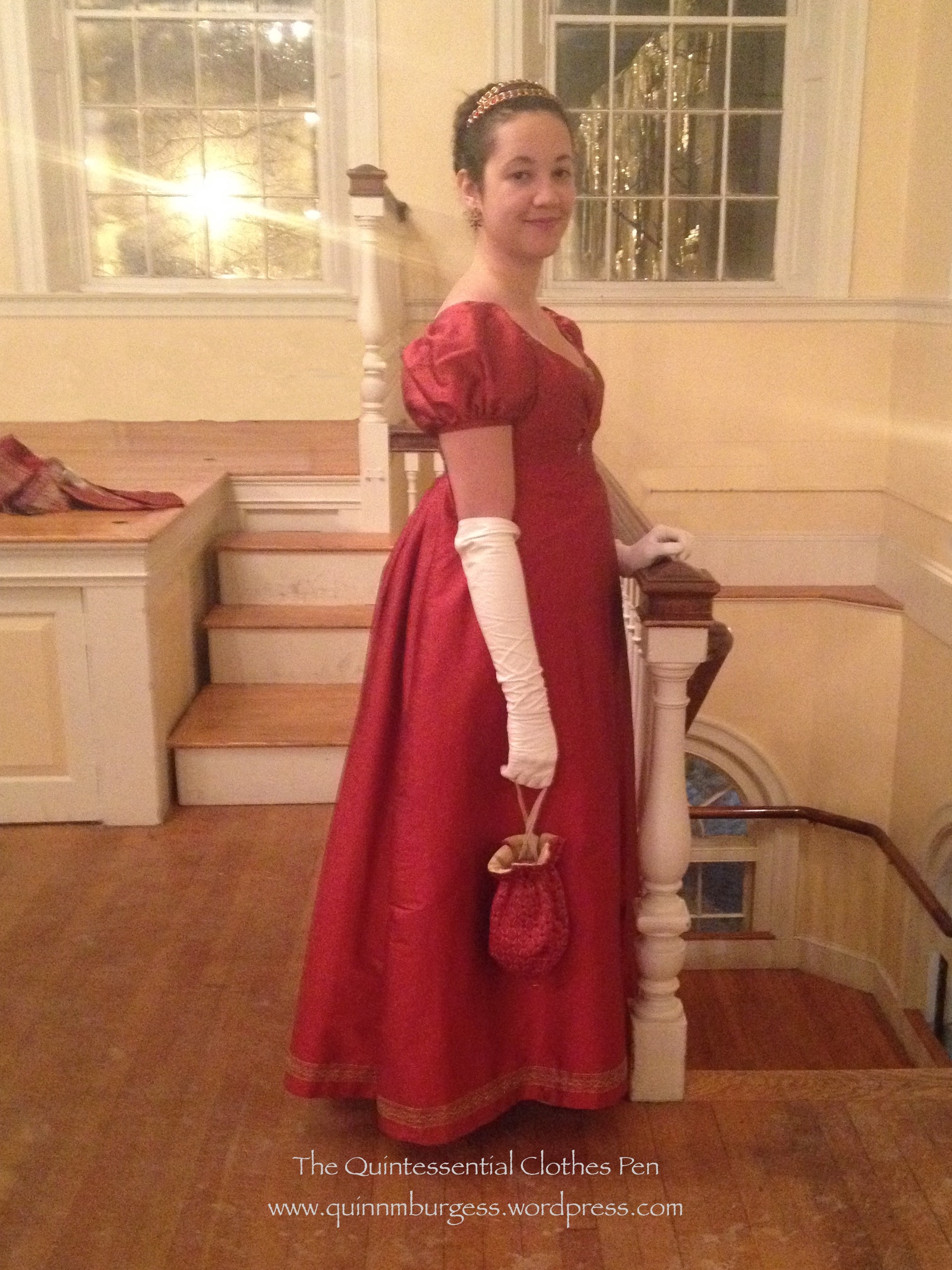
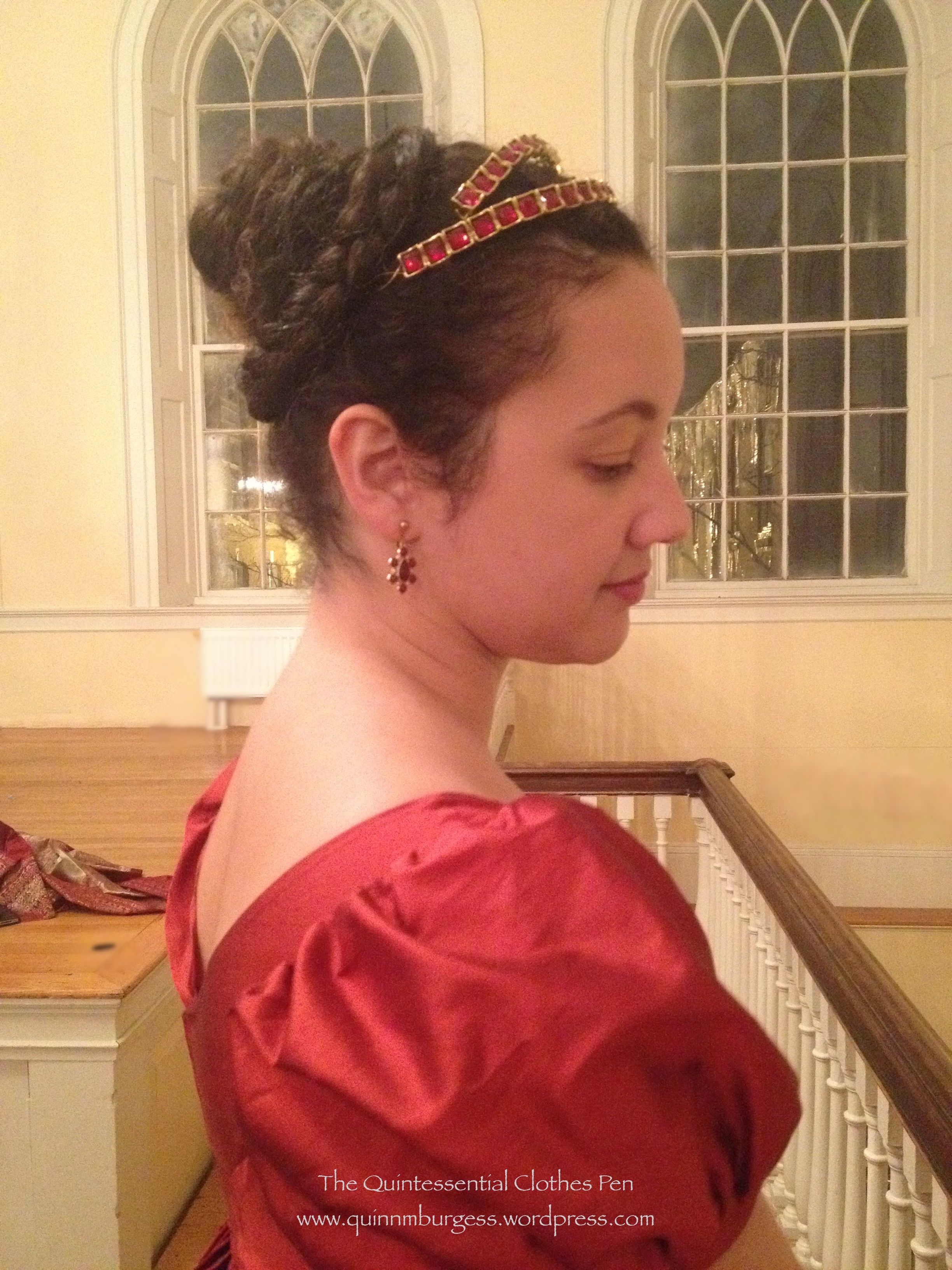
I wore my red 1813 evening gown and my homemade red and gold tiara. (I had hoped to finish and wear my 1811 elusive blue evening gown, but I would have had to do a lot of last minute sewing to finish it in time and after my recent skating costume last minute sewing adventure I was not inclined to do so again so soon. It is very satisfying to have a closet of options for an event, especially when plans to complete something new go awry.) I also brought along my red and gold reticule, because it matches the outfit so perfectly (although the only thing I kept in it was my phone… which is the reason for the slightly blurry, grainy photos).

IMG_1976
All the red and gold Regency pieces in my wardrobe put together in one outfit!
IMG_1980
It was so cold getting dressed that I was not inclined to do a complicated hair style. Heeheehee, fake hair to the rescue! I just put my hair in a pony tail, braided it, and wrapped it around itself. Simple! The big braid is what makes it look complicated, but it is pre-braided fake hair. I think it completes the style perfectly and has a bit of a “chinoise” look to it, too.

What do I mean by “chinoise”? The word itself is from the French adjective meaning Chinese. In terms of fashion, there are scarce references to “chinoise” styles in Regency fashion plates (compared to the abundance of Regency fashion plates showing other styles). Here are a few examples. This Merveilleuse from 1814 has a “Coeffure Chinoise,” this lady from 1812 has a “Coeffure a la Chinoise,” and this fashion plate shows “La Toilette Chinoise.” (I do sort of wonder how some of these attributes, and the hairstyles in particular, said “Chinese” to people during the Regency, but of course the world was perceived very differently then and people had access to vastly different quantities and types of information than I do today.)

I’ve often noticed that “chinoise” hairstyles make use of braids that wrap around the head. In addition, there seems to often be a vertical emphasis to the hair and to a bun, if one is present in the style. It is these attributes that say “a la chinoise” when I look at my own coiffure from last weekend. Sometime, I’ll have to try to make a more exaggerated “chinoise” style with a very tall and flyaway bun such as the Merveilleuse from 1814 has. I’m pretty sure my hair will have no trouble with that since it is naturally curly and wanting to fly away!

19CBRE: Etiquette For The Ballroom ‘Quick List’

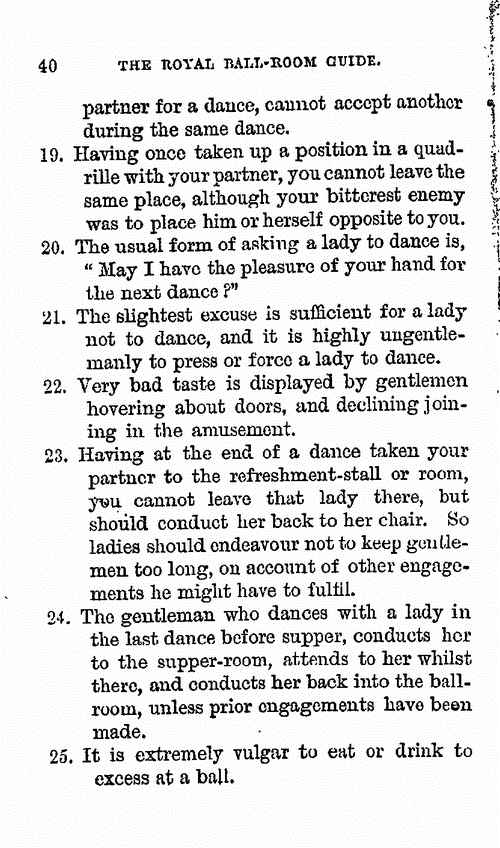
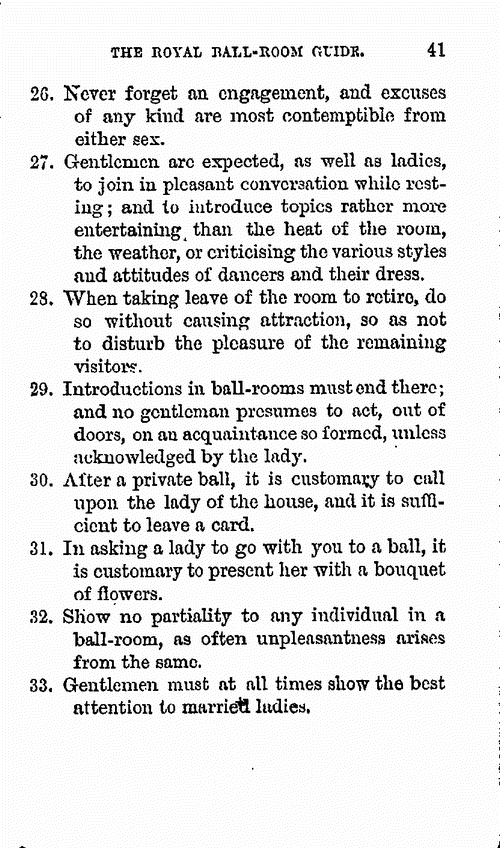
For your 19th century ballroom edification today, we have a list of etiquette points from The Royal Ball-Room Guide and Etiquette of the Drawing Room, 1877 (available through The Library of Congress). This is a great digest of lots of  etiquette points on a variety of topics.

I believe many modern ladies and gentlemen could take note of many of these points when attending recreations of 19th century balls. My top choices for attendees and personal favorites are numbers 4, 11, 18, and 22.

Do you have a favorite (or two)? Did any surprise you? Have you been to a recreated 19th century ball and longed for any of these points to be adopted by modern ball guests?

0037

0038

0039

0040