This video is a behind-the-scences look at the creation of the First Ladies Exhibition at the Smithsonian National Museum of American History.
It’s a really neat video! You get to see some insight into how the dresses and other pieces are displayed, how the dress forms that display them are created, as well as some great pictures of First Ladies and some very lovely dresses!
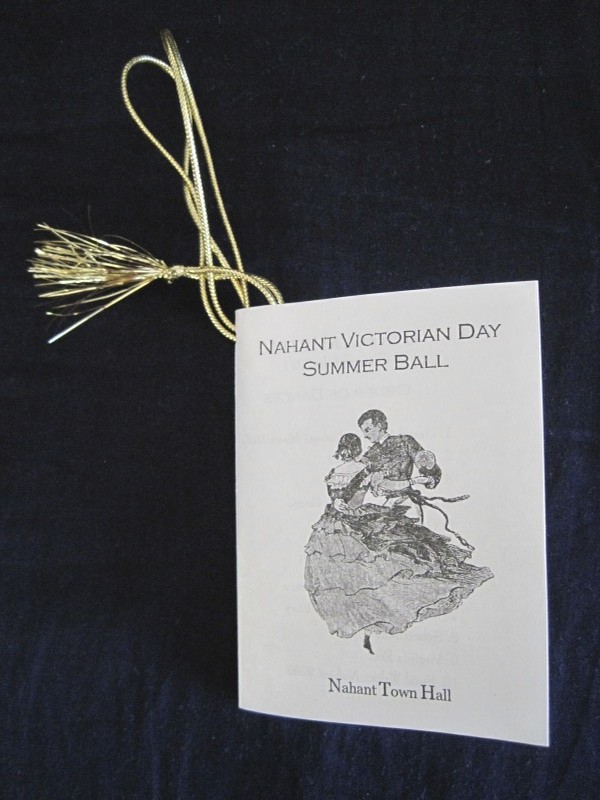
This ball included the use of dance cards, a practice I am aware of but have never participated in. It turns out that they are much more complicated than one thinks they might be! Why are the so complicated?
Well, it all sounds quite glorious and sophisticated. The Oxford English Dictionary defines a “dance-card” as “a card bearing the names of (a woman’s) prospective dance partners at a dance.” In stories and books, a dance card is a memento one can keep so that after the ball is over she can muse about beaus and flirtations. Practically, a dance card might help a person remember who his or her next partner is, what kind of dance the next dance is, or allow a gentleman to ask for a dance later in the evening.
But wait! There are complications and confusions! Does everyone have a dance card, men and women? Does a person take off his or her gloves before writing in a dance card? (I attempted this both ways: it is quite challenging to write your name while wearing gloves…) Does one exchange dance cards with a prospective partner or ask the name of the person and write it herself? (It seems more effective to swap dance cards with your intended partner to allow for ease of spelling, etc. and, in a more romantic sense, so that you have that person’s handwriting in your dance card.) How does one attach the card to her wrist so that it doesn’t get lost? How does one attach the card to her wrist without the pencil sticking out (so that her white dress isn’t marked!)? Really, a lot of questions popped up that would not have made themselves apparent without practical application. Also, at least at this ball, not having a prearranged partner did not necessarily mean that you were not able to dance. I was able to dance most of the dances of the night, despite my somewhat empty dance card.
Interior of my Dance Card from the Nahant VIctorian Day Ball 2011
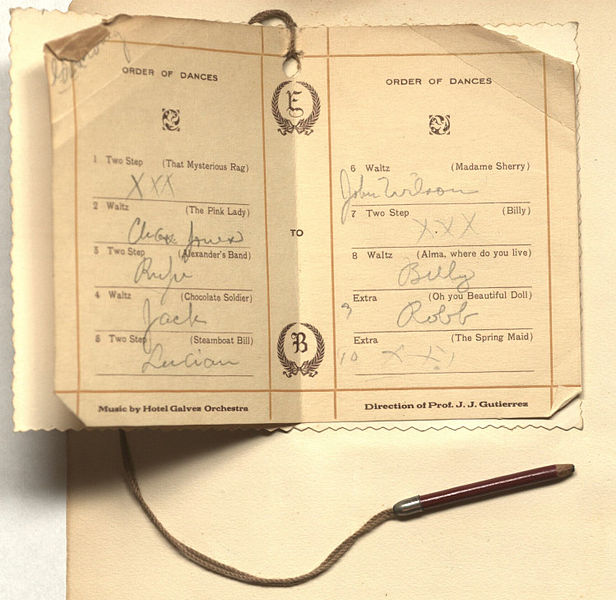
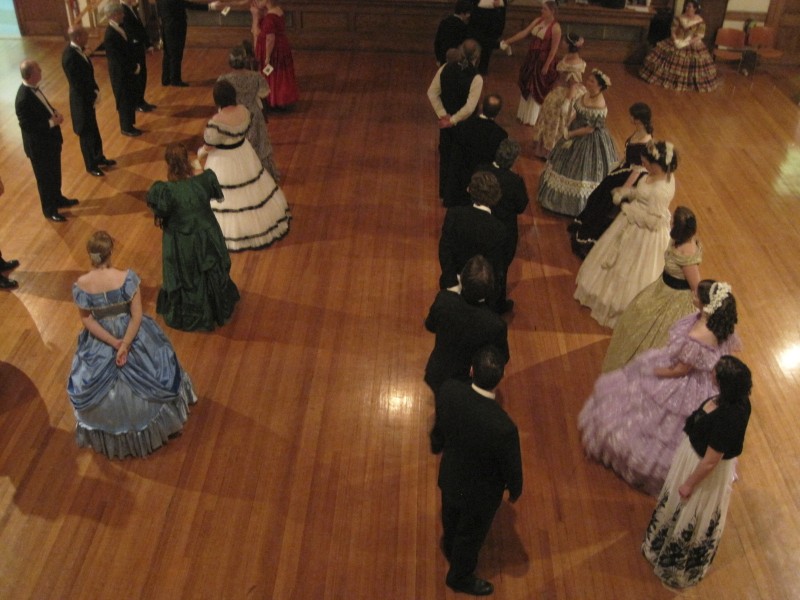
Below you can see a few historic dance card images and below that some images of the ball! If anyone has any research on the use or history of dance cards, please share. I’d love to learn more about the etiquette of dance card use!
1884 Dance Card
1912 Dance CardI believe this dance is the Contradance: Hull's Victory. (Nahant Victorian Day Ball 2011)A different view of the same dance as above.The Grand March. (Nahant Victorian Day Ball 2011)More Grand March.
Flounced 1860s dresses seem to be pure confections: cupcakes iced with lace and frothy ruffles. That is the vision in my mind while I was looking for inspiration for my latest crinoline dress.
Fashion Plate from Godey's Lady's Book September 1859 "Dressed for a Party." (The dress on the right is the inspiration for my latest gown)
I already made one 1860s dress for myself. Named Belle, it is a dark blue satin and velvet gown with a three tiered skirt. It’s very heavy and a dark color: neither of those two features seemed fitting for a summer ball in temperatures around 80 degrees! And so I decided to create an all new gown… in my head this one is named “Annabelle.” (I hope you are also amused by the name!)
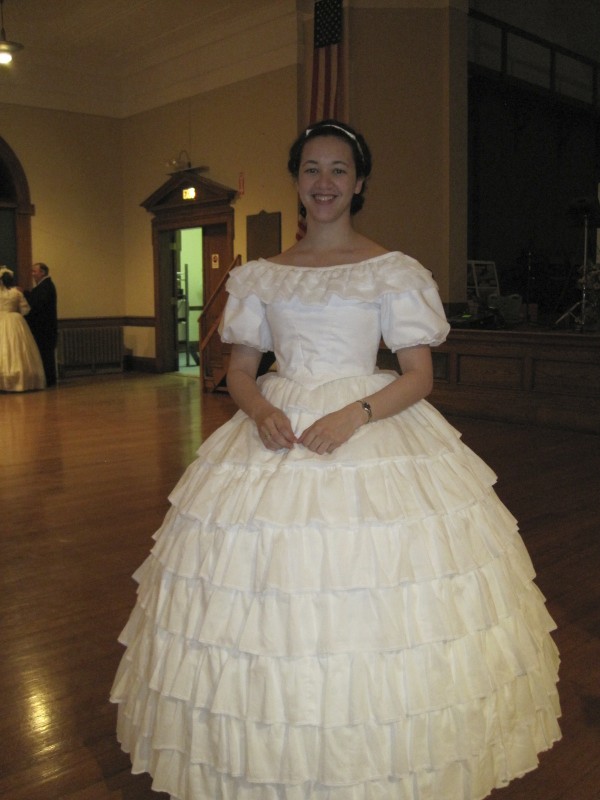
"Annabelle" my new 1860s ball gown
As you can see, there is one crucial element missing… the pink flowers! My goal is to make the flowers by hand from silk organza and to be perfectly honest, I ran out of time. I just decided to wear the dress as-is and finish the flowers later. I also ran out of time to bone the front, as you can see by the wrinkles along my tummy. No worries though, as I’m sure I’ll be able to wear this gown again.
"May I have this dance?" Side view of Annabelle.
In order to be to light and breathable, Annabelle is constructed entirely of cotton. The skirt has a medium weight cotton foundation to which cotton voile flounces are attached. The bodice is three layers of cotton for the sake of being opaque: two of medium weight cotton and one layer of voile. The layers are flatlined together and treated as one piece. The flounces on the skirt and bodice are cotton voile edged in narrow white lace.
This gown was flat patterned using research from books by Janet Arnold, Norah Waugh, and Kristina Harris. View this post about patterning from my Project Journal: Women’s Tailoring to see which titles I used and get a smidgeon of bibliographic information. The skirt pattern is fairly simple: a big tube cartridge pleated at the waist. The bodice has narrow v-shape seams front and back with puffed sleeves and a flounced bertha. It is worn over a chemise, corset, double thickness bum pad, hoops, and petticoat.
While this dress is eventually intended to be a reconstruction of the dress in the 1859 fashion plate above, I was also inspired by these other, similar fashion plates for further information. Enjoy!
Fashion Plate from Godey's Lady's Book October 1859 "The Soiree"Fashion Plate from Godey's Lady's Book August 1859 "Godey's Fashions for August"
A few posts ago, we took a look at Bolero jackets from the mid-19th century. Let’s look at them in another context: Boleros from the early 20th century, with a hint of information from the 1890s as well.
1904 Dress with Bolero
What exactly is a Bolero jacket? The Oxford English Dictionary defines it as “A short jacket, coming barely to the waist; worn by men in Spain; applied to a similar garment worn by women elsewhere, usually over a blouse or bodice.” This definition condenses the influence and origination of the Bolero down quite eloquently (of course, it is the job of the OED to eloquently distill all words down to a concise definition… but still, I do like this definition). The men’s style Spanish Bolero, with elaborate braiding and bright colors, influenced the style of women’s Boleros from the Victorian period. The following quotes from the OED provide more insight into the history of the Bolero (they also mention other styles of short jackets including the Zouave and the Eton).
“1892 Daily News 14 Nov. 6/3 The Zouave is as great a favourite as it has been for some seasons, and though it varies in form—being sometimes a bolero, sometimes a toreador, and sometimes a cross between an Eton jacket and a Zouave.
1893 Daily News 1 Apr. 2/4 The Zouave is quite as popular as it was last year.‥ Sometimes it is pure bolero.
1893 Lady 17 Aug. 178/1 Zouave Bodices are a feature of autumn gowns. (in the Zouave definition)
1899 Westm. Gaz. 6 July 3/2 Robbing the coat of its basque has created‥the bolero corsage, really an actual bodice, though appearing a bolero coat and skirt.”
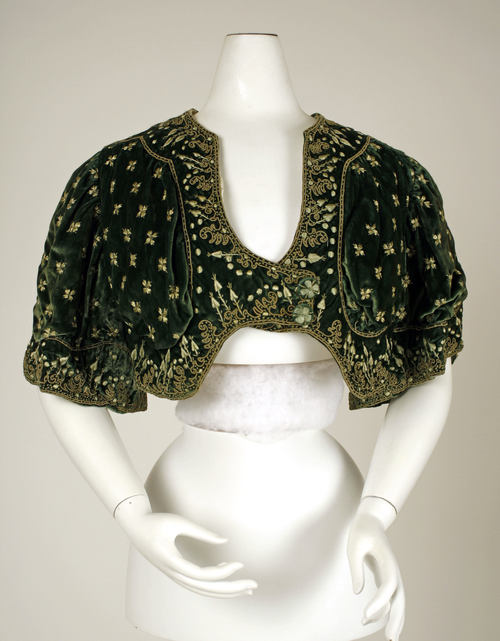
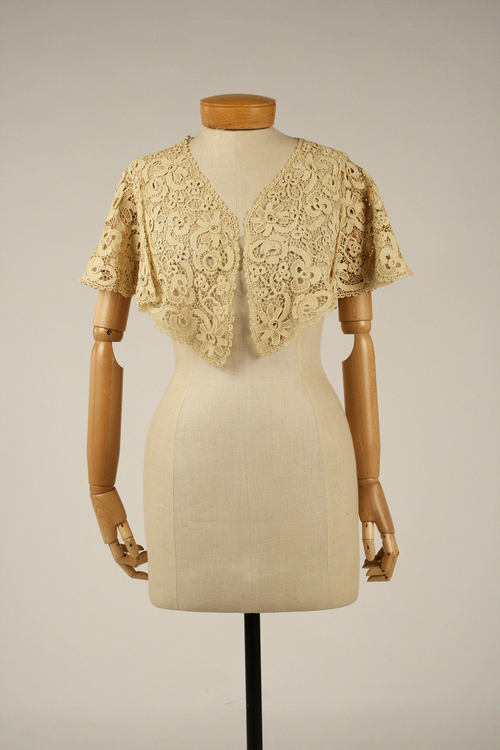
The flared skirt and small waist silhouette of women’s clothing during the first decade of the 20th century was well suited to the style of Bolero jackets, as they could help to visually balance the figure by adding just a small amount of width across the chest and shoulders. Here are a few Boleros from the Metropolitan Museum of Art. One is silk velvet, elaborately trimmed. The other is lace. Can you imagine the dresses that would have accompanied these Boleros? Clearly, they were intended for different purposes. Perhaps the first was intended for evening wear and the second for an afternoon stroll or visiting friends?
c. 1905 Bolero from the Metropolitan Museum of Artc. 1905 Bolero from the Metropolitan Museum of Artc. 1907 Bolero from the Metropolitan Museum of Artc. 1907 Bolero from the Metropolitan Museum of Artc. 1907 Bolero from the Metropolitan Museum of Art











 The Quintessential Clothes Pen