Project Journal: 1780s Ensemble Part I: Initial Research

I’ve decided to attend 2 events in September which require clothing from the last quarter of the 18th century (1775-1799). This decision is rather at the last minute when it comes to building new historic clothes: I now have exactly three weeks to make a decision about what to wear, pick out fabrics, make patterns, and complete the construction of the garments. Yikes!

So I’ve been busy researching this period because it is not within the realm of my previous historic clothing projects, which have generally focused on the 19th century. Unlike women’s clothing in the 19th century, for which I can recall silhouette, construction details, pattern shapes, and fabric choices and colors with far less research for each garment (because I’ve already done all that research and it’s all in my head…), I really need the research to be able to consider reproducing historic clothing from the 18th century. Here are some inspirational images I thought I would share!

Here’s how this conversation went in my head: “Where do I start?” I asked myself. “Silhouette?” I replied. “Ah, yes. That sounds good. But… what is the silhouette during this period? Hopefully not panniers!” because panniers, you see, require a lot more effort to produce and a lot more fabric to cover. “Well, let’s start by looking for some images,” I suggested. And here we go!
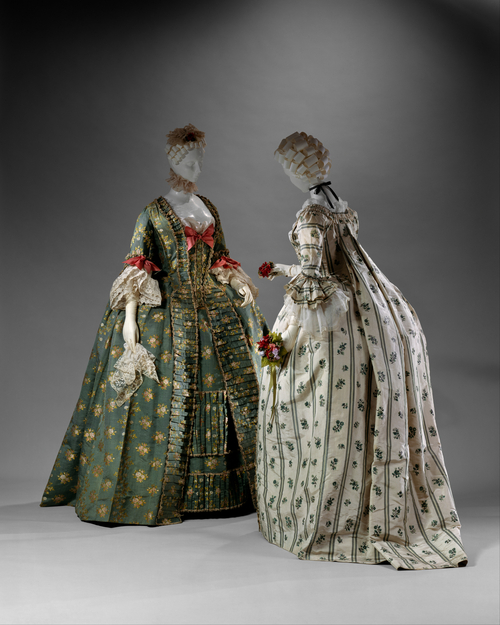
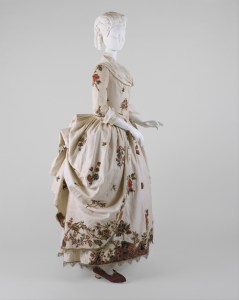
c. 1770 Silk Robe a l'Francaise at the Metropolitan Museum of Art

Now, you can see by looking at the above image that these gowns require panniers to achieve the exaggerated hip shape. You can also see that these gowns are Robes a l’Francaise, meaning robes in the French style. This style of gown has the characteristic pleating at center back that falls from the back neck line to the floor in one piece. This style, with the panniers and the Robe a l’Francaise, is not what I have the time to make in three weeks. So we move on!
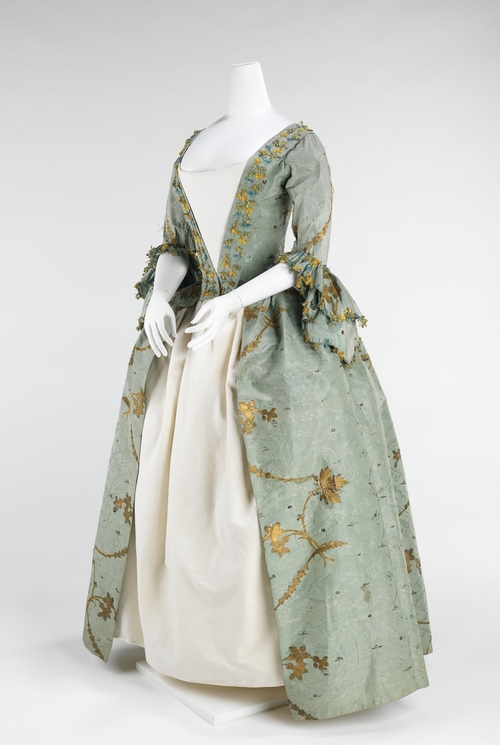
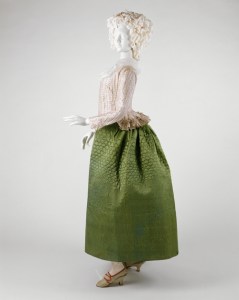
1770-1775 Silk Robe a l'Anglaise at the Metropolitan Museum of Art

In contrast to the Robe a l’Francaise, I am actually interested in the style of dress on the left: the Robe a l’Anglaise, or English style robes. This style evolved from the Robe a l’Francaise: over time the side back seams of the Robe al’Francaise were cut close enough together that the characteristic pleats were no longer used.

Below, you can see another two examples of gowns in the style of a Robe a l’Anglaise. These two are from the 1780s and you can see that the width of the hips has diminished from the 1770s. Note that all of these gowns have open fronts that show the petticoat underneath.

c. 1780 Cotton Robe a l'Anglaise at the Metropolitan Museum of Art
c. 1780 Cotton Robe a l'Anglaise from the Metropolitan Museum of Art
1780-1785 Cotton Robe a l'Anglaise at the Metropolitan Museum of Art
There are other options for this period as well: there is the style Robe a la Polonaise, which has a characteristic  bunching of fabric across the back side as well as the skirt and jacket combination. I’m not interested in making a Robe a la Polonaise at this point, but a skirt and jacket combination is a possibility. You can see these styles below. There is another style as well: the Chemise Dress, but you’ll have to wait for my next post to see and read about it!
c. 1780 Linen Robe a la Polonaise at the Metropolitan Museum of Art
c. 1785 Silk Jacket at the Metropolitan Museum of Art
      

Pleated trimming on dress (c. 1870)

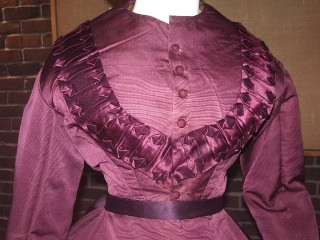
c. 1870 Dress at Smith College

Just recently we looked at pleated trim on 1860s gowns. While I was thinking of that post I was reminded of this gown, which has fabulous pleated trim! It is in the historic costume collection at Smith College, in Northampton, Massachusetts. It was prepared for display and further storage during a historic clothing conservation workshop I took part in a few years ago.

I love the pleated trimming on this dress! It reminds me of origami, in that simple pleats and folds combine to create such a complicated looking outcome.

c. 1870 Dress at Smith College
Pleated trimming on c. 1870 Dress at Smith College

Did you look closely? The pleats are actually just box pleats whose outward pleats have been pressed up or down respectively at the very edges to create the diamond shapes. It’s so neat! I do hope to be able to use this pleated motif on a reproduction dress at some point. I’ll have to scrounge up lots of patience to make yards of a trimming that will be so detailed… but it will be amazing and if I do it in manageable sections it actually does sound like fun!

Pleated trimming on 1860s gowns

I absolutely love the use of pleating as a trim motif in the 19th century! I also admire the immense amount of time and fabric required to edge the dresses of the 1800s in pleated trim.

Take a look at the dress below and note the rolling wave pattern of the pleated trim on the skirt as well as the pleated trim on the sleeves. You can see that the trim is made of the same fabric as the dress, which was a technique often employed in the 19th century for the trimming of gowns.

c. 1862 Afternoon Dress at the Metropolitan Museum of Art

Now, take a look at this dress from 1860-1861 (which was also include in this post). Doesn’t the trim style look familiar? Yes, it’s a more bunting-like placement of the trim, but the idea is exactly the same as the dress above!

1860-1861 Dress at the Metropolitan Museum of Art

So now that we’ve looked at a few actual garments with the pleated trim, let’s look at some fashion plates. You know, I went through about 50-100 fashion plates from 1860-1865 and I was surprised by the lack of plates that included dresses with pleated trim! Considering that I have frequently seen pleated trim used on existing garments I am intrigued by their relative absence in fashion plates… I wonder if pleated trim is just challenging to execute when creating a fashion plate? Certainly I found some with bands of trim, and perhaps those could have been executed with pleated trim when constructed?

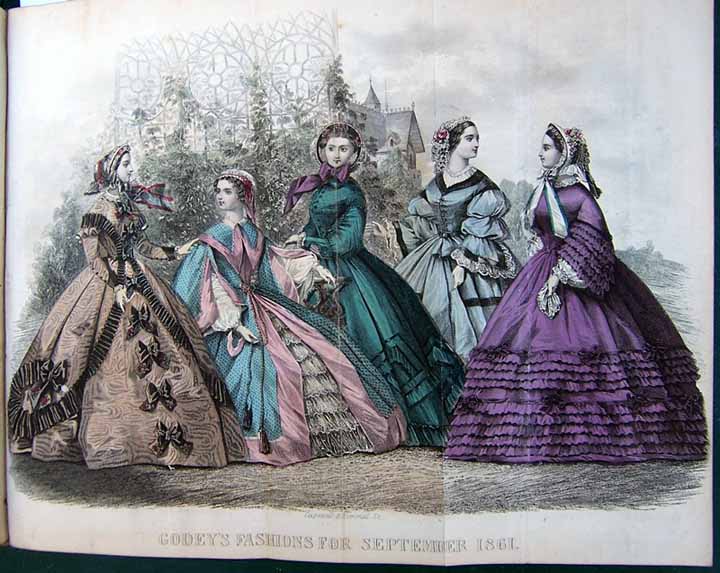
Godey’s Fashions for September 1861
Godey’s Fashions for September 1862

In both of these fashion plates the ladies on the far left are the ones I’m looking at and think that they are wearing dresses with pleated trim. The one from 1862 as especially clear detail that shows the trim being pleated. It is interesting to note that these two fashion plates correspond directly with the two existing dresses at the Metropolitan Museum of Art.

Braid trimming on 1860s gowns

I have noticed a particular style of trim used on multiple 1860s gowns that I find interesting and want to share with you.

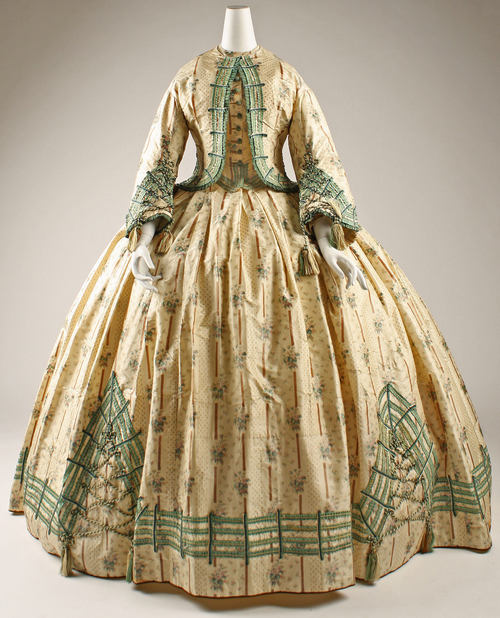
This first gown was also included in my post Bolero and Zouave jackets of the mid-19th century. The bolero style of the bodice is exceptionally well suited to the 1860s: you can read more about that by clicking on the link at the beginning of the paragraph. What I find most fascinating about the dressmaker’s choices in this dress is the fabric and trim. The pale yellow background is wonderful, but to me the foreground (with the cinnamon colored lines and bunches of flowers in between) as well as the small flowers on the background create quite a busy look all on their own. And then to add the green trim on top, with a repeating vertical line motif… but there’s even more! There are tassels and the yellow and green twisted cord zigzagging between the points in the green trim. It’s just a lot going on, and I do think the end result is lovely and congruous, but I think if I was designing a dress I wouldn’t be able to envision all of these elements coming together in such harmony.

c. 1862 dress at the Metropolitan Museum of Art

This second dress is actually a dressing gown. The trimming is not exactly like the bolero dress above, but it is strikingly similar. It is a narrow braid that is used as a border trim in horizontal repetition with points where the trim pattern lifts up into diagonal lattice patterns. The trimming is really quite stunning on it’s own, but consider the time it would take to actually trim a garment in this fashion!

c. 1860 Dressing Gown at the Metropolitan Museum of Art
c. 1860 Dressing Gown trim

National Museum of American History First Ladies Exhibition behind-the scenes video

This video is a behind-the-scences look at the creation of the First Ladies Exhibition at the Smithsonian National Museum of American History.

It’s a really neat video! You get to see some insight into how the dresses and other pieces are displayed, how the dress forms that display them are created, as well as some great pictures of First Ladies and some very lovely dresses!

Of flounces and dance cards: Part II (Nahant Victorian Day 1860s Ball 2011)

Part II: …and dance cards

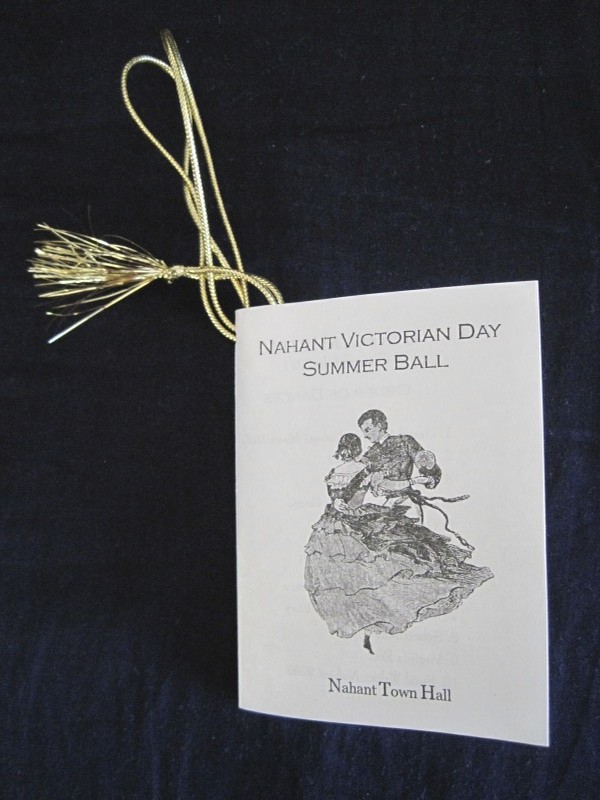
Dance Card from the Nahant Victorian Day Ball 2011

Last post, I shared with you my latest 1860s gown: Annabelle. This gown just recently had its debut at the Nahant Victorian Day Ball hosted by Vintage Victorian.

This ball included the use of dance cards, a practice I am aware of but have never participated in. It turns out that they are much more complicated than one thinks they might be! Why are the so complicated?

Well, it all sounds quite glorious and sophisticated. The Oxford English Dictionary defines a “dance-card” as “a card bearing the names of (a woman’s) prospective dance partners at a dance.” In stories and books, a dance card is a memento one can keep so that after the ball is over she can muse about beaus and flirtations. Practically, a dance card might help a person remember who his or her next partner is, what kind of dance the next dance is, or allow a gentleman to ask for a dance later in the evening.

But wait! There are complications and confusions! Does everyone have a dance card, men and women? Does a person take off his or her gloves before writing in a dance card? (I attempted this both ways: it is quite challenging to write your name while wearing gloves…) Does one exchange dance cards with a prospective partner or ask the name of the person and write it herself? (It seems more effective to swap dance cards with your intended partner to allow for ease of spelling, etc. and, in a more romantic sense, so that you have that person’s handwriting in your dance card.) How does one attach the card to her wrist so that it doesn’t get lost? How does one attach the card to her wrist without the pencil sticking out (so that her white dress isn’t marked!)? Really, a lot of questions popped up that would not have made themselves apparent without practical application. Also, at least at this ball, not having a prearranged partner did not necessarily mean that you were not able to dance. I was able to dance most of the dances of the night, despite my somewhat empty dance card.

Interior of my Dance Card from the Nahant VIctorian Day Ball 2011

Below you can see a few historic dance card images and below that some images of the ball! If anyone has any research on the use or history of dance cards, please share. I’d love to learn more about the etiquette of dance card use!

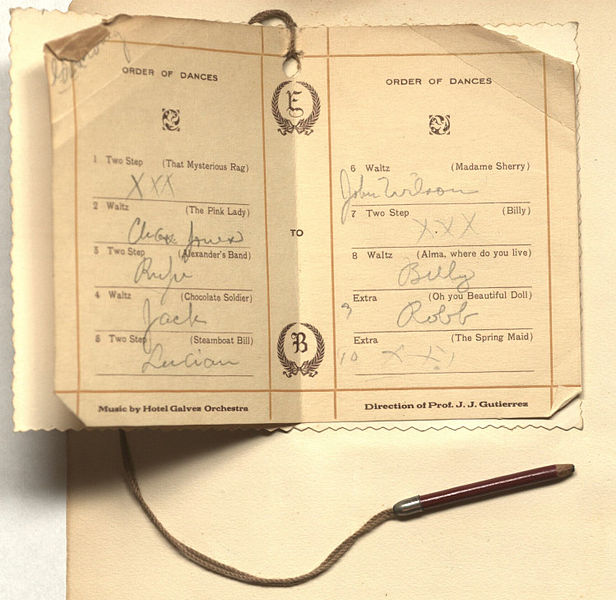
1884 Dance Card
1912 Dance Card
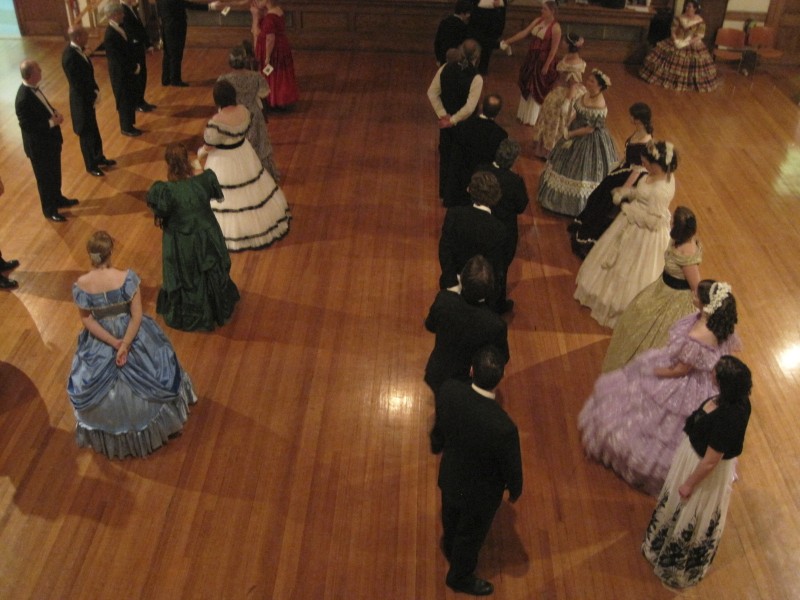
I believe this dance is the Contradance: Hull's Victory. (Nahant Victorian Day Ball 2011)
A different view of the same dance as above.
The Grand March. (Nahant Victorian Day Ball 2011)
More Grand March.

Here’s a video of the Grand March in action!

Of flounces and dance cards: Part I

PART I: Of flounces…

Flounced 1860s dresses seem to be pure confections: cupcakes iced with lace and frothy ruffles. That is the vision in my mind while I was looking for inspiration for my latest crinoline dress.

Fashion Plate from Godey's Lady's Book September 1859 "Dressed for a Party." (The dress on the right is the inspiration for my latest gown)

I already made one 1860s dress for myself. Named Belle, it is a dark blue satin and velvet gown with a three tiered skirt. It’s very heavy and a dark color: neither of those two features seemed fitting for a summer ball in temperatures around 80 degrees! And so I decided to create an all new gown… in my head this one is named “Annabelle.” (I hope you are also amused by the name!)

"Annabelle" my new 1860s ball gown

As you can see, there is one crucial element missing… the pink flowers! My goal is to make the flowers by hand from silk organza and to be perfectly honest, I ran out of time. I just decided to wear the dress as-is and finish the flowers later. I also ran out of time to bone the front, as you can see by the wrinkles along my tummy. No worries though, as I’m sure I’ll be able to wear this gown again.

"May I have this dance?" Side view of Annabelle.

In order to be to light and breathable, Annabelle is constructed entirely of cotton. The skirt has a medium weight cotton foundation to which cotton voile flounces are attached. The bodice is three layers of cotton for the sake of being opaque: two of medium weight cotton and one layer of voile. The layers are flatlined together and treated as one piece. The flounces on the skirt and bodice are cotton voile edged in narrow white lace.

This gown was flat patterned using research from books by Janet Arnold, Norah Waugh, and Kristina Harris.  View this post about patterning from my Project Journal: Women’s Tailoring to see which titles I used and get a smidgeon of bibliographic information. The skirt pattern is fairly simple: a big tube cartridge pleated at the waist. The bodice has narrow v-shape seams front and back with puffed sleeves and a flounced bertha. It is worn over a chemise, corset, double thickness bum pad, hoops, and petticoat.

While this dress is eventually intended to be a reconstruction of the dress in the 1859 fashion plate above, I was also inspired by these other, similar fashion plates for further information. Enjoy!

Fashion Plate from Godey's Lady's Book October 1859 "The Soiree"
Fashion Plate from Godey's Lady's Book August 1859 "Godey's Fashions for August"

Bolero jackets of the 20th century: 1900-1909

A few posts ago, we took a look at Bolero jackets from the mid-19th century. Let’s look at them  in another context: Boleros from the early 20th century, with a hint of information from the 1890s as well.

1904 Dress with Bolero

What exactly is a Bolero jacket? The Oxford English Dictionary defines it as “A short jacket, coming barely to the waist; worn by men in Spain; applied to a similar garment worn  by women elsewhere, usually over a blouse or bodice.” This definition condenses the influence and origination of the Bolero down quite eloquently (of course, it is the job of the OED to eloquently distill all words down to a concise definition… but still, I do like this definition). The men’s style Spanish Bolero, with elaborate braiding and bright colors, influenced the style of women’s Boleros from the Victorian period. The following quotes from the OED provide more insight into the history of the Bolero (they also mention other styles of short jackets including the Zouave and the Eton).

“1892    Daily News 14 Nov. 6/3   The Zouave is as great a favourite as it has been for some seasons, and though it varies in form—being sometimes a bolero, sometimes a toreador, and sometimes a cross between an Eton jacket and a Zouave.
1893    Daily News 1 Apr. 2/4   The Zouave is quite as popular as it was last year.‥ Sometimes it is pure bolero.
1893    Lady 17 Aug. 178/1   Zouave Bodices are a feature of autumn gowns. (in the Zouave definition)
1899    Westm. Gaz. 6 July 3/2   Robbing the coat of its basque has created‥the bolero corsage, really an actual bodice, though appearing a bolero coat and skirt.”

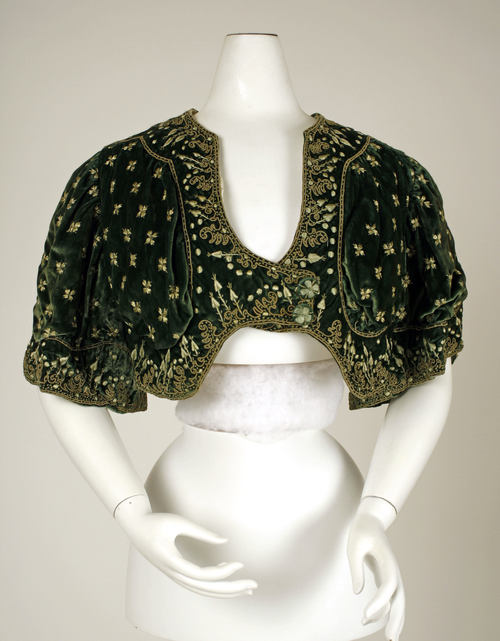
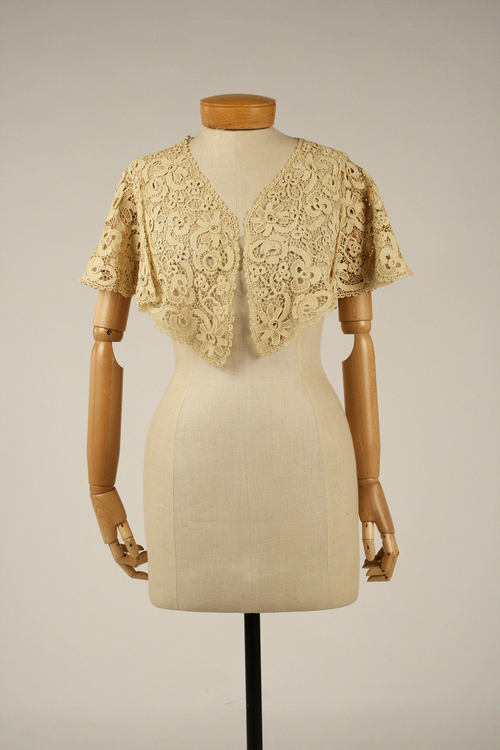
The flared skirt and small waist silhouette of women’s clothing during the first decade of the 20th century was well suited to the style of Bolero jackets, as they could help to visually balance the figure by adding just a small amount of width across the chest and shoulders.  Here are a few Boleros from the Metropolitan Museum of Art. One is silk velvet, elaborately trimmed. The other is lace. Can you imagine the dresses that would have accompanied these Boleros? Clearly, they were intended for different purposes. Perhaps the first was intended for evening wear and the second for an afternoon stroll or visiting friends?

c. 1905 Bolero from the Metropolitan Museum of Art
c. 1907 Bolero from the Metropolitan Museum of Art

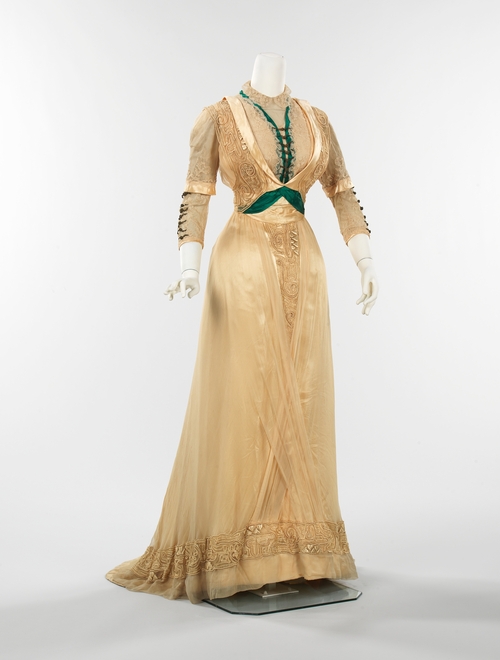
1901-1911 Dress

This dress is fabulous! What a wonderful piece of inspiration! It’s beautiful!

1901-1911 Dress at the Metropolitan Museum of Art

I absolutely love the subtle use of vibrant teal! It really spices up the dress. The cream satin and chiffon as well as the detailed trim are especially wonderful.  The carefully arranged layers are fascinating–they keep your eye moving while managing to not distract from the fabulous fit of the whole dress.

I think this must be one of those Edwardian dresses that has a complicated closure that is hidden under crisscrossing layers. I just can’t imagine any other closure that wouldn’t detract from the beauty of the dress!

I think this is also one of the dresses that has faked layers. It seems to be an illusion that there is a blouse then a vest then a jacket. I think it is probably just one layer with trim and then the outside jacket. It’s so hard to tell from the picture! That’s the beauty of these Edwardian confections… it’s so hard to figure out how they are made and how they close without actually being able to see its inside construction!

I simply adore this dress! I just keep repeating its praise… Beautiful!

Bolero and Zouave jackets of the mid-19th century

Throughout the 19th century, civilian clothing for men and women imitated all sorts of military uniforms in cuts, trim styles, and names. Let’s look at some women’s styles from the the mid-19th century inspired by military wear.

First: the Bolero style jacket

From Peterson's Magazine August 1865

Popular during the mid-19th century, the Bolero is simply a short jacket, usually worn open in front, often fastened at the neck. In the mid-19th century Bolero jackets were worn in all sorts of colors and with all sorts of trim; however, they were often seen in military uniform colors and with trimming styles reminiscent of military trimming, especially braiding.

1863 Bolero from the Metropolitan Museum of Art
c. 1860 Dress with Bolero Jacket and braid trimming

Second: the Zouave style jacket


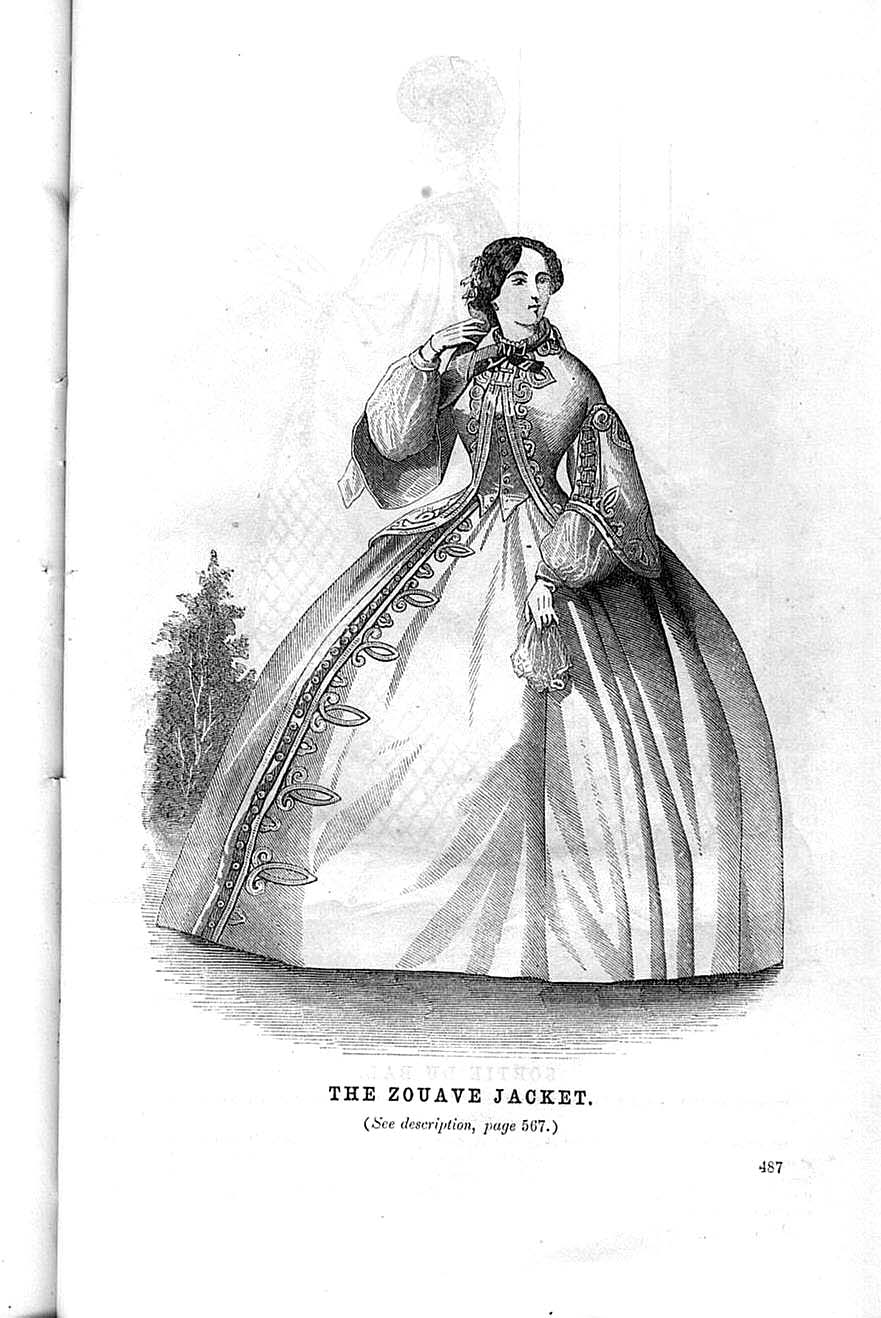
From December 1859 Godey’s Lady’s Book

The Oxford English Dictionary defines a Zouave jacket as follows: “A woman’s short embroidered jacket or bodice, with or without sleeves, resembling the jacket of the Zouave uniform.” The following quotes are included in the OED definition:

1859    Ladies’ Treas. Sept. 285/1   One of the most decided novelties of the present season is the Zouave jacket.
1859    Ladies’ Cabinet Dec. 335/1   Nothing can be prettier for the interior than the little oriental jackets which we call to-day Zouaves.

During the 19th century, this style gained the most popularity during the 1850s, when French Zouaves were fighting in the Crimean War, and during the American Civil War in the 1860s. You can see a few images of Zouave uniforms by looking at this post from a few weeks ago.

The description of the above image from Godey’s is as follows: “Morning-dress for young ladies, of plain merino or cashmere; the skirt trimmed by an inserting of velvet, several shades darker than the dress, with a row of buttons passing through it, and bordered by a rich braid pattern, known as the Greek. The Zouave jacket, which we have before spoken of, forms the waist. It is modelled from the Greek jacket, and has a close vest, with two points; the jacket, itself, rounding over the hips, and fitting easily to the figure. A Gabrielle ruff, and neck-tie finish it.”

Further information about this style was included in the Chitchat section of the same issue of Godey’s: “The Zuoave jackets may be made in black cloth or velvet, for home wear, with skirts whose waists have “outlived their usefulness.” They are especially suitable with dark silks, and a waist of this kind with a black silk skirt will do any amount of street service. Black silks are trimmed with a combination of black and crimson, black and purple, etc. when intended for dress occasions.”

c. 1862 Dress with Bolero from the Metropolitan Museum of Art

Given the description (above)  from Godey’s about the Zouave jacket fashion plate, I think this c. 1862 dress from the Metropolitan Museum of Art falls into the category of a Zouave jacket rather than a Bolero. Clearly, this yellow dress has a jacket with a double pointed vest silhouette, rather than the Bolero style of the jacket with a blouse underneath. Regardless, this dress is quite fabulous! The pattern matches the trimmings exceptionally well in terms of style, and the whole ensemble is quite wonderful (including the crisscross braiding and tassels!).

The quotes are from the digital Godey’s excerpts at the University of Vermont, which can be viewed here.