Project Journal: Versailles Sacque: Finished Shoes!

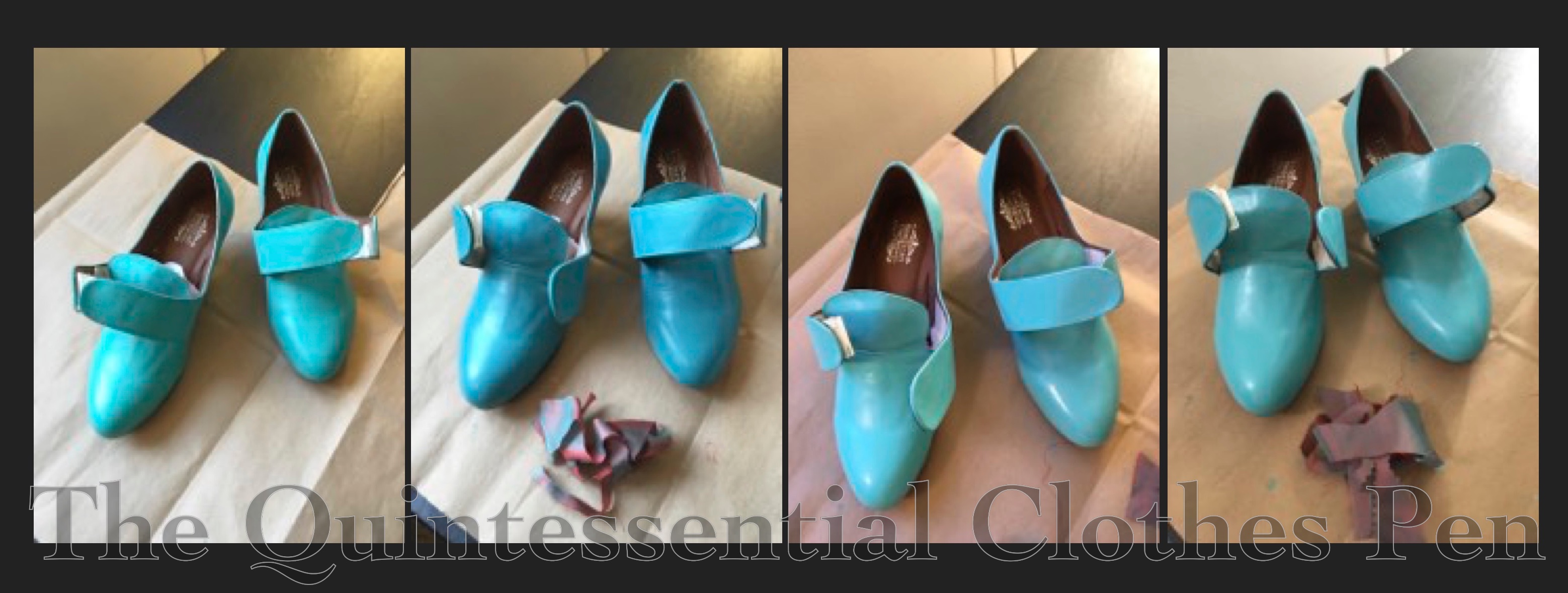
After the many coats of paint I shared about already, there was one final coat that I convinced myself had to be the last because I needed to move on and finish decorating my Kensingtons. After that I went ahead and put on a matte acrylic finisher as suggested by Lauren at American Duchess. I then made the holes for my buckles using this tutorial also from American Duchess. The shoe buckle tutorial was invaluable and made the process incredibly easy!

IMG_0849
Finished?

I told myself the shoes were done, but I still wasn’t entirely happy with them. I think perhaps I was not satisfied because I had painted my shoes a color I’ve only really seen in cloth shoes rather than leather. But I moved on… and then this shoe-remake popped up on Pinterest and I was captured by the idea of adding metallic lace trim to my shoes to finish them off.

And so I went on the hunt on eBay, settling on this. It was a reasonable price and arrived quite speedily. As in the inspiration re-make, I used hot glue to attach the lace to the shoes. It was easy to work with and is generally reversible if I decide to change the shoes sometime in the future (though that’s pretty unlikely…) I think the trim suits my dress fabric nicely and it was narrow enough to follow the curves of the shoe without too much hassle, even on the latchets (which were the trickiest parts).

I also considered creating a design for the toe box area of the shoe, but decided against the idea once I realized how tricky it would be to get something I like. The lace doesn’t do tight curves easily and all the ends would need to be finished if I used non continuous pieces of trim, so all the ideas I came up with were going to be time intensive or poorly executed. I decided on simplicity.

IMG_0858
Ta da!

Now when I look at my shoes I have a smile on my face. They finally feel done and like they make sense! Yay–cross that off the list!

  • Panniers
  • Petticoat
  • Robe a la francaise (with a subset of trimming)
  • Hair
  • Shoes
Product links in this post contain an affiliate code, which provides a small benefit to my shoe fund. This does not affect my impressions and reviews of this product.

SaveSave

Project Journal: Versailles Sacque: Chameleon Shoe Progress

This month has been super crazy busy for me and progress on my Versailles Project has therefore been quite slow. Aside from thinking about my hair the only other real progress I have made is on my shoes, which have been painted with about 10 coats of paint as I’ve tried to make up my mind about what color I want them to be.

The process began after my materials were ordered and assembled: unpainted ivory Kensingtons from American Duchess, 3 colors of Angelus leather paint, and scraps of my changeable silk fabric. The plan was to go for dark turquoise/teal. (I did tape off the heel cap and the inside part of the latchets closest to the vamp with masking tape to keep things tidy. Then I got bored and stopped taping.)

IMG_0738

I’ve referenced two American Duchess resources during the process so far, which included prepping my shoes as suggested and mixing water into my paint for more even layers of color. (Well, I forgot to add water to the first coat, as you’ll see, but I remembered after that!) This blog post and this information page are the two resources I just mentioned.

Here was the first batch of paint. Lots of dark green with a small bit of turquoise and gift box blue.

IMG_0740

I was doing quite well taking pictures of my paint mixing as a record as I started, but then as I kept doing more and more layers and getting frustrated I slacked on the picture taking. I did make a sample card with little swatches of all my paint colors as I went along, though I didn’t take notes on how I achieved each color, so I’m not sure it will be very useful in the future.

Here are the results of the first two coats of paint. The shoe on the right was the first layer, for which I was so excited I forgot to add some water… oops! The color was more green than I wanted, so for the second coat I added more turquoise paint to the mix. The result is on the left.

IMG_0743

I stopped with the two coats of paint, but wasn’t sold on the color–too bright. Fast forward a week and I tried again, painting the shoes in multiple layers between paying attention to other house tasks, like cooking and baking.

First is the shoes after two coats, then after I tried a darker blue, then after I decided they didn’t match and tried a lighter blue, then after I decided they didn’t look like a plausible 18th century color and needed to be a bit more grey…

Untitled 2 (1)

(Oh yes, on the second day of painting I also used some white and black and dark grey paint to mix in as well). Unfortunately, after all that I still wasn’t happy!

I did one final coat you’ll have to wait to see and then put the shoes away to consider if they grew on me over time or not. That was about two weeks ago. I haven’t had time to work on them in that time, but I think I’m mostly happy with the color and frankly I’m running out of time, so the color they ended up with will likely be the color they stay. When I have time I will be applying a matte finisher as suggested in the American Duchess links and then figuring out attaching the buckles.

Product links in this post contain an affiliate code, which provides a small benefit to my shoe fund. This does not affect my impressions and reviews of this product.

SaveSave

A Post About Seaburys

I mentioned in my last post that I am the happy owner of a pair of black American Duchess Seaburys. What I didn’t mention in that post is that I am also the happy owner of a pair of dove gray Seaburys!

I bought the black ones first, around Christmas-time, and picked that color because of the versatility of black shoes. Once I received them and was able to fully appreciate the gorgeous materials, elegant design, and sturdy construction I started raving about them to friends. During one conversation in particular, I managed to inadvertently talk myself into buying the dove grey Seaburys as well… They’re being discontinued and are such lovely shoes with such a distinctive shape that they’re worth having in two different colors.

I’ve only worn the gray ones once so far, when I decided to wear them with modern clothes to the ballet. I found them to be just as elegant for modern dress as for historical dress, which was great! It’s hard to find gorgeous modern heels that meet all my various criteria.

IMG_0660

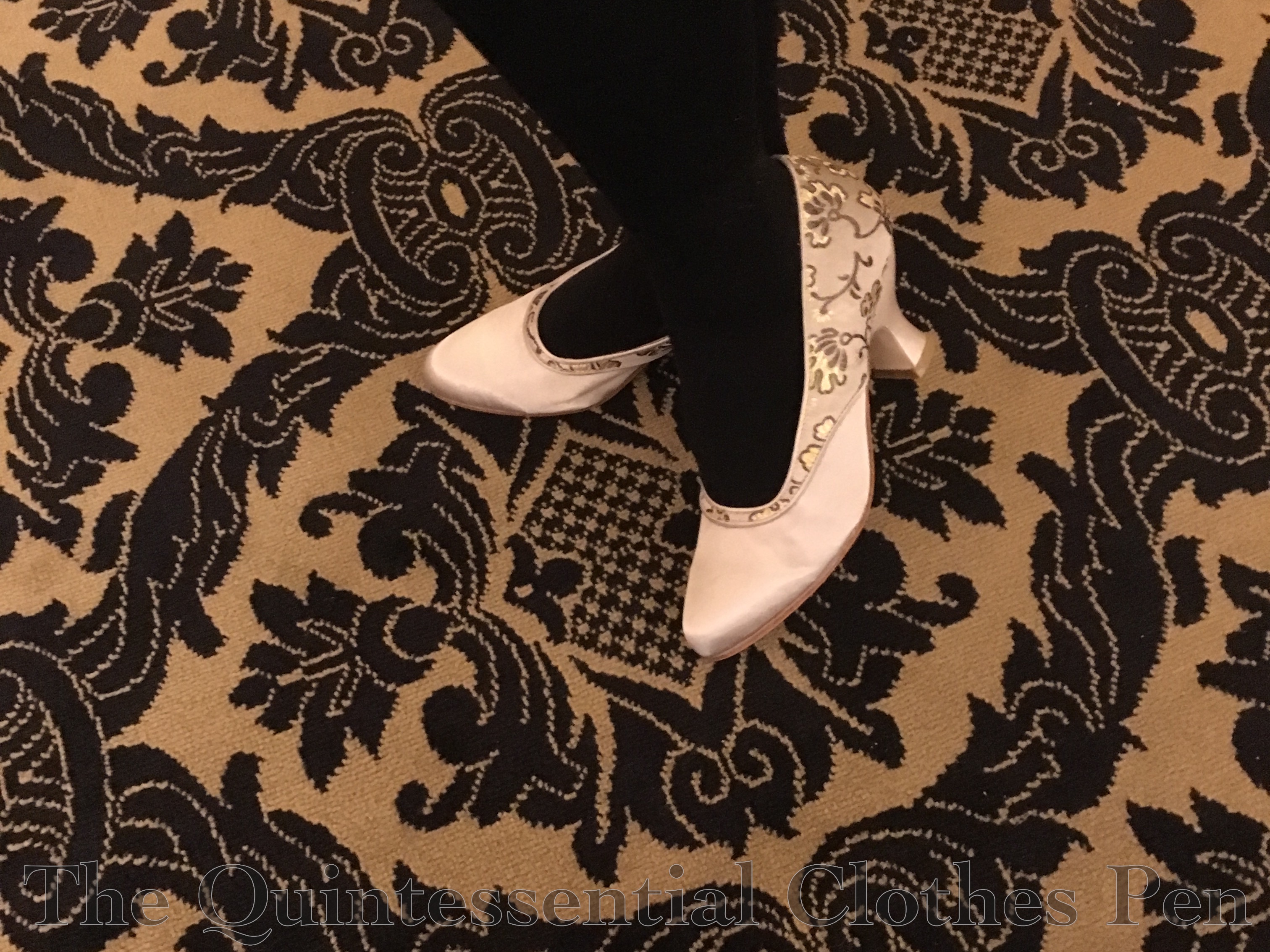
I decided to try this pair without the shoe clip bows. The gray silk gleamed and the custom designed brocade was much more obvious in this color than in the black, as I expected.

IMG_0659

The black pair I wore most recently with my 1924 robe de style at the GBVS White Lightning Ball. Here I am showing them off!

IMG_2369 (1)

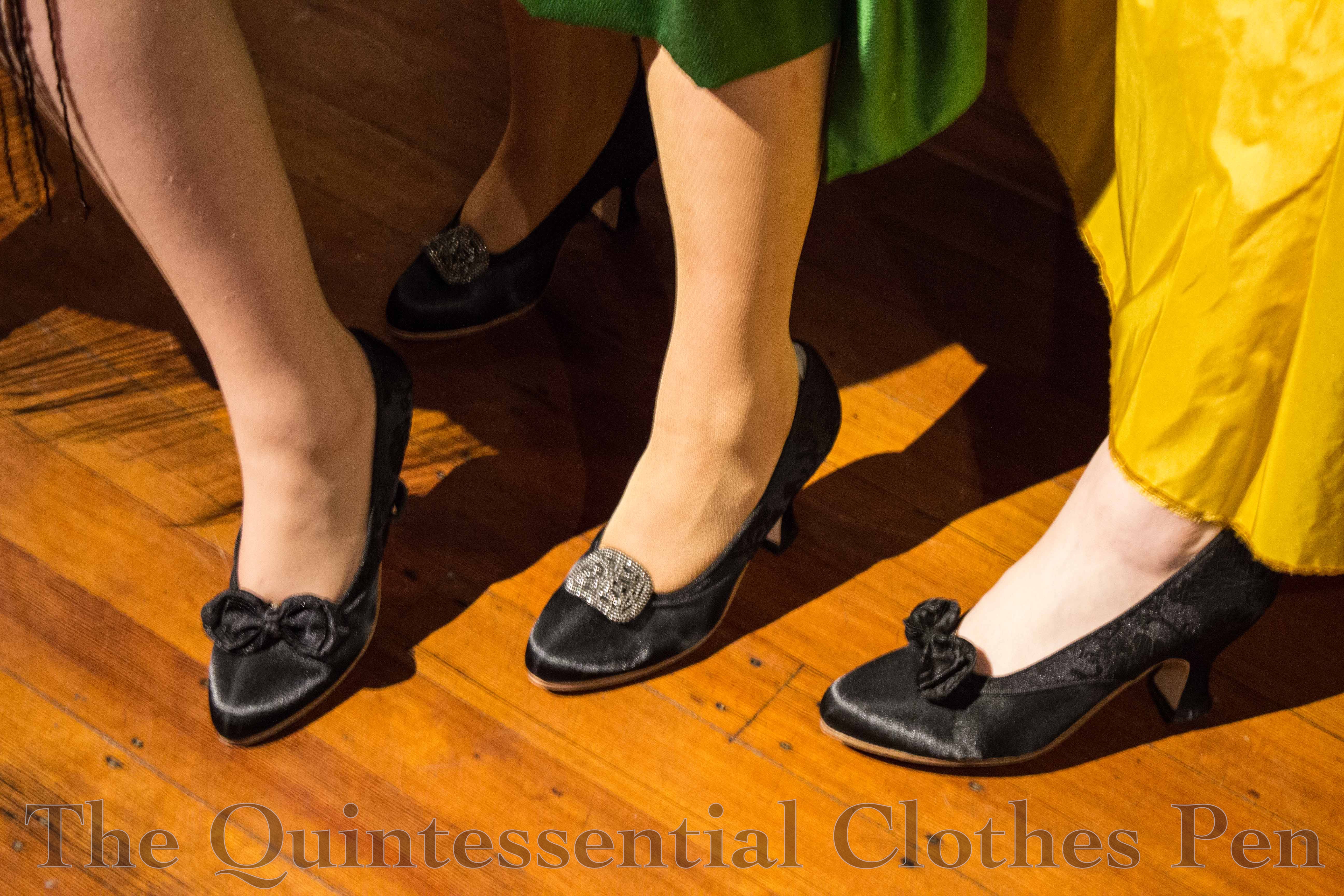
In fact, there were three of us at that event wearing black Seaburys. The nice thing is that they looked elegant and unique on each of us. Emily, in the center, got creative with hers and changed out the removable bows for vintage shoe clips… and it blew my mind!

IMG_2295 (1)

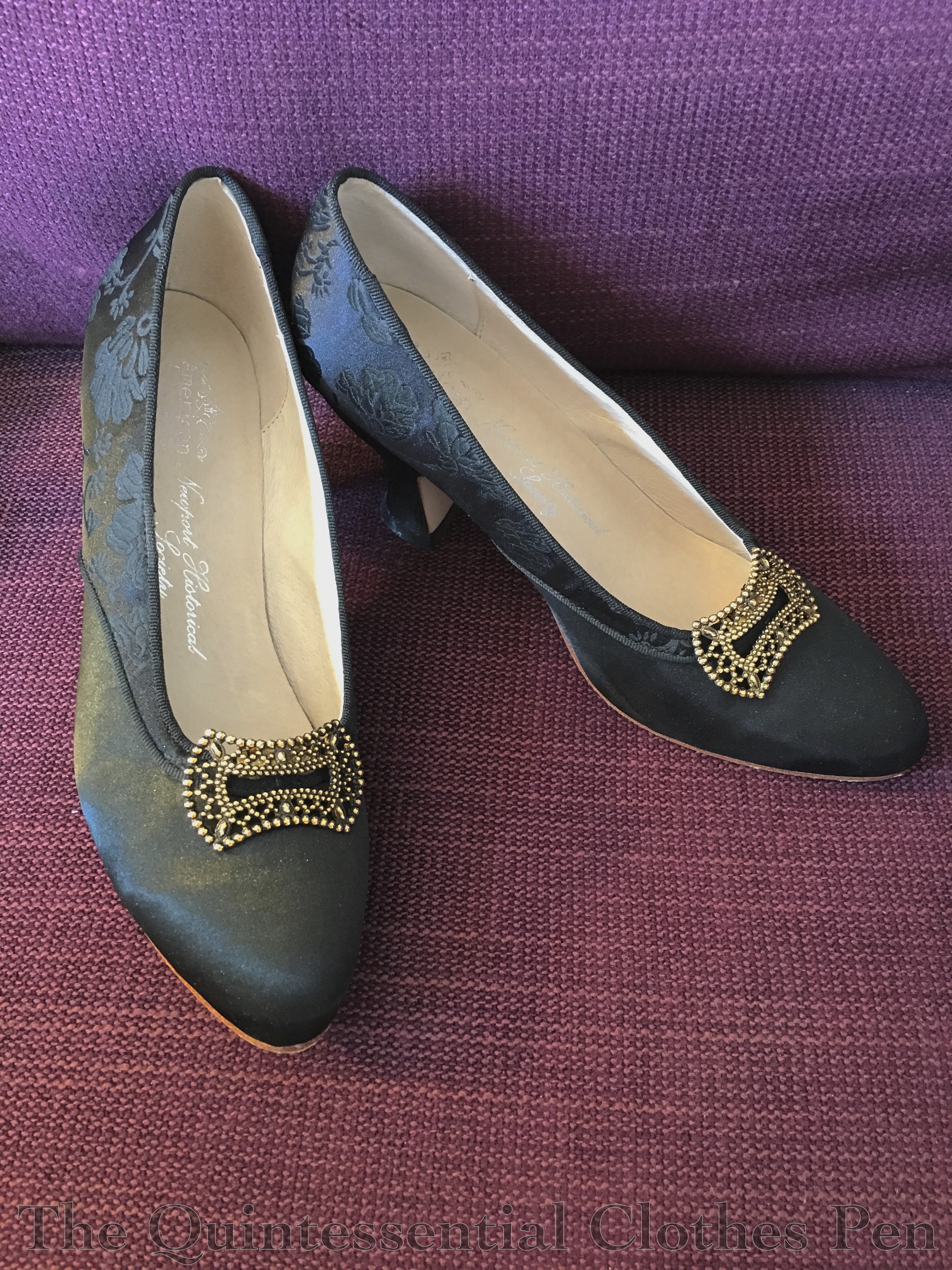
The idea of shoe clips with different decorations for Regency shoes is standard to me at this point, but I had never considered the idea for 20th century shoes. I loved the look of Emily’s and immediately came home and started searching for some that I liked so I could vary my shoes more. Since then, I have acquired two different pairs of shoe clips. Now I need places to wear them!

IMG_0728

The gold buckle ones are my favorite of the two styles. I love the color and the curved edges! The rhinestone ones are a nice bit of bling, but aren’t quite as exciting as the gold. I haven’t tried them on my grey Seaburys, but I’m curious if they might match better. I also like them flipped over so the rhinestones spread over the toes, but wearing them that way would require some finagling, since the clips on the back would be upside down.

IMG_0730

The verdict is that after wearing Seaburys multiple times in different situations, I can say with certainty that they are stunning shoes. They’re quite comfortable for standing around and light walking, with a well balanced, elegantly shaped heel. I have a narrow foot and I am pleased that these pumps stay on the back of my heels without a problem and without extra assistance. I wouldn’t plan to walk too far in mine especially outdoors, partly because the uppers are silk and I wouldn’t want to ruin them with scrapes and scratches.

For dancing, however, these are not the most comfortable shoes. They work pretty well, but as with most heels, my toes started to feel a bit pinched and tight after a few Charlestons and my feet were much more relieved to take off the shoes after wearing them while dancing vs. wearing them while just standing. Also, with nylons, I was more afraid that while dancing my heels might slip out of the back of the pumps.

But as I said at the beginning, these shoes are worth raving about. Both the solid silk and the silk brocade are gorgeous, Lauren created an incredibly elegant design with an attractive toe box and beautiful French heel, and they are sturdy and carefully crafted.

Unfortunately, Seaburys are no longer being produced. However, the new American Duchess Amelie shoes have the same gorgeous silk exteriors (without the brocade). They have a lower heel but are still a unique, historical shape, and they come in a variety of beautiful colors in addition to black and silver.

Product links in this post contain an affiliate code, which provides a small benefit to my shoe fund. This does not affect my impressions and reviews of this product.
SaveSave

Wicked, Monstrous, Silly, And A Good Time

10012673_1109871912380610_4283278151979500963_o
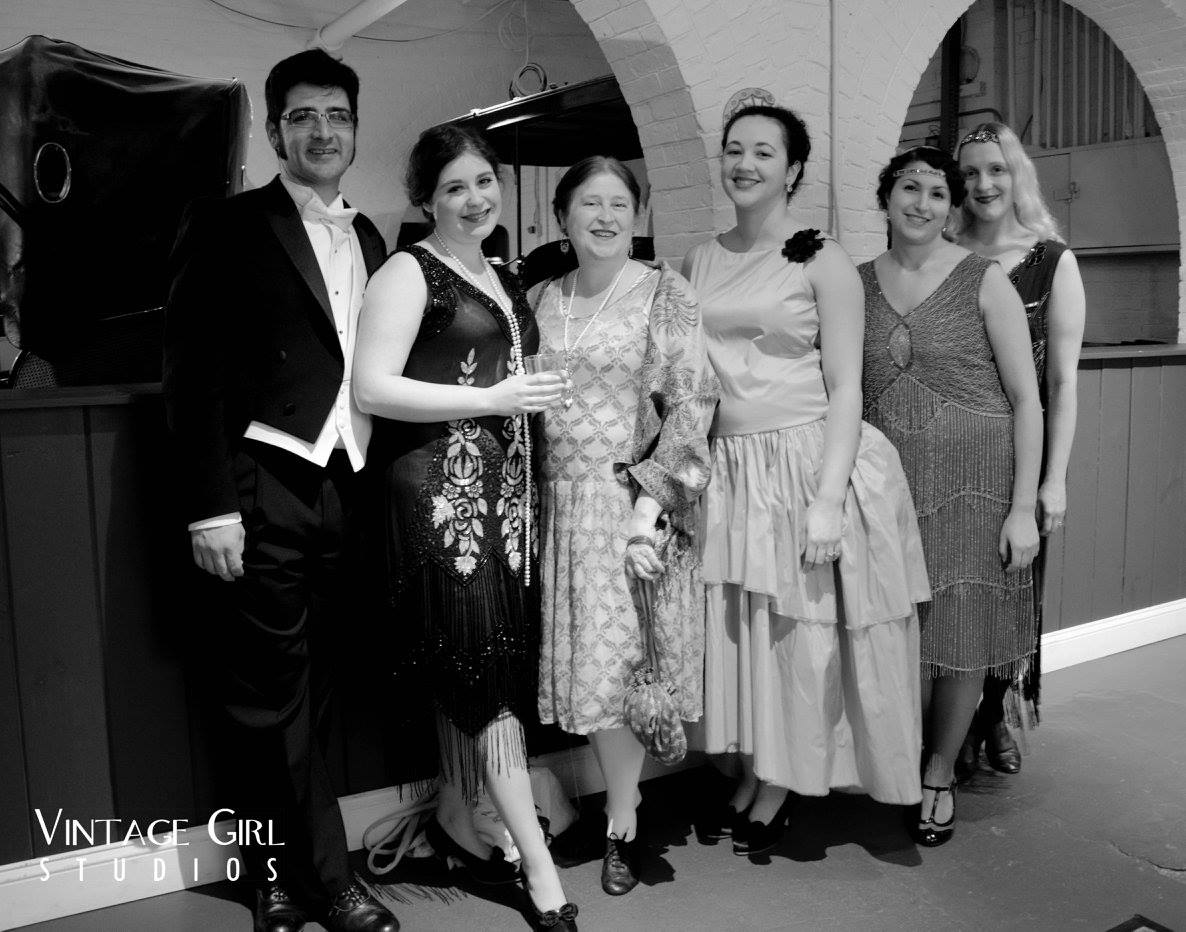
Some friends and I, taken by the official photographer of the night.

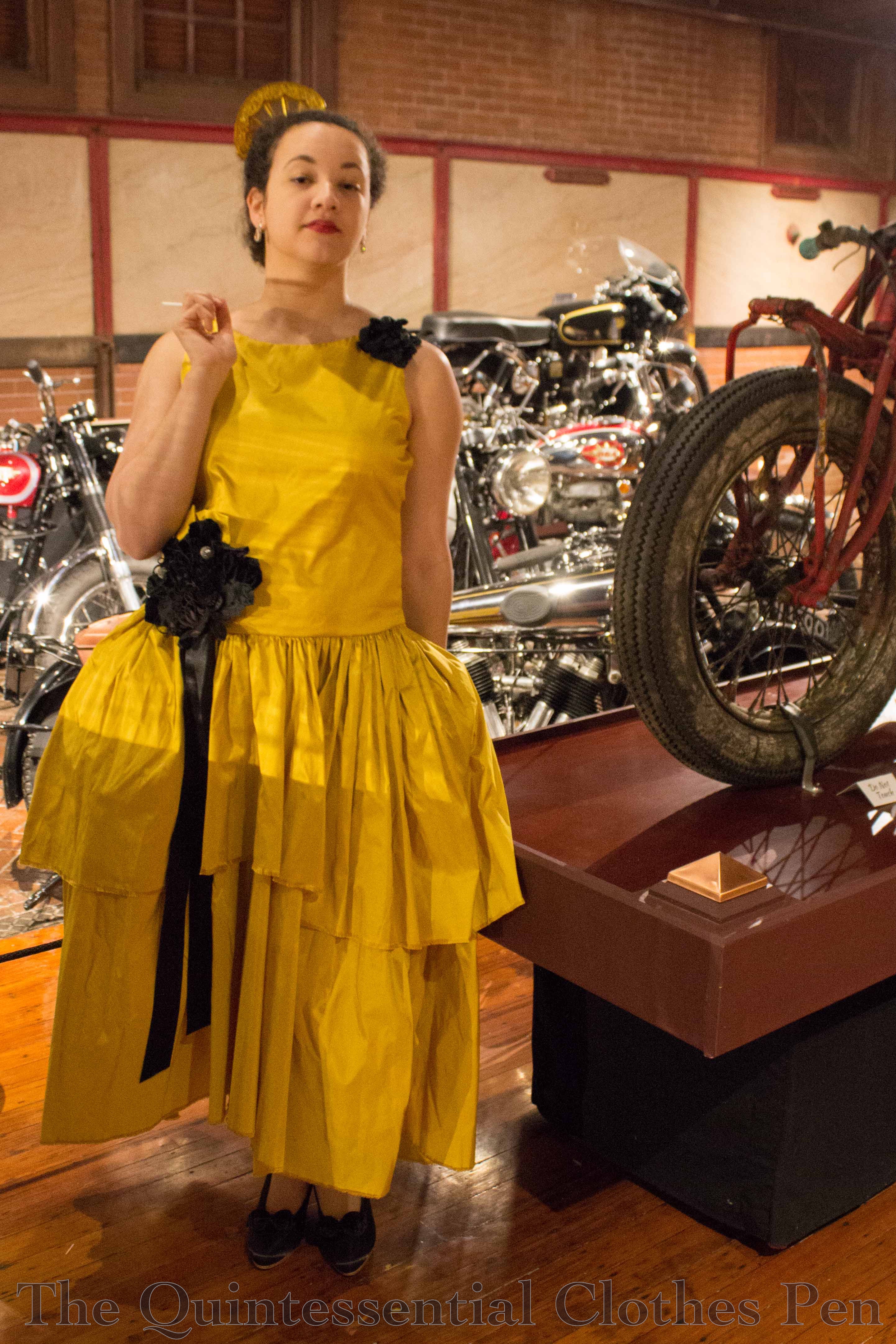
In the words of journalist Heywood Broun, “The Jazz Age was wicked and monstrous and silly. Unfortunately, I had a good time.” I don’t know about wicked or monstrous, but I certainly had a silly and good time recently at the Greater Boston Vintage Society’s White Lightning Ball.

IMG_2309
Silly faces!

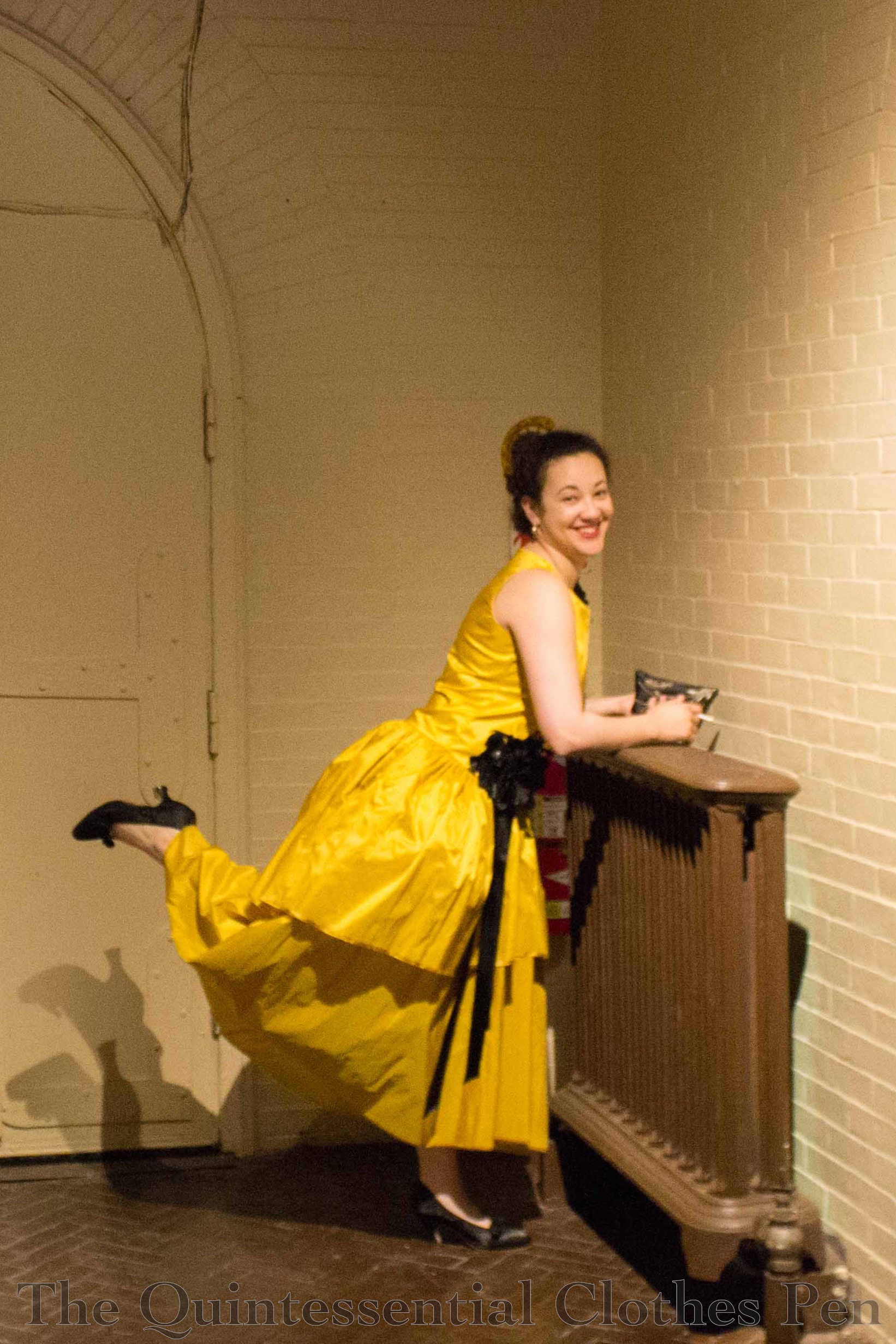
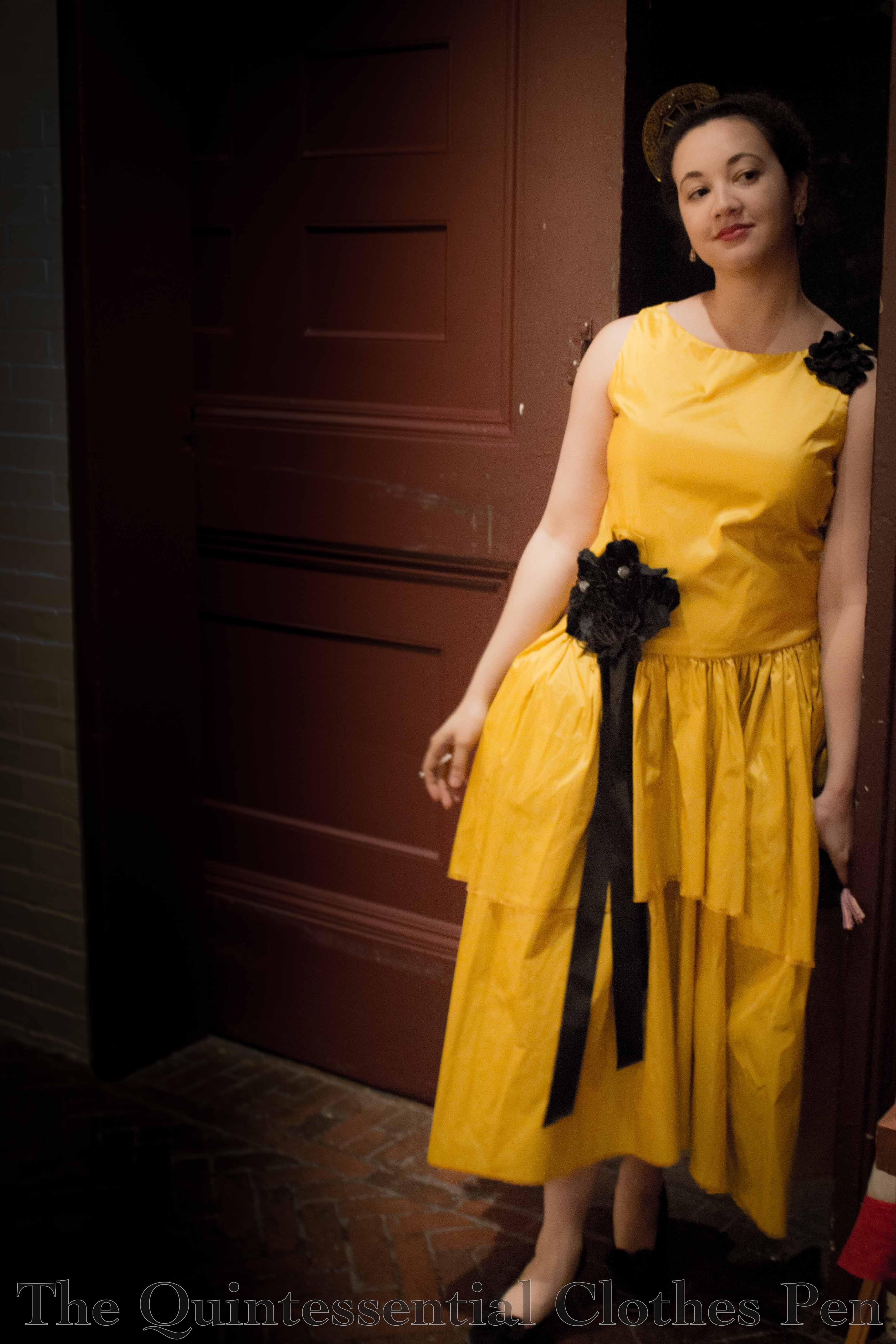
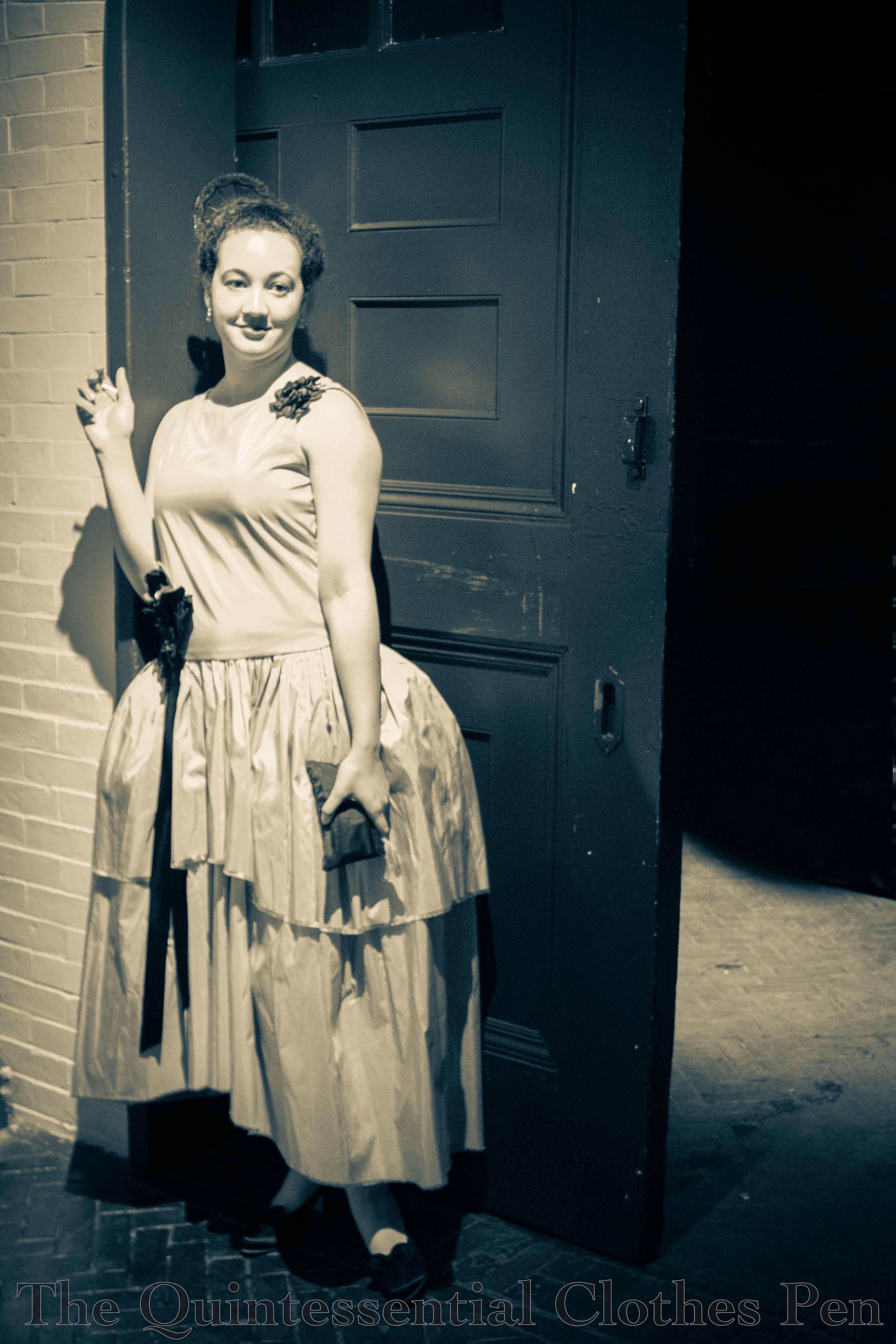
I wore my 1924 robe de style from last summer, updated with new dramatic trimmings that suit the dress much better than the last iteration. It’s such a fun, unusual, and distinctive style to wear. I fielded quite a few questions about the style and happily encouraged people who knew things about it such as that it looked like Lanvin. For my hair, I didn’t have time to attempt waves, so I aimed for a romantic style that was less time consuming, inspired by these: no waves worn with a robe de style, a romantic bun (on the right), and long hair pinned up. Also, this set of drawings shows a large hair comb worn with a robe de style which reminded me that I haven’t worn mine in a long time.

IMG_2331 (1)

My accessories include: my vintage celluloid hair comb; silver drop earrings with peachy faux stones, which don’t often match things, so it was nice to wear them since they don’t get worn often; and a recent purchase from American Duchess, black Seaburys! (Never fear, there’s a whole post coming about the Seaburys, but for now we’re focusing on the event and the clothes.)

IMG_2362 (1)

This event is held at the Larz Anderson Auto Museum in what was the Anderson family’s carriage house in the early 20th century. It is a large building with multiple levels used for stabling horses as well as storing carriages and cars. The upper floor of the carriage house housed an exhibit of motorcycles during the event, if you’re wondering about the background. Downstairs was the collection of Anderson family cars from the 1900s and 1910s. They were very fun to look at and so tempting to sit in… I know it wouldn’t be good for the cars… And there were security cameras… so I had to content myself with looking at them and dreaming of reproductions that we could ride in.

IMG_2352 (1)

My other silly accessory was a candy cigarette. It does rather add to the 20s look, but of course I don’t smoke, so there was rather a lot of me flipping it around in my hand trying to figure out how to hold it and not look ridiculous. I didn’t ever try eating it, so I can’t report how it tasted, but I was pleased that it lasted almost until the end of the night when I dropped it for the second time and it broke in half. Until then it was going strong and gave me something to do with my hands in pictures, which is always a good thing.

IMG_2372-2 (1)

Mostly I stood around and talked to friends, hatched dreamy plans for how to sit in the cars, and took pictures, but we did go out on the dance floor a few times for some Charleston. Too bad nobody got pictures of that!

IMG_2375 (1)

This was the third year of the event, I believe, but only the first year I had been free to attend. It was fun, and nice to attend an event that I wasn’t helping to run.

SaveSave

Vernet Project: Photo Shoot!

I thought I’d start the new year off with photos from my Vernet Ensemble photo shoot. (I’ll be doing separate posts with details about the construction of the ensemble as the year progresses.) I’m so incredibly pleased with my ensemble and with the quality of the pictures. I often have lovely pictures after events and when documenting sewing projects, but these are extra special in terms of the sharpness of the images, the clear colors, and the fun use of a historical lens.

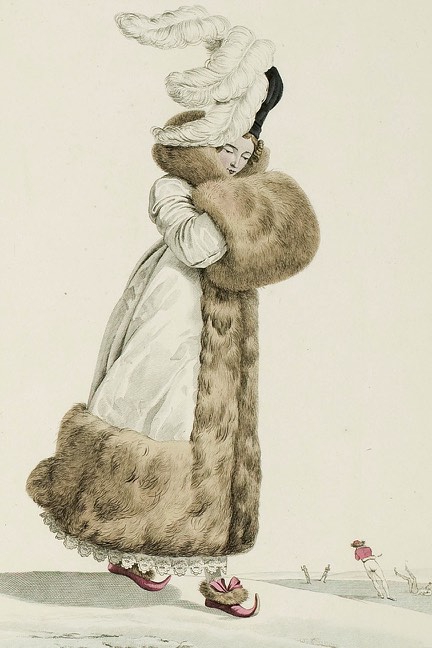
Hopefully, you were following along with the release of finished ensembles in December, but in case you missed mine or haven’t figured out yet which fashion plate I was recreating, here it is.

Plate No. 20 “Toque de Velours. Witz-choura de Satin.”

164-0000-021 - Version 2

Below is the “official release” picture. I did my best to mimic the pose of the fashion plate, but it was really hard to wrap my brain around the left and right of things in my own pose relative to the fashion plate. Left was right and right was left, and in the end we did the best we could and called it done. I think we actually did it right, it’s just that I’m facing the camera at a different angle. It still boggles my brain to try and figure it out!

IMG_1915 blog

Unfortunately, there was no snow in November when we took these pictures and so I didn’t get ice skaters falling over behind me (also, I would have had to find ice skaters)… but I did get unfrozen water, and you’ll just have to imagine the ice and the skaters!

IMG_1903

IMG_1902

IMG_1936

IMG_1978

IMG_1963

IMG_1972

IMG_1985

IMG_2004

IMG_2020

These last few pictures with the blurred background were taken using a reproduction 19th century Petzval lens. You can read more about the lens and how it causes this effect here, at my photographer’s blog. 

IMG_1928

IMG_1922

IMG_1917

I am so incredibly blessed that to have a friend that joyfully enjoys practicing her photography skills with her nice digital camera (with fancy and historical lenses, to boot!) by taking pictures of my endeavors, amongst other things. She happily came over one afternoon in November just to accompany me for the photo shoot and take these absolutely gorgeous pictures. Thank you!!!

Vernet Project: Making Progress

Our group’s early December deadline to finish sewing our Vernet Projects is fast approaching! Thank goodness we’ve had all year to work on these–mine has been quite a project with all the hand sewing and patterning and learning new skills. Of my five pieces, one is totally done, two have less than three tasks left to be finished, and 2 are still about halfway completed. It won’t quite be furious sewing, but I do have to keep at it to get it done in time. For now, here is proof that I’ve been making progress!

IMG_0288

IMG_0284

IMG_0124

IMG_0272

Starting December 7th, you should check in often with the group on Facebook to see each recreation released side by side with the original Vernet fashion plate. It’s going to be really, really amazing to see these crazy and beautiful fashion plates in 3D form!

Ice Skates! (And Polka Dot Soakers)

I bought ice skates! I was so pleased with skating in my 1895 Skating Ensemble that I really wanted to skate again this winter. I had plans to skate on a lake (so exciting!), but unfortunately we’ve had too much snow here in Boston and the lake was covered in huge drifts and unskate-able (also, we just had a day above freezing, the first in over a month, so it might also be unsafe to go out on naturally formed ice at this point). I’d still like to use my ice skates to skate on an outdoor rink like we did in January, it just means I’ll only have to pay to skate, not to rent the skates! We’ll see if these plans materialize…

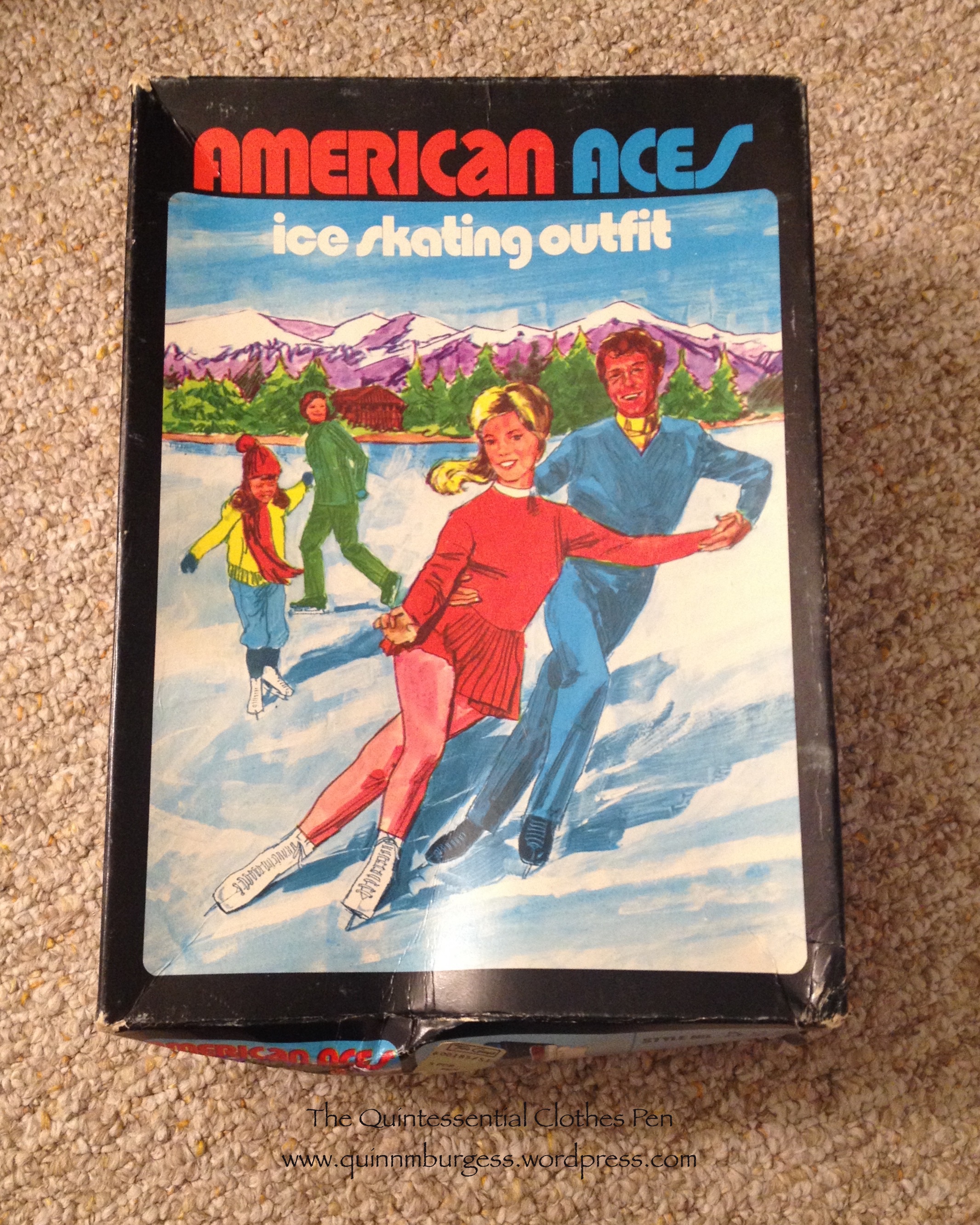
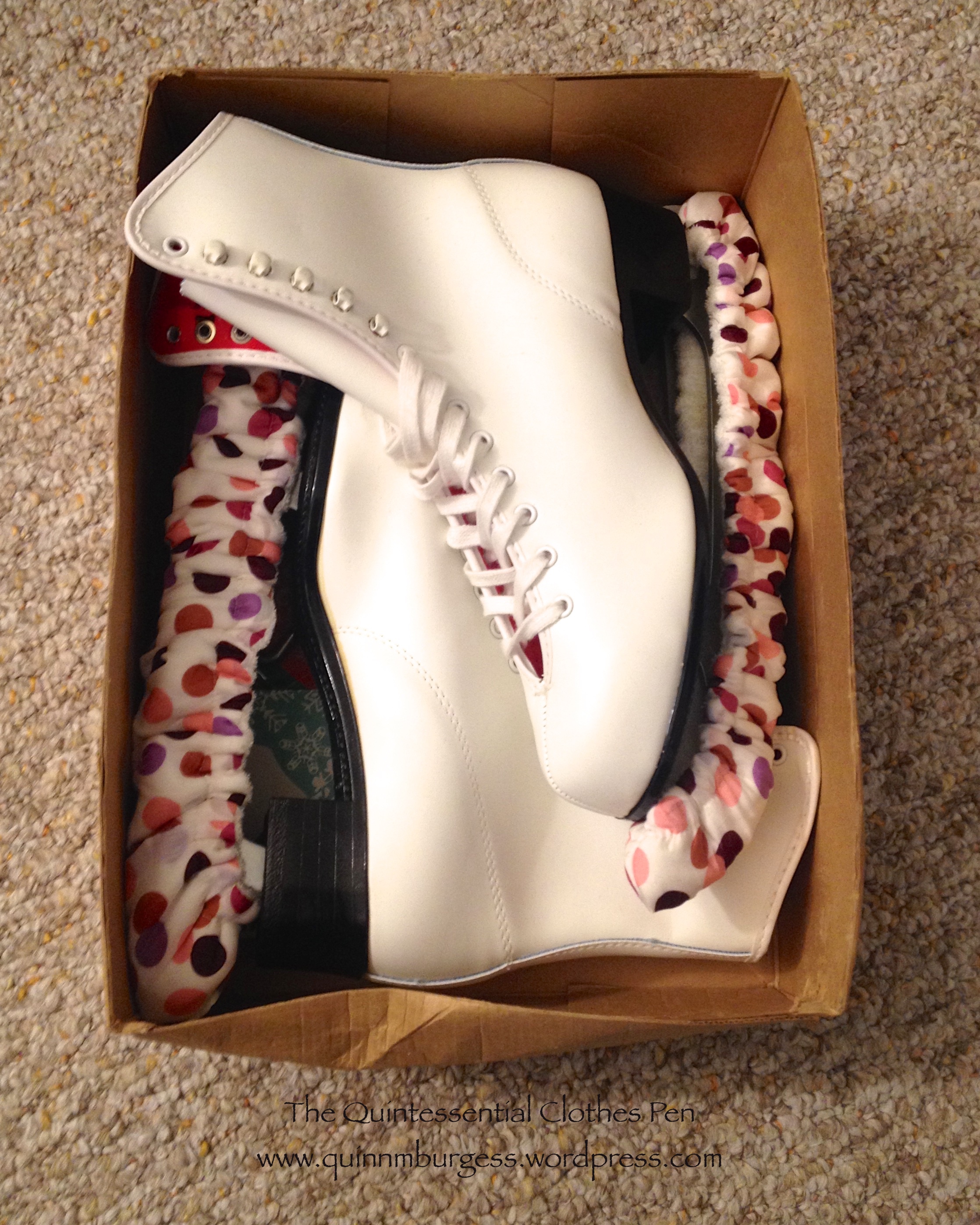
In the meantime, here are skate pictures! I bought vintage skates from Etsy. I’ve never bought ice skates before, so I was definitely guessing on the size. I gauged the size partly based off the size 8 skates I wore in January (too small) and also asked the seller for the length of the boot before purchasing to compare to my foot length (he sent me pictures with a ruler, very helpful!). It worked out and the skates fit! We’ll have to see how they work out once I’ve been in them for a bit while skating.

IMG_2023
I’m guessing these skates are from the 1970s based on the clothing of the illustrated skaters. If anyone has thoughts I’d be happy to hear them!
IMG_2025
They came not only in the original box, but also with their tag, skate scabbards (and packaging) and a hook-y thing. Does anyone know what the hook-y thing is used for or what it is called? Do I carry my skates with it? I feel a little silly not knowing what it is, but it’s a cool thing regardless, all wood and metal.
IMG_2024
These skates have never been worn! The only time-damage was on the tongue lining, which had been glued originally. The glue had entirely disintegrated, leaving a dusty foam behind. I cleaned it off and re-glued the tongue lining in place. So far it seems to have worked beautifully!

But those polka dotted doohickeys are not vintage. I made them! They’re called soakers and I understand that they are put on the skate blades after being used to soak up any excess moisture in order to keep the blades from rusting. I came across them while looking for skate scabbards (the doohickeys you wear around the rink while not on the ice to protect the blades from getting dull) while I was researching skates to purchase. The different pictures I found of them looked so cute that I wanted some for my new skates! (Ha, remember my post about thin-gummies? Yup, here I am using the word doohickey.)

IMG_2021
One soaker on, one soaker off.

This is the tutorial I followed for making my soakers. It was super easy. I had to piece my fabrics because the scraps I had were small, so that added some time, and I made my towel two layers thick since it was thin terry cloth, which added a little time and bulk, but those are the only things I changed. The polka dot exteriors are scraps from my 1953 Polka Dot Dress and the terry cloth linings are cut out of a failed robe I made years ago when I was first learning how to make clothes. Yay for repurposing! I love how silly and girly they are. They make me smile! Plus, I don’t use elastic for many projects of my own, but I happened to have just one piece in my bag of random scrap notions that was the perfect length, so the whole project was free and from my stash!

I have no idea if these skates are sharp. I assume that skates come sharp when you purchase them? They don’t feel very sharp… but I thought I’d try them and see what happens. It’s not like I’m a great skater, I sort of just putter around the rink, so if they’re not terribly sharp I expect I’ll be ok…

HSF #25: Spat-Boots, Or Gaiters

IMG_6934
Spat-boots! WIth my 1917 ensemble.

It’s time for the details about my entry for HSF challenge #25: One Metre. I prefer saying I’m wearing “spat-boots” though the actual items I’m really wearing are shoes and “gaiters.” Spat-boots has more of a ring to it, I think.

IMG_7193
Close up of my spat-boot look.

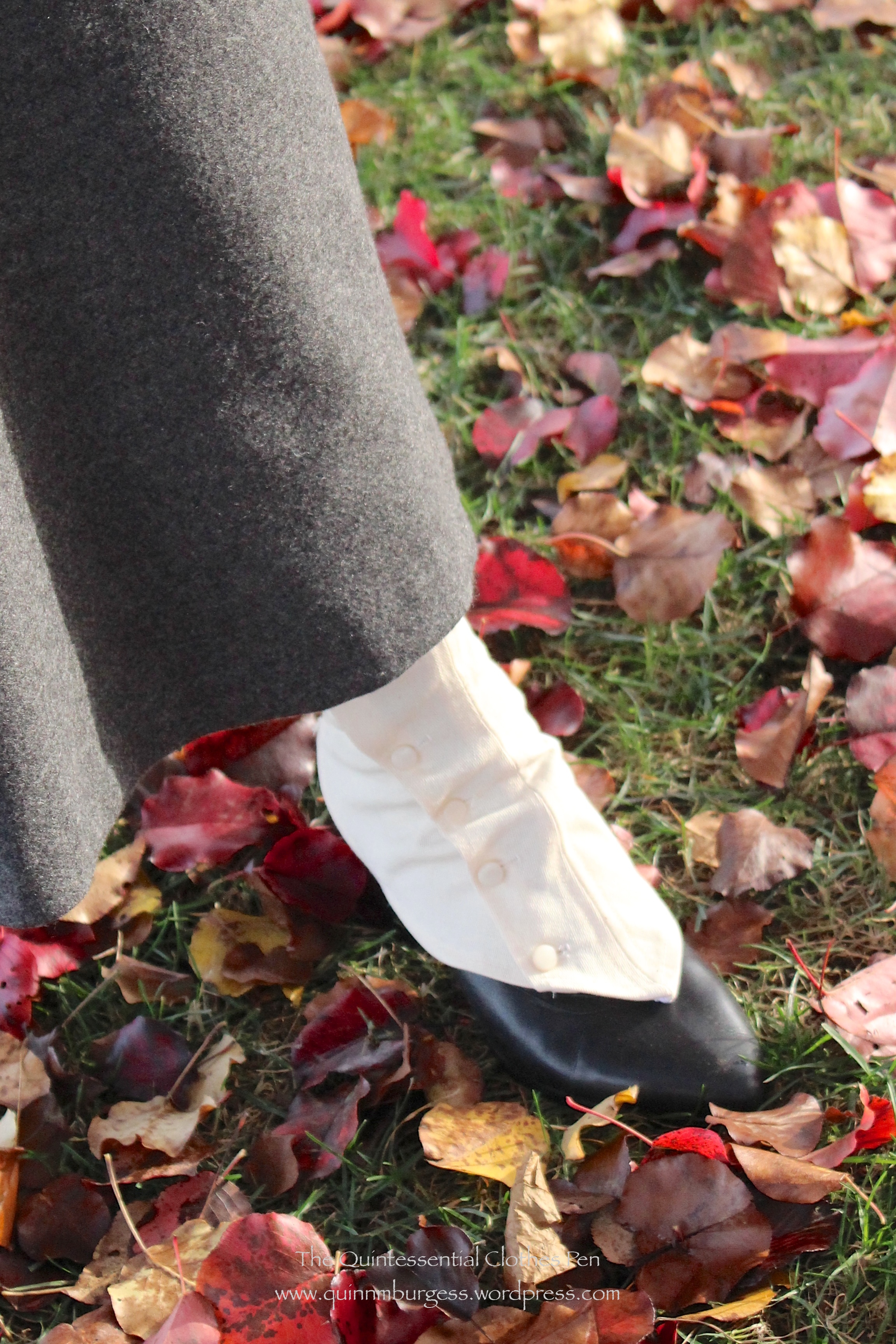
The gaiters very effectively turn my sort-of-1910s-but-more-1920s American Duchess Gibsons into very 19-teens spat-boots! If you look at the first black and white image of suffragists in this previous post you can clearly see some similar spat-boot styles. And if you look at the images on my Sewing Project: 1917 Blouse and Accessories Pinterest board you can see multiple examples of the spat-boot style. Some boots, like these from 1917 at the Met, were made in two different colors of leather. That’s the look I was trying to imitate, except that I was doing it with a separate garment rather than as a part of my shoe. The Met actually has quite a number of early 20th century gaiters, made out of leather and cotton. If you’d like to see these examples, I’ve pinned many of them to my Early 20th Century Accessories Pinterest board.

The facts, you ask?

Fabric: Scraps of heavy unbleached cotton.

Pattern: Created by me.

Year: 1917.

Notions: Thread, black elastic, cotton twill tape in various widths, and plastic buttons.

How historically accurate?: 90%. The look is right but the materials are a mix and match of right and modern.

Hours to complete: 6-8? Took a few fittings to get them ready to sew. Then finishing and sewing on buttons took awhile.

First worn: At a Thanksgiving event in Plymouth.

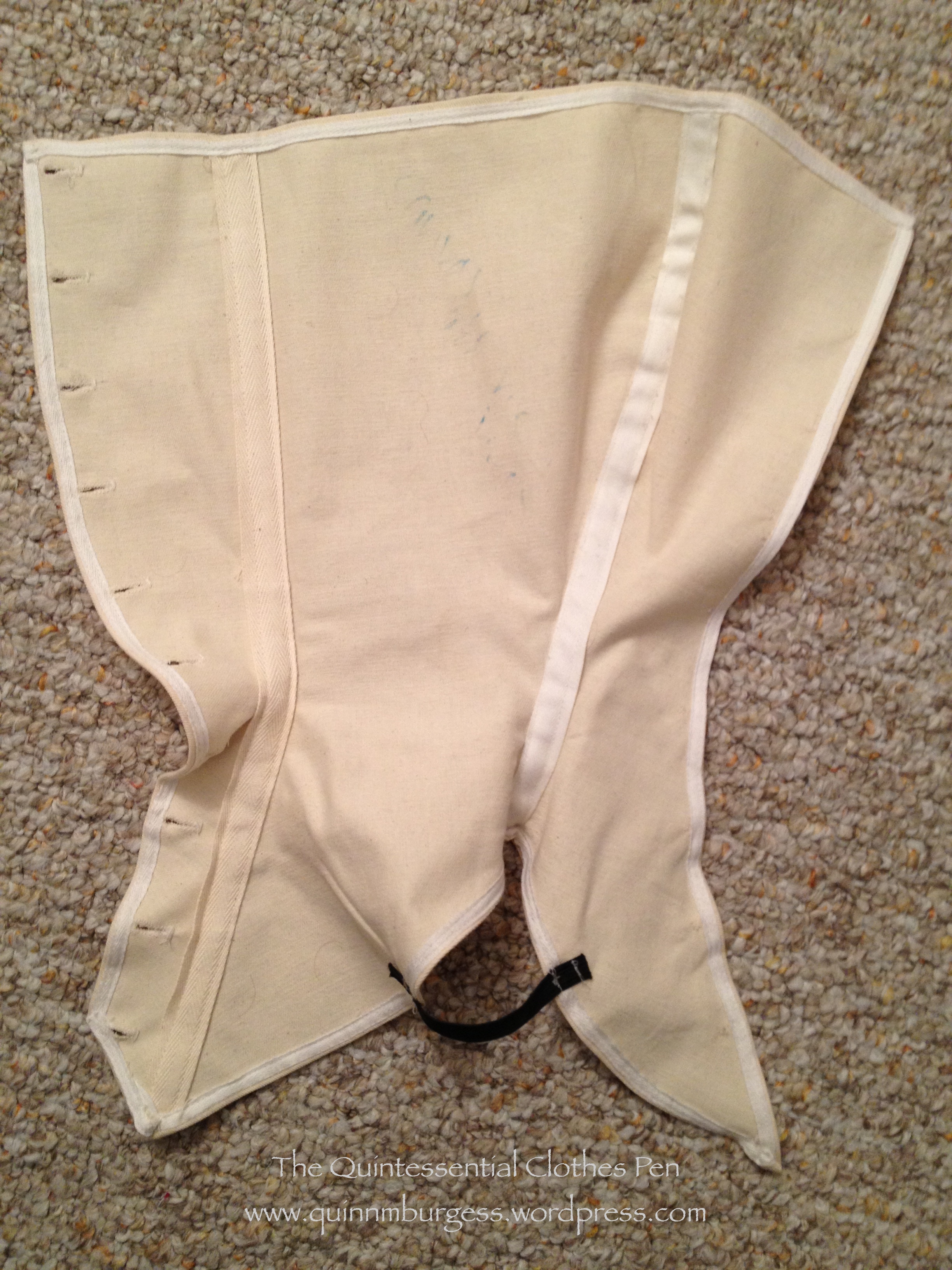
Total cost: None. The fabric was left over from a grad school mock up and the notions were all from my stash. (See that odd marking in the middle of the center piece? That’s blue sharpie that soaked onto this part of the fabric from notes I wrote on the mock up… There was a lot of blue sharpie, and I couldn’t cut around it and still have enough fabric. Doesn’t show on the outside though!)

IMG_0626
Here’s an inside view of one of the gaiters. You can see that I’ve used three different kinds of twill tape to bind the seams and the edges. All of the sewing was done by machine except sewing on the buttons.

There are a few things that I would change consider changing if I made these again in some other reality. #1: Having my buttons spaced closer together, as the extant gaiters and boots do. But in this case I only had a limited number of buttons to work with! #2: Potentially putting a strap with a buckle to go under the foot rather than elastic, since the buckle method is what extant gaiters have. But the elastic worked so well and you really couldn’t see it… so I probably wouldn’t actually change this, especially since I don’t have the right sort of buckles in my stash. #3: Making the back part that comes down over my heel longer. I was aiming for a nice swoop up from the part held down by the elastic, but the back of the gaiters kept popping up over the edge of my shoes, which was a little uncomfortable. I spent a lot of time during the day I wore these pulling the back of the gaiters down.

IMG_6965
Like a flamengo, I’m standing on one leg and pulling down the back of my gaiter, which had popped up over the back of my shoe.
IMG_7195
Overall, I’m super pleased. These were quite successful. You should try some yourself!
Product links in this post contain an affiliate code, which provides a small benefit to my shoe fund. This does not affect my impressions and reviews of this product.
SaveSave

Thankful For Suffrage

If you saw my last post, you were left guessing as to what event I was furiously sewing for. I think most you guessed that it had to do with women’s suffrage… Yay you! The entire event wasn’t really about suffrage, but suffrage was a part of it. We went down to Plymouth, MA to be a part of a historic village event that was linked to the main Thanksgiving parade in town.
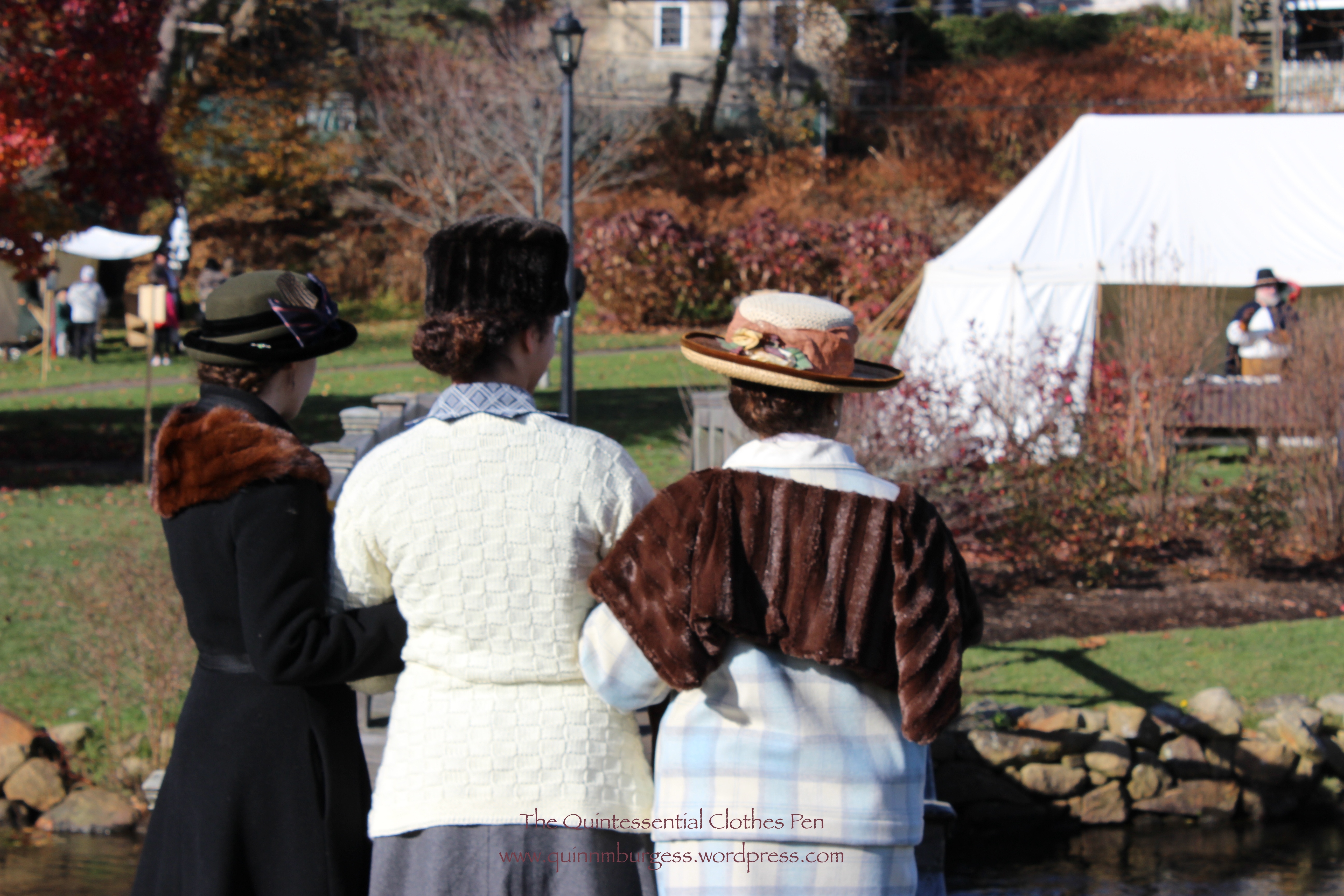
The historic village contained various groups from the early 17th century, groups from the 18th century, Marines from 1812, a unit from the Civil War, my usual dancing friends and I representing women’s suffrage c. 1914, and paratroopers from the 1940s. The parade was…a parade. There were historic groups in it (including some of the military groups I just mentioned), there were marching bands, there were floats, there were unicycles, and there were horses doing various things.

And I’ve got pictures! To start, here are some images of the parade:

IMG_7068
Happy Thanksgiving! The giant inflatable turkey was pretty amusing, especially when he had to slightly deflate to get his head under the power lines!
IMG_7024
Often these guys are dancing with us, but at this event they were hanging out in the 1630s as the Salem Trayned Band.
IMG_7088
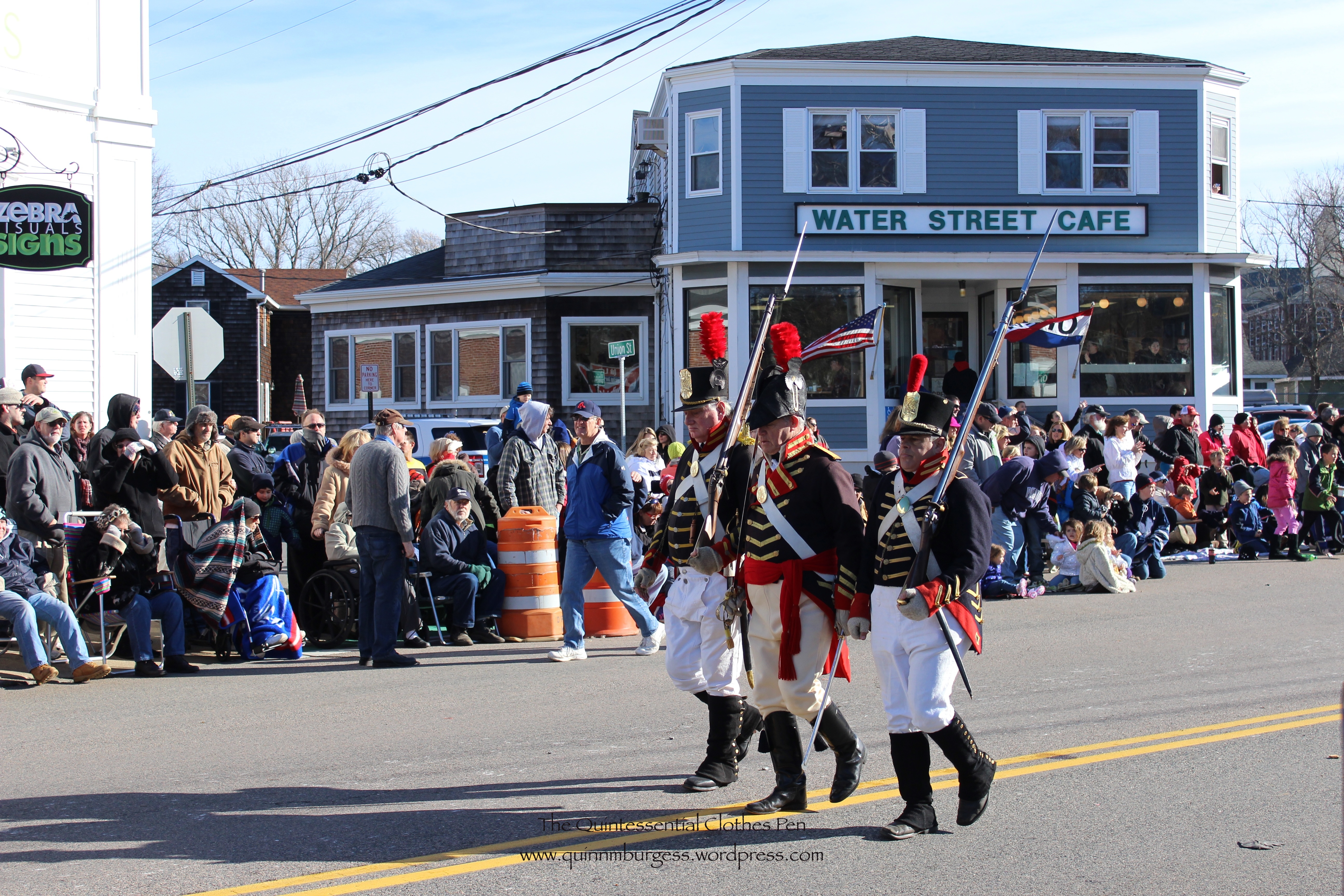
Some of our other friends: 1812 Marines.
IMG_7077
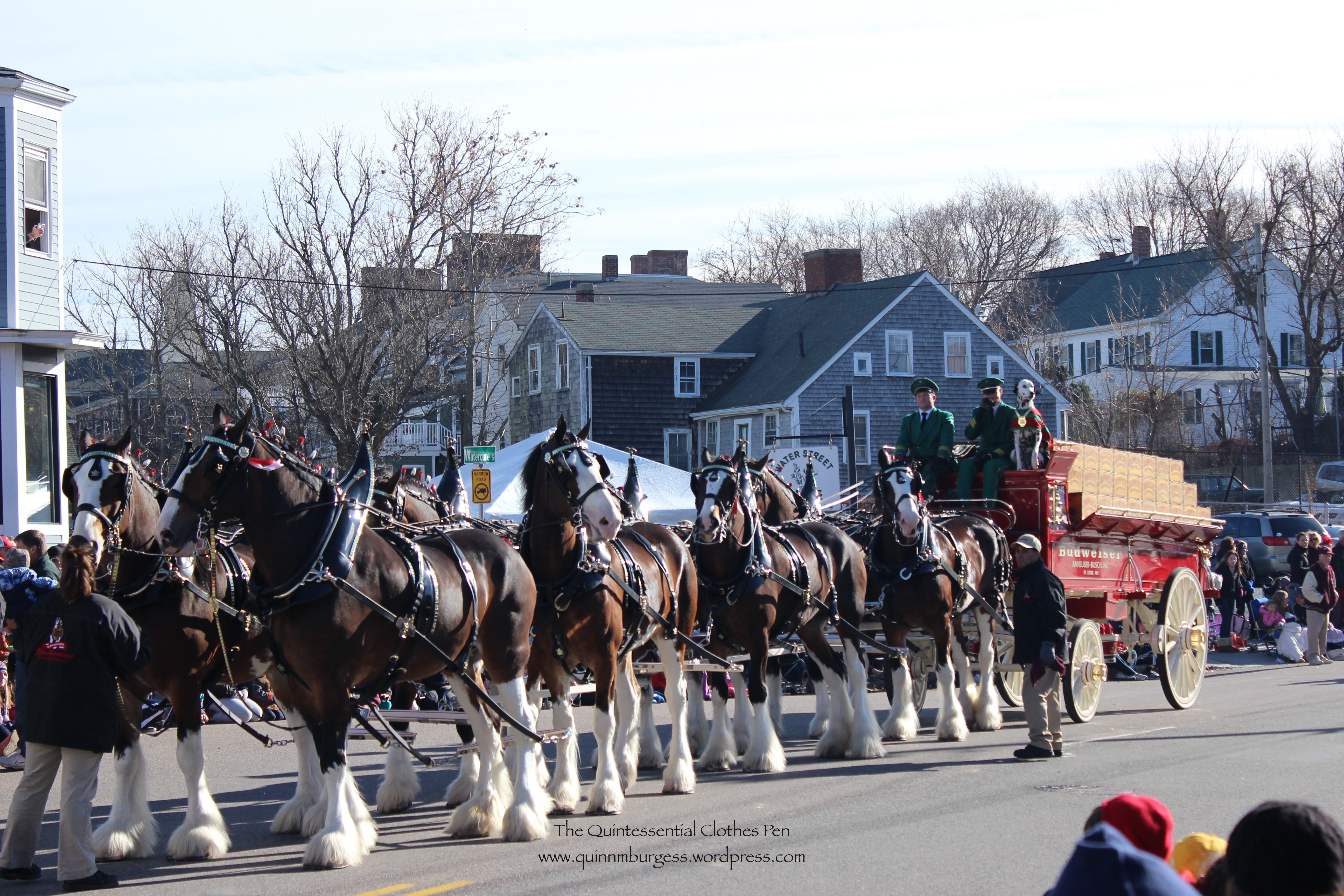
8 beautiful (and large!) Budweiser Clydesdales.
IMG_7104
4 spirited horses pulling…
IMG_7105
A fancy Wells Fargo stage coach!
IMG_7119
A super snazzy green car, with bright green trim!
IMG_7177
Red, white, and blue confetti in the cold, clear air near the end of the parade route.

Next, here are some images of our representation of Suffragists and our setup in the historic village:

IMG_6903
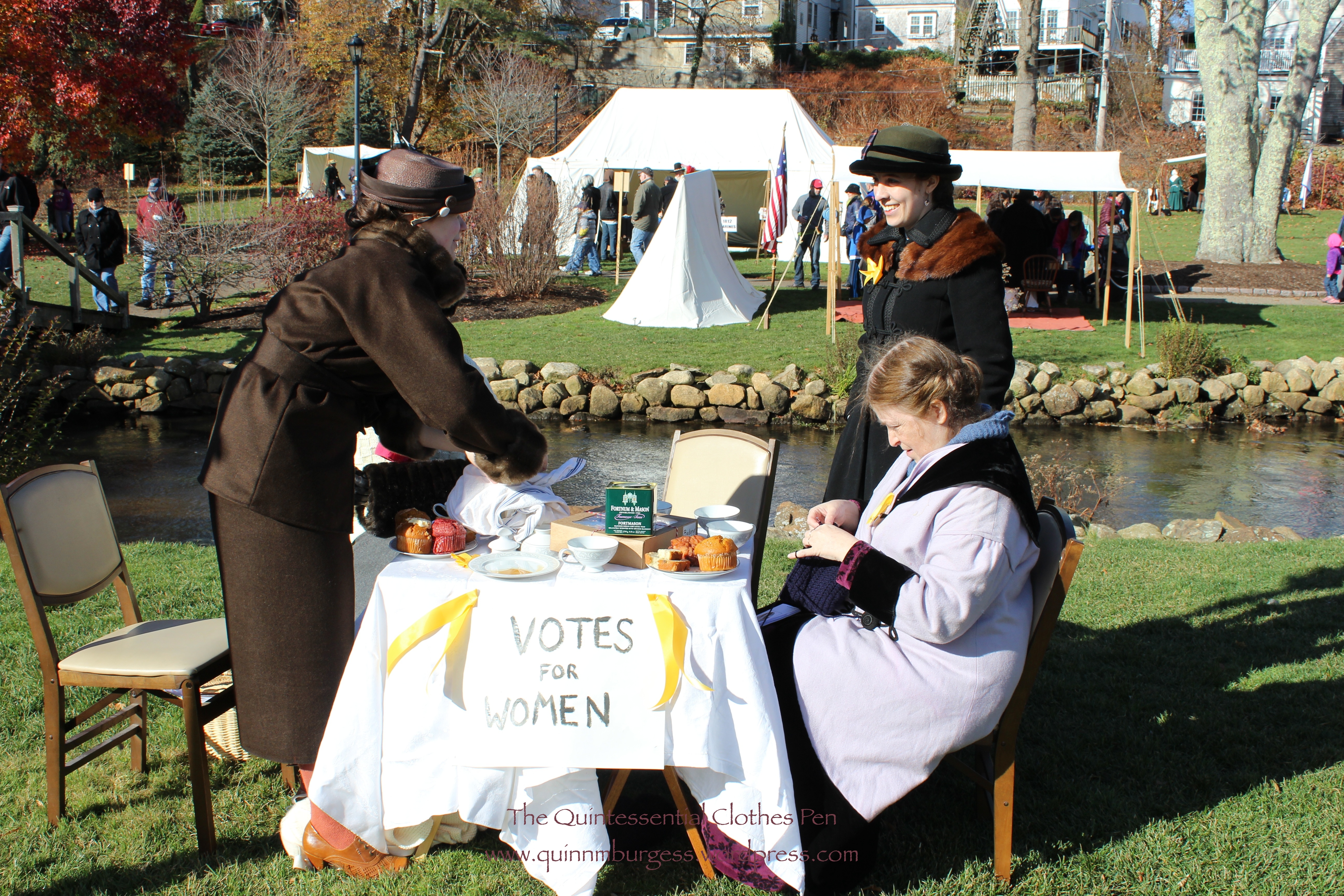
Setting up our tea table. Other setups included tents and smoking fires (it had rained the day before and everything was damp and mushy, so the fires didn’t really work…).
IMG_6900
Yes, we really did drink tea. In china cups. It actually was very nice to have hot beverages throughout the day given how cold it was outside!
IMG_6979
See, we’re drinking our tea!
IMG_6962
We didn’t march in the parade or parade around the historic village, but we did serenade the ducks in the creek behind us (and visitors walking by) with suffrage songs.
IMG_7208
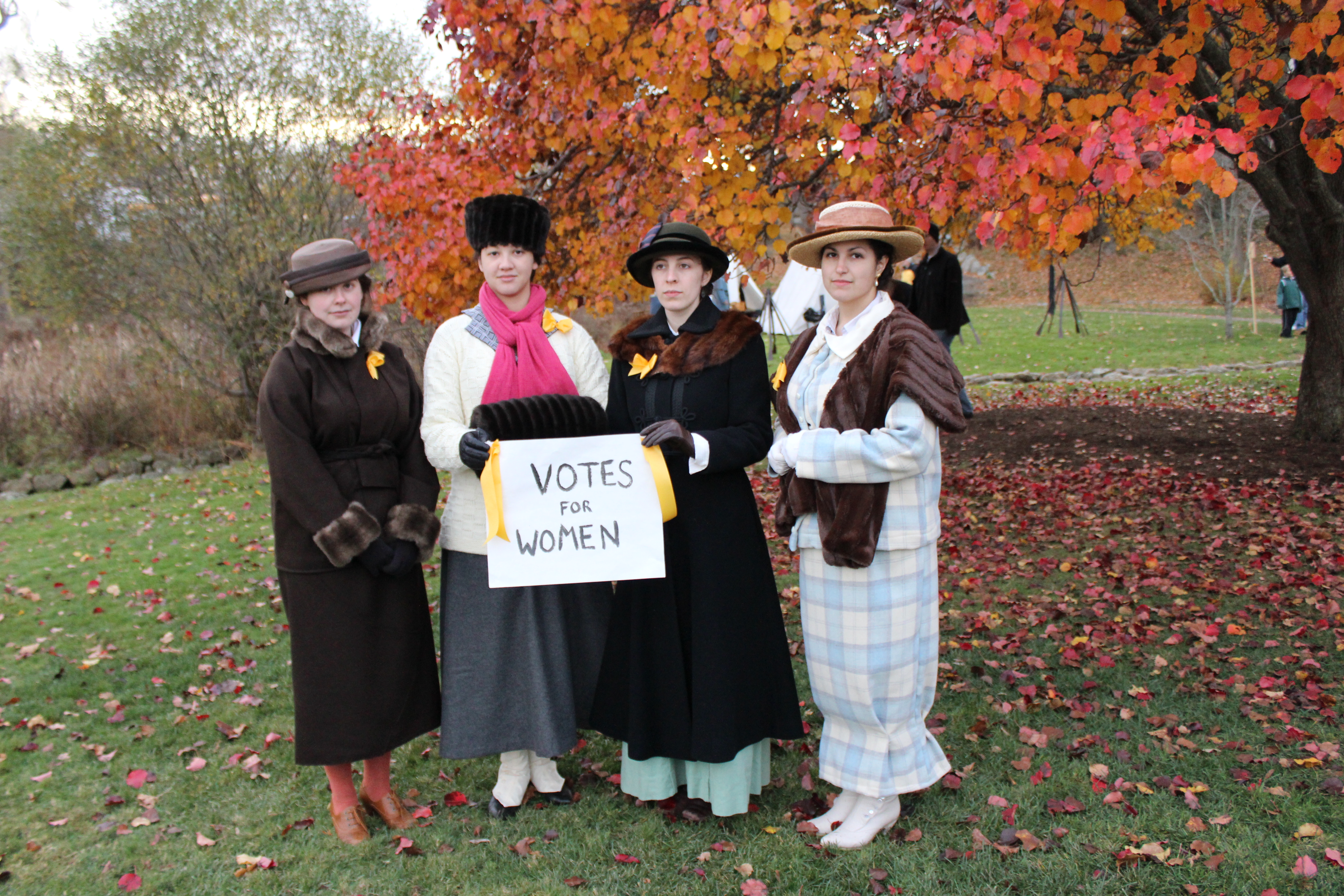
Here we are making “serious suffrage” faces.
IMG_7209
Ok, smile for the camera.

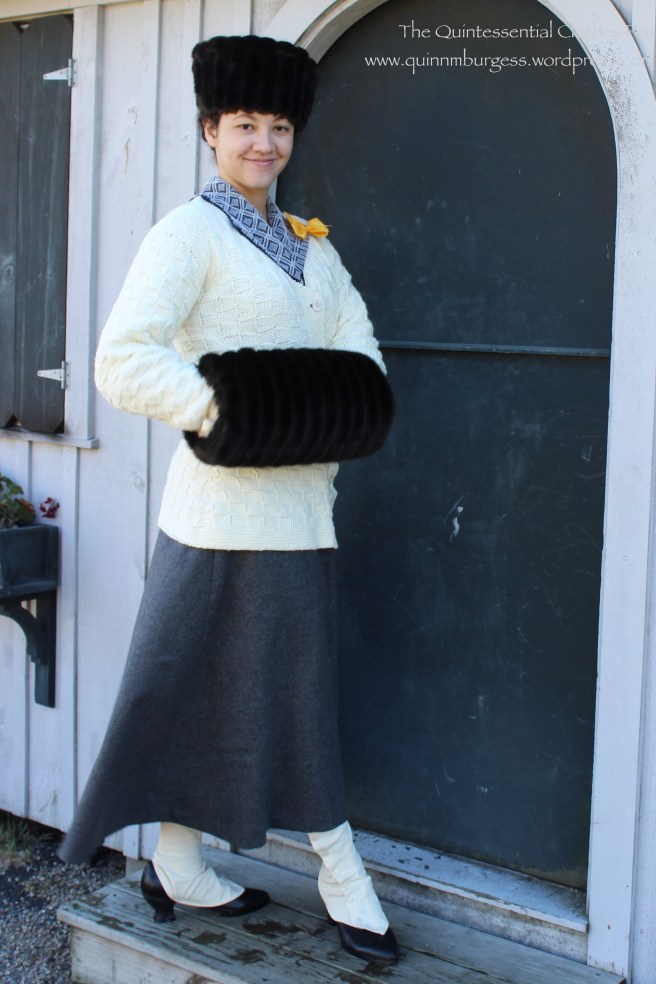
The best part is that in addition to sharing a little bit about history with the public and getting to watch the Thanksgiving parade in all its glory, I was able to use this opportunity to build and wear an outfit showing off my recently completed 1917 Knitted Sweater of Angorina. I had to plan for cold weather, but I didn’t want to cover up my sweater! So I planned a faux fur hat to match an existing muff, a wool skirt, a polyester crepe blouse (in this case, the polyester was a great choice, because the fact that it wouldn’t breathe would help me stay warm and use up a random bit of fabric in my stash that had no other project in its future!), and did a mostly unnoticeable revamp on my 1860s/can-look-like-other-decades fur muff (which was essential, it turned out, for keeping my hands warm!). And to look stylish, I made gaiters to turn my 1920s American Duchess Gibsons into 19-teens looking spat-boots. And all of the fabrics were from my stash! The gaiters might just be my favorite part of the outfit, and both they and my fur hat will qualify for the next two HSF challenges, so you’ll see more detailed information on those soon! All in all, I managed to stay warm, except for my feet! I wore thick tights, but I didn’t think to wear extra socks, and my toes and feet were SO cold! Note to self: wear thick socks next time an all day outside event in the cold is on the horizon…

And here is my brand new 1917 outfit:

IMG_6948
Yay! New hat, revised muff, new blouse, hand knit sweater, new skirt, and new gaiters, worn with my Gibsons, my modern cashmere lined leather gloves, my 1913 petticoat pinned up to shorten its length, and a golden yellow ribbon in support of women’s suffrage. I was able to completely finish my accessories, but the blouse and skirt didn’t get as far as closures. You can’t tell of course, but safety pins are great sometimes. These two garments now live in the “need to be finished” section of my sewing list.
IMG_6963
One of the only back views. The blouse has neat collar details (see those cute points?) and neat cuff details you obviously can’t see. When I eventually finish the blouse and skirt I’ll post more details about their design and construction.

Despite last minute sewing for all of us, we all looked good and had fun wearing clothes from the 1910s while sharing a bit of important history with the public:

IMG_7158
Brown wool suit with fur trim.
IMG_7144
A wool plaid hobble skirt and jacket and a lovely black wool coat with fur collar.

The 19th Amendment, which gave women the right to vote in the US, was ratified in 1920, after over 70 years of struggle. I think it’s fitting that Thanksgiving and women’s suffrage were related events for us ladies this year. In addition to many other things, we’re thankful for those who fought to get women the right to vote!

Product links in this post contain an affiliate code, which provides a small benefit to my shoe fund. This does not affect my impressions and reviews of this product.