Of flounces and dance cards: Part I

PART I: Of flounces…

Flounced 1860s dresses seem to be pure confections: cupcakes iced with lace and frothy ruffles. That is the vision in my mind while I was looking for inspiration for my latest crinoline dress.

Fashion Plate from Godey's Lady's Book September 1859 "Dressed for a Party." (The dress on the right is the inspiration for my latest gown)

I already made one 1860s dress for myself. Named Belle, it is a dark blue satin and velvet gown with a three tiered skirt. It’s very heavy and a dark color: neither of those two features seemed fitting for a summer ball in temperatures around 80 degrees! And so I decided to create an all new gown… in my head this one is named “Annabelle.” (I hope you are also amused by the name!)
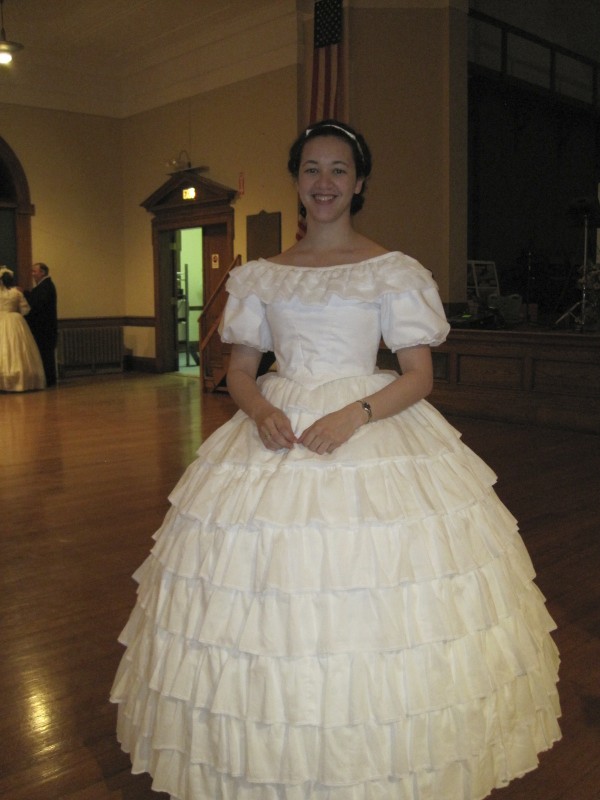
"Annabelle" my new 1860s ball gown

As you can see, there is one crucial element missing… the pink flowers! My goal is to make the flowers by hand from silk organza and to be perfectly honest, I ran out of time. I just decided to wear the dress as-is and finish the flowers later. I also ran out of time to bone the front, as you can see by the wrinkles along my tummy. No worries though, as I’m sure I’ll be able to wear this gown again.

"May I have this dance?" Side view of Annabelle.

In order to be to light and breathable, Annabelle is constructed entirely of cotton. The skirt has a medium weight cotton foundation to which cotton voile flounces are attached. The bodice is three layers of cotton for the sake of being opaque: two of medium weight cotton and one layer of voile. The layers are flatlined together and treated as one piece. The flounces on the skirt and bodice are cotton voile edged in narrow white lace.

This gown was flat patterned using research from books by Janet Arnold, Norah Waugh, and Kristina Harris.  View this post about patterning from my Project Journal: Women’s Tailoring to see which titles I used and get a smidgeon of bibliographic information. The skirt pattern is fairly simple: a big tube cartridge pleated at the waist. The bodice has narrow v-shape seams front and back with puffed sleeves and a flounced bertha. It is worn over a chemise, corset, double thickness bum pad, hoops, and petticoat.

While this dress is eventually intended to be a reconstruction of the dress in the 1859 fashion plate above, I was also inspired by these other, similar fashion plates for further information. Enjoy!

Fashion Plate from Godey's Lady's Book October 1859 "The Soiree"
Fashion Plate from Godey's Lady's Book August 1859 "Godey's Fashions for August"

Project Journal: Victorian Women’s Tailoring Part II: Patterns

The first step of this women’s tailoring project was to research what exactly I wanted to recreate. That being finished, I embarked on the next task: to create patterns for each of the garments I would be building. Each look is made up of about 8 separate garments: a chemise/combination, corset, corset cover, petticoat, blouse, skirt, jacket, and hat (the 1883 look also includes a bustle). To create the patterns for these garments I used a combination of the methods mentioned below.

Basic Sloper: a starting point for patterning

The simple undergarment patterns such as the chemises and corset covers were drafted using my models’ measurements. Pattern Drafting for Fashion Design, by Helen Joseph Armstrong, was a great starting point for creating these shapes.

The corset patterns were adapted to fit my models from the book Corsets and Crinolines by Norah Waugh.

The petticoat patterns were created using a combination of methods. For all of them I found an image I wanted to recreate, then I either used the drafting method I used for chemises and corset covers, or I used a historic pattern that was lifted from a historic garment like the patterns for the skirts and jackets (mentioned below). The images came from a wide variety of books, including The History of Underclothes by C. Willett Cunnington, Everyday Fashions, 1909-1920, as Pictured in Sears Catalogs edited by JoAnne Olian, and Victorian Fashions and Costumes from Harper’s Bazaar, 1867-1898 edited by Stella Blum.

For the outer garments (skirts and jackets), I used patterns from historic garments that were resized to fit the models who will be wearing the garments. The patterns are lifted from historic garments and printed in books such as Patterns of Fashion 2: Englishwomen’s Dresses and Their Construction C. 1860-1940 by Janet Arnold, Turn of the Century Fashion Patterns and Tailoring Techniques by S. S. Gordon, and The Cut of Women’s Clothes: 1600-1930 by Norah Waugh.

In addition, I also consulted a variety of books to get more background information about the fabrics and colors, method of construction, and look, name and use of each garment. Other helpful reference books include, but are certainly not limited to, English Women’s Clothing in the Nineteenth Century: A Comprehensive Guide with 1,117 Illustrations by C. Willett Cunnington, Underwear: Fashion in Detail by Eleri Lynn, and Authentic Victorian Dressmaking Techniques edited by Kristina Harris.

For the hats, I found an image I liked and then used millinery reference books to get more information. Millinery books included From the Neck Up: An Illustrated Guide to Hatmaking by Denise Dreher and Edwardian Hats: The Art of Millinery by Anna Ben-Yusef, edited by R. L. Shep.

More coming soon! Next, a look at my mockups of these garments!