This dress is fabulous! What a wonderful piece of inspiration! It’s beautiful!
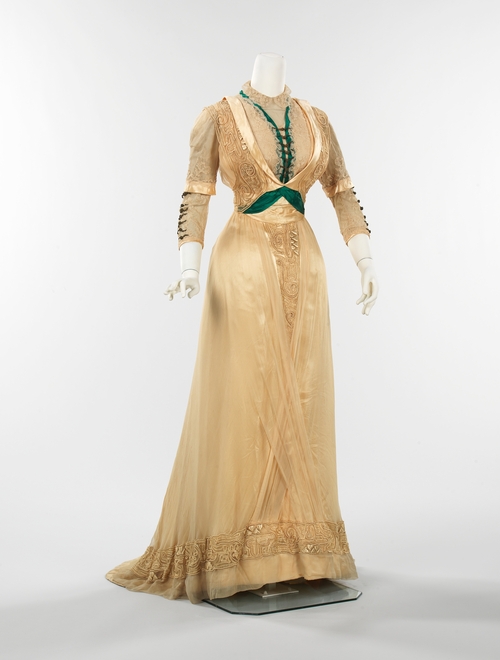
1901-1911 Dress at the Metropolitan Museum of Art
I absolutely love the subtle use of vibrant teal! It really spices up the dress. The cream satin and chiffon as well as the detailed trim are especially wonderful. The carefully arranged layers are fascinating–they keep your eye moving while managing to not distract from the fabulous fit of the whole dress.
I think this must be one of those Edwardian dresses that has a complicated closure that is hidden under crisscrossing layers. I just can’t imagine any other closure that wouldn’t detract from the beauty of the dress!
I think this is also one of the dresses that has faked layers. It seems to be an illusion that there is a blouse then a vest then a jacket. I think it is probably just one layer with trim and then the outside jacket. It’s so hard to tell from the picture! That’s the beauty of these Edwardian confections… it’s so hard to figure out how they are made and how they close without actually being able to see its inside construction!
I simply adore this dress! I just keep repeating its praise… Beautiful!
Throughout the 19th century, civilian clothing for men and women imitated all sorts of military uniforms in cuts, trim styles, and names. Let’s look at some women’s styles from the the mid-19th century inspired by military wear.
First: the Bolero style jacket
From Peterson's Magazine August 1865
Popular during the mid-19th century, the Bolero is simply a short jacket, usually worn open in front, often fastened at the neck. In the mid-19th century Bolero jackets were worn in all sorts of colors and with all sorts of trim; however, they were often seen in military uniform colors and with trimming styles reminiscent of military trimming, especially braiding.
1863 Bolero from the Metropolitan Museum of Artc. 1860 Dress with Bolero Jacket and braid trimming
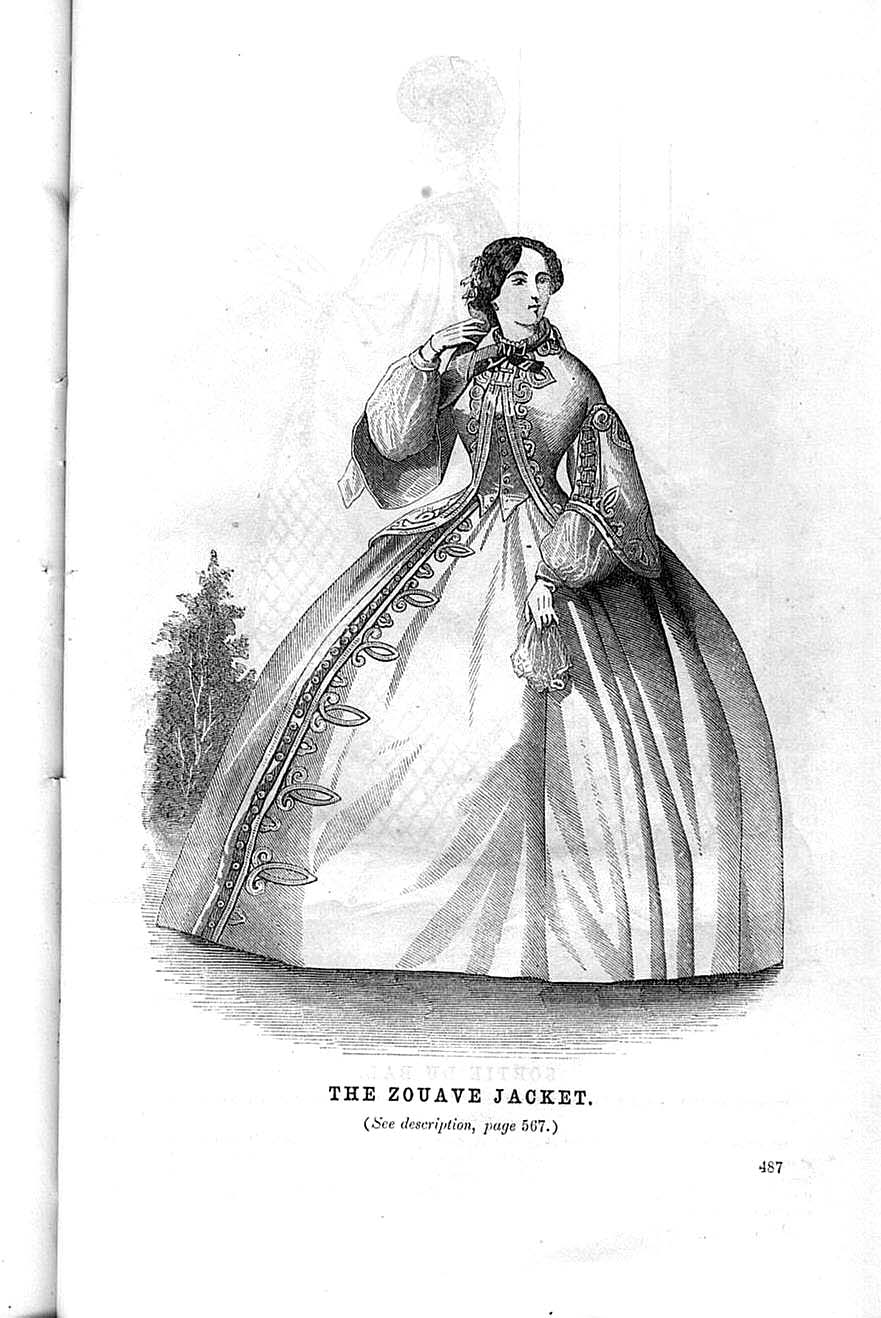
Second: the Zouave style jacket
From December 1859 Godey’s Lady’s Book
The Oxford English Dictionary defines a Zouave jacket as follows: “A woman’s short embroidered jacket or bodice, with or without sleeves, resembling the jacket of the Zouave uniform.” The following quotes are included in the OED definition:
1859 Ladies’ Treas. Sept. 285/1 One of the most decided novelties of the present season is the Zouave jacket.
1859 Ladies’ Cabinet Dec. 335/1 Nothing can be prettier for the interior than the little oriental jackets which we call to-day Zouaves.
During the 19th century, this style gained the most popularity during the 1850s, when French Zouaves were fighting in the Crimean War, and during the American Civil War in the 1860s. You can see a few images of Zouave uniforms by looking at this post from a few weeks ago.
The description of the above image from Godey’s is as follows: “Morning-dress for young ladies, of plain merino or cashmere; the skirt trimmed by an inserting of velvet, several shades darker than the dress, with a row of buttons passing through it, and bordered by a rich braid pattern, known as the Greek. The Zouave jacket, which we have before spoken of, forms the waist. It is modelled from the Greek jacket, and has a close vest, with two points; the jacket, itself, rounding over the hips, and fitting easily to the figure. A Gabrielle ruff, and neck-tie finish it.”
Further information about this style was included in the Chitchat section of the same issue of Godey’s: “The Zuoave jackets may be made in black cloth or velvet, for home wear, with skirts whose waists have “outlived their usefulness.” They are especially suitable with dark silks, and a waist of this kind with a black silk skirt will do any amount of street service. Black silks are trimmed with a combination of black and crimson, black and purple, etc. when intended for dress occasions.”
c. 1862 Dress with Bolero from the Metropolitan Museum of Art
Given the description (above) from Godey’s about the Zouave jacket fashion plate, I think this c. 1862 dress from the Metropolitan Museum of Art falls into the category of a Zouave jacket rather than a Bolero. Clearly, this yellow dress has a jacket with a double pointed vest silhouette, rather than the Bolero style of the jacket with a blouse underneath. Regardless, this dress is quite fabulous! The pattern matches the trimmings exceptionally well in terms of style, and the whole ensemble is quite wonderful (including the crisscross braiding and tassels!).
The quotes are from the digital Godey’s excerpts at the University of Vermont, which can be viewed here.
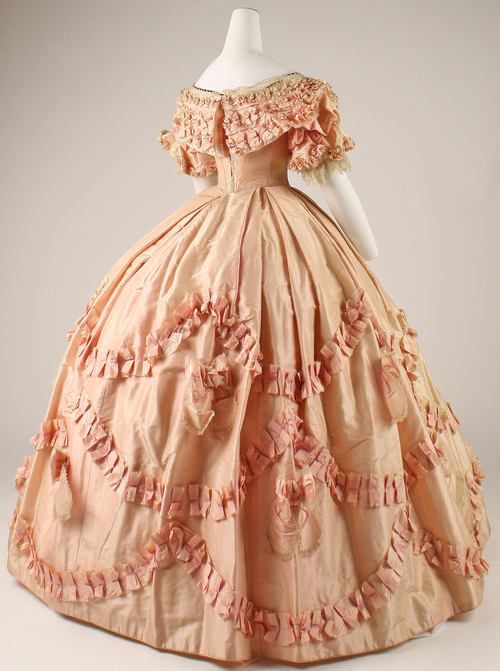
I found this dress while browsing the Costume Institute Collection Database at the Metropolitan Museum of Art website. It’s beautiful!
It’s actually one of my favorite 1860s dresses from museum collections. Why? Well, the color is particularly striking (it looks like it is constructed of peach/champagne shot silk) and the fullness of skirt makes my heart sing (it’s actually even bigger than the hoops under it, which is why it falls in pleats all the way to the hem).
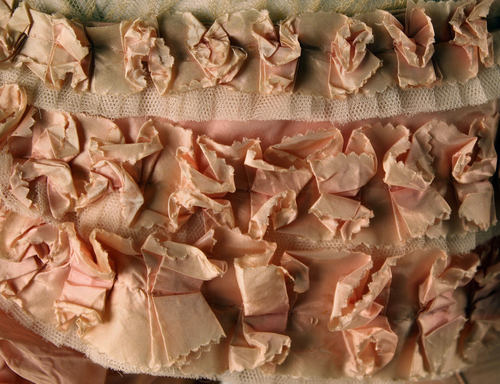
I also really love the trim! The scale of it is perfect for the 1860s, when trimmings occupied a large portion of the expansive skirts. The bertha and sleeves gracefully complement style of the dress, completing the look. The scalloped arrangement of trim on the skirt and the use of pleating to create the trim all add to my high opinion of this dress. Box pleating of this type was frequently used to adorn and trim garments in the 19th century, but this dress uses this trimming style to better effect than some. (There are close up pictures of the trim below.)
Bertha TrimmingSkirt Trimming
I plan on keeping this dress in mind for future 1860s reproduction dress ideas. I think it would be a fun and fabulous dress to wear to a ball!








 The Quintessential Clothes Pen