HSF #1: 1813 Evening Gown

IMG_4162
1813 Evening Gown

Historical Sew Fortnightly (HSF) Challenge #1 complete! It was actually completed a few days ago, which I am super pleased about. Even better is that it is for a Regency ball in February, and it is entirely complete a full month ahead of time! All the trim, all the closures, everything! All I have to do on the day of the ball is put it on. Wow! Usually when I wear a new dress to a ball I’m furiously sewing right up until the end and often all the trim doesn’t make it on (that’s what happened with my 1820s green dress back in December, remember?).

The facts:

Fabric: 4 yds red and black shot polyester

Pattern: The bodice front was draped, the back was adapted from my 1812 square neck Ikea gown, and the skirt is the same as the 1812 square neck Ikea gown, with the pattern originally from Janet Arnold’s Patterns of Fashion

Year: 1813

Notions: 3 yds metallic gold bobbin lace, hooks, and little brooch bits

How historically accurate?: The silhouette, cut, and style are accurate, as is the interior finishing (all flat felled and bound edges… it’s quite pretty!). The fabric is obviously not accurate and neither is the lace fiber content, though the style of it is. The closure is accurate. The little brooch bits are accurate in style, though not in materials.

Hours to complete: I’m so bad at estimating this. Let’s say 48 hours.

First worn: Hasn’t been worn yet! Its first wear will be in February 2013.

Total cost: Approximately $26

Now for other details!

Well, first, here’s a closeup of the bodice, so you can actually see the details and the little brooch bits. I’m super pleased with them, because I think they really finish off the bodice and add a little extra touch. I got them from New York and Company, actually. They were part of triple drop earrings, which I took apart. I kept the bottom drop and put them on clip backs (so now I have matching earrings for the dress!) which you can see in the picture below. And the best part is that one of the sections had a missing gem, so the cost of the earrings was refunded by NY&Co and so the total cost of the earrings is $0! Awesome! (It worked out perfectly, because I only used 5 sections of the triple drop earrings, so the damaged one wasn’t a problem.) Of course, the materials used in the earrings are not at all historically accurate, but I’m ok with that, for the cost (yay!) and the fact that they do have the right look.

IMG_4170
Little brooch bits!
IMG_4169
Single drop! Clips! Perfect!

And here’s the back. As you can see, it doesn’t quite fit Squishy in the back, but it shouldn’t have trouble fitting me. I love the drape of the fabric! Now that all the raw edges are enclosed and the polyester can’t fray everywhere, I am totally happy with the fabric choice (bargain!). The photos don’t really do justice to the fabulous gold lace at the hem.
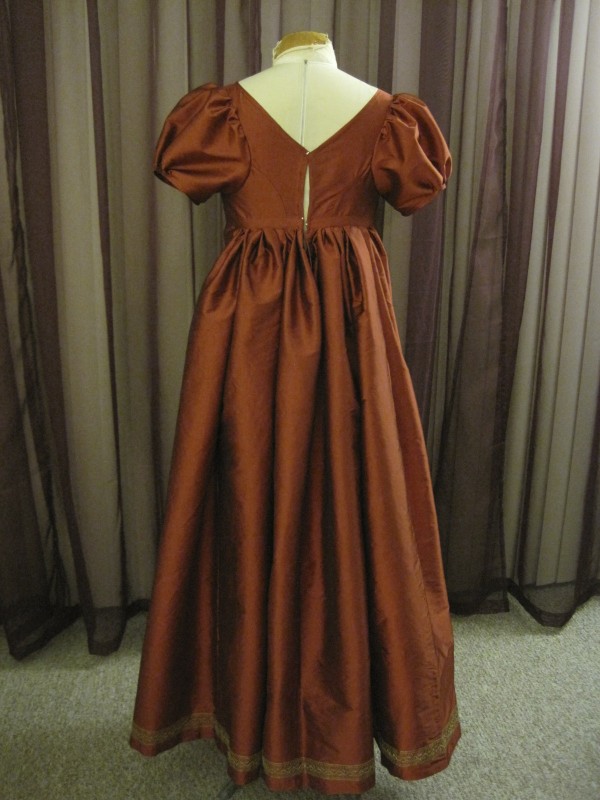
IMG_4164
Aren’t those gathers and folds lovely?!?

The dress is entirely hand finished and mostly hand sewn. Originally, I was going to make it all by machine, but then I had sewing parties and things that required hand sewing, and I just didn’t feel like lugging out the machine, so I wound up hand sewing a lot of it, which was quite satisfying. There’s one side back seam sewn my machine, I think the long skirt seams are sewn by machine (though I can’t remember, because I started this dress back in October or November), and the waistband was sewn by machine. Actually, it was so much easier to keep the width consistent using the machine than when sewing it by hand.

The only other information to share is my inspiration for the dress.

19562579602239981_TEw2UjIU_c
For her neckline and sleeves: Comtesse de Tournon by Ingres, 1812.
131378514099875826_v9iatcAj_c
Another neckline inspiration: L’Art de vivre au temps de Josephine.
1810-gold-mccord
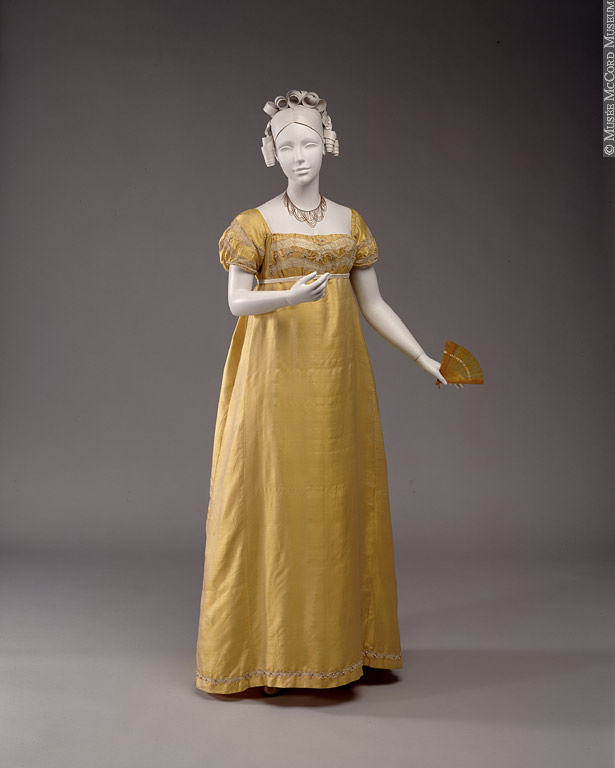
For the overall silhouette and the trim style: 1810.
12-501052
One more neckline inspiration and another similar dress built by Natalie Garbett. Here is her post about her 1812 gown with a v neck.

Clearly, I need a Kashmir shawl to complete the ensemble… I have a pashmina that sort of looks the part, so I’ll have to try that out at the ball. Stay tuned for more pictures of this dress in about a month!
Project Journal: 1822-1824 Ensemble Part VI: Muff and Tippet

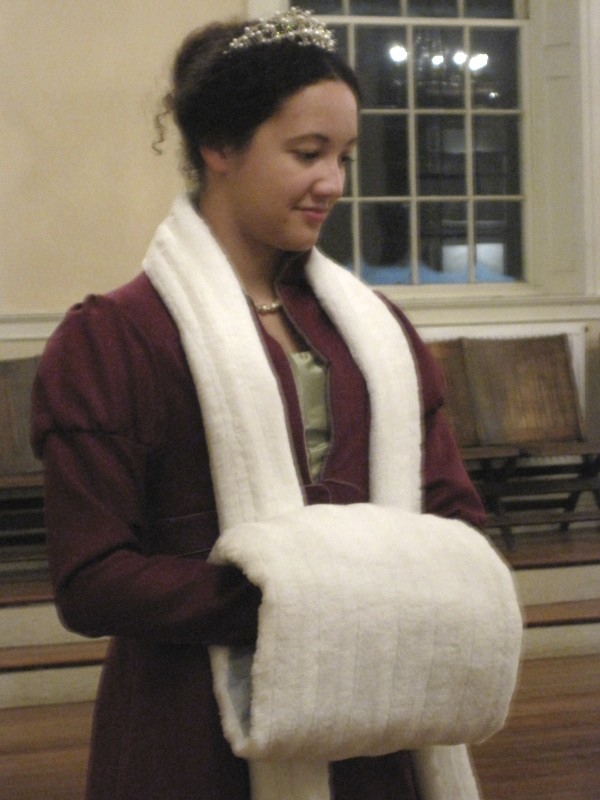
One thing I actually did finish for the recent ball was the muff and tippet. For visual reference, the picture below shows the garments I’m discussing.

IMG_4145
1822 walking dress with muff and tippet (and a bit of the 1824 ball gown peeking out).

What is tippet, exactly? Merriam-Webster defines it, thus:

1: a long hanging end of cloth attached to a sleeve, cap, or hood
2: a shoulder cape of fur or cloth often with hanging ends


So, how did I make my tippet? First, I cut a piece of high loft polyester batting the length and width that I wanted. (I know they didn’t have poly batting  in the 19th century… but it’s super warm and sometimes just worth it!) Then I cut a piece of my faux fur that was double the width of the batting plus an extra 3/4″ or so on each side as well as about 1″ longer on each end. I centered the batting on the wrong side of the fur, wrapped the fur around to the back, turned one edge under, and pinned. The ends of the fur I just turned up and under the other pinned bits. Then I whip stitched that folded edge down using pretty large stitches. The stitches disappeared in the fur… and voila, tippet! Too bad I didn’t take pictures of the construction!

The muff was slightly more tricky, not because of construction details, but because I agonized over what color lining to use! (To construct the muff, I made two tubes, one out of fur and one out of silk lining. I stitched one end of each tube to the other, turned the whole thing right sides out, inserted a tube of poly batting (warm!), pulled the lining through the middle, and pinned the open side of the fur to the silk, with the fur edge turned under. Then I simply whip stitched it like I did the tippet.

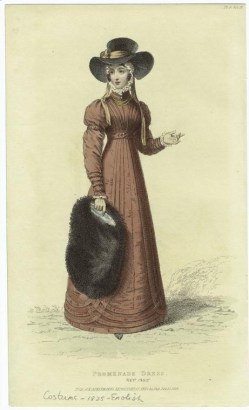
But before I could make the muff, I had to pick the lining color! Did I want it to match my walking dress trim (and be lavender?) Did I want to pick a color from a fashion plate? What colors were used in fashion plates? So many questions! I determined that of the muff linings I could see in fashion plates from that general period, there were three recurring colors: pink, blue, and white. Here’s what I came up with, image-wise:

PINK

19562579602803386_gVTjJrmC_c
January 1823 Walking Dress. La Belle Assemblee.
19562579602401776_TvaRkZoN_c
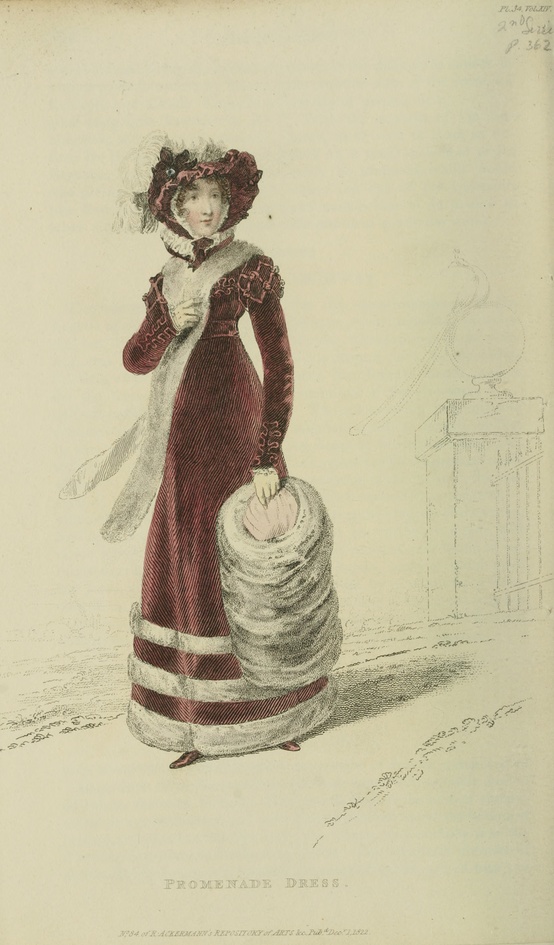
December 1822 Promenade Dress. Ackerman’s Repository.
19562579602401842_51zasE7P_c
January 1826 Promenade Dress. Ackerman’s Repository.

BLUE

19562579602401785_nUUKnK8g_c
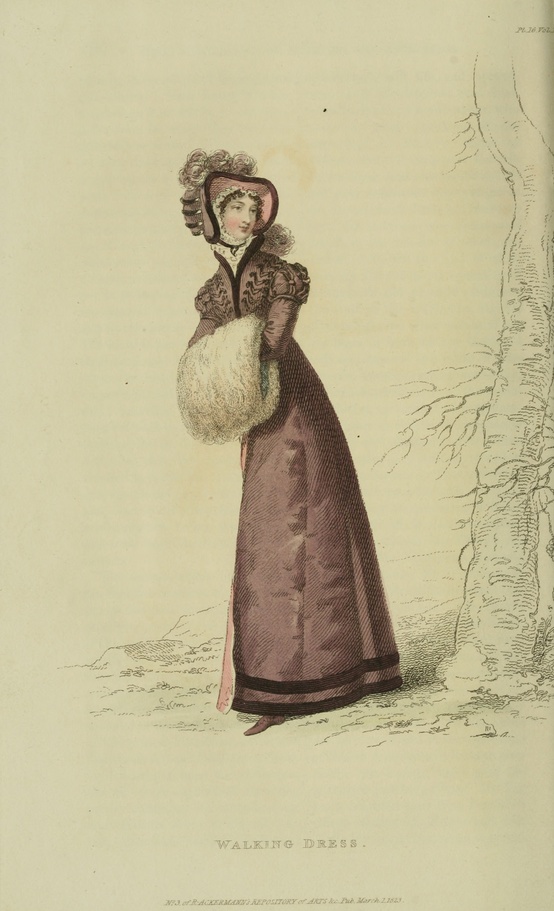
March 1823 Walking Dress. Ackerman’s Repository.
186688347022992512_HVaD6lEY_c
December 1825 Carriage Dress. Lady’s Magazine.

WHITE

186688347022992610_ERzVeK6C_c
1825 Promenade Dress.
83035186849486953_XGi68fzU_c
1829 Walking Dress. Ackerman’s Repository.

UNKNOWN/OTHER

145663369167455361_eRX7bB2f_c
c. 1810 Redingote (and muff!). KCI. (Also a tippet, though they call it a “palantine”: which M-W defines as a fur cape or stole covering the neck and shoulders.)
19562579602930398_Bi3xvCKC_c
November 1814. La Belle Assemblee.
Volare Digital Capture
November 1817 Walking Dress. Ackerman’s Repository.
186688347023026494_QoWFeN5r_c
1823 Carriage Dress

So pink came in with 3, blue and white tied with 2 each, and then there were an assortment of unknown/other. But I didn’t like the idea of pink with my dark pinkish wool (you can see what that would look like in the December 1822 fashion plate: that’s the inspiration for my walking dress), so I settled for the light blue, which I think is delicate and softly Regency. Also, I had just a small amount of that color silk, and it’s a color that doesn’t really complement my skin, so I wasn’t likely to use it for a bonnet or something similar… but with a muff most of my skin is hidden! You can see the predominance of white fur for the muffs in these fashion plates (one of the reasons I chose white fur for the muff and tippet). There are brown, too, but a lot of white! 7 out of the 11 I included are white. Well, there you go. That’s my rationale for the muff and tippet.

All of these images are on my Pinterest pages with lots of other beautiful garments. Specifically, these are on the 1810s Inspiration1820-1824 Inspiration, and 1825-1829 Inspiration pages.

Project Journal: 1822-1824 Ensemble Part II: Initial Petticoat Details

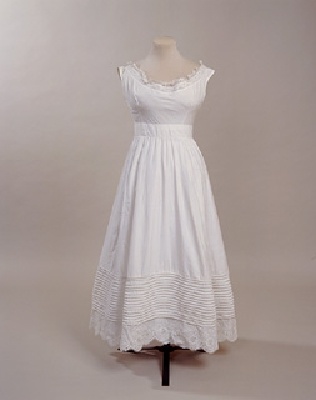
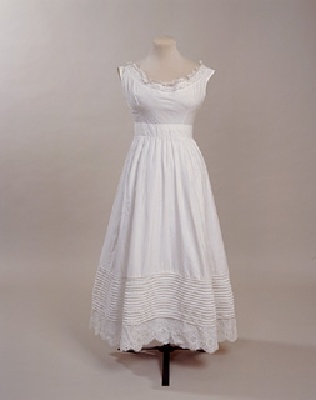
Petticoat. 1828-1835. Manchester City Galleries.

This bodiced petticoat is the inspiration for the first piece of my 1822-1824 ensemble that I need for December events. You can read more about the overview of the ensemble by viewing my last post: here. Despite the slightly later date given for this garment (later than my target of 1822-1824), the shape and construction are consistent with garments from the earlier 1820s, so I have no qualms about using this for my purposes in this case.

The description from Manchester City Galleries:

White cotton with high waist. Low, wide, round neck edged with embroidery and lace frill; piped armholes; front in one bias-cut section, back in two shaped sections, centre back fastening with drawstring at top and bottom of neck edging and at high waistband and two buttons; skirt front in one slightly flared section, two sections each side flared towards back, slit at hip in right back seam, centre back in two straight sections, closely gathered at centre waist; sixteen lines of piping at hem; edging of finer cotton scalloped and with openwork embroidery.


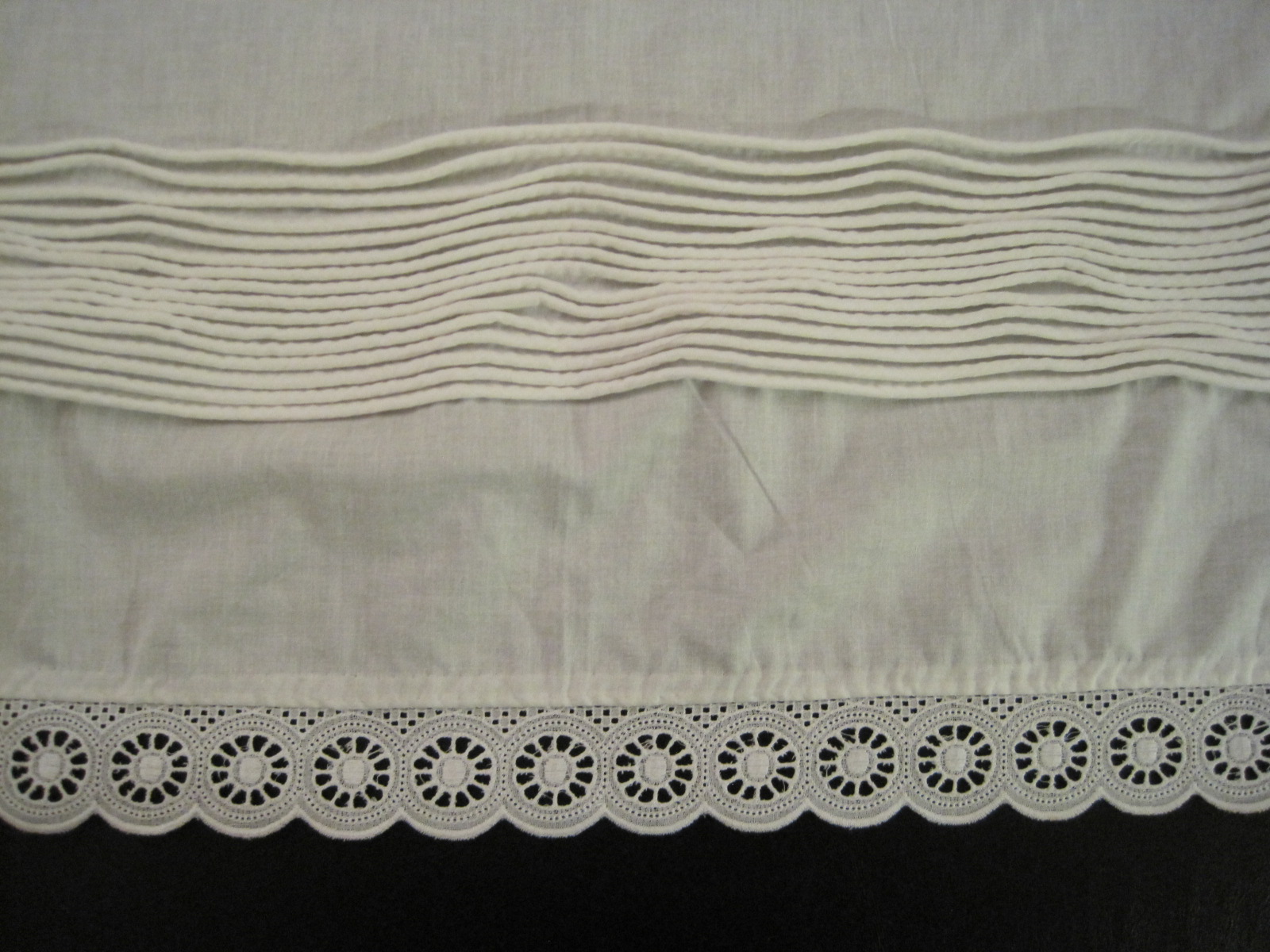
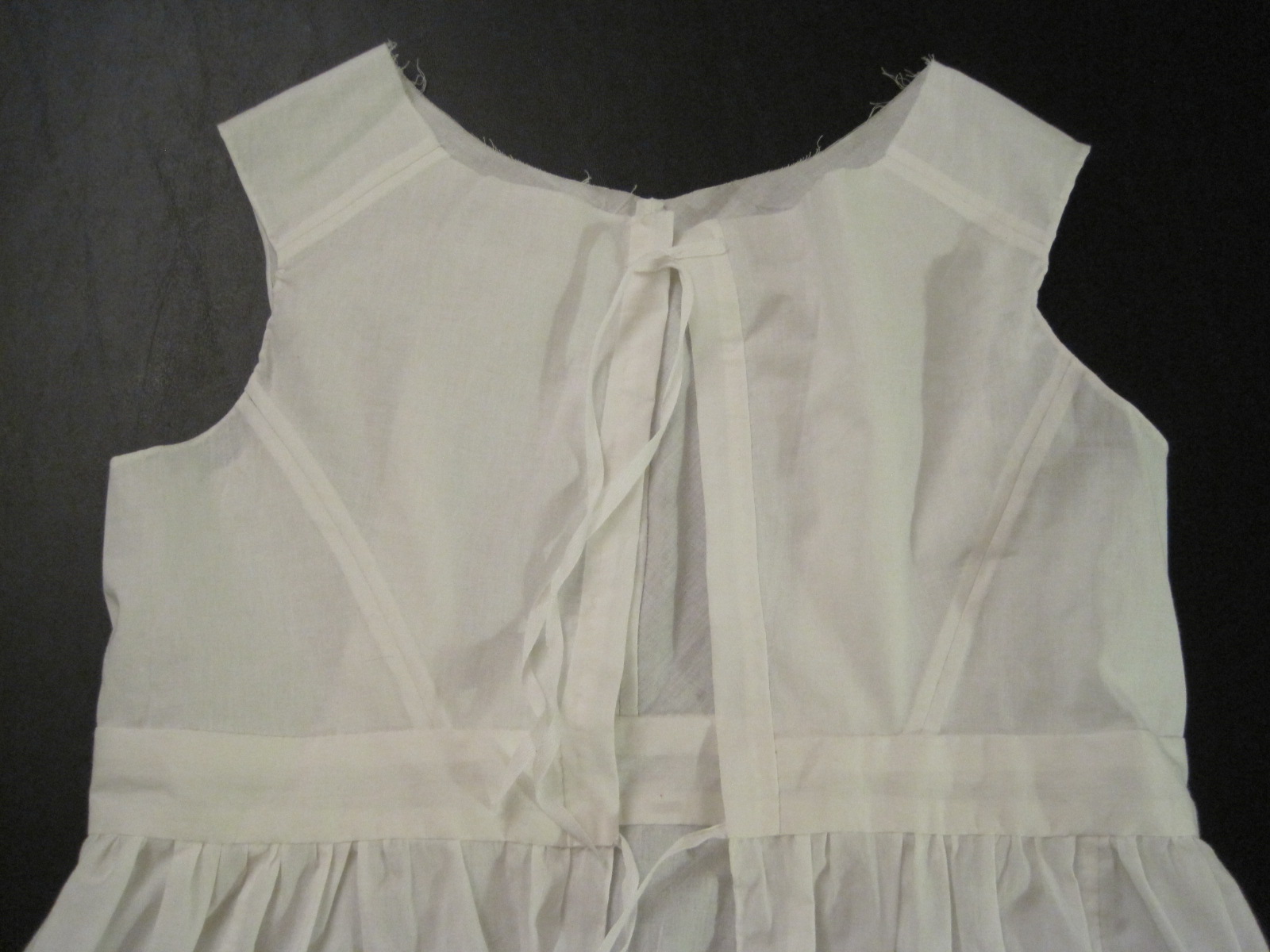
I used this description in combination with the 1820s patterns in Janet Arnold to create the bodice and skirt patterns. My petticoat is constructed out of plain white cotton. It is entirely hand sewn and has 16 rows of cording in the skirt. There is a edging of white cotton openwork embroidery at the hem. The seams are all flat felled in the skirt. The bodice seams are turned twice and stitched on each side of the seam. The petticoat closes in the back with ties.

Bodice of the petticoat with unfinished neckline.
Near the hem: 16 rows of cording and embroidery edging.
Super close up of a flat felled skirt seam, narrow hem, and whip stitches attaching the embroidery. The embroidery is whip stitched to the hem at the very bottom, and the top edge is whipped again on the inside (that’s the top horizontal row of stitches).
Back of the bodice.

The only remaining work to be done is to add another tie between the current two since the back wants to gap open just below my shoulder blades, to finish the neckline, and to adjust the gathers across the back (secret tip I’ve learned through building these garments: to get that great 1820s triangle shape, your gathers have to be super concentrated at the center back area, not spread out across the entire back, as these currently are). I plan to finish the neckline with narrow white lace, but I want to determine the neckline of my ball gown before finishing the neck of the petticoat. You understand that desire, I’m sure!

Differences from the original include: that I have a seam up center front of the bodice (no particular reason, it’s just that’s how it turned out), my cording is spaced closer together (which I’m not sure I like as much as the original, but I’m not taking it out now!), my armholes are narrow hemmed rather than piped, and my skirt closes right in the middle of the gathers rather than off center at the side back seam.

Pictures of the entire petticoat will have to wait. It looks pretty foolish on hanger, doesn’t fit a dress form (because the bust is so high), and it’s super awkward to get a full length picture of oneself… so we’ll just have to wait until I’m wearing it!

Project Journal: 1822-1824 Ensemble Part I: Overview

Well, as you recently read, I have a 9 month sewing plan to get me through May of 2013. It’s not set in stone (which means that mostly I keep adding to it, not taking things away…), but it gives me a great overview of what I need to accomplish and by what month. Deadlines really help in getting things completed!

The first major portion of the sewing plan is an ensemble of clothing from about the year 1823. I’ve been doing lots of looking at fashion plates and extant clothing from the early 1820s, in books and online. Here’s a link to my pinterest board: 1820-1824. I had so many pins in the 1820-1829 board that I had to separate the decade, so I also have a separate pin board of 1825-1829.

The 9 month plan includes the following pieces: petticoat, ball gown, walking dress, muff, bonnet, and chemisette. I’ve added one more thing since the plan was created: a tippet to match the muff! Before I explain why I want these items (ie, where I plan to wear them!), let’s look at my inspiration for the items themselves!

Petticoat. Manchester City Galleries. (I’m making a petticoat out of white cotton. It is entirely hand sewn.)
Actually a Dinner Dress (but I’ll use it as a ball gown). Ackerman’s Repository. May 1824. (I guess I lied about the year… I’ve been looking at the images so much I haven’t even glanced at the date in ages! Anyway… I’m making this in apple green silk with hand sewn silk organza appliqués.)
Promenade Dress. Ackerman’s Repository. December 1822. (I am making this out of deep, rich pinkish burgundy wool with hand sewn lavender silk trim.) This is also my inspiration for the tippet. (I’m making the tippet out of white faux fur.)
Walking Dress. Ackerman’s Repository. March 1823. (I think this is where I got the year 1823 from… This is another influence on my walking dress design, especially at the collar.) This is also my inspiration for my muff. (The muff will be the same fur as the tippet, lined with pale blue silk shantung.)
Bonnet. C. 1820. The Met. (I plan to make this in lavender to match the walking dress.)
Chemisette. c. 1810-1825. Snowshill Collection. (Yes, this is one of the ones in Janet Arnold. I plan to make this out of lightweight cotton and use my fluting iron! However, I have to say that if one thing in my December-to-do doesn’t make the cut, this would be it. I really want to take my time on this and play with my fluting iron, and I’m not sure I’ll have the time on this one…)

What is all of this for, you ask? I plan to wear the whole ensemble in December when I attend Fezziwig’s Ball, a 19th century ball hosted by the Commonwealth Vintage Dancers in Salem, MA. Since it’s a ball, I’m sure you understand why the petticoat and ball gown are required! But why the outerwear? Before the ball begins, ball-goers have the opportunity to go caroling around the streets! It’s really fun, and usually pretty cold. I need to stay warm, hence the wool walking dress, tippet, and muff. The chemisette is to fill in the collar of the walking dress, and the bonnet is really icing on the cake to help pull the whole ensemble together! As an added bonus, later this winter my friends and I hope to go ice skating in 19th century dress, so this will also be my ice skating outfit!

Sort-Of-New 1895 Blouse: At A Picnic With Teddy And Me

This is another case of the delays… The Commonwealth Vintage Dancers performed at an event in June (cough, cough… I am so slow!) that was called something like A Picnic for Teddy, Mommy, and Me. It was at the Salem Athenaeum, a private library, and was targeted toward young girls, their mothers, and their teddy bears! Cute!

We performed in 1890s whites. I had been dragging my feet about constructing my own whites, so I took this opportunity to go for it.

Dancing “Teddy Bear’s Picnic.” It’s really a ridiculous dance, but it fit the theme of the event perfectly!
It was super hot that day! Sitting, in the shade, was wonderful. As was my fan…
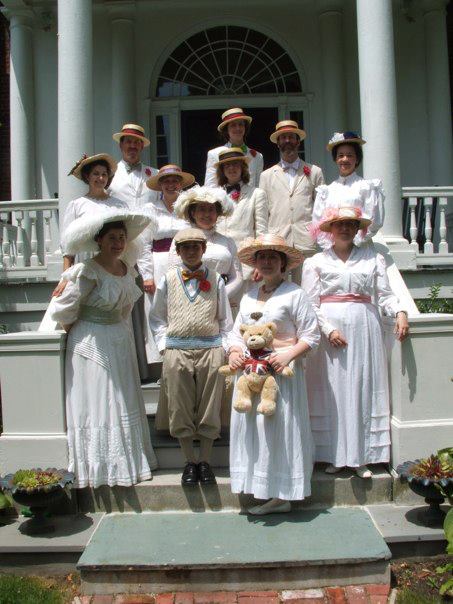
CVD on the steps of the Athanaeum.
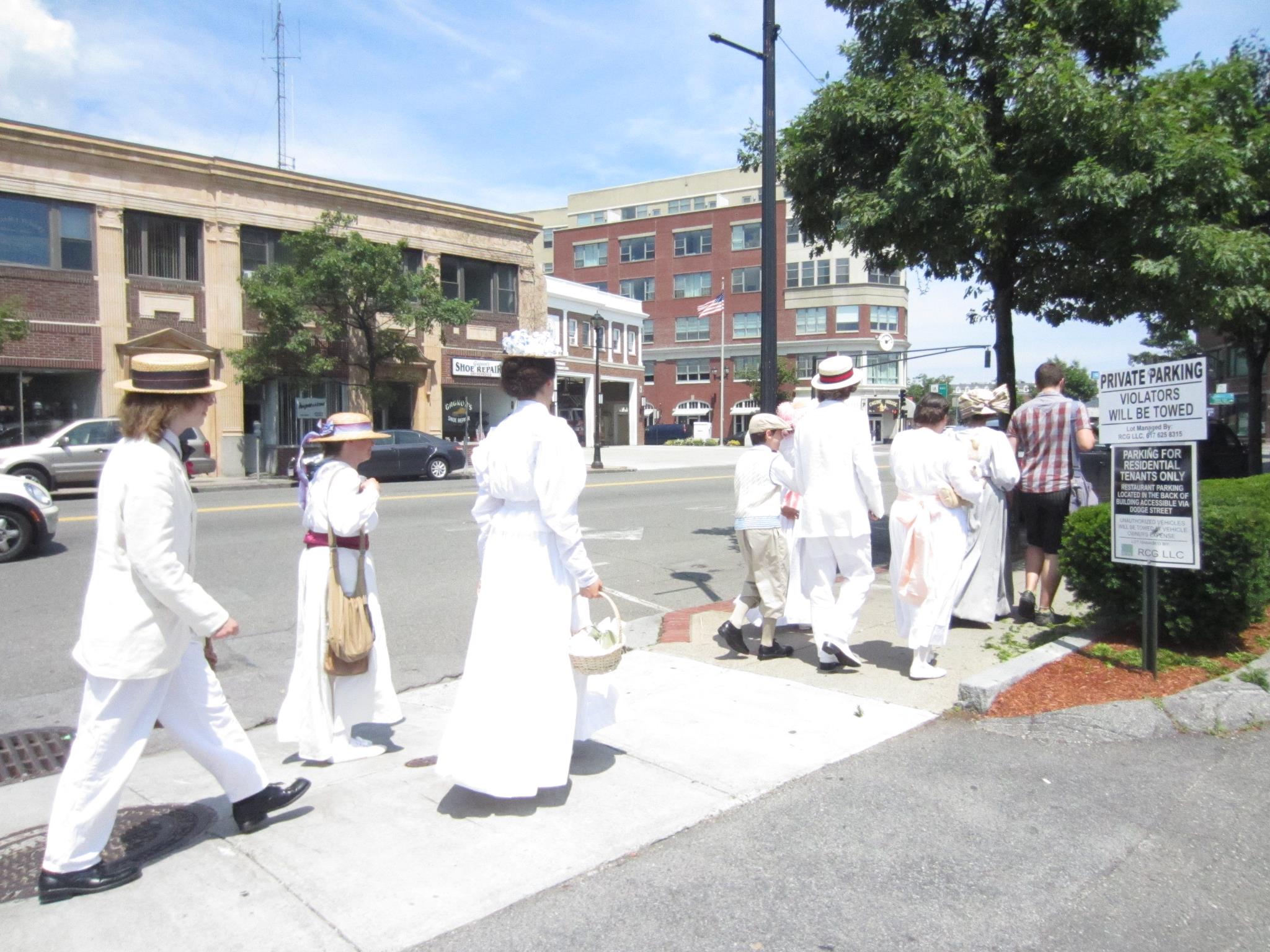
After the event we walked across Salem to get some lunch. Of course, Salem often sees people dressed in odd clothes, so we didn’t surprise people, but they were curious about what event we were going to.

I’m not totally sold on the white skirt I made. It’s a gored skirt and it works fine, it’s just not super eye catching (aka, it’s great for performances, but won’t get worn for other things… maybe it will be a petticoat if needed?). Oh, and I also threw the hat together, thinking that the white and blue would be nautical and good for Newport. But then I totally re-trimmed the hat at Newport because it didn’t have quite enough oomph with the white and blue. But the blouse… I love the blouse! It’s super comfy and lightweight, it closes in front (yay!), is washable,  and I like the fabric. Win!

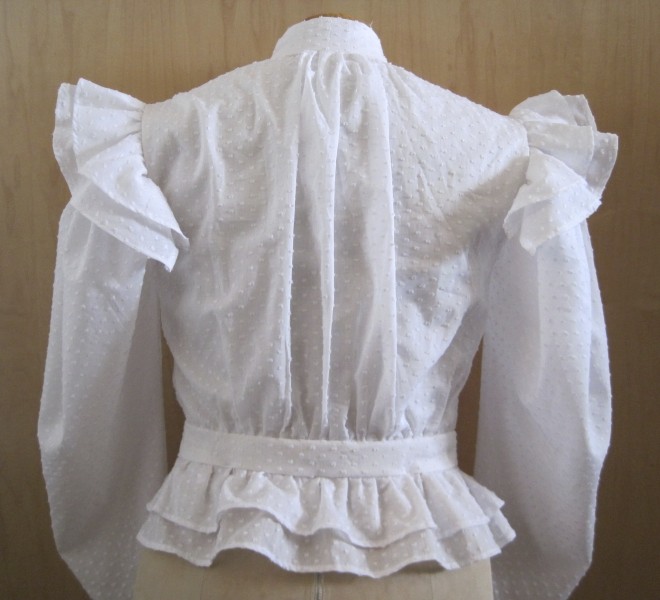
It is based off of a fashion plate in one of my many books. I draped a basic blouse pattern and adapted the pattern as needed to add the gathers in the front and back. The exterior is mounted on a lining made from the basic blouse pattern so that they gathers will stay where they are supposed to be. It is constructed of cotton with swiss dots for the exterior and a lightweight woven stripe cotton for the base (which I bought for $1 a yard a while ago! Love that price!). It closes up the front with concealed hooks and thread bars. The sleeves are quite large gigot sleeves, but because they are not lined they sort of just droop. Here are some pictures! I think I got pretty close to that inspiration image, don’t you? I love the feeling of success that comes with really nailing the look in reproducing a garment! Don’t we all?

The inspiration image.
Front of the blouse, on Squishy, the mannequin.
Back of the blouse on Squishy.
In the garden.

Edwardian Gown Eye Candy

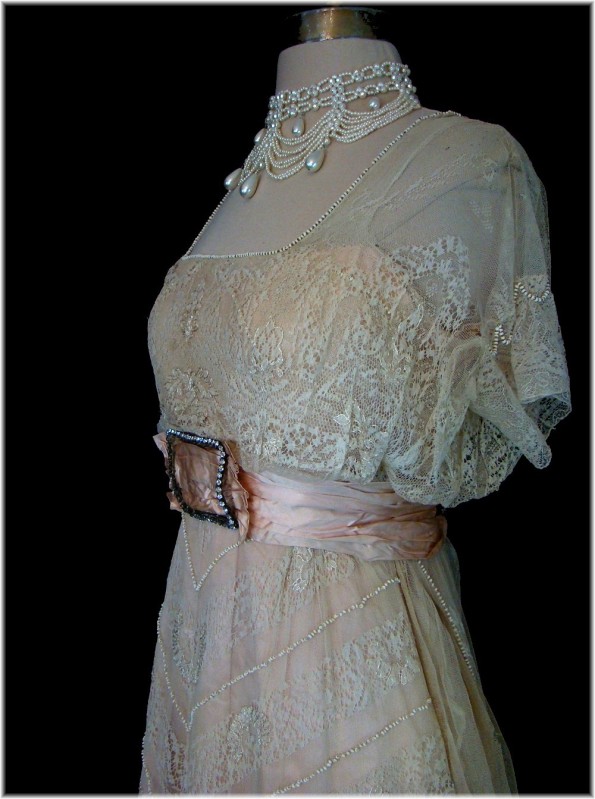
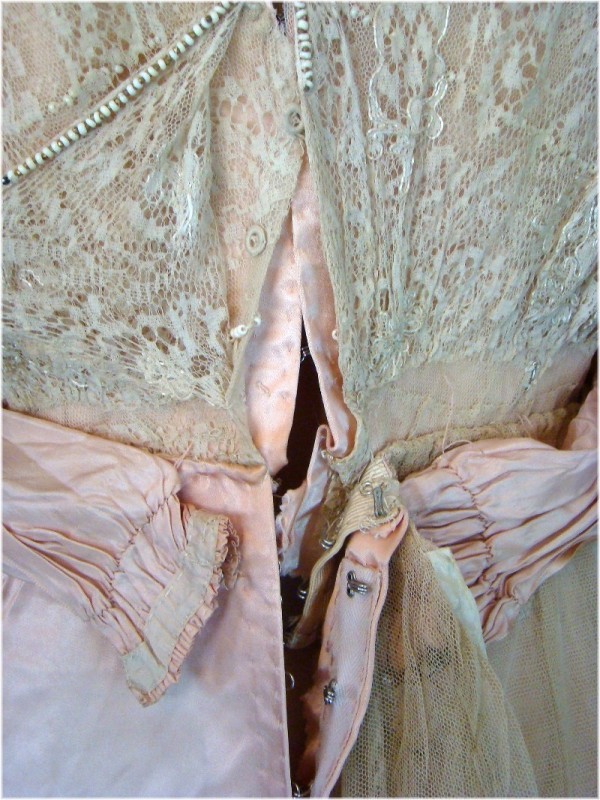
This fabulous vintage Edwardian dress was recently brought to my attention by one of you fabulous readers. It is for sale on eBay for $2,250! I certainly won’t be purchasing this original, but I absolutely think it is something to add to my body of inspirational images of clothing for future projects… The seller has included many pictures of the dress as well as background information on the dressmaker and a detailed description of the garment. I have included some of that information in addition to pictures for you to view here in this post.

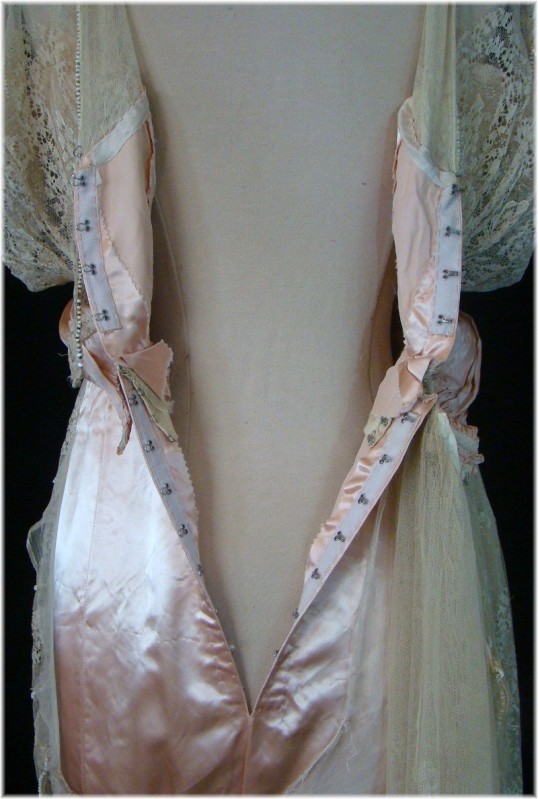
The lace is exquisite! The rhinestones add even more sparkle! I love that there are pictures which show the closures and construction details. I classify this gown as “drool-worthy.” What do you think? Do you like it? Or not? Why?

Some of the information from the eBay seller, labellevintage_inc:

“This was created by Mrs. Catherine Donovan who was originally from Ireland (b.1826) and studied fashion in Paris. She owned the couture shop “MRS. C. DONOVAN & CO” which was located at 29 East 55th St.in New York. Her dresses in 1910 were billed at $100 and up which was extravagant as a gown from her would cost over $4,000 today!

Many of her garments are found in Museums throughout the world. There are 4 dresses at the Metropolitan Museum of Art alone. But the detailing and workmanship of these garments are worth every penny in my opinion.

FABRIC:
This is made of peach satin (formerly peach silk) and covered in exquisite ivory lace with re-embroidered patterns done with silk thread. The lace gives hints of Orientalism (which was made popular by Paul Poiret ) with its Royal Pavillion shapes on the back panels. The rosette and belt details are done in peach silk.

This enchanting garment features a fitted satin strapless bodice covered with a blouson bodice of lace. The bodice features a low square neckline and the dolman sleeves are short. Both the neckline and arms are decorated with cream glass and gold painted cut steel beads. There is an inner netted bodice which helps with the weight of the dress.

The empire waist is decorated with a ruched sash which is adorned with rhinestones, each individually sewn on a gold lame’ backing in the shape of a buckle.

The straight satin skirt is covered in two tiers of lace at the front. Each tier is decorated with cream glass beads and gold steel cut beads in a chevron shape. The tier is separated with a silk band featuring a large silk rosette. The top tier is adorned with crystal cut glass beads around the hemline.

The back has a surplice detail on the bodice with the silk band closing at the back decorated with more rhinestones.

The lace skirt is made of 3 tiers with one extra panel which attaches to the finger as a drape or can be left hanging as a short train. The top tier and second tier are both decorated with crystal cut glass beads.

This closes with several snaps, hook & eyes and tiny crochet buttons at the back.”

Thank you, Kimberly, for bringing this dress to my attention!

A Series Of Striped Shoes

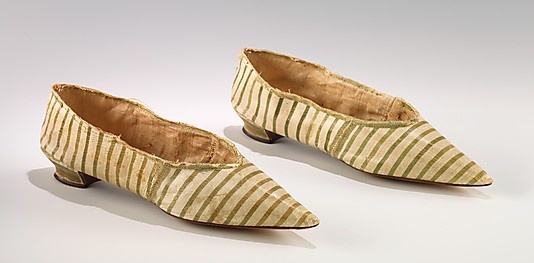
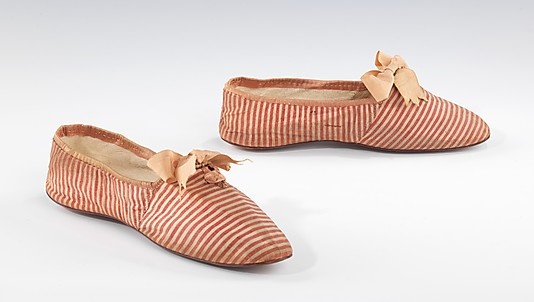
Since I seem to be on a shoe spree, I thought it would be a fitting time to share with you a series of striped shoes from the 19th and early 20th century. The continuity of the adornment over the changing shoe styles on these first three pairs is so interesting.

Striped evening slippers. 1840-1849. The Met.
Striped evening slippers. 1860-1870. The Met.
Striped evening pumps. 1920. The Met.

Do you have a favorite amongst these? Personally, I like the pair from 1860-1870 best (maybe it’s the rosette that appeals to me in addition to the stripes!). You can also pick from these next few pairs, which I’ve included just for fun.

Striped slippers. 1795-1810. The Met.
Striped shoes. 1845-1865. The Met. (These kind of look like Toms?!?)
Striped evening shoes. Late 1920s. The Met.

Titanic Weekend Part I: All About The New 1912 Evening Gown

I recently returned from a successful Titanic-themed weekend of events, including multiple vintage dance opportunities. I’ve been working on some new clothing for these events since January, which you can read more about in my past posts relating to the 100th Anniversary of the Titanic. I’ve been rather remiss in posting updates about the progress of the new dresses I constructed for these events… So my first task is to share pictures of my attire and explain the inspiration and construction of the garments.

I created two new 1912 ensembles: an evening gown and a day gown with accompanying hat. Let’s start with the evening gown!

My camera had a challenging time capturing the colors and shimmering sequins on this gown, but this is a good representation of the colors. Look! I wore my ballroom dance shoes, which worked well, and my white kid opera gloves and pearl drop earrings... fabulous!
Fabulous painted backdrop! Perfect for taking photos, although my camera didn't quite catch the colors so well in this photo. I think this gown is so much more fabulous in person! I was told that the sequins just shimmer in subdued mood lighting.

This gown is burgundy silk charmeuse with a gold silk charmeuse underskirt. The bodice is gold silk layered under gold sequined net. The sleeves are the same gold sequined net flat lined with nude colored tulle: the tulle provides unnoticeable stability for the net layer. The burgundy layers are pleated up and held in place in two places by gold silk and sequined net covered buttons. The bodice and skirt are lined with brown cotton and the entire dress is mounted on a foundation of some extra white cotton which I have an excess of in my fabric stash. The foundation layer is essential to the drape of the dress, because it provides stability as well as a layer to attach all of the pleats and drapery points to. The foundation allows the burgundy silk to effortlessly hang and artfully fold without looking heavy or as though it serves to hold an weight. The foundation layer also supports the underskirt which is attached at about knee height (thus not extending all the way up to the waist and saving fabric). If you plan to create a draped Edwardian gown I strongly suggest that you include a foundation layer: the practice is historically accurate and will help your dress look effortless rather than heavy. This gown closes center back with hooks and eyes along the gold sequin area and a complicated series of further hooks and eyes at the top of the burgundy back drape. The hooks and eyes help create the tension that is required to keep the waist carefully draped in elegant folds across the waist.

There is not a hat associated with this gown because hats were not worn for formal evening events. I did create a wonderful Edwardian coiffure with loops and puffs of hair on the crown of my head surmounting the two front sweeps from the front as they swooped around the base of the back of my head. Unfortunately, I didn’t get any closeups of the style. I feel it is necessary to encourage you by saying that the more often I practice my Edwardian hair styling the faster I am and the better the styles look. You, too, can have fabulous Edwardian hair! Practice! Practice! Practice!

I draped the pattern for the foundation, bodice, and sleeves. The underskirt is a mix of information from the usual pattern book culprits (Janet Arnold and Norah Waugh) that I took in and then kept in mind while flat patterning a knee high underskirt pattern. The outer draped layer is just that: draped. It was a good challenge–I would have a hard time creating a flat pattern of that layer. All I can say is that it is just one rectangular piece of fabric that was sometimes frustrating and draped with many references to my inspirational images.

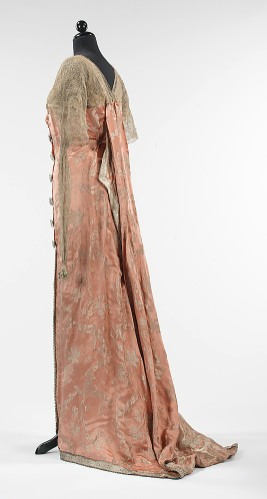
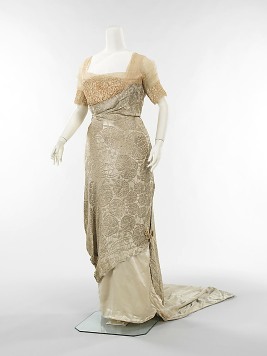
It turns out that the evening gown is a mash-up of two gowns (pictured below) at the Metropolitan Museum of Art. I think I started by aiming for the pink dress but wound up moseying my way along to the pale blue dress. Do you see the influence of both the pink and pale blue dresses? I do…

1914 Callot Soeurs evening dress
Side/Back of the same.
1911-1914 Callot Souers evening dress.
Side/Back of the same.

1912 Ivory “Mushroom” Hat: Part I

Possible millinery materials...

The plan: to create an ivory and black hat to accompany my (almost) completed Titantic-era tea gown. I started with some ideas in mind, but was also open to inspiration from challenges of construction or materials. I raided my millinery trim stash for ivory and black millinery flowers and leaves, black and white ostrich feathers, pleated and plain ivory ribbons and trims, and other practical necessities like millinery wire, buckram, and organza…

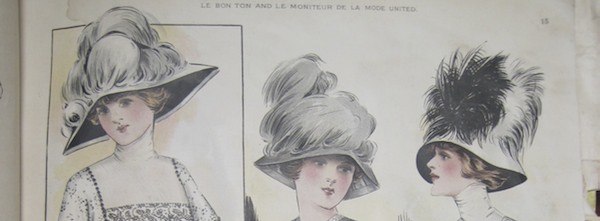
I’m calling this hat a “mushroom” hat because it is my goal to make the crown roomy about the head  and puffy in the crown, like a mushroom top! You can see this mushroom-y detail in the images below: look at how the head size opening is often bigger than the head! Given that the head size opening needs to be big, one challenge I will face is figuring out how to make the thing stay up on my head and not fall down over my face. I’m not sure big hair will be enough… That’s something I’ll have to determine once the hat is complete. I might have to use some sort of bandeau inside of the hat to support it. Bandeaus are often used to perch hats on the head, especially in periods like the 1870s and last quarter of the 18th century, but it seems like a practical solution to this 1912 hat perching problem, also! I’ll have to let you know how the bandeau situation turns out.

A selection of inspirational and awesome hats from a 1910 issue of the magazine Bon Ton. I particularly like the be-feathered hat on the far right...
From the 1910 issue of Bon Ton. Look at how huge that head size opening is! And the feathers are just giant! I don't plan to attempt to create this, but I do think it fabulous!
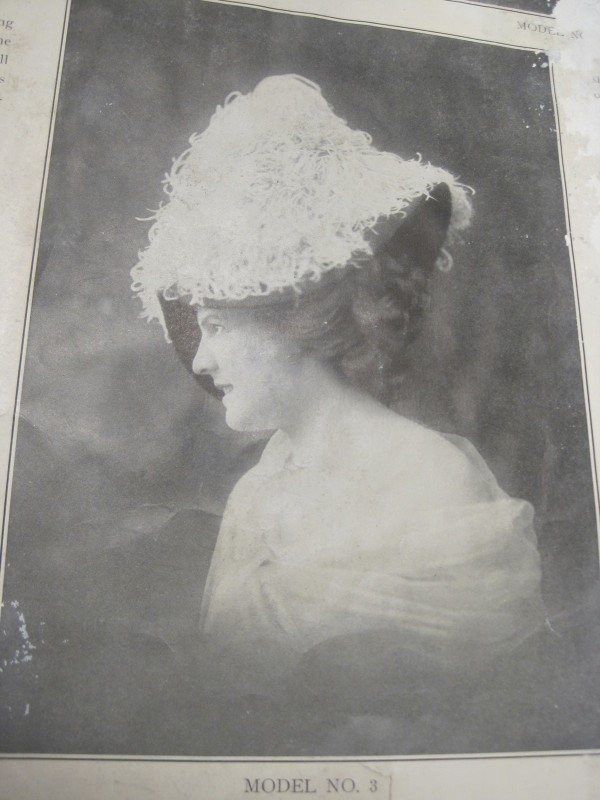
Another fabulously feathered hat from Bon Ton, 1910. Also included simply because it is wonderful, not because I intend to build it...

These last two images show the direction this hat is going. I love the mushroom-y shapes (which also resemble mob-caps), large scale trim, and head size openings.

Another hat from the 1910 issue of Bon Ton. This hat is one of my top inspirational images for my hat creation. It has that mushroom-y shape.
The hat on the right from The Metropolitan Museum of Art via American Duchess. Love the mob-cap-like/mushroom-y shape... and that buckle! Wow!

I wonder where my creativity will take me…

Resource: The Bartos Collection

Oh my goodness! This is such a cool and huge collection of photographs and fashion plates! Lauren over at American Duchess has been referencing images from the Bartos Collection for awhile now, but I didn’t get a chance to check it out for myself until just recently. It is WONDERFUL!

The collection focuses on the mid-19th century through the early 20th century. There are fashion plates and mounds of period photographs and pictures of extant clothing… If you love historic clothes and hats and hair you MUST VISIT! Here’s the link, again, because you must go visit and drop your jaw with me!