Is there enough alphabet soup for you in the title of this post? In case you’re not familiar with those acronyms, it means that this is a post about the Historical Sew Fortnightly Challenge #2: Un-Finished Object. In this case, the UFO is my 1820s petticoat from the very end of 2012.
You’ll remember that I wore it to Fezziwig’s Ball in December, but that I hadn’t finished the neckline? I’m pleased to say that it is now entirely complete!
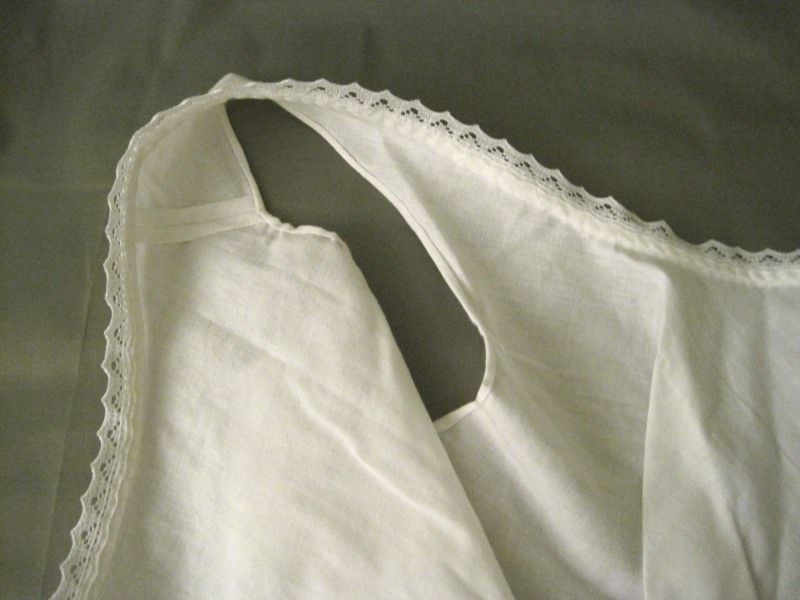
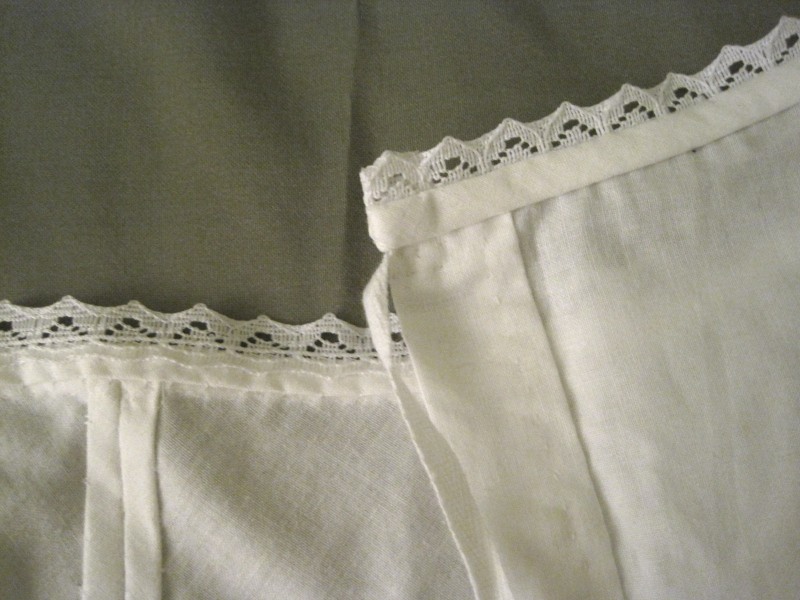
Inside view. This petticoat has three ties at center back to keep it closed.You know I like my insides to be pretty. This is a closeup of the arm hole and the neckline, which is bound with bias before having the lace sewn on.The double hem on the left is center front. Diagonally across the photo is the right side of the back.This cording was done last month, so it’s not really part of the UFO-ness, but it is still an accomplishment. 16 rows of hand sewn cording all around the hem.A close-up of the lace at the hem and my tiny stitches.
Pattern: Adapted from my 1822 green ball gown pattern. It’s pretty much exactly the same except that it doesn’t have sleeves. The ball gown pattern is based off of a pattern in Janet Arnold and styled as in the fashion plate you can see in this previous post.
Year: 1820s. The inspiration image is dated 1828-1835. You can see the inspiration image and my reasoning for it being more 1820s than 1830s here, in this past post.
Notions: About 1 1/2 yds of broderie anglaise trim, cut in half the long way to create double length; about 1 yd of white edging lace; and about 1 yd of 1/4″ cotton twill tape.
How historically accurate?: Very, having used modern materials. The pattern is from Janet Arnold, so you know it is good on accuracy. The entire petticoat is hand sewn and made of accurate fabric. The lace is machine made and the content is almost certainly not entirely accurate, but it is in the style of the early 19th century and the lace in the inspiration image. I’m not 100% sure that all of my seam finishes are perfectly accurate for this garment, but they are accurate for the period as a whole.
Hours to complete: I’m always bad at estimating this. Let’s say 120 hours.
Historical Sew Fortnightly (HSF) Challenge #1 complete! It was actually completed a few days ago, which I am super pleased about. Even better is that it is for a Regency ball in February, and it is entirely complete a full month ahead of time! All the trim, all the closures, everything! All I have to do on the day of the ball is put it on. Wow! Usually when I wear a new dress to a ball I’m furiously sewing right up until the end and often all the trim doesn’t make it on (that’s what happened with my 1820s green dress back in December, remember?).
The facts:
Fabric: 4 yds red and black shot polyester
Pattern: The bodice front was draped, the back was adapted from my 1812 square neck Ikea gown, and the skirt is the same as the 1812 square neck Ikea gown, with the pattern originally from Janet Arnold’s Patterns of Fashion
Year: 1813
Notions: 3 yds metallic gold bobbin lace, hooks, and little brooch bits
How historically accurate?: The silhouette, cut, and style are accurate, as is the interior finishing (all flat felled and bound edges… it’s quite pretty!). The fabric is obviously not accurate and neither is the lace fiber content, though the style of it is. The closure is accurate. The little brooch bits are accurate in style, though not in materials.
Hours to complete: I’m so bad at estimating this. Let’s say 48 hours.
First worn: Hasn’t been worn yet! Its first wear will be in February 2013.
Total cost: Approximately $26
Now for other details!
Well, first, here’s a closeup of the bodice, so you can actually see the details and the little brooch bits. I’m super pleased with them, because I think they really finish off the bodice and add a little extra touch. I got them from New York and Company, actually. They were part of triple drop earrings, which I took apart. I kept the bottom drop and put them on clip backs (so now I have matching earrings for the dress!) which you can see in the picture below. And the best part is that one of the sections had a missing gem, so the cost of the earrings was refunded by NY&Co and so the total cost of the earrings is $0! Awesome! (It worked out perfectly, because I only used 5 sections of the triple drop earrings, so the damaged one wasn’t a problem.) Of course, the materials used in the earrings are not at all historically accurate, but I’m ok with that, for the cost (yay!) and the fact that they do have the right look.
Little brooch bits!Single drop! Clips! Perfect!
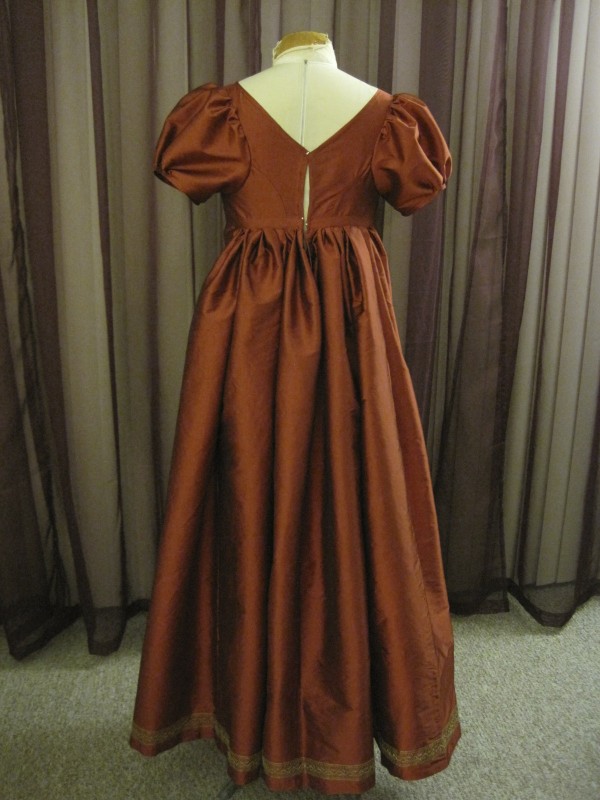
And here’s the back. As you can see, it doesn’t quite fit Squishy in the back, but it shouldn’t have trouble fitting me. I love the drape of the fabric! Now that all the raw edges are enclosed and the polyester can’t fray everywhere, I am totally happy with the fabric choice (bargain!). The photos don’t really do justice to the fabulous gold lace at the hem.
Aren’t those gathers and folds lovely?!?
The dress is entirely hand finished and mostly hand sewn. Originally, I was going to make it all by machine, but then I had sewing parties and things that required hand sewing, and I just didn’t feel like lugging out the machine, so I wound up hand sewing a lot of it, which was quite satisfying. There’s one side back seam sewn my machine, I think the long skirt seams are sewn by machine (though I can’t remember, because I started this dress back in October or November), and the waistband was sewn by machine. Actually, it was so much easier to keep the width consistent using the machine than when sewing it by hand.
The only other information to share is my inspiration for the dress.
For her neckline and sleeves: Comtesse de Tournon by Ingres, 1812.Another neckline inspiration: L’Art de vivre au temps de Josephine.For the overall silhouette and the trim style: 1810.One more neckline inspiration and another similar dress built by Natalie Garbett. Here is her post about her 1812 gown with a v neck.
Clearly, I need a Kashmir shawl to complete the ensemble… I have a pashmina that sort of looks the part, so I’ll have to try that out at the ball. Stay tuned for more pictures of this dress in about a month!
Maybe you haven’t heard yet, but Leimomi, of The Dreamstress, is hosting the Historical Sew Fortnightly in 2013. It’s a historic clothing themed sew along, and you should join! “One year, a challenge every fortnight, and at the end of it, 26 fabulous historical garments.”
You don’t have to commit to participating in every challenge, only those that you have the time and interest for. You can interpret each challenge in your own way and at your own level, as long as it is historic. For the purposes of the Historic Sew Fortnightly (HSF), Leimomi is defining “historic” as anything pre-1938.
I’m going to selectively participate in the challenges I’m able to. It will be a fun way to connect to other historic costumers from around the world (literally!), gain inspiration and knowledge, and see pretty things! (And we all like pretty things!) You can read detailed information about how it works and how to participate here.
The first challenge: #0 (the bonus challenge): Starting Simple – due 31 December. Finish a project, make a very simple garment, or something you have made before. (I’m on a no-sew vacation until the New Year, so I won’t be joining in this one. I needed a break after my furious costuming in 2012!) But there’s still time for you to join in the bonus challenge (barely!). Come, join us!








 The Quintessential Clothes Pen