Throughout the 19th century, civilian clothing for men and women imitated all sorts of military uniforms in cuts, trim styles, and names. Let’s look at some women’s styles from the the mid-19th century inspired by military wear.
First: the Bolero style jacket
From Peterson's Magazine August 1865
Popular during the mid-19th century, the Bolero is simply a short jacket, usually worn open in front, often fastened at the neck. In the mid-19th century Bolero jackets were worn in all sorts of colors and with all sorts of trim; however, they were often seen in military uniform colors and with trimming styles reminiscent of military trimming, especially braiding.
1863 Bolero from the Metropolitan Museum of Artc. 1860 Dress with Bolero Jacket and braid trimming
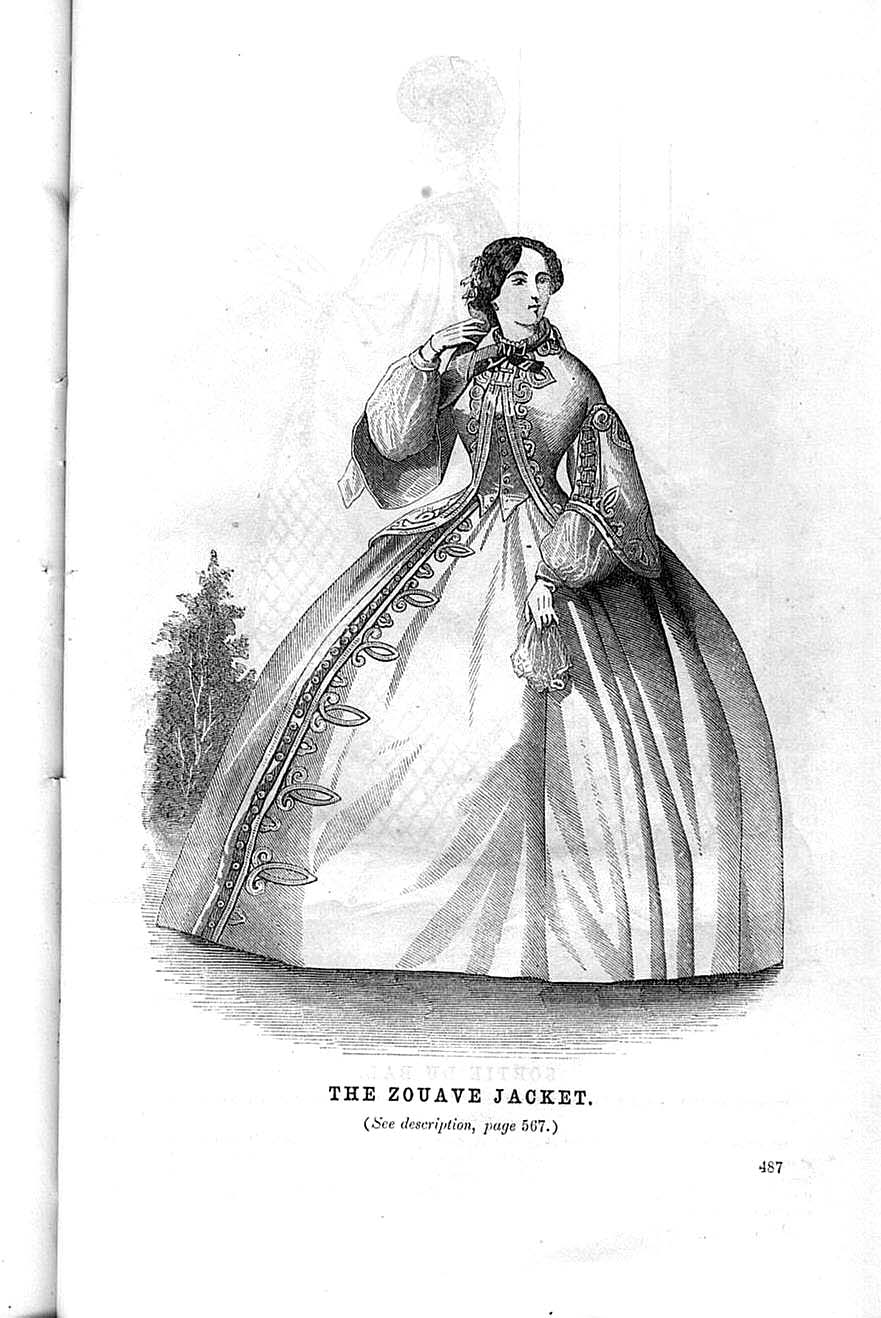
Second: the Zouave style jacket
From December 1859 Godey’s Lady’s Book
The Oxford English Dictionary defines a Zouave jacket as follows: “A woman’s short embroidered jacket or bodice, with or without sleeves, resembling the jacket of the Zouave uniform.” The following quotes are included in the OED definition:
1859 Ladies’ Treas. Sept. 285/1 One of the most decided novelties of the present season is the Zouave jacket.
1859 Ladies’ Cabinet Dec. 335/1 Nothing can be prettier for the interior than the little oriental jackets which we call to-day Zouaves.
During the 19th century, this style gained the most popularity during the 1850s, when French Zouaves were fighting in the Crimean War, and during the American Civil War in the 1860s. You can see a few images of Zouave uniforms by looking at this post from a few weeks ago.
The description of the above image from Godey’s is as follows: “Morning-dress for young ladies, of plain merino or cashmere; the skirt trimmed by an inserting of velvet, several shades darker than the dress, with a row of buttons passing through it, and bordered by a rich braid pattern, known as the Greek. The Zouave jacket, which we have before spoken of, forms the waist. It is modelled from the Greek jacket, and has a close vest, with two points; the jacket, itself, rounding over the hips, and fitting easily to the figure. A Gabrielle ruff, and neck-tie finish it.”
Further information about this style was included in the Chitchat section of the same issue of Godey’s: “The Zuoave jackets may be made in black cloth or velvet, for home wear, with skirts whose waists have “outlived their usefulness.” They are especially suitable with dark silks, and a waist of this kind with a black silk skirt will do any amount of street service. Black silks are trimmed with a combination of black and crimson, black and purple, etc. when intended for dress occasions.”
c. 1862 Dress with Bolero from the Metropolitan Museum of Art
Given the description (above) from Godey’s about the Zouave jacket fashion plate, I think this c. 1862 dress from the Metropolitan Museum of Art falls into the category of a Zouave jacket rather than a Bolero. Clearly, this yellow dress has a jacket with a double pointed vest silhouette, rather than the Bolero style of the jacket with a blouse underneath. Regardless, this dress is quite fabulous! The pattern matches the trimmings exceptionally well in terms of style, and the whole ensemble is quite wonderful (including the crisscross braiding and tassels!).
The quotes are from the digital Godey’s excerpts at the University of Vermont, which can be viewed here.
My current historic sewing project is reproducing three tailor-made garments and their undergarments from the end of the 19th century. The project aims to show the development of women’s tailoring from the 1880s to the 1910s–essentially the turning point between a tailored dress and a suit.
Look 1: 1883.
This garment is characterized by its bustle. The bustle goes in and out of use, changing shape and size, throughout the 1870s and 1880s. In 1883 the bustle is at a point where I call it the “shelf bustle,” extending from the back at an almost ninety degree angle once being covered by the voluminous skirt layers. During the 1880s, in particular, “tailor-made” garments were fashionable, but these were essentially dresses, not suits.
Look 2: 1903.
This garment is characterized by its romantic figure, featuring “pigeon breast” blousing and gracefully flaring skirts. The foundation of this shape is the new corset design introduced at the turn of the century, augmented by extra padding at the bust and rear. Tailored looks of this period separated jackets from skirts, but still these do not qualify as suits.
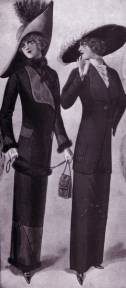
Look 3: 1913.
This garment stands between the corseted Victorian woman of the 19th century and the independent, working woman of the 20th century. Just a few years after this the rigid corset disappears in favor of new, lighter undergarments such as brassieres, knickers, camisoles, and girdles. Clearly, this garment is a suit, not a dress, but its undergarments remain in the past where dresses, not suits, were what women wore.
More journal entries will be coming with more information about each look as well as updates on the actual construction of these garments. Stay tuned!
Hoop skirts and crinolines make me so excited I get the wiggles. I was in ninth grade the first time I read Gone With The Wind. Scarlett O’Hara, while being a debatably lovable character in my mind, has inspired my absolute love of the 1860s, crinolines, hoops, and costume history ever since that first time I read the book. It only took once.
Years later, I am fascinated by costume, material, and social history. I get excited about the entire 19th century–but the only period that really gives me the wiggles remains the 1860s. There’s just something about women resembling giant moving cupcakes that is fascinating and inspiring.
There is something very dreamy about imagining the world these huge constructions moved through. The world had to adapt to these gowns: chairs for ladies had no arms and doors were wider to accommodate their skirts. Can you imagine wearing clothing five feet across? That’s two feet too wide to fit through a modern door! How does a person cope with that all day every day? Sometimes I can envision it and sometimes it just seems impossible. But these questions just remind me that THIS is why the 1860s are particularly fascinating to me.
Gone With The Wind is definitely a controversial story. I found this report to be an interesting and factual discussion of its merits and faults. It clearly states why it is such a classic story and how it glosses over reality. This blog also has an interesting post about Gone With The Wind, discussing if it is a “great American novel.”
As a side note, I love both the book and movie versions of Gone With The Wind. While both are moving, sweeping epics, the book has much more depth and character exploration than the movie. Thus, I encourage you to read Gone With The Wind for yourself and to be inspired by history and by skirts with a circumference of 124″!



 Look 1: 1883.

 The Quintessential Clothes Pen