Titanic Weekend Part II: All About The New 1912 Day Ensemble

We took a rather in-depth look at my new 1912 evening gown. Now, on to the second 1912 ensemble that I also wore during the weekend: day gown and hat!

Gown and hat with (unbuttoned...) white kid opera gloves. I'm so pleased with the overall effect! Unfortunately, I don't have pictures of the back. There are cool details back there, so another fashion shoot will be required in the future...

This gown is constructed from silk charmeuse. The skirt is a single layer in addition to the overskirt panel in front. The bodice has a foundation of the same white cotton as my new evening gown. Mounted on to that cotton are (from the neck down) layers of ivory silk charmeuse, ivory silk flat lined with fabulous ivory colored diamond lace, black silk velvet, and black silk charmeuse. The overskirt panel is trimmed with matching silk velvet and the belt is constructed of the same. There are small buttons on the overskirt velvet trim (because, really, the Edwardians just loved adding buttons everywhere!). Because the back bodice mirrors the front in its style (which unfortunately I don’t have a picture of right now…), I had to be crafty with my closures. The dress has two places that open with hooks and bars: the left side from just under the arm to a few inches down the hip and the left shoulder seam around the neck to the center back of the collar. The effect is a form fitting dress that looks like it was magically donned. The side closure is straight forward, with the foundation layer hooking first, to take the tension of holding the dress tight, and the outer charmeuse layer hooking over that simply to stay closed. Again, the foundation is essential to achieving the elegant, effortless exterior. The neck closure is a series of hook and bars that turn different directions to accommodate the seams: front to back at the shoulder, hooks that hook up on the collar to attach it to the back neck, and hooks going sideways on the center back of the collar.

In addition to the gown, I also constructed what I call the “mushroom” hat, which you can read more about in this previous post. I created the pattern for the hat, which is basically just a shaped brim with circular side band. The side band support the crown, which is a circle that is pleated to create that “mushroom” shape. I love the hat! It lends such an air of Edwardian drama and elegance to the look! And I am so pleased the the “mushroom” shape worked out!

Hm… Patterning this dress… Well, the general skirt shape is from Janet Arnold, but it is adapted to have two symmetrical box pleats that terminate at the top in delightfully detailed seams (which I really, really need pictures of!). The bodice pattern was draped with many references to my inspiration image. I created a basic shape for the bodice and then cut in into the different pieces (ivory silk, ivory silk and lace, black velvet, and black charmeuse) so that each piece would fit together perfectly. The belt is slightly shaped but doesn’t actually have a pattern.

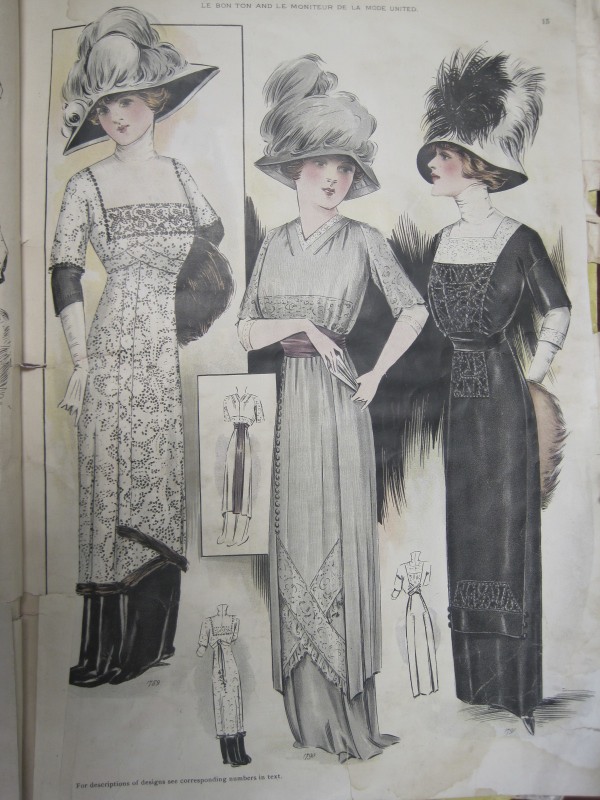
The dress is inspired by this image from a 1910 issue of the magazine Bon Ton.

I'm sure you can guess, but the dress I was referring to is the one on the right.

In the end I made a few changes: I added a train, discarded the white under sleeves (I made them, I tried them, and they just didn’t work! They pulled the bodice in all sorts of weird ways… Maybe if the were not so tight they wouldn’t pull so much? I am fine with having gloves cover my lower arms, anyway.), and drastically scaled back the beading. Perhaps you’ll remember my plan to bead this dress? Well, the beading was drastically scaled back because I didn’t like the beads I bought as much as I thought I would (they are rectangular and larger than I thought… not seed bead-y at all), I realized I didn’t want to devote as much time as it would take to do the amount of beading I originally intended, I didn’t have enough beads to bead all four panels as much as the one panel I completed and I didn’t want to buy more beads, and I didn’t like the beading motif I had created, nor was I inspired to change it. You can see that I did leave one outline shape of beading on the bodice in the velvet section, but the rest was scrapped. That one line is repeated front and back (symmetry, you know). I did actually complete the overskirt top panel, but decided not to use it after my scaling back plan was complete (you can see it, below). I’m going to keep the beaded panel and see if it finds its way onto another project one day… I would still love to do intense beading on a garment, but I’ll have to pick a different one, because it wasn’t measuring up to my expectations for this dress.

Scrapped beaded panel. A mix of silvery and black beads. I started in the center with the somewhat wonky lines, can you see improvement? I think it would have been distracting from the dress to have four panels like this.

1912 Ivory “Mushroom” Hat: Part I

Possible millinery materials...

The plan: to create an ivory and black hat to accompany my (almost) completed Titantic-era tea gown. I started with some ideas in mind, but was also open to inspiration from challenges of construction or materials. I raided my millinery trim stash for ivory and black millinery flowers and leaves, black and white ostrich feathers, pleated and plain ivory ribbons and trims, and other practical necessities like millinery wire, buckram, and organza…

I’m calling this hat a “mushroom” hat because it is my goal to make the crown roomy about the head  and puffy in the crown, like a mushroom top! You can see this mushroom-y detail in the images below: look at how the head size opening is often bigger than the head! Given that the head size opening needs to be big, one challenge I will face is figuring out how to make the thing stay up on my head and not fall down over my face. I’m not sure big hair will be enough… That’s something I’ll have to determine once the hat is complete. I might have to use some sort of bandeau inside of the hat to support it. Bandeaus are often used to perch hats on the head, especially in periods like the 1870s and last quarter of the 18th century, but it seems like a practical solution to this 1912 hat perching problem, also! I’ll have to let you know how the bandeau situation turns out.

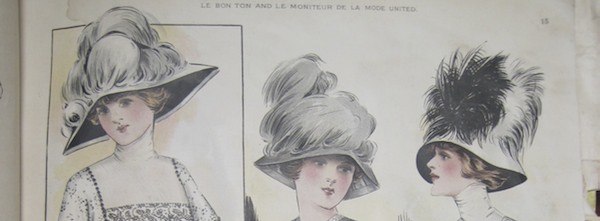
A selection of inspirational and awesome hats from a 1910 issue of the magazine Bon Ton. I particularly like the be-feathered hat on the far right...
From the 1910 issue of Bon Ton. Look at how huge that head size opening is! And the feathers are just giant! I don't plan to attempt to create this, but I do think it fabulous!
Another fabulously feathered hat from Bon Ton, 1910. Also included simply because it is wonderful, not because I intend to build it...

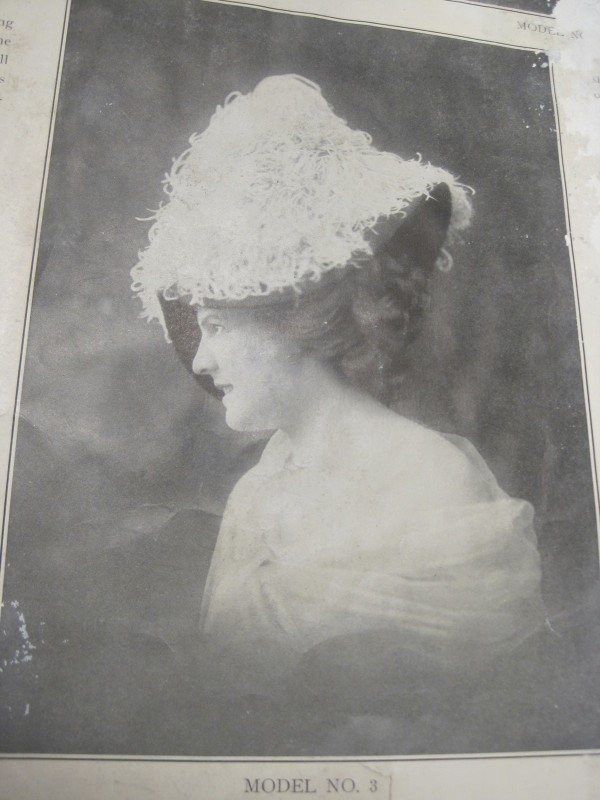
These last two images show the direction this hat is going. I love the mushroom-y shapes (which also resemble mob-caps), large scale trim, and head size openings.

Another hat from the 1910 issue of Bon Ton. This hat is one of my top inspirational images for my hat creation. It has that mushroom-y shape.
The hat on the right from The Metropolitan Museum of Art via American Duchess. Love the mob-cap-like/mushroom-y shape... and that buckle! Wow!

I wonder where my creativity will take me…

Resource: The Bartos Collection

Oh my goodness! This is such a cool and huge collection of photographs and fashion plates! Lauren over at American Duchess has been referencing images from the Bartos Collection for awhile now, but I didn’t get a chance to check it out for myself until just recently. It is WONDERFUL!

The collection focuses on the mid-19th century through the early 20th century. There are fashion plates and mounds of period photographs and pictures of extant clothing… If you love historic clothes and hats and hair you MUST VISIT! Here’s the link, again, because you must go visit and drop your jaw with me!

Project Journal: 1815-1820 Regency Ensemble Part VI: Updating the Gown

Original construction

I have decided to remake my ivory 1819 cotton gown for an upcoming Regency ball. Originally, my plan was to add trim to the dress as it currently exists, but I realized there were many things about the dress I wanted to change: with my new late Regency corset the neckline tended to sit away from my body in front, the back closure was too tight for comfort, the bust line in front was so high that it was very hard to get it to sit below my bust, the sleeve openings were uncomfortably tight, the sleeves weren’t puffed enough, I wanted to separate all the petticoat layers to be individual layers rather than petticoats built into the dress, and I wanted to add ruffles to the skirt  to really bring it up to the years just before the 1820s. Indeed, the things I wanted to change were so numerous that I decided to just remake the dress!

In the end, the only thing that I decided to keep the same is the skirt base fabric… Using just one additional yard of the original fabric, I plan to complete the following changes: constructing an entirely new bodice with ruffled trimming, creating entirely new puffed sleeves with a cute v-shaped detail, making stand alone petticoats out of the original built in petticoats, and adding bias ruffles to the skirt.

From Ackermann's Repository 1822

My dress is from the period just before the 1820s and I felt that I needed to go more in an 1820s direction with the new trimming and adornment. The main feature of trimming in the 1820s is wide sections of trimmings on the skirt, in combination with corresponding trim across the bodice and sleeves. Thus, there two horizontal lines of interest with a simple, unadorned mid-section (as in the fashion plate on the left, from 1822).

Before I had decided to make so many changes, my original intention was to simply add ruffles to the bottom hem, along the lines of the dress (below) from the Kyoto Costume Institute.

c. 1820 Silk Day Dress (Kyoto Costume Institute)
Ribbon trim on 1819 dress before the remake

However, as I thought about it I realized that the ruffle style (above) just would not have a corresponding look to the current zig zag ribbon trim on the dress bodice (right). Those two styles did not make sense on one dress.

The logical step was to change the trim on the bodice. But remember that I had other complaints about the bodice as well… So came the decision to remake the bodice. But how to trim it to correspond with the ruffles on the skirt? I was not at all interested in the bodice trimming on the Kyoto dress for my dress, because the fabric doesn’t lend itself to that look. Well, I started researching trimming from the late 18-teens to see if I would be inspired. The image below is one of my favorites that didn’t make the cut, and there are more on my 1819 dress trimming ideas Pinterest board (thank you to Lauren, at American Duchess, for linking to her Pinterest board in a post and sparking my interest in this fabulous organization tool).

From Ackermann's Repository 1819

Many of my Pinterest images come from the same place: the blog “My Fanciful Muse” by EK Duncan. She has a series of posts that contain text and fashion plates from Ackermann’s Repository beginning in 1808 and going through 1828! Here is the link for the post on 1828: if you scroll to the bottom you will see a list of links to all of the previous years. It is absolutely fabulous! If you haven’t seen this yet you MUST visit! (Thank you for sharing, Evelyn!)

In the end, I decided on a combination of the two dresses in the image below: the ruffles on the skirt of the dress on the right (for some reason I really like the idea of ruffles on my skirt!) and the bodice of the dress on the left. The repeated use of ruffles on the skirt and bodice will produce the corresponding style I am aiming for. The sleeves will be a style from the first few pages of the first half of the 19th century Janet Arnold pattern book: a puffed sleeve with a triangular inset coming from the shoulder. I’ve wanted to use that sleeve style for months and now I finally have a way to use it that makes sense!

1820 illustration from Cunnington's English Women's Clothing in the Nineteenth Century (the illustration is based off of contemporary fashion plates)


1912 Dress Beading Motifs

I am leaving the Regency period for now to focus on preparing dresses from 1912 to wear to Titantic-themed events in April. I’m hoping that by starting early I will be able to spread the workload out and include lots of beautiful details.

I am making the dress on the right side (the black one) and I plan to include beaded panels (this is why I am getting an early start!)… I can see a beaded pattern: the top and mid beaded sections appear to have an inner outlined area that mimics the exterior shape of the beaded panel and the remaining space appears to be filled in by zig zags. Similarly, the bottom panel appears to also be filled in with a zig zag pattern. (Or is it a pattern more curvy than a zig zag?)

(From Vol. 59 of the magazine Bon Ton)

I feel like I have a clear idea and can move forward with the beading, but at the same time I am doubting myself and thinking that perhaps I need to do more research on 1912 beading motifs. Do you think I can take creative license and go forward with the information I can glean from the Bon Ton image? I did find this example of an extant 1912 beaded dress that is similar on the one from Bon Ton.

1912 Beaded Ball Gown

I don’t own any books that are specific enough to assist me in this search and various online searches have been generally disappointing. And yet it seems that someone out there must have some good information! Do you know of any sources for information on Edwardian beading motifs? I hope to hear from you, if you do have any ideas!

Project Journal: 1815-1820 Regency Ensemble Part III: Spencer Research

Merry Christmas!

Let me start by explaining my reasoning about adding to my Regency wardrobe. You see, I had two events in mind for which I needed two different Regency looks: the Massachusetts Costumers annual Regency Holiday Tea and the Commonwealth Vintage Dancers 1812 Ball. What to wear???

“Well,” I thought, “I have an 1819 dress that I built last year for the Sense and Sensibility Ball… but I don’t have the right corset to wear under it. Nor do I have any way to make the ball gown into day wear… And, now that I think of it, what will I do with my hair for a day style???”

The first and most foundational step was to build a corset to provide the proper support and shape for the Regency period. You can see my research and construction of the corset in previous posts.

The next step was to turn my ball gown into day wear! Well, Spencers are a classic Regency garment that can perfectly disguise my ball gown by hiding the short sleeves and low neckline, thus turning it into day wear. Perfect! After the Spencer will come the adventure of finding a suitable hair/hat solution.

What is a Spencer? It is a short, waist length jacket from the 18th and 19th centuries first worn by men but quickly adapted into women’s wear. The garment is named after George John, the 2nd Earl of Spencer who was an English politician during the last quarter of the 18th century and the first quarter of the 19th century.

Early 19th Century Fashion Plate at LACMA (Spencer on the right)
Fashion Plate, 1807 at LACMA (Spencer on the right)


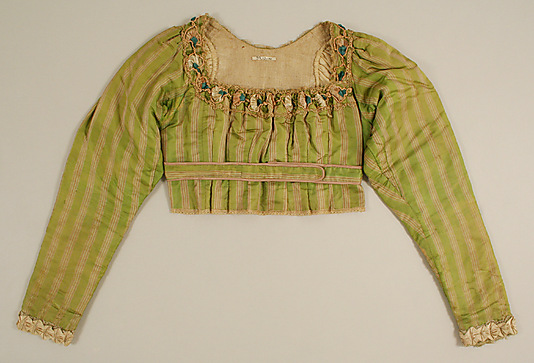
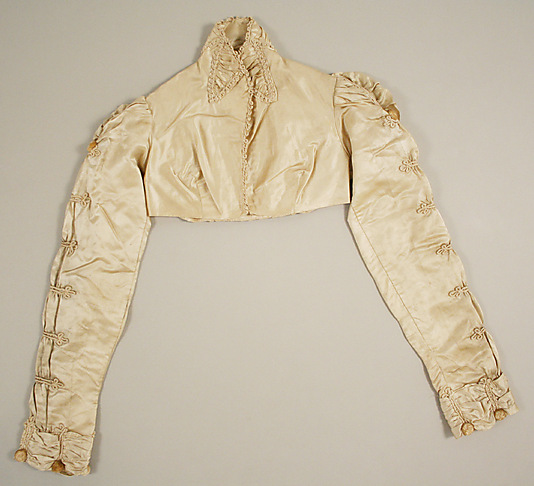
Right now I am interested in the Regency style Spencers, since that is what I will be making, so I will focus my research on that period. Here are some of the Spencers I found most inspirational for my reproduction. These garments are from the Metropolitan Museum of Art’s collection.

1819-1822 Spencer
Early 19th Century Spencer
c. 1815 Spencer
1814-1820 Spencer
c. 1816 Spencer
c. 1818 Spencer
1804-1818 Spencer (That is a lot of tassels!)
c. 1820 Spencer

Let’s leave the Spencer here, in the research stage, for today. More will be coming soon with mock-up pictures of my reproduction!

While looking for research images I did come across this blog post that shows a reproduction of an 1815 Spencer at the LACMA. The post (and her other posts as well)  have great commentary about the research and construction of reproduction garments with lots of pictures included!

Reproduction 1815 Spencer

Annabelle, adorned with flowers

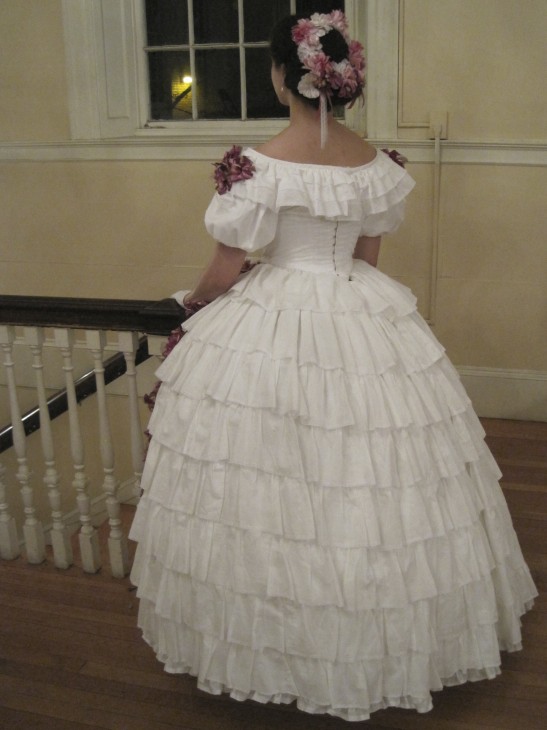
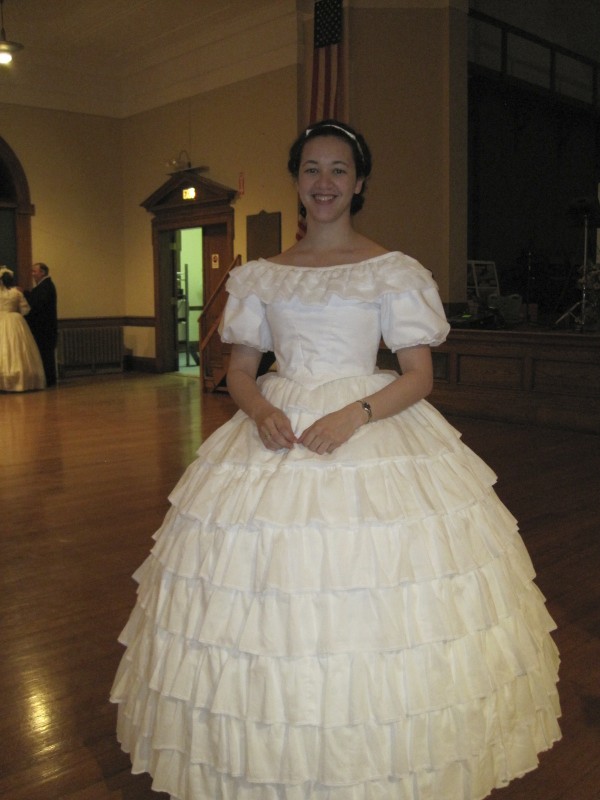
Over the summer I built Annabelle, a white flounced 1860 ball gown, in order to have an alternative to my dark blue 1860 ball gown. My intention was to adorn Annabelle with flowers, as in my inspiration fashion plate from Godey’s Lady’s Book (Annabelle is based off of the gown on the far right); however, I did not have time over the summer to add the flowers.

September 1860 "Dressed for a party" (Fitting title, don't you think?)

I decided to wear a be-flowered Annabelle to the Commonwealth Vintage Dancer’s German Cotillion last week. My original plan was to hand make the flowers from hand painted pink silk organza. I started on that endeavor, but the process was time consuming and so I have only made perhaps 100 flowers (first: cut 5 rounded point shapes, second: fray check the edge all around, third: gather the center of each flower). Each flower is about 1 1/2″ across. When I went to sew the flowers on the dress I realized two things that made me change my mind about using them: the flowers were too small for the scale of the dress and I would need so many more hundreds to make the look work. In the end I used purple millinery flowers, from the fantastic stash I mentioned in the post about my 1860 hair crescent, to adorn the dress. I actually really enjoy the purple flowers and the scale is far better for the overall look as well.

Annabelle with flowers!

I used matching flowers plus a few others in the pink family to create a wreath for my hair to match the dress.
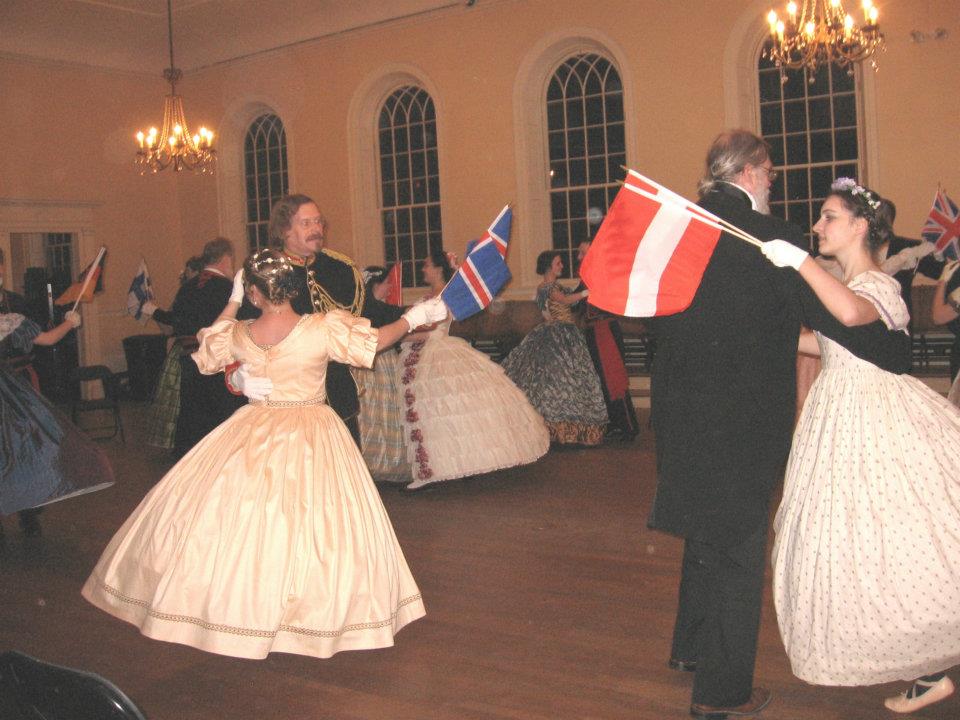
Annabelle back
Matching hair wreath

If you would like to see what Annabelle looked like without the flowers, you can visit the following posts and see pictures: Of Flounces and Dance Cards: Part I and Ochre Court 1860s Ball 2011. And, to finish off this post, here are a few pictures of Annabelle in action at the German!

Playing dance games at the German Cotillion

Pleated trimming on 1860s gowns

I absolutely love the use of pleating as a trim motif in the 19th century! I also admire the immense amount of time and fabric required to edge the dresses of the 1800s in pleated trim.

Take a look at the dress below and note the rolling wave pattern of the pleated trim on the skirt as well as the pleated trim on the sleeves. You can see that the trim is made of the same fabric as the dress, which was a technique often employed in the 19th century for the trimming of gowns.

c. 1862 Afternoon Dress at the Metropolitan Museum of Art

Now, take a look at this dress from 1860-1861 (which was also include in this post). Doesn’t the trim style look familiar? Yes, it’s a more bunting-like placement of the trim, but the idea is exactly the same as the dress above!

1860-1861 Dress at the Metropolitan Museum of Art

So now that we’ve looked at a few actual garments with the pleated trim, let’s look at some fashion plates. You know, I went through about 50-100 fashion plates from 1860-1865 and I was surprised by the lack of plates that included dresses with pleated trim! Considering that I have frequently seen pleated trim used on existing garments I am intrigued by their relative absence in fashion plates… I wonder if pleated trim is just challenging to execute when creating a fashion plate? Certainly I found some with bands of trim, and perhaps those could have been executed with pleated trim when constructed?

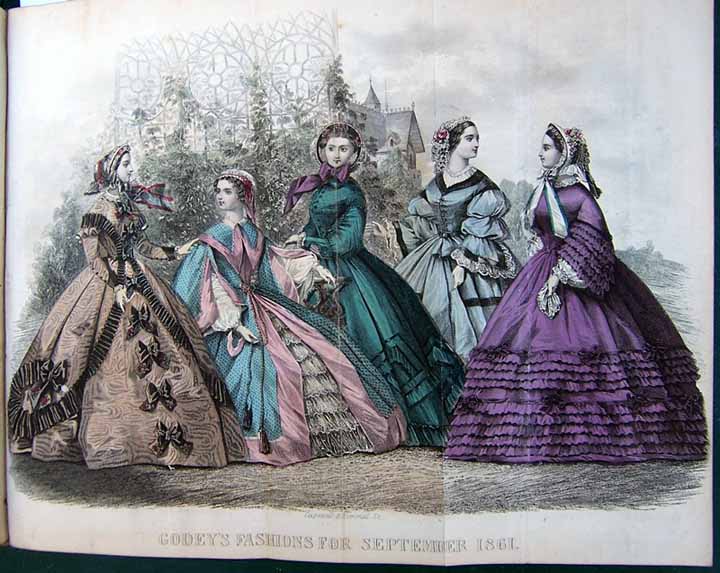
Godey’s Fashions for September 1861
Godey’s Fashions for September 1862

In both of these fashion plates the ladies on the far left are the ones I’m looking at and think that they are wearing dresses with pleated trim. The one from 1862 as especially clear detail that shows the trim being pleated. It is interesting to note that these two fashion plates correspond directly with the two existing dresses at the Metropolitan Museum of Art.

Of flounces and dance cards: Part I

PART I: Of flounces…

Flounced 1860s dresses seem to be pure confections: cupcakes iced with lace and frothy ruffles. That is the vision in my mind while I was looking for inspiration for my latest crinoline dress.

Fashion Plate from Godey's Lady's Book September 1859 "Dressed for a Party." (The dress on the right is the inspiration for my latest gown)

I already made one 1860s dress for myself. Named Belle, it is a dark blue satin and velvet gown with a three tiered skirt. It’s very heavy and a dark color: neither of those two features seemed fitting for a summer ball in temperatures around 80 degrees! And so I decided to create an all new gown… in my head this one is named “Annabelle.” (I hope you are also amused by the name!)

"Annabelle" my new 1860s ball gown

As you can see, there is one crucial element missing… the pink flowers! My goal is to make the flowers by hand from silk organza and to be perfectly honest, I ran out of time. I just decided to wear the dress as-is and finish the flowers later. I also ran out of time to bone the front, as you can see by the wrinkles along my tummy. No worries though, as I’m sure I’ll be able to wear this gown again.

"May I have this dance?" Side view of Annabelle.

In order to be to light and breathable, Annabelle is constructed entirely of cotton. The skirt has a medium weight cotton foundation to which cotton voile flounces are attached. The bodice is three layers of cotton for the sake of being opaque: two of medium weight cotton and one layer of voile. The layers are flatlined together and treated as one piece. The flounces on the skirt and bodice are cotton voile edged in narrow white lace.

This gown was flat patterned using research from books by Janet Arnold, Norah Waugh, and Kristina Harris.  View this post about patterning from my Project Journal: Women’s Tailoring to see which titles I used and get a smidgeon of bibliographic information. The skirt pattern is fairly simple: a big tube cartridge pleated at the waist. The bodice has narrow v-shape seams front and back with puffed sleeves and a flounced bertha. It is worn over a chemise, corset, double thickness bum pad, hoops, and petticoat.
While this dress is eventually intended to be a reconstruction of the dress in the 1859 fashion plate above, I was also inspired by these other, similar fashion plates for further information. Enjoy!

Fashion Plate from Godey's Lady's Book October 1859 "The Soiree"
Fashion Plate from Godey's Lady's Book August 1859 "Godey's Fashions for August"

Bolero jackets of the 20th century: 1900-1909

A few posts ago, we took a look at Bolero jackets from the mid-19th century. Let’s look at them  in another context: Boleros from the early 20th century, with a hint of information from the 1890s as well.

1904 Dress with Bolero

What exactly is a Bolero jacket? The Oxford English Dictionary defines it as “A short jacket, coming barely to the waist; worn by men in Spain; applied to a similar garment worn  by women elsewhere, usually over a blouse or bodice.” This definition condenses the influence and origination of the Bolero down quite eloquently (of course, it is the job of the OED to eloquently distill all words down to a concise definition… but still, I do like this definition). The men’s style Spanish Bolero, with elaborate braiding and bright colors, influenced the style of women’s Boleros from the Victorian period. The following quotes from the OED provide more insight into the history of the Bolero (they also mention other styles of short jackets including the Zouave and the Eton).

“1892    Daily News 14 Nov. 6/3   The Zouave is as great a favourite as it has been for some seasons, and though it varies in form—being sometimes a bolero, sometimes a toreador, and sometimes a cross between an Eton jacket and a Zouave.
1893    Daily News 1 Apr. 2/4   The Zouave is quite as popular as it was last year.‥ Sometimes it is pure bolero.
1893    Lady 17 Aug. 178/1   Zouave Bodices are a feature of autumn gowns. (in the Zouave definition)
1899    Westm. Gaz. 6 July 3/2   Robbing the coat of its basque has created‥the bolero corsage, really an actual bodice, though appearing a bolero coat and skirt.”

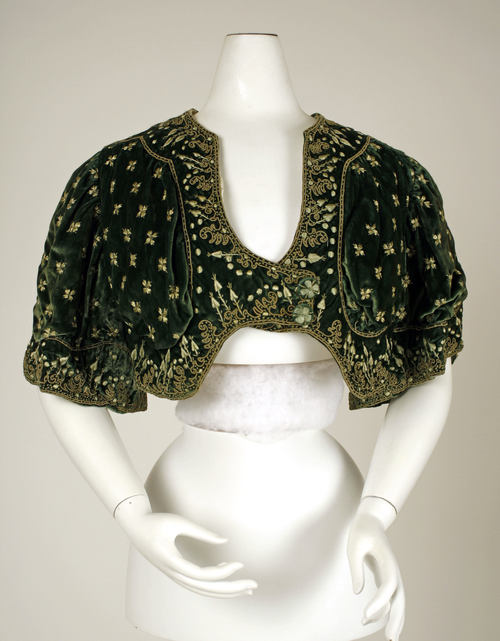
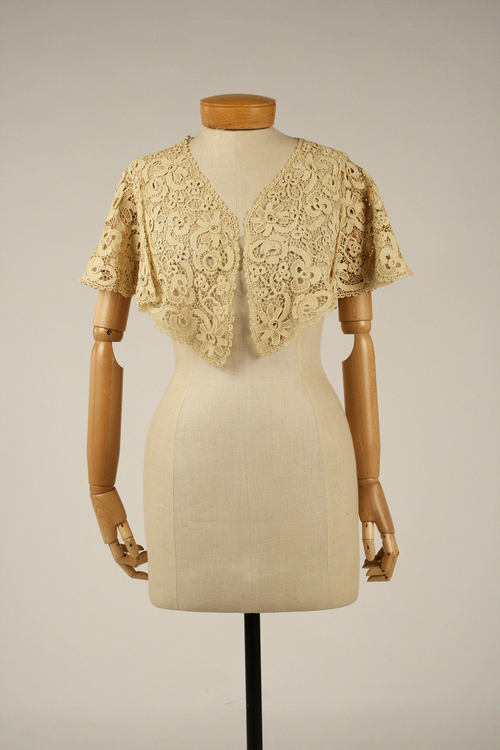
The flared skirt and small waist silhouette of women’s clothing during the first decade of the 20th century was well suited to the style of Bolero jackets, as they could help to visually balance the figure by adding just a small amount of width across the chest and shoulders.  Here are a few Boleros from the Metropolitan Museum of Art. One is silk velvet, elaborately trimmed. The other is lace. Can you imagine the dresses that would have accompanied these Boleros? Clearly, they were intended for different purposes. Perhaps the first was intended for evening wear and the second for an afternoon stroll or visiting friends?

c. 1905 Bolero from the Metropolitan Museum of Art
c. 1907 Bolero from the Metropolitan Museum of Art