Fun in the Sun Part I (Regency Picnic 2012)

Vacationing is lovely while it lasts, but it does seem to make real life a bit overwhelming. I’ve been slow on the posting lately because of my vacationing. And, to be honest, life + vacationing is most likely going to be slowing me down some more over the next month or so. Some of my vacations will generate some really great pictures, though, so stay tuned for those in August!

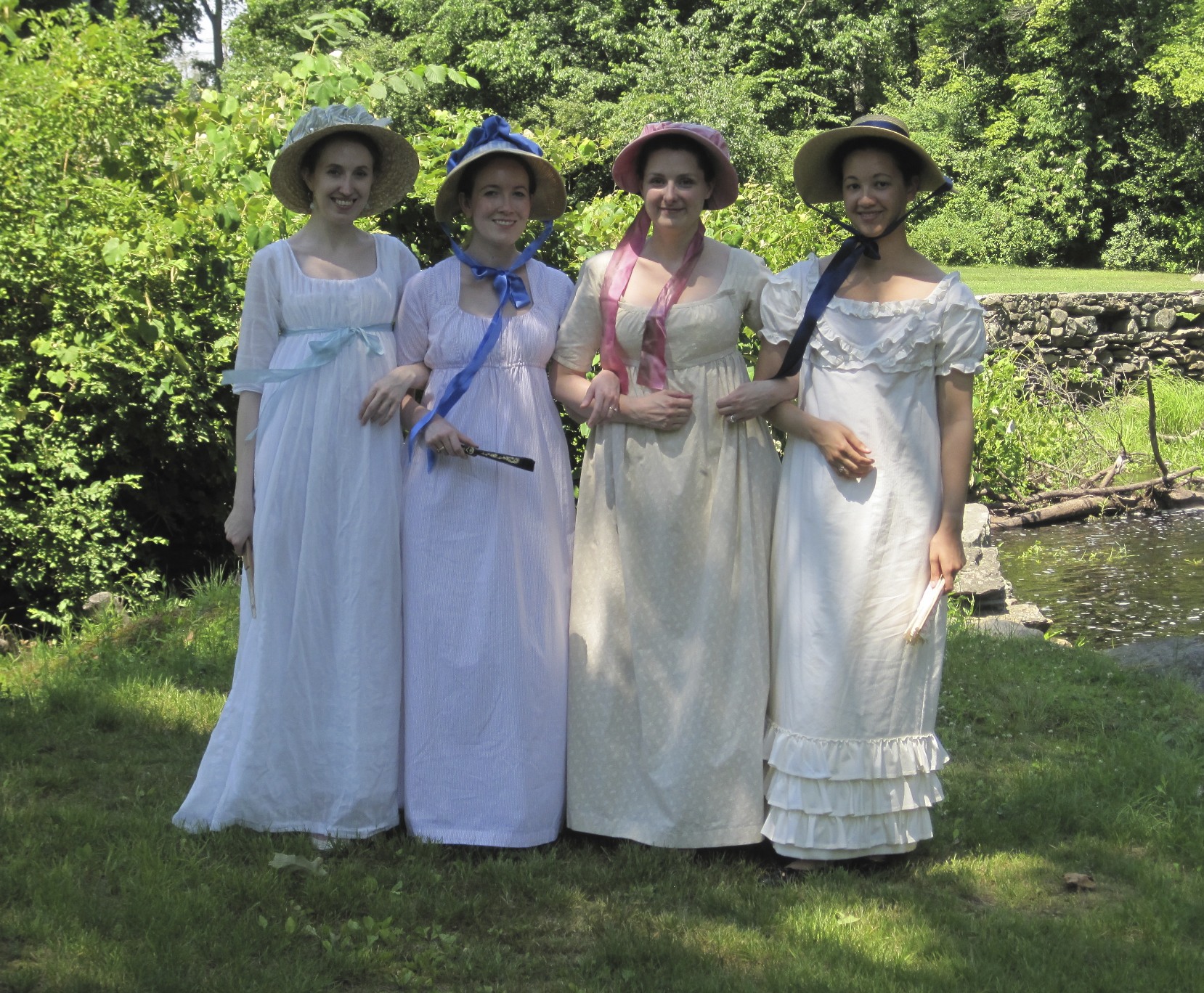
It’s been roasting-ly hot here in Massachusetts for the last few weeks, but the heat didn’t stop the Massachusetts Costumers from enjoying the annual Regency Picnic. It was toasty, but we tried to spend lots of time in the shade. And despite the heat, we had a marvelous time! Join me in recalling the fun through viewing (just a few of the 300 or so) pictures we snapped that day.
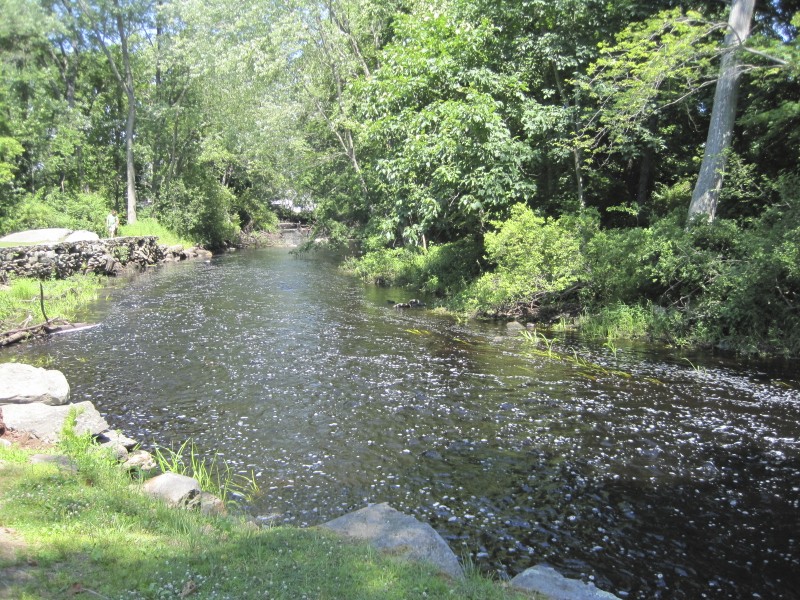
Our idyllic setting at a lovely park in Bridgewater, MA.
Okay, so our food and table setting was not historically accurate. But the colors were so nice and summer-y! (And the pink lemonade was quite refreshing.)
After eating, we strolled through the park and took pictures (and coerced random passers-by to take photos of us…). Lovely group of ladies, don’t you think?
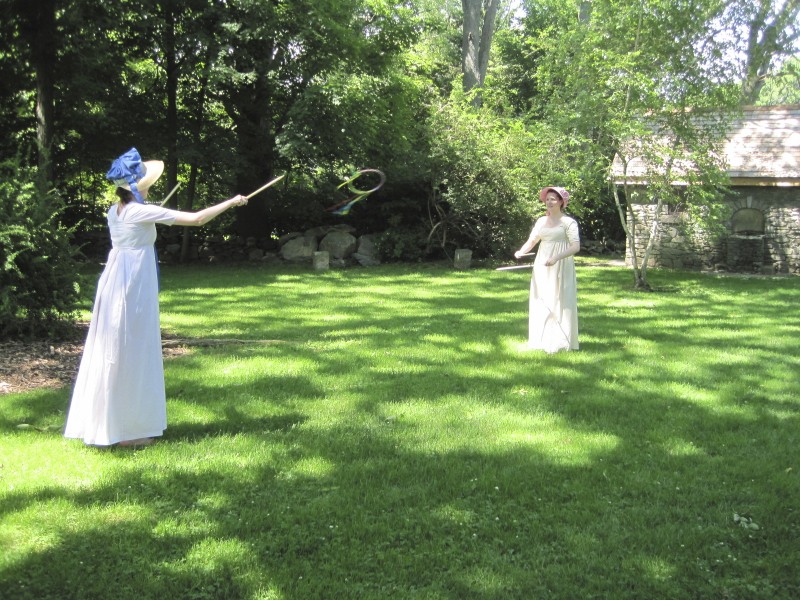
Then we played a Regency game called… “Graces?” (Ack! I can’t remember the name… Jenni, help me!)
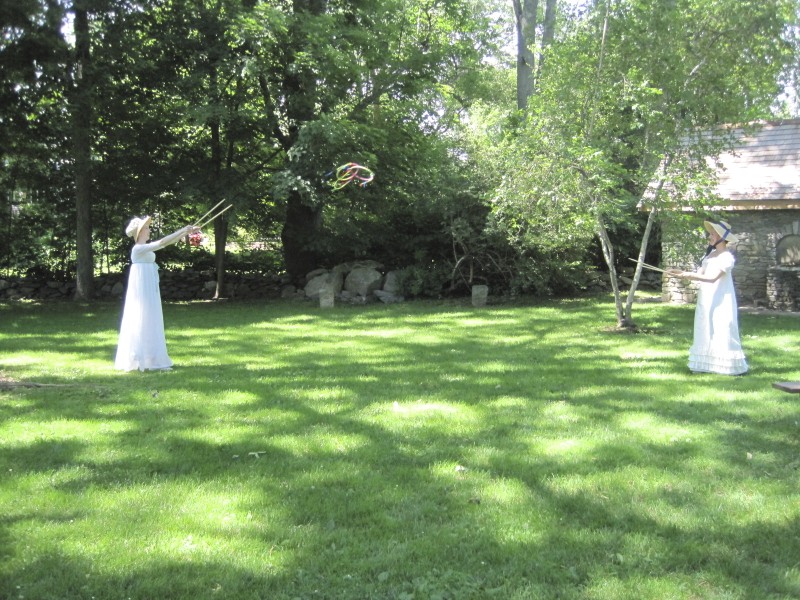
Basically, each person has two long sticks which they use to fling the be-ribboned hoops at the other player. The second person catches the hoops on their own sticks before flinging them back again.
I’ve included pictures where you can see the hoops in midair. Despite the fact that we often seem to be catching the hoops, I also have many pictures where we, um, didn’t catch the hoops…
Eventually, we got the hang of it and decided to make it more challenging. In this instance we had two hoops going at once, one flung by each player!
It took a little time to get used to the coordination of flinging and catching in quick succession.
But we got the hang of it and then we started flinging two hoops at the same time in one direction! That meant the person catching had to catch two at once! Eep!

After that challenge we thought we were finished with the game… but then one of us (I can’t remember who…) had the brilliant idea to attempt to make graceul, Regency-like poses, while playing the game. That kept us going for awhile longer, with some amusing photos and lots of laughs, but you’ll have to wait till my next post for those photos (I don’t want to overload you with too many fun in the sun Regency picnic photos at once, you know!). In the end, the heat wasn’t so bad!

Project Journal: 1815-1820 Regency Ensemble Part V: Completed Spencer (Massachusetts Costumers Regency Holiday Tea)

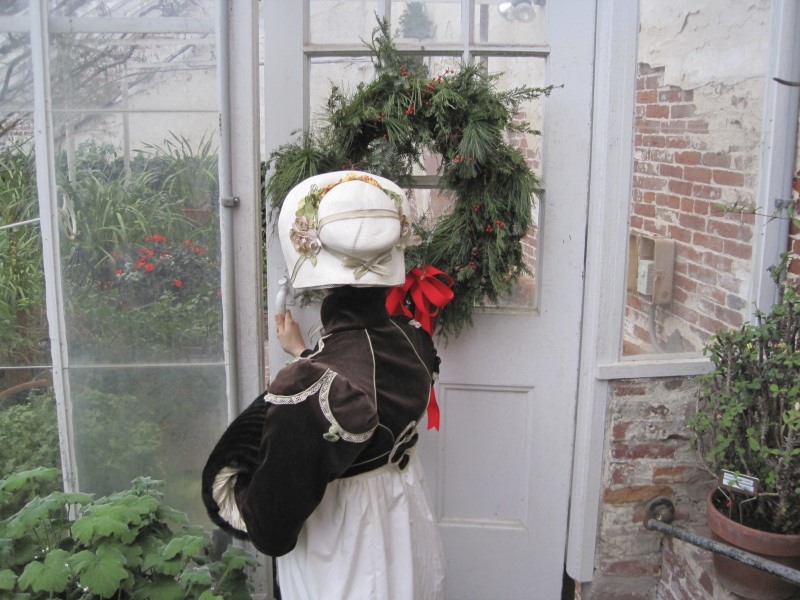
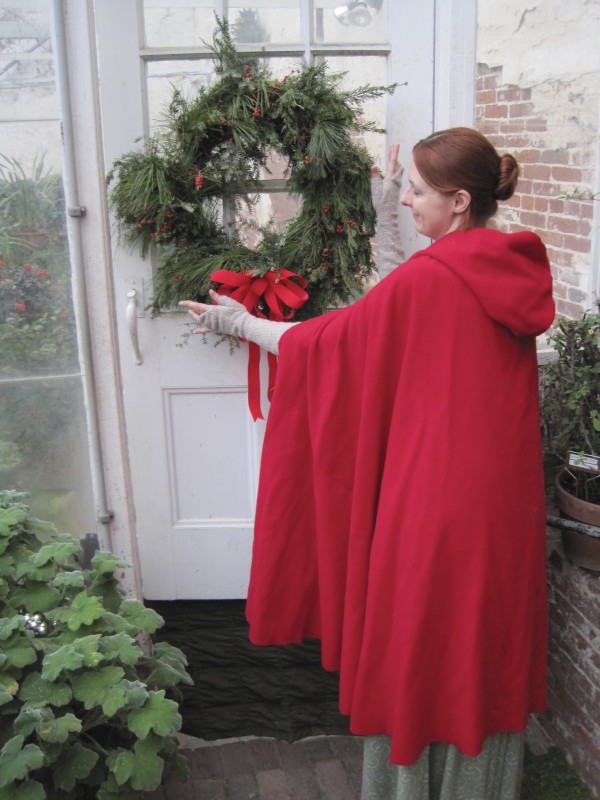
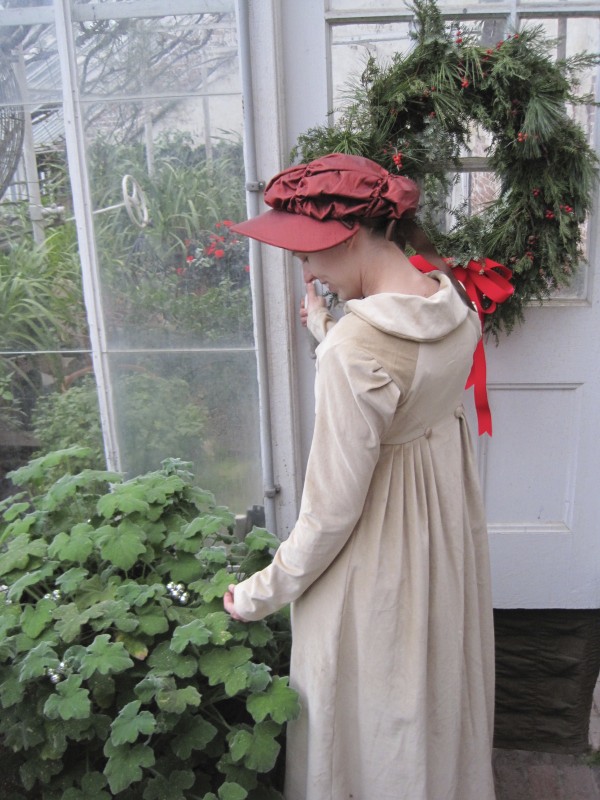
In the greenhouses at the Regency Holiday Tea.

Despite the long name of this post… Here it is! My (almost) finished 1819 Regency Ensemble! The ensemble includes an early 19th century white linen chemise, 1815-1820 pink cotton corset, 1815-1825 ivory cotton gown, 1819 brown velvet Spencer, 1819 straw bonnet, and mid-19th century fur muff (ok, so it’s not quite as giant and droopy as a Regency muff… but it was cold outside!). You can click on the links to see more about each piece. There is more to come on the gown and bonnet.

Right now I want to focus on the completed Spencer and its details. Please click on the link above to see my research for the Spencer: it is based off a Spencer at the Metropolitan Museum of Art. You can see pictures of the mockup Spencer here. The Spencer is constructed of brown cotton velvet that is flatlined with white cotton. It is trimmed with green cotton cording, vintage brown lace, and green tassels to match (Aren’t the tassels so adorable?).

1819 Spencer
Back of the 1819 Spencer

I wore this Spencer to the Massachusetts Costumers annual Regency Holiday Tea. This year, in addition to having tea, we visited the Lyman Estates Greenhouses, which were built in 1804 and added to in 1820, 1840, and 1930.

On to see more of the greenhouses
Ornaments hanging from a tree!
Picture time!
Admiring the decor
So many beautiful things to look at

The tea was lovely and I do believe that my Spencer turned out wonderfully! Spencers are so adorable and varied. I hope to make more in the future… but there are other things to do before I go back to Spencers. The next big push is going to be Edwardian outfits for Titantic evens in April!

Project Journal: 1815-1820 Regency Ensemble Part III: Spencer Research

Merry Christmas!

Let me start by explaining my reasoning about adding to my Regency wardrobe. You see, I had two events in mind for which I needed two different Regency looks: the Massachusetts Costumers annual Regency Holiday Tea and the Commonwealth Vintage Dancers 1812 Ball. What to wear???

“Well,” I thought, “I have an 1819 dress that I built last year for the Sense and Sensibility Ball… but I don’t have the right corset to wear under it. Nor do I have any way to make the ball gown into day wear… And, now that I think of it, what will I do with my hair for a day style???”

The first and most foundational step was to build a corset to provide the proper support and shape for the Regency period. You can see my research and construction of the corset in previous posts.

The next step was to turn my ball gown into day wear! Well, Spencers are a classic Regency garment that can perfectly disguise my ball gown by hiding the short sleeves and low neckline, thus turning it into day wear. Perfect! After the Spencer will come the adventure of finding a suitable hair/hat solution.

What is a Spencer? It is a short, waist length jacket from the 18th and 19th centuries first worn by men but quickly adapted into women’s wear. The garment is named after George John, the 2nd Earl of Spencer who was an English politician during the last quarter of the 18th century and the first quarter of the 19th century.

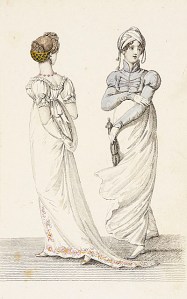
Early 19th Century Fashion Plate at LACMA (Spencer on the right)
Fashion Plate, 1807 at LACMA (Spencer on the right)


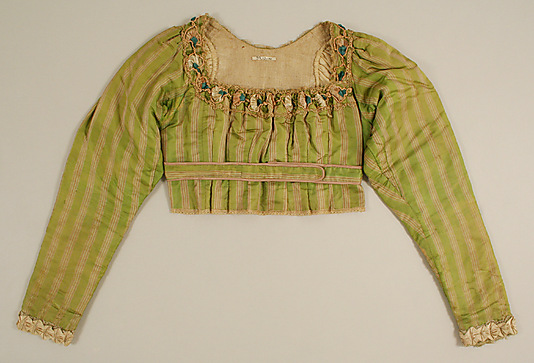
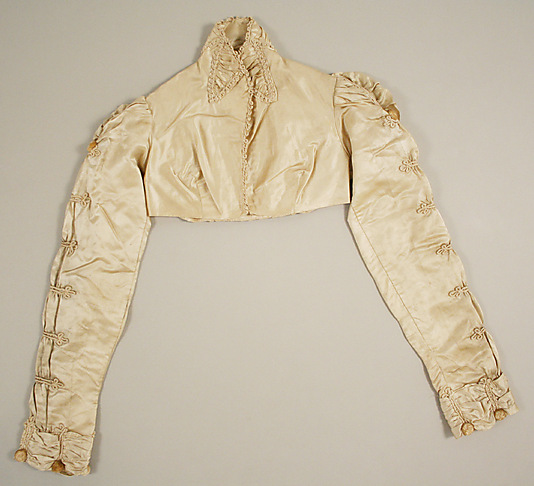
Right now I am interested in the Regency style Spencers, since that is what I will be making, so I will focus my research on that period. Here are some of the Spencers I found most inspirational for my reproduction. These garments are from the Metropolitan Museum of Art’s collection.

1819-1822 Spencer
Early 19th Century Spencer
c. 1815 Spencer
1814-1820 Spencer
c. 1816 Spencer
c. 1818 Spencer
1804-1818 Spencer (That is a lot of tassels!)
c. 1820 Spencer

Let’s leave the Spencer here, in the research stage, for today. More will be coming soon with mock-up pictures of my reproduction!

While looking for research images I did come across this blog post that shows a reproduction of an 1815 Spencer at the LACMA. The post (and her other posts as well)  have great commentary about the research and construction of reproduction garments with lots of pictures included!

Reproduction 1815 Spencer

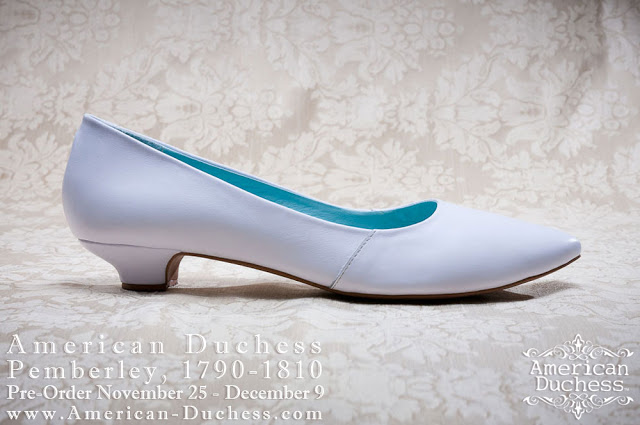
New Regency shoe from American Duchess!

Dear fellow costumers,

I’m sure many of you have read about the Pemberley shoes being offered by American Duchess… but in case you have not seen yet, or in case you need a reminder… American Duchess is now offering a Regency style, historically accurate shoe! The shoe is available for pre-order today (November 25 through December 9) and at least 100 orders must be placed for the shoe to be produced. Let’s make it happen!

Also, given that it is the holiday season (which is a time for wishes, you know), I would like to wish that a higher heel Pemberley shoe would one day be produced by American Duchess… I envision a shoe with a 1 1/2″ –  2″ heel that can be worn with late 19th century clothing, like the styles below…

Happy shoe-ing to all!

SaveSave

1812 Tailcoat Pattern

I thought I would just quickly share with you this 1812 Tailcoat Pattern. You can find it in the pattern section of Wm. Booth, Draper. The pattern actually has a wider date range on it than strictly 1812: it is listed as a tailcoat pattern 1800-1820. This is the description:

This tailcoat pattern is the first well made civilian tailcoat pattern specific to the first two decades of the 19th century. The pattern comes with three sizes: Medium, Large and XLarge. There are two options for the collar, comprehensive directions and documentation. 


And here is the information about the quantity of fabric needed, etc. (the underlined sections are other items that Wm. Booth, Draper carries):

To make this coat between 2 1/2 to 2 3/4 yards of superfine wool broadcloth or slightly more (to allow for shrinking) linen and about the same amount for a lining of oatmeal 3.7 oz. linen is required. An extra 1/4 yard will be needed for the pocket bags. Notions needed are about 1 1/4 yard linen buckram interfacing, between 6 to 8 5/8″ buttons or button molds, one or two additional buttons that are flat on both top and bottom are recommended for a double breasted coat. For the sleeves 4 to 6 1/2″ optional matching cuff buttons or button molds are needed as is Linen threadof either 50/3 or 35/2 to match the lining and outer fabric. For sewing the button holes you will need one or possibly two spools of quilter’s thread or buttonhole twist that matches the outer fabric.
 

Project Journal: 1780s Ensemble Part III: Undergarments and Sources

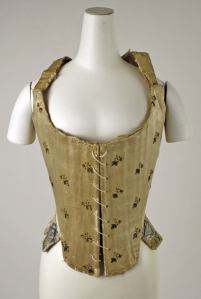
I’ve decided to build a Robe a l’Anglaise, in addition to a chemise and pair of stays to wear under it. You can look at this post to see pictures of the Robe a l’Anglaise. The style of stays that I plan to use is the one below left: no straps allow ease of movement in the upper body, which is more suitable for dancing. The corset on the right is from the same period: I include it for informational and comparison purposes. Many stays at this time were either made of patterned or colored cloth, as these two are, and I enjoy the use of color on the undergarments.

c. 1780 Wool and Linen Corset and the Metropolitan Museum of Art
c. 1780 Silk Stays at the Metropolitan Museum of Art

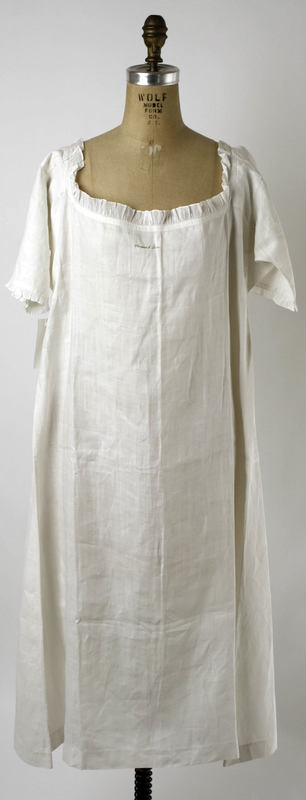
The chemises that were worn under these stays were fairly simple and almost always constructed of linen. Here are a few examples.

c. 1780 Linen and Cotton Chemise at the Metropolitan Museum of Art
1780-1800 Linen Chemise at the Metropolitan Museum of Art
1790-1810 Linen Chemise at the Metropolitan Museum of Art

I’ve collected some interesting (and sometimes conflicting) information regarding clothing from this period: these sources below were most helpful.

One of the best resources for this project is The Cut of Women’s Clothes: 1600-1930 by Norah Waugh. This book has images, patterns, contemporary quotes and construction details. It’s a great reference book to have access to for historic projects. Another wonderful reference book is Patterns of Fashion 1: 1660-1860 by Janet Arnold. This book is great supplement to Norah Waugh because it has an abundance of great drawings to explain the construction of garments. Another book that I know would have been useful to have is Seventeenth and Eighteenth-Century Fashion in Detail by Avril Hart and Susan North.

This website is also a great resource: La Couturiere Parisienne. It includes a fantastic collection of fashion plates, paintings, construction and pattern information, as well as fabric and color research for clothing from the 1400s through the 1900s. (Just a quick note that it can be viewed in English or German, and if you suddenly find yourself viewing it in German look to the top right for a little icon that you can click to switch it back to English.)

In terms of the materials needed for these items I found a great source for this project and future projects here: Wm. Booth, Draper. This website has all sorts of great things. For example, low prices on yardage of linen, cotton, and silk (in 18th century patterns and colors) and cane boning for corsets.