A Mysterious Domino, Part II: Making & Wearing

This is a continuation of my last post, which shared the background of why I created this black domino cape as well as research about what a domino is and its history.

Making My Mysterious Domino

Having decided on an idea, and probably conducted more research into its history than was strictly necessary for this purpose, I proceeded to figure out how to bring my idea to life. I had the additional goal of not wanting to spend money and therefore restricted my domino-endeavors to the stash.

I started by looking through my stash binder (I posted about my stash organization in this past post) to see what fabrics I had on hand that might be able to be made into a quick and easy domino. I came up with just one — a gifted-to-me three yard piece of a black synthetic sheer, with alternating satin and sheer narrow stripes and a bit of metallic thread woven in between each stripe. I liked the drape of the fabric, as I thought it would move nicely while dancing, and I liked that while being black, it was also interesting and had more to look at than a plain solid. Three yards was plenty of fabric to allow for a large hood and plenty of length!
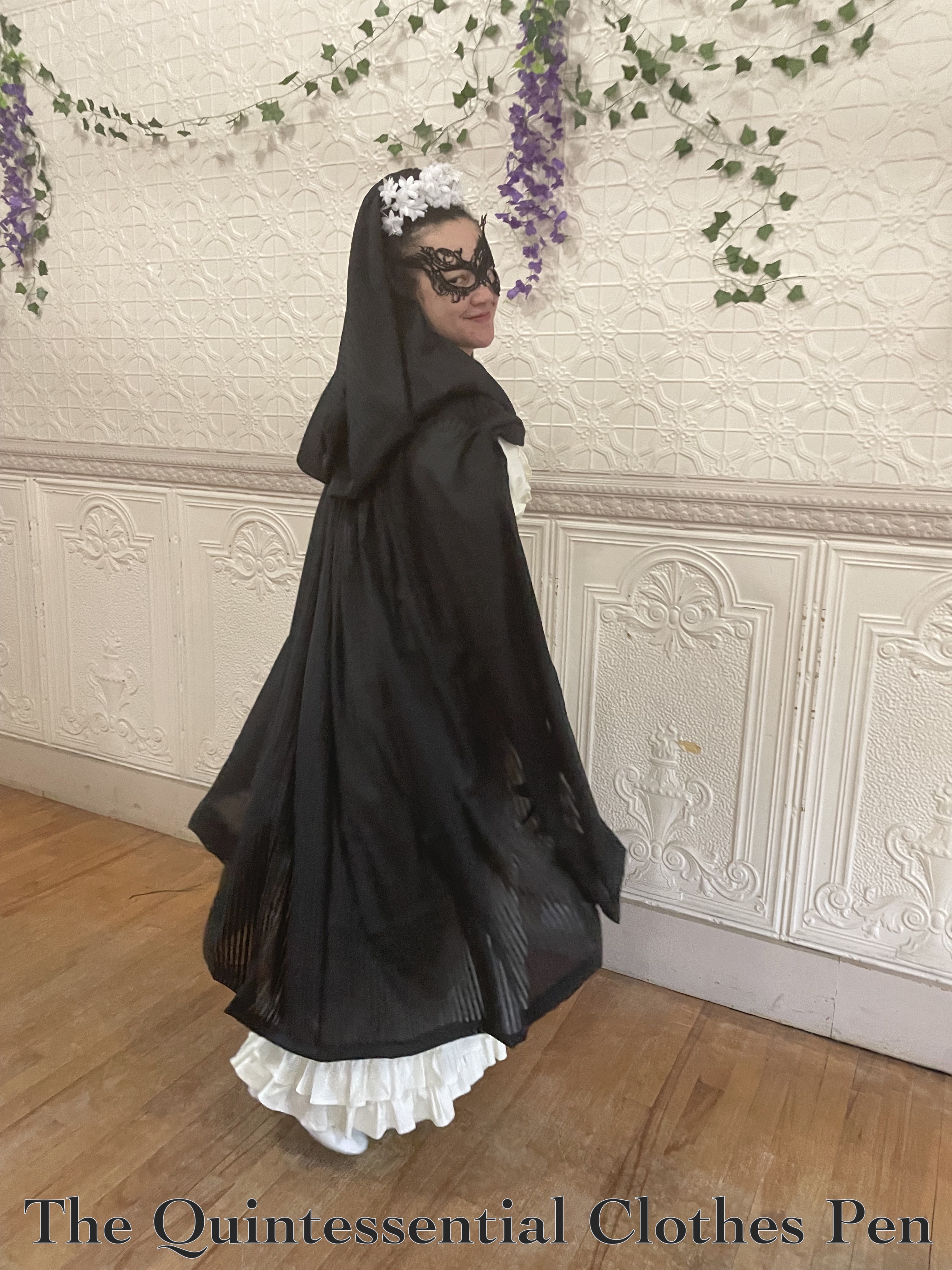
I think this fabric might be fun to use for something else someday, so I was loathe to actually cut it to make a domino cape. From past experience (and my patterning books), I was aware of the general shape and construction of the hoods of 18th century capes, which I was more excited by than the shape of the main body portion of capes from this period. The hoods often have quite a bit of fabric pleated into a central spot on the back of the hood and the bases are often pleated into the neck area, as well.

I started experimenting with my fabric and safety pinned a central pleated area in the center of my three yard piece. Then, I safety pinned a center back seam in the two ends of the piece, which hung down below the ‘hood.’ The next step was to safety pin a row of large pleats around what would be the ‘neck’ area, to draw in the width of the fabric around the shoulders. And… I basically had a cape!

A bit rough and ready, but my safety pinning did create a cape with a hood!
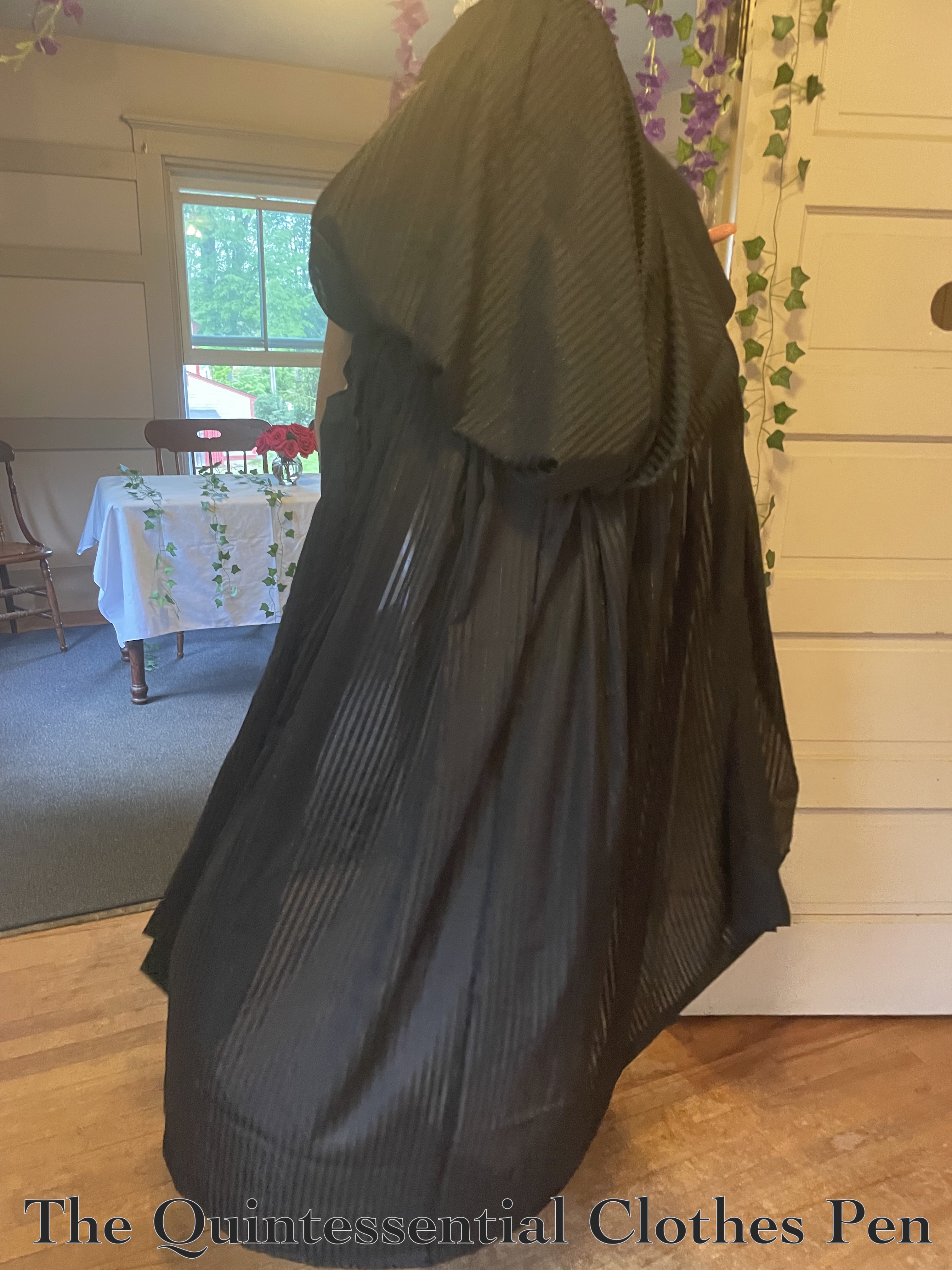
I fiddled a bit, by turning under some of the depth of the hood (and pinning it back near the central pleats) as well as pinning up swags at the front shoulder areas. I agreed with Erté (in the quote in my previous post)– that my domino should have a distinguished cut to keep me from looking like a shapeless bundle!

At that point, I realized that most of my pinned areas really didn’t need to be sewn… I could just leave in the safety pins, making it much faster to take apart if I wanted to do that someday! In the end, the only two things I sewed were the center back seam (with basting stitches by hand) and the hem (again, with basting stitches by hand). Calling it a ‘hem’ is generous, I think! I really just turned it up once with the raw edge left visible.

Wearing My Mysterious Domino

My historically plausible, mysterious looking domino cape was ready to go. I was all prepared for The Footwork and Frolick Society’s early 19th century themed Masquerade Ball!

I chose to pin the cape to my dress rather than having it closed at my neck. It made the hood pretty long in the back, but it kept the cape from pulling backwards and feeling claustrophobic, while also opening up the front view and not covering my entire dress.

And, since I felt like black mask, dark hair, and black hood was all a bit much around my face, I put my hair up around a huge bun form to raise the hood and added white flowers in front to add some contrast and a relief for the eyes.
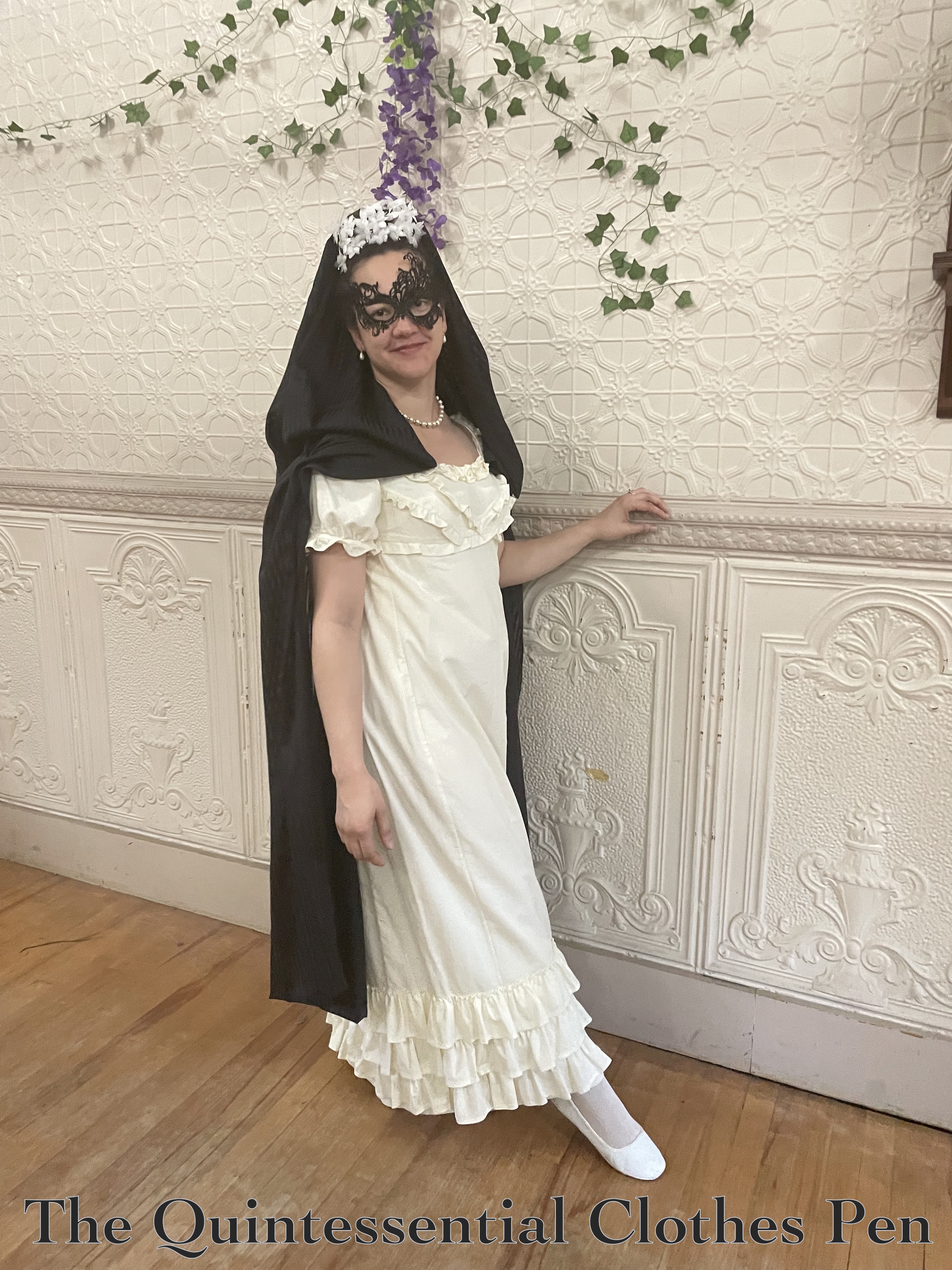
Paired with white, gold, and pearl accessories, I created a fun new variation on an old dress!
A Mysterious Domino, Part I: Background & Research

Earlier this year, The Footwork and Frolick Society hosted an early 19th century themed Masquerade Ball. I enjoy fancy dress themes, and so the idea of a masquerade (which takes the idea of a costume to another level by adding a mask) seemed like a lot of fun. But what was I to do to about a costume?

The dress: I had already decided that I wanted to wear an oldie-but-goodie dress to the ball — my ivory 1819 ruffle dress, finished in 2012 (and resized at some point, though I don’t seem to have a post about that on the blog).

The mask: I don’t really enjoy wearing masks (unless they are on a stick, like this, but that’s not good for a ball when you need your hands!). I find that masks irritate my face, but at some point I did buy a black lace mask for a fantasy masquerade that is very malleable and irritates me less. So I knew that I wanted to incorporate that mask into my outfit.

The costume: I wasn’t sure… my creative problem was to figure out what kind of costume would unite an ivory dress and a black mask!

I liked the idea of choosing something historically plausible and I know that themes like flowers, seasons, and historical periods were all popular for Fancy Dress costumes (and therefore, I figured, for masquerades), but I couldn’t think of a good theme that made sense with my color choices.

So I started doing some research, and came across the idea of a domino. Not a numbered playing piece from a game… but a mysterious, historical domino!

What Is A Domino?

What is that, then? A mysterious, historical domino?

A domino is traditionally a voluminous black robe-like hooded cape worn with a black half mask as a disguise during Venetian Carnival. Dominos were popular during the 18th century at masquerades and it seems that hooded capes in this century were sometimes just generally called dominos (such as this one, perhaps, at the Metropolitan Museum of Art). By the 19th century, dominos were occasionally seen at masquerades, and even less often at fancy dress events (a costume party without masks).

Examples Of Dominos

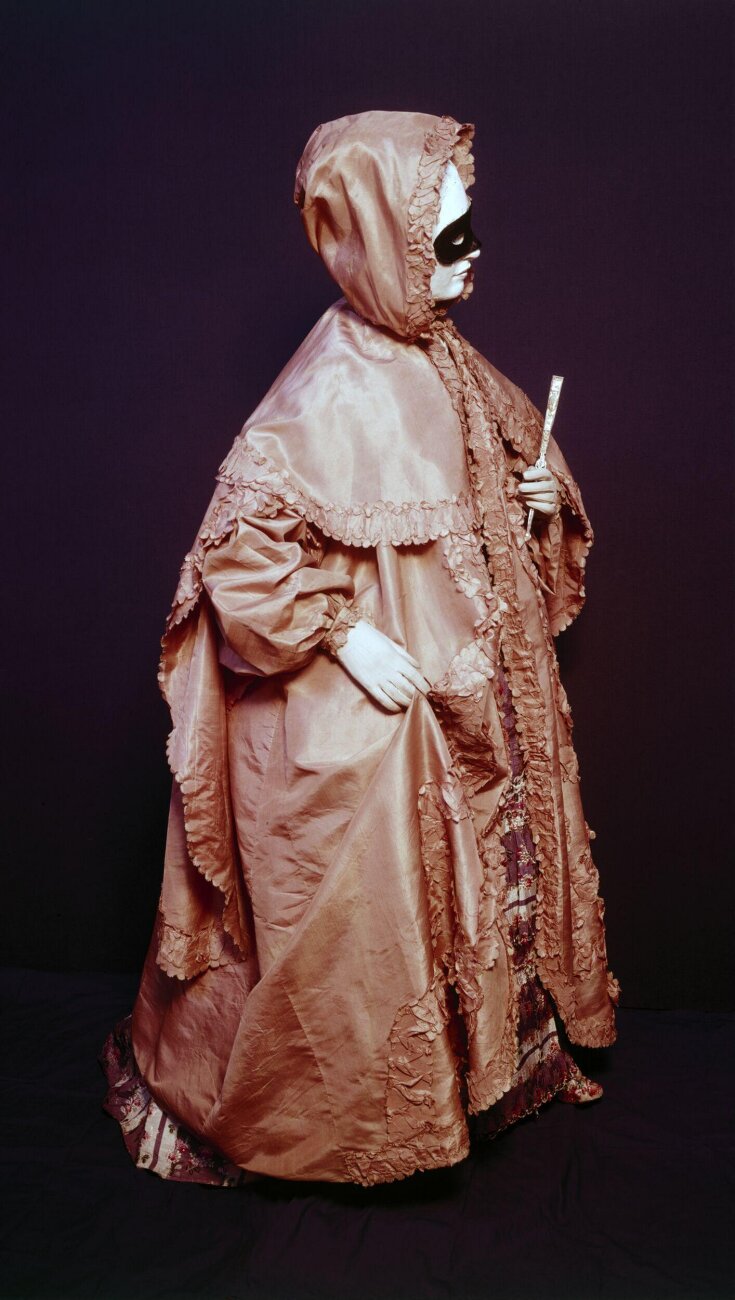
Below is an example of an 18th century domino in the collection of the Victoria and Albert museum. In this case, the idea has been reimagined in pink, rather than the usual black. The museum gives this information regarding a date: 1765 – 1770 (sewing), ca. 1775 (altered) (accession number T.195-1968).

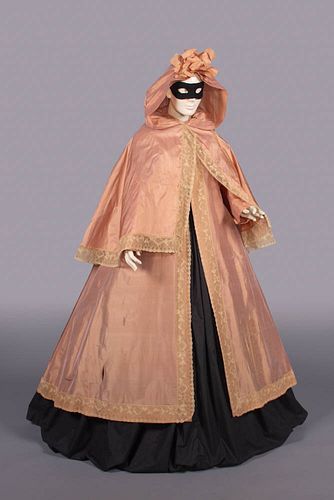
Below is another example, from the late 18th or early 19th century, also pink. This domino still shows evidence of 18th century construction styles — particularly the large gathered hood and what appear to be rectangle shaped sleeves. The extant example below is from Augusta Auctions. They labeled it as a Two Piece Shot Silk Domino, c.1800.

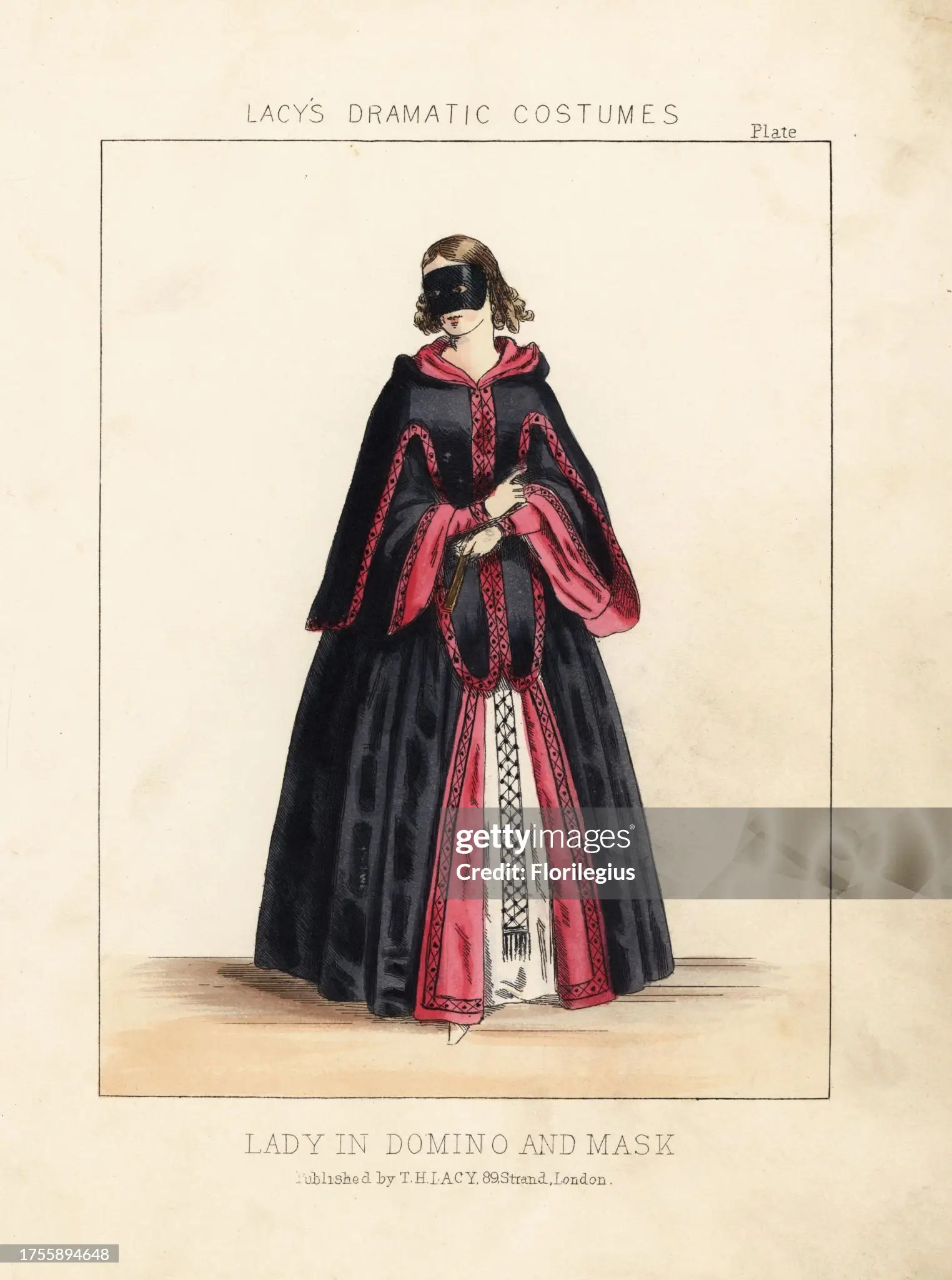
Below is an example of a mid-19th century take on a domino. This is a costume idea for a masked ball (or masquerade). This plate is from Thomas Hailes Lacy’s “Female Costumes Historical, National and Dramatic in 200 Plates,” London, 1865 (from Getty Images).

Susan de Guardiola has collected later 19th century descriptions of dominos that are available here, as well.

Though less common, dominos were still in use for masquerades even in the early 20th century. While looking for other unrelated research, I came across a mention of them from January 1920, when the accomplished fashion designer Erté wrote in a letter he was asked to write from Monte Carlo to the editor of Harper’s Bazar:

This winter will mark the first organized effort at gaiety since the dark night of war… Already we are planning to revive the masked ball in all its mad gaiety…

The domino–aha! … In Venice until the fall of the Republic, it was commonly worn in the streets. There reigned in the enchanted city at this decadent epoch a strange corruption of manners, and the mask was a necessity. At every entrance hung the black domino. Rich and poor alike donned it, in order that they might sally forth enveloped in anonymity…

“But,” argue some, “the domino gives to the fête an air of mystery.” I reply, “Then one may attain this illusion by means of a domino of distinguished cut, a domino which shall not make one’s figure look like a shapeless bundle.”

(From Designs By Erté: Fashion Drawings & Illustrations From ‘Harper’s Bazar’ Including 8 Covers In Full Color By Stella Blum)

I think this is a great place to pause. I’ll continue sharing in my next post, which will focus on how I whipped up a quick domino and what it looked like when worn!